
Homework Answers
Add Answer to:
The pupil of the eye is the circular opening through which light enters. Its diameter can...
Attempt 2 The pupil of the eye is the circular opening through which light enters. Its...
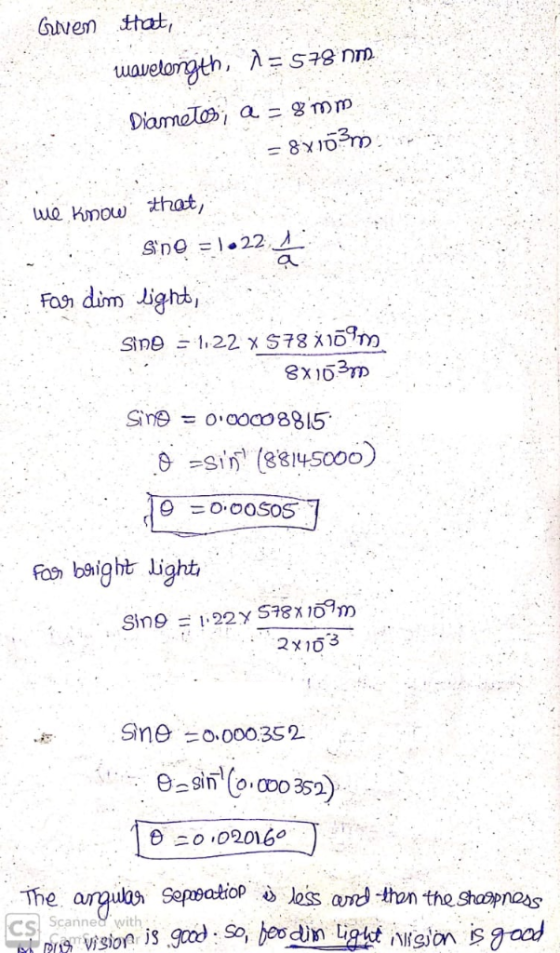
 Attempt 2 The pupil of the eye is the circular opening through which light enters. Its diameter can vary from about 8.00 mm to about 2.00 mm to control the intensity of the light reaching the interior. Calculate the angular resolution, Br, of the that has a wavelength of 558 nm in both bright light and dim light. суе for light dim light: 487.49 bright light: 194.81 Incorrect Incorrect At which light level is diffraction less of a limiting factor...
The pupil of the eye is the circular opening through which light enters. Its diameter can...
 The pupil of the eye is the circular opening through which light enters. Its diameter can vary from about 2.0 mm to about 8.0 mm to control the intensity of the light reaching the retina. 1) Calculate the angular resolution, Br, of the eye for light that has a wavelength of 580 nm in bright light. (Express your answer to two significant figures.) x10 rad Submit 2) Calculate the angular resolution, or of the eye for light that has a...
What is the theoretical resolution of your eye to 605-nm light in bright light when the...
What is the theoretical resolution of your eye to 605-nm light in bright light when the pupil is only 3 mm across? How many times brighter would the light have to be to get the same number of photons entering the eye as when the pupil is dilated to 8.00 mm? The resolution limit for the 3-mm-diameter pupil is __?__arcseconds. The light would have to be __?__ times brighter to get the same number of photons entering the eye as...
Constants Part A The maximum resolution of the eye depends on the diameter of the opening...
 Constants Part A The maximum resolution of the eye depends on the diameter of the opening of the pupil (a diffraction effect) and the size of the light receptor cells (rods or cones) on the retina. The size of the retinal cells (about 5.0 am in diameter) limits the size of an object at the near point (25 em )of the eye to a height of about 50 pam. (To get a reasonable estimate without having to go through complicated...
Between this and the next assignment, we want to get a better under- standing of how light intera...
 Between this and the next assignment, we want to get a better under- standing of how light interacts with the eye. Here are two questions to get us started, focused on diffraction (i.e., the spreading of light when it passes through a narrow opening) A. To regulate the intensity of light reaching our retinas, our pupils1 change diameter anywhere from 2 mm in bright light to 8 mm in dim light. Find the angular resolution of the eye for 550...
 Attempt 2 The pupil of the eye is the circular opening through which light enters. Its diameter can vary from about 8.00 mm to about 2.00 mm to control the intensity of the light reaching the interior. Calculate the angular resolution, Br, of the that has a wavelength of 558 nm in both bright light and dim light. суе for light dim light: 487.49 bright light: 194.81 Incorrect Incorrect At which light level is diffraction less of a limiting factor...
 The pupil of the eye is the circular opening through which light enters. Its diameter can vary from about 2.0 mm to about 8.0 mm to control the intensity of the light reaching the retina. 1) Calculate the angular resolution, Br, of the eye for light that has a wavelength of 580 nm in bright light. (Express your answer to two significant figures.) x10 rad Submit 2) Calculate the angular resolution, or of the eye for light that has a...
 Constants Part A The maximum resolution of the eye depends on the diameter of the opening of the pupil (a diffraction effect) and the size of the light receptor cells (rods or cones) on the retina. The size of the retinal cells (about 5.0 am in diameter) limits the size of an object at the near point (25 em )of the eye to a height of about 50 pam. (To get a reasonable estimate without having to go through complicated...
 Between this and the next assignment, we want to get a better under- standing of how light interacts with the eye. Here are two questions to get us started, focused on diffraction (i.e., the spreading of light when it passes through a narrow opening) A. To regulate the intensity of light reaching our retinas, our pupils1 change diameter anywhere from 2 mm in bright light to 8 mm in dim light. Find the angular resolution of the eye for 550...
Most questions answered within 3 hours.
-
Where is the error in this code sequence?
String s1 = "Hello";
String s2 = "ello";...
asked 11 months ago -
Financial data for Joel de Paris, Inc., for last year
follow:
Joel de Paris, Inc.
Balance...
asked 11 months ago -
Consider this reaction:
Al2(SO4)3 (aq)+ BaCl3
(aq) Al2Cl6 (aq)- +
3BaSO4(s) . What is the...
asked 11 months ago -
Suppose that Savneet is considering increasing her
recent random sample from 20 car rentals to 40...
asked 11 months ago -
Trucks arrive at an unloading terminal at an average rate of 120
per hour.
Trucks arrive...
asked 11 months ago -
Why are methanol and ethanol completely soluble in water while
octanol is not very little soluble....
asked 11 months ago -
A facilities manager at a university reads in a research report
that the mean amount of...
asked 11 months ago -
When the CuSO4 is rehydrated by adding water to the anhydrous
compound, is this an endothermic...
asked 11 months ago -
A ray of sunlight is passing from diamond into crown glass; the
angle of incidence is...
asked 11 months ago -
A block of mass 0.249 kg is placed on top of a light, vertical
spring of...
asked 11 months ago -
how do the kidneys compensate in the presences of acidosis
a) trigger hyperventilate
b) reserve acid...
asked 11 months ago -
Question 501 pts
The rental rate of capital to the firm increases. Which of the
following...
asked 11 months ago