

Homework Answers


0.2 Find the Fourier seris for (periodic extension of) 1, t e [0,2): f(t) = (-1, t E [2,4). Determine the sum of this series. 2. Find the Fourier series for (periodic extension of) t 1, te[0, 2):...
 0.2 Find the Fourier seris for (periodic extension of) 1, t e [0,2): f(t) = (-1, t E [2,4). Determine the sum of this series. 2. Find the Fourier series for (periodic extension of) t 1, te[0, 2): 3-t, te[2, 4) Determine the sum of this series. 3. Find the sine Fourier series for (periodic extension of) t -1, t[o,2) , (t)- Determine the sum of this series. 4 Pind the Fosine Fourier series for (periodic extension of) 1, tE...
(1 point) Given that cos(At)e 4 Ct find the Laplace transtorm of y E(VE cos(4t)) = Cos(4t)
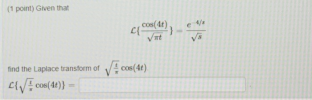 (1 point) Given that cos(At)e 4 Ct find the Laplace transtorm of y E(VE cos(4t)) = Cos(4t)
(1 point) Given that cos(At)e 4 Ct find the Laplace transtorm of y E(VE cos(4t)) = Cos(4t)
(1 point) Given that cos(At)e 4 Ct find the Laplace transtorm of y E(VE cos(4t)) = Cos(4t)
4. Consider the signal co(t) = et, 0<t<1 , elsewhere Determine the Fourier transform of each...
 4. Consider the signal co(t) = et, 0<t<1 , elsewhere Determine the Fourier transform of each of the signals shown in Figure 2. You should be able to do this by explicitly evaluating only the transform of co(t) and then using properties of the Fourier transform. X(t) X2(t) Xolt) Xp(t) -Xol-t) X3(t) Xolt +1) X4(t) Xolt) txo(t) My Lane 1 0
Question 4 (a) Determine the Fourier transform of v(t) in the circuit shown in Figure 4...
 Question 4 (a) Determine the Fourier transform of v(t) in the circuit shown in Figure 4 below. (10 marks) 232 e-21u(t) V (+ + v(t) + IF ele 0.5H 28(1) A Figure 4 (b) For the network shown in Figure 5, by means of the Laplace Transform, evaluate i(t). (15 marks) 2e-fu(t) V + 1F io 1 H HI 112 WW 4u(t) A 122 Figure 5
Let x(t) be the signal with Fourier transform Xjw) shown below x(j) Let Xs(t) be obtained...
 Let x(t) be the signal with Fourier transform Xjw) shown below x(j) Let Xs(t) be obtained by sampling x(t) with sampling period Td let xdin]- x(nT) for all integer n. Which option is the plot of Xd(e the Fourier transform of xdinj? Instructions: First sketchXs ω which is the Fourier transtorm of xs nt is going to be infinite number of replicas of Sketch on 3 e cas. You need to n he span between heep as he )and Xole...
A. By hand, find the Fourier transform of g(t)-cos(4t)+ cos(5t) Page 2 of3 B. Now assume that g(t...
 A. By hand, find the Fourier transform of g(t)-cos(4t)+ cos(5t) Page 2 of3 B. Now assume that g(t) can be observed for only a finite time, say T seconds. Then, t-T/2 what we observe is actually y(t) g (t)rect . Find (analytically) the Fourier transtorm of y(t). Write your answer in terms of sinc functions.
A. By hand, find the Fourier transform of g(t)-cos(4t)+ cos(5t) Page 2 of3 B. Now assume that g(t) can be observed for only a finite...
A. By hand, find the Fourier transform of g(t)-cos(4t)+ cos(5t) Page 2 of3 B. Now assume that g(t) can be observed for only a finite time, say T seconds. Then, t-T/2 what we observe is actually y(t) g (t)rect . Find (analytically) the Fourier transtorm of y(t). Write your answer in terms of sinc functions.
A. By hand, find the Fourier transform of g(t)-cos(4t)+ cos(5t) Page 2 of3 B. Now assume that g(t) can be observed for only a finite...
Given that f (t) e-au(t to), where a 0, determine the Fourier transform F() of f(t)....
 Given that f (t) e-au(t to), where a 0, determine the Fourier transform F() of f(t). 7.1 (b) Given that where a > 0, determine the Fourier transform G (w) of g(0) by using the symmetry property and the result of part (a). Confirm the result of part (b) by calculating g) from G(w), using the inverse Fourier transform integral
The trigonometric Fourier series of the signal f(t) derived in the lecture notes as e-a, 0...
 The trigonometric Fourier series of the signal f(t) derived in the lecture notes as e-a, 0 < t T, with T π was n=1 where, 16n 1-e 2 a0 = π (1-e-2), a,- 41-e 2 2 and bn - Show that, f(t) = (1-e-2) +- COSL2n n=1
Problem 3. 0 Figure 2 Given: f(t) = { 2.5, -1.5 <=<= 1.5 f(t) = {...
 Problem 3. 0 Figure 2 Given: f(t) = { 2.5, -1.5 <=<= 1.5 f(t) = { 0 otherwise See figure(2) above. A) Find the Fourier transform for f( (see figure 2) and sketch its waveform. B) Determine the values of the first three frequency terms (w1, W2, W3) where F(w) = 0. C) Given x(t) = 1.58(-0.8) edt Determine whether or not Fourier transform exists for x(t). If yes, find the Fourier transfe not explain why it does not. Problem...
4. Solve the initial, boundary value problem by the Fourier integral method. u (0,t)0, u(r,t) bounded as-00 4. Solve the initial, boundary value problem by the Fourier integral method. u (0,t...
 4. Solve the initial, boundary value problem by the Fourier integral method. u (0,t)0, u(r,t) bounded as-00
4. Solve the initial, boundary value problem by the Fourier integral method. u (0,t)0, u(r,t) bounded as-00
4. Solve the initial, boundary value problem by the Fourier integral method. u (0,t)0, u(r,t) bounded as-00
 0.2 Find the Fourier seris for (periodic extension of) 1, t e [0,2): f(t) = (-1, t E [2,4). Determine the sum of this series. 2. Find the Fourier series for (periodic extension of) t 1, te[0, 2): 3-t, te[2, 4) Determine the sum of this series. 3. Find the sine Fourier series for (periodic extension of) t -1, t[o,2) , (t)- Determine the sum of this series. 4 Pind the Fosine Fourier series for (periodic extension of) 1, tE...
 (1 point) Given that cos(At)e 4 Ct find the Laplace transtorm of y E(VE cos(4t)) = Cos(4t)
(1 point) Given that cos(At)e 4 Ct find the Laplace transtorm of y E(VE cos(4t)) = Cos(4t)
(1 point) Given that cos(At)e 4 Ct find the Laplace transtorm of y E(VE cos(4t)) = Cos(4t)
 4. Consider the signal co(t) = et, 0<t<1 , elsewhere Determine the Fourier transform of each of the signals shown in Figure 2. You should be able to do this by explicitly evaluating only the transform of co(t) and then using properties of the Fourier transform. X(t) X2(t) Xolt) Xp(t) -Xol-t) X3(t) Xolt +1) X4(t) Xolt) txo(t) My Lane 1 0
 Question 4 (a) Determine the Fourier transform of v(t) in the circuit shown in Figure 4 below. (10 marks) 232 e-21u(t) V (+ + v(t) + IF ele 0.5H 28(1) A Figure 4 (b) For the network shown in Figure 5, by means of the Laplace Transform, evaluate i(t). (15 marks) 2e-fu(t) V + 1F io 1 H HI 112 WW 4u(t) A 122 Figure 5
 Let x(t) be the signal with Fourier transform Xjw) shown below x(j) Let Xs(t) be obtained by sampling x(t) with sampling period Td let xdin]- x(nT) for all integer n. Which option is the plot of Xd(e the Fourier transform of xdinj? Instructions: First sketchXs ω which is the Fourier transtorm of xs nt is going to be infinite number of replicas of Sketch on 3 e cas. You need to n he span between heep as he )and Xole...
 A. By hand, find the Fourier transform of g(t)-cos(4t)+ cos(5t) Page 2 of3 B. Now assume that g(t) can be observed for only a finite time, say T seconds. Then, t-T/2 what we observe is actually y(t) g (t)rect . Find (analytically) the Fourier transtorm of y(t). Write your answer in terms of sinc functions.
A. By hand, find the Fourier transform of g(t)-cos(4t)+ cos(5t) Page 2 of3 B. Now assume that g(t) can be observed for only a finite...
A. By hand, find the Fourier transform of g(t)-cos(4t)+ cos(5t) Page 2 of3 B. Now assume that g(t) can be observed for only a finite time, say T seconds. Then, t-T/2 what we observe is actually y(t) g (t)rect . Find (analytically) the Fourier transtorm of y(t). Write your answer in terms of sinc functions.
A. By hand, find the Fourier transform of g(t)-cos(4t)+ cos(5t) Page 2 of3 B. Now assume that g(t) can be observed for only a finite...
 Given that f (t) e-au(t to), where a 0, determine the Fourier transform F() of f(t). 7.1 (b) Given that where a > 0, determine the Fourier transform G (w) of g(0) by using the symmetry property and the result of part (a). Confirm the result of part (b) by calculating g) from G(w), using the inverse Fourier transform integral
 The trigonometric Fourier series of the signal f(t) derived in the lecture notes as e-a, 0 < t T, with T π was n=1 where, 16n 1-e 2 a0 = π (1-e-2), a,- 41-e 2 2 and bn - Show that, f(t) = (1-e-2) +- COSL2n n=1
 Problem 3. 0 Figure 2 Given: f(t) = { 2.5, -1.5 <=<= 1.5 f(t) = { 0 otherwise See figure(2) above. A) Find the Fourier transform for f( (see figure 2) and sketch its waveform. B) Determine the values of the first three frequency terms (w1, W2, W3) where F(w) = 0. C) Given x(t) = 1.58(-0.8) edt Determine whether or not Fourier transform exists for x(t). If yes, find the Fourier transfe not explain why it does not. Problem...
 4. Solve the initial, boundary value problem by the Fourier integral method. u (0,t)0, u(r,t) bounded as-00
4. Solve the initial, boundary value problem by the Fourier integral method. u (0,t)0, u(r,t) bounded as-00
4. Solve the initial, boundary value problem by the Fourier integral method. u (0,t)0, u(r,t) bounded as-00
Most questions answered within 3 hours.
-
Where is the error in this code sequence?
String s1 = "Hello";
String s2 = "ello";...
asked 11 months ago -
Financial data for Joel de Paris, Inc., for last year
follow:
Joel de Paris, Inc.
Balance...
asked 11 months ago -
Consider this reaction:
Al2(SO4)3 (aq)+ BaCl3
(aq) Al2Cl6 (aq)- +
3BaSO4(s) . What is the...
asked 11 months ago -
Suppose that Savneet is considering increasing her
recent random sample from 20 car rentals to 40...
asked 11 months ago -
Trucks arrive at an unloading terminal at an average rate of 120
per hour.
Trucks arrive...
asked 11 months ago -
Why are methanol and ethanol completely soluble in water while
octanol is not very little soluble....
asked 11 months ago -
A facilities manager at a university reads in a research report
that the mean amount of...
asked 11 months ago -
When the CuSO4 is rehydrated by adding water to the anhydrous
compound, is this an endothermic...
asked 11 months ago -
A ray of sunlight is passing from diamond into crown glass; the
angle of incidence is...
asked 11 months ago -
A block of mass 0.249 kg is placed on top of a light, vertical
spring of...
asked 11 months ago -
how do the kidneys compensate in the presences of acidosis
a) trigger hyperventilate
b) reserve acid...
asked 11 months ago -
Question 501 pts
The rental rate of capital to the firm increases. Which of the
following...
asked 11 months ago