
Homework Answers

Add Answer to:
If 2x + 128x = 4 cos (7t) determine the natural frequency, excitation frequency, and amplitude...
An excitation (Force) 60sin(ot)+80 cos(1) N produces a steady-state response (particular solution) whose quasi-static amplitude is...
 An excitation (Force) 60sin(ot)+80 cos(1) N produces a steady-state response (particular solution) whose quasi-static amplitude is 50 mm. The natural frequency of the system is 20 Hz, and a = 18 Hz produces a steady-state response that is in phase with a sine response. Determine the amplitude of the displacement (x) when ( = 18 Hz. Hint: The system is in damped vibration.
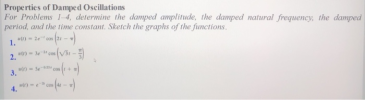
Properties of Damped Oscillations For Problems 1-4, determine the damped amplitude, the damped na...
 Question 4 please!
Properties of Damped Oscillations For Problems 1-4, determine the damped amplitude, the damped natural frequency, the damped period, and the time constant. Sketch the graphs of the functions. 1. m(t)-5e-oas , cos (r + π 3. 4.
Properties of Damped Oscillations For Problems 1-4, determine the damped amplitude, the damped natural frequency, the damped period, and the time constant. Sketch the graphs of the functions. 1. m(t)-5e-oas , cos (r + π 3. 4.
Question 4 please!
Properties of Damped Oscillations For Problems 1-4, determine the damped amplitude, the damped natural frequency, the damped period, and the time constant. Sketch the graphs of the functions. 1. m(t)-5e-oas , cos (r + π 3. 4.
Properties of Damped Oscillations For Problems 1-4, determine the damped amplitude, the damped natural frequency, the damped period, and the time constant. Sketch the graphs of the functions. 1. m(t)-5e-oas , cos (r + π 3. 4.
In damped motion, what decreases with time? Frequency Amplitude Wavelength Period The purpose of a shock...
In damped motion, what decreases with time? Frequency Amplitude Wavelength Period The purpose of a shock absorber on a car is to prevent the car from bouncing when you go over a pot hole. Therefore a shock absorber should be: underdamped overdamped Resonance will occur when: the excitation frequency is near the natural frequency the damping is small both the excitation frequency is near the natural frequency and the damping is small
Determine the real amplitude A such that 4 cos(70πt + 2π/3) + A cos(70πt − π/6)...
Determine the real amplitude A such that 4 cos(70πt + 2π/3) + A cos(70πt − π/6) = C cos(70πt)
1. Oscillating system performs damped oscillations with frequency 1000 Hz. Determine the frequency of natural oscillations...
 1. Oscillating system performs damped oscillations with frequency 1000 Hz. Determine the frequency of natural oscillations if the resonance frequency is 998 Hz. 2. Amplitude of vibrations during 5 minutes decreased by 2 times, during which time the amplitude reduced by 8 times? 3. For 8 minutes amplitude decreased 8 times. Find damping factor. 4. Determine how much resonance frequency is different from the natural oscillation frequency (1kHz) when the damping factor is 400 s decreased 20 times 6. The...
Without graphing the function y 10 sin(2x), determine its amplitude, period, and the distance between its...
 Without graphing the function y 10 sin(2x), determine its amplitude, period, and the distance between its critical points. Leave answers in exact form; type pi for 7. amplitude = period Distance between critical points - Without graphing the function y = 7 cos(4.c), determine its amplitude, period, and section width. Leave answers in exact form; type pi for . amplitude - period - section width
Approximate the area of the region bounded by the graph of f(t) f(t) cos(t/2-7t / 8)...
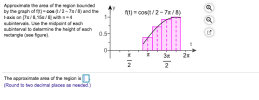 Approximate the area of the region bounded by the graph of f(t) f(t) cos(t/2-7t / 8) (t/2-7T/8) and the cos t-axis on [7T/8,15/ 8] with n 4 subintervals. Use the midpoint of each subinterval to determine the height of each rectangle (see figure) 0.5 27 2 The approximate area of the region is (Round to two decimal places as needed.) N| a.
Approximate the area of the region bounded by the graph of f(t) f(t) cos(t/2-7t / 8) (t/2-7T/8) and...
Approximate the area of the region bounded by the graph of f(t) f(t) cos(t/2-7t / 8) (t/2-7T/8) and the cos t-axis on [7T/8,15/ 8] with n 4 subintervals. Use the midpoint of each subinterval to determine the height of each rectangle (see figure) 0.5 27 2 The approximate area of the region is (Round to two decimal places as needed.) N| a.
Approximate the area of the region bounded by the graph of f(t) f(t) cos(t/2-7t / 8) (t/2-7T/8) and...
Use the following information to determine cos(2x). cos(x) 3 and tan(x) is positive 4
 Use the following information to determine cos(2x). cos(x) 3 and tan(x) is positive 4
Problem # 4 15 points The base of a damped spring-mass system, with m 25 kg...
 Problem # 4 15 points The base of a damped spring-mass system, with m 25 kg and k 2500 N/m, is subjected to a harmonic excitation y(t) Xo cos ω. The amplitude of the mass is found to be 0.05 m when the base is excited at the natural frequency of the system with Yo 0.0 m. Determine the damping constant of the system.
TT 7T T Write cos cos sin 2 4. function of one number. as a trigonometric...
 TT 7T T Write cos cos sin 2 4. function of one number. as a trigonometric 2 Keep a in your answer. Be sure to PREVIEW your answer before submitting!
 An excitation (Force) 60sin(ot)+80 cos(1) N produces a steady-state response (particular solution) whose quasi-static amplitude is 50 mm. The natural frequency of the system is 20 Hz, and a = 18 Hz produces a steady-state response that is in phase with a sine response. Determine the amplitude of the displacement (x) when ( = 18 Hz. Hint: The system is in damped vibration.
 Question 4 please!
Properties of Damped Oscillations For Problems 1-4, determine the damped amplitude, the damped natural frequency, the damped period, and the time constant. Sketch the graphs of the functions. 1. m(t)-5e-oas , cos (r + π 3. 4.
Properties of Damped Oscillations For Problems 1-4, determine the damped amplitude, the damped natural frequency, the damped period, and the time constant. Sketch the graphs of the functions. 1. m(t)-5e-oas , cos (r + π 3. 4.
Question 4 please!
Properties of Damped Oscillations For Problems 1-4, determine the damped amplitude, the damped natural frequency, the damped period, and the time constant. Sketch the graphs of the functions. 1. m(t)-5e-oas , cos (r + π 3. 4.
Properties of Damped Oscillations For Problems 1-4, determine the damped amplitude, the damped natural frequency, the damped period, and the time constant. Sketch the graphs of the functions. 1. m(t)-5e-oas , cos (r + π 3. 4.
 1. Oscillating system performs damped oscillations with frequency 1000 Hz. Determine the frequency of natural oscillations if the resonance frequency is 998 Hz. 2. Amplitude of vibrations during 5 minutes decreased by 2 times, during which time the amplitude reduced by 8 times? 3. For 8 minutes amplitude decreased 8 times. Find damping factor. 4. Determine how much resonance frequency is different from the natural oscillation frequency (1kHz) when the damping factor is 400 s decreased 20 times 6. The...
 Without graphing the function y 10 sin(2x), determine its amplitude, period, and the distance between its critical points. Leave answers in exact form; type pi for 7. amplitude = period Distance between critical points - Without graphing the function y = 7 cos(4.c), determine its amplitude, period, and section width. Leave answers in exact form; type pi for . amplitude - period - section width
 Approximate the area of the region bounded by the graph of f(t) f(t) cos(t/2-7t / 8) (t/2-7T/8) and the cos t-axis on [7T/8,15/ 8] with n 4 subintervals. Use the midpoint of each subinterval to determine the height of each rectangle (see figure) 0.5 27 2 The approximate area of the region is (Round to two decimal places as needed.) N| a.
Approximate the area of the region bounded by the graph of f(t) f(t) cos(t/2-7t / 8) (t/2-7T/8) and...
Approximate the area of the region bounded by the graph of f(t) f(t) cos(t/2-7t / 8) (t/2-7T/8) and the cos t-axis on [7T/8,15/ 8] with n 4 subintervals. Use the midpoint of each subinterval to determine the height of each rectangle (see figure) 0.5 27 2 The approximate area of the region is (Round to two decimal places as needed.) N| a.
Approximate the area of the region bounded by the graph of f(t) f(t) cos(t/2-7t / 8) (t/2-7T/8) and...
 Use the following information to determine cos(2x). cos(x) 3 and tan(x) is positive 4
 Problem # 4 15 points The base of a damped spring-mass system, with m 25 kg and k 2500 N/m, is subjected to a harmonic excitation y(t) Xo cos ω. The amplitude of the mass is found to be 0.05 m when the base is excited at the natural frequency of the system with Yo 0.0 m. Determine the damping constant of the system.
 TT 7T T Write cos cos sin 2 4. function of one number. as a trigonometric 2 Keep a in your answer. Be sure to PREVIEW your answer before submitting!
Most questions answered within 3 hours.
-
Where is the error in this code sequence?
String s1 = "Hello";
String s2 = "ello";...
asked 10 months ago -
Financial data for Joel de Paris, Inc., for last year
follow:
Joel de Paris, Inc.
Balance...
asked 10 months ago -
Consider this reaction:
Al2(SO4)3 (aq)+ BaCl3
(aq) Al2Cl6 (aq)- +
3BaSO4(s) . What is the...
asked 10 months ago -
Suppose that Savneet is considering increasing her
recent random sample from 20 car rentals to 40...
asked 10 months ago -
Trucks arrive at an unloading terminal at an average rate of 120
per hour.
Trucks arrive...
asked 10 months ago -
Why are methanol and ethanol completely soluble in water while
octanol is not very little soluble....
asked 10 months ago -
A facilities manager at a university reads in a research report
that the mean amount of...
asked 10 months ago -
When the CuSO4 is rehydrated by adding water to the anhydrous
compound, is this an endothermic...
asked 10 months ago -
A ray of sunlight is passing from diamond into crown glass; the
angle of incidence is...
asked 10 months ago -
A block of mass 0.249 kg is placed on top of a light, vertical
spring of...
asked 10 months ago -
how do the kidneys compensate in the presences of acidosis
a) trigger hyperventilate
b) reserve acid...
asked 10 months ago -
Question 501 pts
The rental rate of capital to the firm increases. Which of the
following...
asked 10 months ago