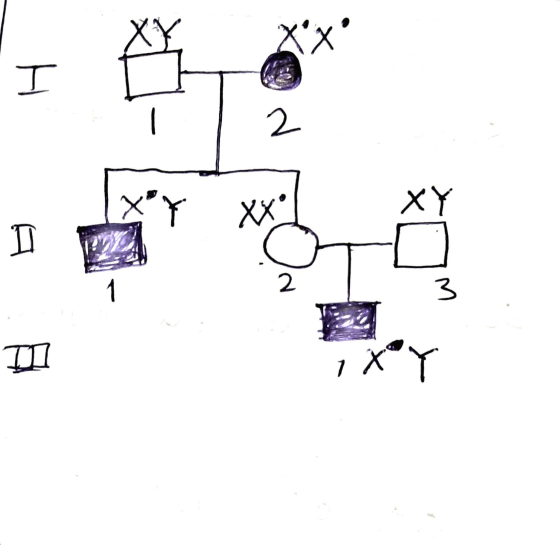
 a.) Before individual II-2 had an affected
son, this family believed the condition followed a dominant mode of
inheritance. Why does the phenotype of III-1 support a
recessive rather than a dominant mode of inheritance?
a.) Before individual II-2 had an affected
son, this family believed the condition followed a dominant mode of
inheritance. Why does the phenotype of III-1 support a
recessive rather than a dominant mode of inheritance?
b.) Could the mode of inheritance actually be dominant? Explain using appropriate genetic terms.
c.) In order to better understand the risk of passing this condition on to additional offspring, individual II-2 sought genetic counseling which resulted in the drawing of this pedigree. This action makes her the ______________________.
d.)
1. IF the characteristic is X-linked recessive, what are the genotypes for the following individuals?
2.What is the term for the genotype of individual III-1?
I-2:________
II-2:________
II-3:________
III-1:________
Homework Answers
a) The pedigree shows X-linked (trait passes from affected or carrier female to male) recessive inheritance. The phenotype of the III-1 support recessive trait because the affected III-1 (X•Y) has both unaffected parent (XX• and XY). If it is dominant, one of those parent should be affected. Here, II-2 female parent act as carrier (XX•).
b) Only one character support that the trait is dominant that is the trait doesn't skip generations but the unaffected parent of affected III-1 support that the trait is recessive.
c) This action makes II-2 carrier of this trait.
d)
1. If it is X-linked, the genotypes of
I-2 = X•X•
II-2 = XX•
II-3 = XY
III-1 = X•Y
2. The term for the genotype of III-1 is affected male.
Add Answer to:
a.) Before individual II-2 had an affected
son, this family believed the condition followed a dominant...
Question 3 The following human pedigree shows a family affected by a specific disease. Assume that...
 Question 3 The following human pedigree shows a family affected by a specific disease. Assume that the individuals marked with an asterisk () do not carry any allele associated with the affected phenotype and that no other mutation spontaneously occurs. Also assume complete penetrance a) State the most likely mode of inheritance for this disease. Choose from: autosomal dominant, autosomal recessive, X-linked dominant, X-linked recessive b) Write all possible genotypes of the following individuals in the pedigree. Use the uppercase...
For each pedigree below determine the most likely mode of inheritance and label each individual with...
 For each pedigree below determine the most likely mode of
inheritance and label each individual with a genotype. If you know
they have a dominant phenotype, but don’t know the genotype, then
label them with both possibilities. Please use the alleles A and a.
Modes of inheritance for these pedigrees are autosomal dominant or
autosomal recessive. For each pedigree determine if the alternative
mode (not the one you chose) is also possible.
female = male = III 4 6 IV...
For each pedigree below determine the most likely mode of
inheritance and label each individual with a genotype. If you know
they have a dominant phenotype, but don’t know the genotype, then
label them with both possibilities. Please use the alleles A and a.
Modes of inheritance for these pedigrees are autosomal dominant or
autosomal recessive. For each pedigree determine if the alternative
mode (not the one you chose) is also possible.
female = male = III 4 6 IV...
Part B Determining genotypes in pedigrees of X-linked conditions The pedigree from Part A is shown...
 Part B Determining genotypes in pedigrees of X-linked
conditions
The pedigree from Part A is shown below. Fill in the most likely
genotypes of the indicated individuals in the pedigree. Note that a
dominant allele followed by an underscore (_) indicates that either
the dominant or the recessive allele may be present at the second
position. Drag one pink label (for condition A, autosomal
recessive) to each pink target. Drag one blue label (for condition
B, X-linked recessive) to each...
Part B Determining genotypes in pedigrees of X-linked
conditions
The pedigree from Part A is shown below. Fill in the most likely
genotypes of the indicated individuals in the pedigree. Note that a
dominant allele followed by an underscore (_) indicates that either
the dominant or the recessive allele may be present at the second
position. Drag one pink label (for condition A, autosomal
recessive) to each pink target. Drag one blue label (for condition
B, X-linked recessive) to each...
In the pedigree below, what is the most likely mode of inheritance for this condition?: X-linked...
 In the pedigree below, what is the most likely mode of inheritance for this condition?: X-linked recessive, autosomal dominant, or autosomal recessive? Affected individuals are shown as black symbols. Based on your prediction, give the genotypes of the following individuals: I-1, I-2, II-1, II-3, II-4, III-1, III-2, III-4, IV-2, and IV-3. If you choose autosomal, use A or a; if you choose X-linked, use X^A, X^a, or Y List the proposed genotypes of the designated individuals along the side:
In the family's pedigree shown below, a horizontal pink bar indicates that an individual is affected...
 In the family's pedigree shown below, a horizontal pink bar
indicates that an individual is affected with hypercholesterolemia
(high blood cholesterol levels). A vertical blue bar indicates that
an individual is affected with Hunter's syndrome (a lysosomal
storage disease). Individuals I-1 and I-2 have no family history of
Hunter's syndrome, but individuals I-3 and I-4 do.
What is the mode of inheritance for Hunter's syndrome?
For hypercholesterolemia?
a. Autosomal dominant
b. Autosomal recessive
c. X-linked dominant
d. X-linked recessive
e.More...
In the family's pedigree shown below, a horizontal pink bar
indicates that an individual is affected with hypercholesterolemia
(high blood cholesterol levels). A vertical blue bar indicates that
an individual is affected with Hunter's syndrome (a lysosomal
storage disease). Individuals I-1 and I-2 have no family history of
Hunter's syndrome, but individuals I-3 and I-4 do.
What is the mode of inheritance for Hunter's syndrome?
For hypercholesterolemia?
a. Autosomal dominant
b. Autosomal recessive
c. X-linked dominant
d. X-linked recessive
e.More...
모모모 < 모 2 1 | 미모 모 오 or lo III = - - genetic...
 모모모 < 모 2 1 | 미모 모 오 or lo III = - - genetic disorder is segregating. 3. Each of the pedigrees shown represents a human family within which a genetic disorder is se Assume the two traits are extremely rare in the population and completely penetrant. Part 1. For the first pedigree. lisorder: autosomal recessive, autosomal a. Determine the most probable inheritance pattern of the disorder: autosomal recessive dominant, X-linked recessive or X-linked dominant. b. Indicate the...
A family tree of sorts is called a pedigree. The symbols used for a pedigree are:...
 A family tree of sorts is called a pedigree. The symbols used for a pedigree are: O female, unaffected Siblings are placed in birth order from left to right and are labeled with Arabic numerals. Each generation is labeled with a Roman numeral. Therefore the male exhbiting the female, affected male, unaffected trait in the pedigree below in the bottom, center would be identified as Il-4. male, affected -utington's Disease REVIEW – Reading a pedigree and dominant/recessive Inheritance. For questions...
QUESTION 3 If the characteristic depicted in the pedigree below is subject to complete penetrance, which...
 QUESTION 3 If the characteristic depicted in the pedigree below is subject to complete penetrance, which of the following modes of inheritance are possible? 3 4 1 2 Y linked Mitochondrial X linked recessive Autosomal recessive QUESTION 4 5 p. If the characteristic depicted in the pedigree below is subject to complete penetrance, what is the genotype of individual II-3? 2 2 3 Shop N 1 2 3 AA, homozygous dominant aa, homozygous recessive Aa, heterozygous QUESTION 5 If the...
What is the mode of inheritance for hypercholesterolemia? a. Autosomal dominant b. Autosomal recessive c. X-linked...
 What is the mode of inheritance for hypercholesterolemia?
a.
Autosomal dominant
b.
Autosomal recessive
c.
X-linked dominant
d.
X-linked recessive
e.
More than one of the above are possible
----------------------------------------------------------------
What is the mode of inheritance for Hunter's syndrome?
a.
Autosomal dominant
b.
Autosomal recessive
c.
X-linked dominant
d.
X-linked recessive
e.
More than one of the above are possible.
------------------------------------------------------------
What is the genotype for individual II-3 at the
hypercholesterolemia locus (dominant allele is denoted by H,
recessive allele...
What is the mode of inheritance for hypercholesterolemia?
a.
Autosomal dominant
b.
Autosomal recessive
c.
X-linked dominant
d.
X-linked recessive
e.
More than one of the above are possible
----------------------------------------------------------------
What is the mode of inheritance for Hunter's syndrome?
a.
Autosomal dominant
b.
Autosomal recessive
c.
X-linked dominant
d.
X-linked recessive
e.
More than one of the above are possible.
------------------------------------------------------------
What is the genotype for individual II-3 at the
hypercholesterolemia locus (dominant allele is denoted by H,
recessive allele...
In the pedigree below, what is the most likely mode of inheritance for this condition? X-linked...
 In the pedigree below, what is the most likely mode of
inheritance for this condition? X-linked dominant, X-linked
recessive, autosomal dominant, or autosomal recessive? Affected
individuals are shown as black symbols.
Based on your prediction, give the genotypes of the following
individuals: I-1, I-2, II-1, II-3, II-4, III-1, III-2, III-4, IV-2,
and IV-3. If you choose autosomal, use A or a; if you choose
X-linked, use XA, Xa, or Y List the proposed genotypes of the
designated individuals along the...
In the pedigree below, what is the most likely mode of
inheritance for this condition? X-linked dominant, X-linked
recessive, autosomal dominant, or autosomal recessive? Affected
individuals are shown as black symbols.
Based on your prediction, give the genotypes of the following
individuals: I-1, I-2, II-1, II-3, II-4, III-1, III-2, III-4, IV-2,
and IV-3. If you choose autosomal, use A or a; if you choose
X-linked, use XA, Xa, or Y List the proposed genotypes of the
designated individuals along the...
 Question 3 The following human pedigree shows a family affected by a specific disease. Assume that the individuals marked with an asterisk () do not carry any allele associated with the affected phenotype and that no other mutation spontaneously occurs. Also assume complete penetrance a) State the most likely mode of inheritance for this disease. Choose from: autosomal dominant, autosomal recessive, X-linked dominant, X-linked recessive b) Write all possible genotypes of the following individuals in the pedigree. Use the uppercase...
 For each pedigree below determine the most likely mode of
inheritance and label each individual with a genotype. If you know
they have a dominant phenotype, but don’t know the genotype, then
label them with both possibilities. Please use the alleles A and a.
Modes of inheritance for these pedigrees are autosomal dominant or
autosomal recessive. For each pedigree determine if the alternative
mode (not the one you chose) is also possible.
female = male = III 4 6 IV...
For each pedigree below determine the most likely mode of
inheritance and label each individual with a genotype. If you know
they have a dominant phenotype, but don’t know the genotype, then
label them with both possibilities. Please use the alleles A and a.
Modes of inheritance for these pedigrees are autosomal dominant or
autosomal recessive. For each pedigree determine if the alternative
mode (not the one you chose) is also possible.
female = male = III 4 6 IV...
 Part B Determining genotypes in pedigrees of X-linked
conditions
The pedigree from Part A is shown below. Fill in the most likely
genotypes of the indicated individuals in the pedigree. Note that a
dominant allele followed by an underscore (_) indicates that either
the dominant or the recessive allele may be present at the second
position. Drag one pink label (for condition A, autosomal
recessive) to each pink target. Drag one blue label (for condition
B, X-linked recessive) to each...
Part B Determining genotypes in pedigrees of X-linked
conditions
The pedigree from Part A is shown below. Fill in the most likely
genotypes of the indicated individuals in the pedigree. Note that a
dominant allele followed by an underscore (_) indicates that either
the dominant or the recessive allele may be present at the second
position. Drag one pink label (for condition A, autosomal
recessive) to each pink target. Drag one blue label (for condition
B, X-linked recessive) to each...
 In the pedigree below, what is the most likely mode of inheritance for this condition?: X-linked recessive, autosomal dominant, or autosomal recessive? Affected individuals are shown as black symbols. Based on your prediction, give the genotypes of the following individuals: I-1, I-2, II-1, II-3, II-4, III-1, III-2, III-4, IV-2, and IV-3. If you choose autosomal, use A or a; if you choose X-linked, use X^A, X^a, or Y List the proposed genotypes of the designated individuals along the side:
 In the family's pedigree shown below, a horizontal pink bar
indicates that an individual is affected with hypercholesterolemia
(high blood cholesterol levels). A vertical blue bar indicates that
an individual is affected with Hunter's syndrome (a lysosomal
storage disease). Individuals I-1 and I-2 have no family history of
Hunter's syndrome, but individuals I-3 and I-4 do.
What is the mode of inheritance for Hunter's syndrome?
For hypercholesterolemia?
a. Autosomal dominant
b. Autosomal recessive
c. X-linked dominant
d. X-linked recessive
e.More...
In the family's pedigree shown below, a horizontal pink bar
indicates that an individual is affected with hypercholesterolemia
(high blood cholesterol levels). A vertical blue bar indicates that
an individual is affected with Hunter's syndrome (a lysosomal
storage disease). Individuals I-1 and I-2 have no family history of
Hunter's syndrome, but individuals I-3 and I-4 do.
What is the mode of inheritance for Hunter's syndrome?
For hypercholesterolemia?
a. Autosomal dominant
b. Autosomal recessive
c. X-linked dominant
d. X-linked recessive
e.More...
 모모모 < 모 2 1 | 미모 모 오 or lo III = - - genetic disorder is segregating. 3. Each of the pedigrees shown represents a human family within which a genetic disorder is se Assume the two traits are extremely rare in the population and completely penetrant. Part 1. For the first pedigree. lisorder: autosomal recessive, autosomal a. Determine the most probable inheritance pattern of the disorder: autosomal recessive dominant, X-linked recessive or X-linked dominant. b. Indicate the...
 A family tree of sorts is called a pedigree. The symbols used for a pedigree are: O female, unaffected Siblings are placed in birth order from left to right and are labeled with Arabic numerals. Each generation is labeled with a Roman numeral. Therefore the male exhbiting the female, affected male, unaffected trait in the pedigree below in the bottom, center would be identified as Il-4. male, affected -utington's Disease REVIEW – Reading a pedigree and dominant/recessive Inheritance. For questions...
 QUESTION 3 If the characteristic depicted in the pedigree below is subject to complete penetrance, which of the following modes of inheritance are possible? 3 4 1 2 Y linked Mitochondrial X linked recessive Autosomal recessive QUESTION 4 5 p. If the characteristic depicted in the pedigree below is subject to complete penetrance, what is the genotype of individual II-3? 2 2 3 Shop N 1 2 3 AA, homozygous dominant aa, homozygous recessive Aa, heterozygous QUESTION 5 If the...
 What is the mode of inheritance for hypercholesterolemia?
a.
Autosomal dominant
b.
Autosomal recessive
c.
X-linked dominant
d.
X-linked recessive
e.
More than one of the above are possible
----------------------------------------------------------------
What is the mode of inheritance for Hunter's syndrome?
a.
Autosomal dominant
b.
Autosomal recessive
c.
X-linked dominant
d.
X-linked recessive
e.
More than one of the above are possible.
------------------------------------------------------------
What is the genotype for individual II-3 at the
hypercholesterolemia locus (dominant allele is denoted by H,
recessive allele...
What is the mode of inheritance for hypercholesterolemia?
a.
Autosomal dominant
b.
Autosomal recessive
c.
X-linked dominant
d.
X-linked recessive
e.
More than one of the above are possible
----------------------------------------------------------------
What is the mode of inheritance for Hunter's syndrome?
a.
Autosomal dominant
b.
Autosomal recessive
c.
X-linked dominant
d.
X-linked recessive
e.
More than one of the above are possible.
------------------------------------------------------------
What is the genotype for individual II-3 at the
hypercholesterolemia locus (dominant allele is denoted by H,
recessive allele...
 In the pedigree below, what is the most likely mode of
inheritance for this condition? X-linked dominant, X-linked
recessive, autosomal dominant, or autosomal recessive? Affected
individuals are shown as black symbols.
Based on your prediction, give the genotypes of the following
individuals: I-1, I-2, II-1, II-3, II-4, III-1, III-2, III-4, IV-2,
and IV-3. If you choose autosomal, use A or a; if you choose
X-linked, use XA, Xa, or Y List the proposed genotypes of the
designated individuals along the...
In the pedigree below, what is the most likely mode of
inheritance for this condition? X-linked dominant, X-linked
recessive, autosomal dominant, or autosomal recessive? Affected
individuals are shown as black symbols.
Based on your prediction, give the genotypes of the following
individuals: I-1, I-2, II-1, II-3, II-4, III-1, III-2, III-4, IV-2,
and IV-3. If you choose autosomal, use A or a; if you choose
X-linked, use XA, Xa, or Y List the proposed genotypes of the
designated individuals along the...
Most questions answered within 3 hours.
-
Where is the error in this code sequence?
String s1 = "Hello";
String s2 = "ello";...
asked 10 months ago -
Financial data for Joel de Paris, Inc., for last year
follow:
Joel de Paris, Inc.
Balance...
asked 10 months ago -
Consider this reaction:
Al2(SO4)3 (aq)+ BaCl3
(aq) Al2Cl6 (aq)- +
3BaSO4(s) . What is the...
asked 10 months ago -
Suppose that Savneet is considering increasing her
recent random sample from 20 car rentals to 40...
asked 10 months ago -
Trucks arrive at an unloading terminal at an average rate of 120
per hour.
Trucks arrive...
asked 10 months ago -
Why are methanol and ethanol completely soluble in water while
octanol is not very little soluble....
asked 10 months ago -
A facilities manager at a university reads in a research report
that the mean amount of...
asked 10 months ago -
When the CuSO4 is rehydrated by adding water to the anhydrous
compound, is this an endothermic...
asked 10 months ago -
A ray of sunlight is passing from diamond into crown glass; the
angle of incidence is...
asked 10 months ago -
A block of mass 0.249 kg is placed on top of a light, vertical
spring of...
asked 10 months ago -
how do the kidneys compensate in the presences of acidosis
a) trigger hyperventilate
b) reserve acid...
asked 10 months ago -
Question 501 pts
The rental rate of capital to the firm increases. Which of the
following...
asked 10 months ago