what are c# methodes for calculating unadjusted metrics to adjusted metrics? write down code as well.
Homework Answers
Counting Function Point (FP):
F=14*scale
Scale varies from 0 to 5 according to character of Complexity Adjustment Factor (CAF). Below table shows scale:
0 - No Influence
1 - Incidental
2 - Moderate
3 - Average
4 - Significant
5 - Essential
Step 2:
Calculate Complexity Adjustment Factor (CAF):
CAF = 0.65 + ( 0.01 * F )
Step 3: Calculate Unadjusted Function Point (UFP).
TABLE (Required)
| FUNCTION UNITS | LOW | AVG | HIGH |
|---|---|---|---|
| EI | 3 | 4 | 6 |
| EO | 4 | 5 | 7 |
| EQ | 3 | 4 | 6 |
| ILF | 7 | 10 | 15 |
| EIF | 5 | 7 | 10 |
Multiply each individual function point to corresponding values in TABLE.
Step 4: Calculate Function Point
FP = UFP * CAF
Example:
Given the following values, compute function point when all complexity adjustment factor (CAF) and weighting factors are average.
User Input = 50
User Output = 40
User Inquiries = 35
User Files = 6
External Interface = 4
Explanation:
Step 1: As complexity adjustment factor is average (given in question), hence,
scale = 3.
F = 14 * 3 = 42
Step 2:
CAF = 0.65 + ( 0.01 * 42 ) = 1.07
Step 3: As weighting factors are also average (given in question) hence we will multiply each individual function point to corresponding values in TABLE.
UFP = (50*4) + (40*5) + (35*4) + (6*10) + (4*7) = 628
Step-4:
Function Point = 628 * 1.07 = 671.96
Code:
using namespace std;
// Function to calculate Function Point
void calfp(int
frates[][3], int
fac_rate)
{
// Function
Units
string funUnits[5] =
{
"External
Inputs"
,
"External
Outputs"
,
"External
Inquiries"
,
"Internal
Logical Files"
,
"External
Interface Files"
};
// Weight
Rates
string wtRates[3] =
{ "Low",
"Average", "High"
};
// Weight
Factors
int
wtFactors[5][3] = {
{
3, 4, 6 },
{
4, 5, 7 },
{
3, 4, 6 },
{
7, 10, 15 },
{
5, 7, 10 },
};
int UFP
= 0;
// Calculating UFP
(Unadjusted Function Point)
for
(int i = 0; i < 5; i++)
{
for
(int j = 0; j < 3; j++)
{
int
freq = frates[i][j];
UFP
+= freq * wtFactors[i][j];
}
}
// 14
factors
string aspects[14] =
{
"reliable
backup and recovery required ?"
,
"data
communication required ?"
,
"are
there distributed processing functions ?"
,
"is
performance critical ?"
,
"will
the system run in an existing heavily utilized operational
environment ?"
,
"on
line data entry required ?"
,
"does
the on line data entry require the input transaction to be built
over multiple screens or operations ?"
,
"are
the master files updated on line ?"
,
"is
the inputs, outputs, files or inquiries complex
?"
,
"is
the internal processing complex ?"
,
"is
the code designed to be reusable ?"
,
"are
the conversion and installation included in the design
?"
,
"is
the system designed for multiple installations in different
organizations ?"
,
"is
the application designed to facilitate change and ease of use by
the user ?"
};
/*
Rate Scale of
Factors
Rate the following
aspects on a scale of 0-5 :-
0 - No
influence
1 -
Incidental
2 -
Moderate
3 -
Average
4 -
Significant
5 -
Essential
*/
int sumF
= 0;
// Taking Input of
factors rate
for
(int i = 0; i < 14; i++)
{
int
rate = fac_rate;
sumF
+= rate;
}
// Calculate
CFP
double
CAF = 0.65 + 0.01 * sumF;
// Calculate Function
Point (FP)
double
FP = UFP * CAF;
// Output
Values
cout <<
"Function Point Analysis :-" <<
endl;
cout <<
"Unadjusted Function Points (UFP) : " <<
UFP << endl;
cout <<
"Complexity Adjustment Factor (CAF) : " <<
CAF << endl;
cout <<
"Function Points (FP) : " << FP <<
endl;
}
// driver function
int main()
{
int
frates[5][3] = {
{
0, 50, 0 },
{
0, 40, 0 },
{
0, 35, 0 },
{
0, 6, 0 },
{
0, 4, 0 }
};
int
fac_rate = 3;
calfp(frates,
fac_rate);
return
0;
}
Add Answer to:
what are c# methodes for calculating unadjusted metrics to adjusted
metrics?
write down code as well.
What is polymorphism in Object-oriented programming? Write down C# code example support the polymorphism
What is polymorphism in Object-oriented programming? Write down C# code example support the polymorphism
**WRITE IN C# INTERMEDIATE LEVEL CODE A 2ND SEMESTER STUDENT COULD UNDERSTAND WELL** Problem Statement: Write...
**WRITE IN C# INTERMEDIATE LEVEL CODE A 2ND SEMESTER STUDENT COULD UNDERSTAND WELL** Problem Statement: Write an abstract class called Vacation includes a budget and a destination. It has an abstract method returning by how much the vacation is over or under budget. This class has two non-abstract subclasses: All-Inclusive Vacation brand (such as ClubMed, Delta Vacations, etc) a rating (you can use # of stars) price Piecemeal Vacation set of items (hotel, meal, airfare, etc) set of corresponding costs...
what is the procedure for making: A-a trial balance B- unadjusted trial balance C- adjusted trial...
what is the procedure for making: A-a trial balance B- unadjusted trial balance C- adjusted trial balance D- financial statement
What is the major difference between the unadjusted trial balance and the adjusted trial balance? a....
 What is the major difference between the unadjusted trial balance and the adjusted trial balance? a. The adjusted trial balance will show the net income (loss) as an additional account. b. Unlike the adjusted trial balance, the unadjusted trial balance will continue with the end-of- period processing even if it is not in balance. c. The adjusted trial balance includes the postings of the adjustments for the period in the balance of the accounts. d. The adjusted trial balance will...
What is the difference between an adjusted trial balance and an unadjusted trial balance?
What is the difference between an adjusted trial balance and an unadjusted trial balance? (Check all that apply.) The unadjusted trial balance is more up to date and should be used to prepare financial statements. The adjusted trial balance is a list of accounts and their balances after adjusting entries have been posted. The adjusted trial balance is used to prepare financial statements. The adjusted trial balance generally has more accounts listed than the unadjusted trial balance.
Please write down the equation for calculating the probability & use c language for programming part....
 Please write down the equation for calculating the probability
& use c language for programming part.
Thank you!
Prob. 5 (20pts) (Birthday attack) A birthday attack is a type of cryptographic attack that exploits the mathematics behind the birthday problem in probability theory. It can be used to find collisions in a cryptographic hash function. Suppose that we have a hash function which, when supplied with a random input, returns one of 256 equally likely values. The attack generates n...
Please write down the equation for calculating the probability
& use c language for programming part.
Thank you!
Prob. 5 (20pts) (Birthday attack) A birthday attack is a type of cryptographic attack that exploits the mathematics behind the birthday problem in probability theory. It can be used to find collisions in a cryptographic hash function. Suppose that we have a hash function which, when supplied with a random input, returns one of 256 equally likely values. The attack generates n...
5. What is the Output? (2 x 5p each -10p) For cach of the following code snippets write down what...
 for java
5. What is the Output? (2 x 5p each -10p) For cach of the following code snippets write down what will be printed on the screen. (a) for(int a-0; a<5; a++) for (int b-0 b
for java
5. What is the Output? (2 x 5p each -10p) For cach of the following code snippets write down what will be printed on the screen. (a) for(int a-0; a<5; a++) for (int b-0 b
(a) Write down the objective function of K-means. (b) Assume you have n d-dimension vectors, write down the code of K-m...
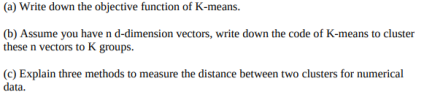 (a) Write down the objective function of K-means. (b) Assume you have n d-dimension vectors, write down the code of K-means to cluster these n vectors to K groups (c) Explain three methods to measure the distance between two clusters for numerical data
(a) Write down the objective function of K-means. (b) Assume you have n d-dimension vectors, write down the code of K-means to cluster these n vectors to K groups (c) Explain three methods to measure the distance...
(a) Write down the objective function of K-means. (b) Assume you have n d-dimension vectors, write down the code of K-means to cluster these n vectors to K groups (c) Explain three methods to measure the distance between two clusters for numerical data
(a) Write down the objective function of K-means. (b) Assume you have n d-dimension vectors, write down the code of K-means to cluster these n vectors to K groups (c) Explain three methods to measure the distance...
Write in C code What to do Write a function with the following signature: float* matrix...
 Write in C code
What to do Write a function with the following signature: float* matrix multiplication(float* left, float* right, int rows, int shared, int columns); The first two arguments are two pointers to the beginning of two matrices with the dimensions (rows,shared) and (shared, columns) correspondingly. The remaining arguments specify these dimensions. The return value will return a pointer to the very beginning of the result matrix. That said, you need to provide the space for the result matrix...
Write in C code
What to do Write a function with the following signature: float* matrix multiplication(float* left, float* right, int rows, int shared, int columns); The first two arguments are two pointers to the beginning of two matrices with the dimensions (rows,shared) and (shared, columns) correspondingly. The remaining arguments specify these dimensions. The return value will return a pointer to the very beginning of the result matrix. That said, you need to provide the space for the result matrix...
MUST BE ANSWERED BY USING C++ Please explain the code as well. Question 1 Write a...
MUST BE ANSWERED BY USING C++ Please explain the code as well. Question 1 Write a recursive function defined by the following recursive formula: foo (Y, X) = Y if X = 1 0 if X = Y (foo ( Y-1, X-1) + 3* foo ( Y-1, X)) if Y > X > 1 Write a driver to print out the value for foo (5, 4) and foo (7, 5). In addition, print out the total number...
 What is the major difference between the unadjusted trial balance and the adjusted trial balance? a. The adjusted trial balance will show the net income (loss) as an additional account. b. Unlike the adjusted trial balance, the unadjusted trial balance will continue with the end-of- period processing even if it is not in balance. c. The adjusted trial balance includes the postings of the adjustments for the period in the balance of the accounts. d. The adjusted trial balance will...
 Please write down the equation for calculating the probability
& use c language for programming part.
Thank you!
Prob. 5 (20pts) (Birthday attack) A birthday attack is a type of cryptographic attack that exploits the mathematics behind the birthday problem in probability theory. It can be used to find collisions in a cryptographic hash function. Suppose that we have a hash function which, when supplied with a random input, returns one of 256 equally likely values. The attack generates n...
Please write down the equation for calculating the probability
& use c language for programming part.
Thank you!
Prob. 5 (20pts) (Birthday attack) A birthday attack is a type of cryptographic attack that exploits the mathematics behind the birthday problem in probability theory. It can be used to find collisions in a cryptographic hash function. Suppose that we have a hash function which, when supplied with a random input, returns one of 256 equally likely values. The attack generates n...
 for java
5. What is the Output? (2 x 5p each -10p) For cach of the following code snippets write down what will be printed on the screen. (a) for(int a-0; a<5; a++) for (int b-0 b
for java
5. What is the Output? (2 x 5p each -10p) For cach of the following code snippets write down what will be printed on the screen. (a) for(int a-0; a<5; a++) for (int b-0 b
 (a) Write down the objective function of K-means. (b) Assume you have n d-dimension vectors, write down the code of K-means to cluster these n vectors to K groups (c) Explain three methods to measure the distance between two clusters for numerical data
(a) Write down the objective function of K-means. (b) Assume you have n d-dimension vectors, write down the code of K-means to cluster these n vectors to K groups (c) Explain three methods to measure the distance...
(a) Write down the objective function of K-means. (b) Assume you have n d-dimension vectors, write down the code of K-means to cluster these n vectors to K groups (c) Explain three methods to measure the distance between two clusters for numerical data
(a) Write down the objective function of K-means. (b) Assume you have n d-dimension vectors, write down the code of K-means to cluster these n vectors to K groups (c) Explain three methods to measure the distance...
 Write in C code
What to do Write a function with the following signature: float* matrix multiplication(float* left, float* right, int rows, int shared, int columns); The first two arguments are two pointers to the beginning of two matrices with the dimensions (rows,shared) and (shared, columns) correspondingly. The remaining arguments specify these dimensions. The return value will return a pointer to the very beginning of the result matrix. That said, you need to provide the space for the result matrix...
Write in C code
What to do Write a function with the following signature: float* matrix multiplication(float* left, float* right, int rows, int shared, int columns); The first two arguments are two pointers to the beginning of two matrices with the dimensions (rows,shared) and (shared, columns) correspondingly. The remaining arguments specify these dimensions. The return value will return a pointer to the very beginning of the result matrix. That said, you need to provide the space for the result matrix...
Most questions answered within 3 hours.
-
Where is the error in this code sequence?
String s1 = "Hello";
String s2 = "ello";...
asked 11 months ago -
Financial data for Joel de Paris, Inc., for last year
follow:
Joel de Paris, Inc.
Balance...
asked 11 months ago -
Consider this reaction:
Al2(SO4)3 (aq)+ BaCl3
(aq) Al2Cl6 (aq)- +
3BaSO4(s) . What is the...
asked 11 months ago -
Suppose that Savneet is considering increasing her
recent random sample from 20 car rentals to 40...
asked 11 months ago -
Trucks arrive at an unloading terminal at an average rate of 120
per hour.
Trucks arrive...
asked 11 months ago -
Why are methanol and ethanol completely soluble in water while
octanol is not very little soluble....
asked 11 months ago -
A facilities manager at a university reads in a research report
that the mean amount of...
asked 11 months ago -
When the CuSO4 is rehydrated by adding water to the anhydrous
compound, is this an endothermic...
asked 11 months ago -
A ray of sunlight is passing from diamond into crown glass; the
angle of incidence is...
asked 11 months ago -
A block of mass 0.249 kg is placed on top of a light, vertical
spring of...
asked 11 months ago -
how do the kidneys compensate in the presences of acidosis
a) trigger hyperventilate
b) reserve acid...
asked 11 months ago -
Question 501 pts
The rental rate of capital to the firm increases. Which of the
following...
asked 11 months ago