
Homework Answers

Add Answer to:
Explain why vegetable oil mixes completely with heptane(C7H16), but forms a layer with water?
B) Are the densities of methanol, vegetable oil, biodiesel, and glycerol consistent with the methanol layer floating on top of the vegetable oil and the glycerol layer resting beneath the biodies...
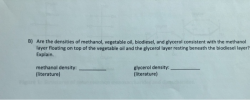 B) Are the densities of methanol, vegetable oil, biodiesel, and glycerol consistent with the methanol layer floating on top of the vegetable oil and the glycerol layer resting beneath the biodiesel layer? Explain. glycerol density: (literature) methanol density: (literature
B) Are the densities of methanol, vegetable oil, biodiesel, and glycerol consistent with the methanol layer floating on top of the vegetable oil and the glycerol layer resting beneath the biodiesel layer? Explain. glycerol density: (literature) methanol density: (literature
B) Are the densities of methanol, vegetable oil, biodiesel, and glycerol consistent with the methanol layer floating on top of the vegetable oil and the glycerol layer resting beneath the biodiesel layer? Explain. glycerol density: (literature) methanol density: (literature
Liquid heptane, C7H16 (100.21 g/mol) burns in oxygen gas to yield carbon dioxide and water. What...
Liquid heptane, C7H16 (100.21 g/mol) burns in oxygen gas to yield carbon dioxide and water. What mass of carbon dioxide (44.01 g/mol) is produced when 10.3 g of heptane burns completely? C7H16 + 11O2 --> 7CO2 +8H2O
A glass is half-full of water, with a layer of vegetable oil (n = 1.47) floating...
A glass is half-full of water, with a layer of vegetable oil (n = 1.47) floating on top. A ray of light traveling downward through the oil is incident on the water at an angle of 64.7°. Determine the critical angle for the oil-water interface θc = ° A point source of light is submerged 2.3 m below the surface of a lake and emits rays in all directions. On the surface of the lake, directly above the source, the area...
A test-tube containing vegetable oil and water settles into two layers. Solids of land Cl4 are...
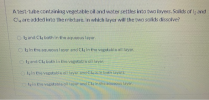 A test-tube containing vegetable oil and water settles into two layers. Solids of land Cl4 are added into the mixture. In which layer will the two solids dissolve? 12 and Cla both in the aqueous layer. lain the aqueous layer and Cld in the vegetable oil layer, Iz and Cla both in the vegetable oit layer lain the vegetable oil layer and Clis in both layers, Izin the vegetable oil layer and Cld in the aqueous layer
Liquid heptane, C7H16, burns in oxygen gas to yield carbon dioxide and water. What is the...
Liquid heptane, C7H16, burns in oxygen gas to yield carbon dioxide and water. What is the minimum mass of oxygen required for the complete reaction of 25.5 mL of heptane? (density of heptane = 0.6838 g/mL) a)5.57 g b)8.14 g c)30.6 g d)61.3 g e)89.6 g
Oil with a specific gravity of 0.80 forms a layer 0.90m deep in an open tank...
Oil with a specific gravity of 0.80 forms a layer 0.90m deep in an open tank that is otherwise filled with water. The total depth of water and oil is 3m. What is the gage pressure at the bottom of the tank?
Question 20 of 65 Vegetable oil is composed of long-chain hydrocarbon molecules. Vegetable oil and water...
 Question 20 of 65 Vegetable oil is composed of long-chain hydrocarbon molecules. Vegetable oil and water do not mix but form separate layers. Which statement describes the interactions between molecules in this case? The water molecules and the hydrocarbon molecules interact with their own kind through hydrophilic interactions, but they do not interact with each other. The water molecules interact through hydrophilic interactions, and the hydrocarbon molecules interact through hydrophobic interactions. The water molecules interact through hydrophobic interactions, and the...
BIOCHEMISTRY please help me out! A2. A scientist has a beaker of water. She adds 10 ml of sunflower oil into the beaker...
 BIOCHEMISTRY
please help me out!
A2. A scientist has a beaker of water. She adds 10 ml of sunflower oil into the beaker of water and stirs it. The water becomes cloudy, then gradually clears as an oily layer forms on the surface. The structure of sunflower oil is shown below: o O What is happening here? Why does the oil behave this way in the solvent water? Draw diagrams of chemical structures and use thermodynamic terms and equations to...
BIOCHEMISTRY
please help me out!
A2. A scientist has a beaker of water. She adds 10 ml of sunflower oil into the beaker of water and stirs it. The water becomes cloudy, then gradually clears as an oily layer forms on the surface. The structure of sunflower oil is shown below: o O What is happening here? Why does the oil behave this way in the solvent water? Draw diagrams of chemical structures and use thermodynamic terms and equations to...
A clear liquid forms a layer when added to water. would you expect it to be...
 A clear liquid forms a layer when added to water.
would you expect it to be organic or inorganic.
Bonding Melting point Solubility in water Flammability ould you expect it to Q2 A white solid is soluble in water and is not flammable. Would you es organic or inorganic? Explain your reason. A clear liquid forms a layer when added to water. Would you expect it to be organ or inorganic? Explain your reason.
A clear liquid forms a layer when added to water.
would you expect it to be organic or inorganic.
Bonding Melting point Solubility in water Flammability ould you expect it to Q2 A white solid is soluble in water and is not flammable. Would you es organic or inorganic? Explain your reason. A clear liquid forms a layer when added to water. Would you expect it to be organ or inorganic? Explain your reason.
Suppose a layer of oil is on the top of a beaker of water. Water in...
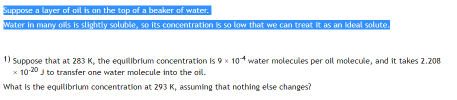 Suppose a layer of oil is on
the top of a beaker of water. Water in many oils is slightly
soluble, so its concentration is so low that we can treat it as an
ideal solute.
uppose a layer of oil is on the top of a beaker of water ter in many oils is slightly soluble, so its concentration is so low that we can treat it as an ideal solute 1) Suppose that at 283 K, the equilibrium...
Suppose a layer of oil is on
the top of a beaker of water. Water in many oils is slightly
soluble, so its concentration is so low that we can treat it as an
ideal solute.
uppose a layer of oil is on the top of a beaker of water ter in many oils is slightly soluble, so its concentration is so low that we can treat it as an ideal solute 1) Suppose that at 283 K, the equilibrium...
 B) Are the densities of methanol, vegetable oil, biodiesel, and glycerol consistent with the methanol layer floating on top of the vegetable oil and the glycerol layer resting beneath the biodiesel layer? Explain. glycerol density: (literature) methanol density: (literature
B) Are the densities of methanol, vegetable oil, biodiesel, and glycerol consistent with the methanol layer floating on top of the vegetable oil and the glycerol layer resting beneath the biodiesel layer? Explain. glycerol density: (literature) methanol density: (literature
B) Are the densities of methanol, vegetable oil, biodiesel, and glycerol consistent with the methanol layer floating on top of the vegetable oil and the glycerol layer resting beneath the biodiesel layer? Explain. glycerol density: (literature) methanol density: (literature
 A test-tube containing vegetable oil and water settles into two layers. Solids of land Cl4 are added into the mixture. In which layer will the two solids dissolve? 12 and Cla both in the aqueous layer. lain the aqueous layer and Cld in the vegetable oil layer, Iz and Cla both in the vegetable oit layer lain the vegetable oil layer and Clis in both layers, Izin the vegetable oil layer and Cld in the aqueous layer
 Question 20 of 65 Vegetable oil is composed of long-chain hydrocarbon molecules. Vegetable oil and water do not mix but form separate layers. Which statement describes the interactions between molecules in this case? The water molecules and the hydrocarbon molecules interact with their own kind through hydrophilic interactions, but they do not interact with each other. The water molecules interact through hydrophilic interactions, and the hydrocarbon molecules interact through hydrophobic interactions. The water molecules interact through hydrophobic interactions, and the...
 BIOCHEMISTRY
please help me out!
A2. A scientist has a beaker of water. She adds 10 ml of sunflower oil into the beaker of water and stirs it. The water becomes cloudy, then gradually clears as an oily layer forms on the surface. The structure of sunflower oil is shown below: o O What is happening here? Why does the oil behave this way in the solvent water? Draw diagrams of chemical structures and use thermodynamic terms and equations to...
BIOCHEMISTRY
please help me out!
A2. A scientist has a beaker of water. She adds 10 ml of sunflower oil into the beaker of water and stirs it. The water becomes cloudy, then gradually clears as an oily layer forms on the surface. The structure of sunflower oil is shown below: o O What is happening here? Why does the oil behave this way in the solvent water? Draw diagrams of chemical structures and use thermodynamic terms and equations to...
 A clear liquid forms a layer when added to water.
would you expect it to be organic or inorganic.
Bonding Melting point Solubility in water Flammability ould you expect it to Q2 A white solid is soluble in water and is not flammable. Would you es organic or inorganic? Explain your reason. A clear liquid forms a layer when added to water. Would you expect it to be organ or inorganic? Explain your reason.
A clear liquid forms a layer when added to water.
would you expect it to be organic or inorganic.
Bonding Melting point Solubility in water Flammability ould you expect it to Q2 A white solid is soluble in water and is not flammable. Would you es organic or inorganic? Explain your reason. A clear liquid forms a layer when added to water. Would you expect it to be organ or inorganic? Explain your reason.
 Suppose a layer of oil is on
the top of a beaker of water. Water in many oils is slightly
soluble, so its concentration is so low that we can treat it as an
ideal solute.
uppose a layer of oil is on the top of a beaker of water ter in many oils is slightly soluble, so its concentration is so low that we can treat it as an ideal solute 1) Suppose that at 283 K, the equilibrium...
Suppose a layer of oil is on
the top of a beaker of water. Water in many oils is slightly
soluble, so its concentration is so low that we can treat it as an
ideal solute.
uppose a layer of oil is on the top of a beaker of water ter in many oils is slightly soluble, so its concentration is so low that we can treat it as an ideal solute 1) Suppose that at 283 K, the equilibrium...
Most questions answered within 3 hours.
-
Where is the error in this code sequence?
String s1 = "Hello";
String s2 = "ello";...
asked 10 months ago -
Financial data for Joel de Paris, Inc., for last year
follow:
Joel de Paris, Inc.
Balance...
asked 10 months ago -
Consider this reaction:
Al2(SO4)3 (aq)+ BaCl3
(aq) Al2Cl6 (aq)- +
3BaSO4(s) . What is the...
asked 10 months ago -
Suppose that Savneet is considering increasing her
recent random sample from 20 car rentals to 40...
asked 10 months ago -
Trucks arrive at an unloading terminal at an average rate of 120
per hour.
Trucks arrive...
asked 10 months ago -
Why are methanol and ethanol completely soluble in water while
octanol is not very little soluble....
asked 10 months ago -
A facilities manager at a university reads in a research report
that the mean amount of...
asked 10 months ago -
When the CuSO4 is rehydrated by adding water to the anhydrous
compound, is this an endothermic...
asked 10 months ago -
A ray of sunlight is passing from diamond into crown glass; the
angle of incidence is...
asked 10 months ago -
A block of mass 0.249 kg is placed on top of a light, vertical
spring of...
asked 10 months ago -
how do the kidneys compensate in the presences of acidosis
a) trigger hyperventilate
b) reserve acid...
asked 10 months ago -
Question 501 pts
The rental rate of capital to the firm increases. Which of the
following...
asked 10 months ago