
Homework Answers
Add Answer to:
2. For the circuit shown in Figure 2: (a) (5 points) Calculate the transfer function H(s)-Volo)/V(o)....
V.(5) V (5 Using the figure given below, realize the transfer function C2 S + 1000...
 V.(5) V (5 Using the figure given below, realize the transfer function C2 S + 1000 2(5 + 4000) where G = 8 uF. C R2 Vi VO + w R References eBook & Resources Section Break Difficulty: Medium value: 10.00 points Find the values of R1 and R2. 12. The value of R1 = The value of R2 = Ω.
For the circuit shown in Figure 1, determine (a) The transfer function H(s) Vo(s)/V(s) 1 (b)....
 For the circuit shown in Figure 1, determine (a) The transfer function H(s) Vo(s)/V(s) 1 (b). The impulse response h(t) given that R,-5Q, R2-2Q, L,-1 mH, and L2 = 2 mH Ri L R2 Figure 1.
Determine the complex transfer function T(s) = V/V; for the circuit shown below. Specify it as...
 Determine the complex transfer function T(s) = V/V; for the circuit shown below. Specify it as a function of the complex frequency, s, and the symbols for the resistors and capacitor. On the attached graph, plot the magnitude of the complex transfer function T(jw) in decibels as a function of the frequency f of the source as f varies from 1 Hz to 1 MHz. Assume that the op amp is ideal. Use as the numerical values for the resistors...
The transfer function relating Z(s) to the input U(s) is given below: It can be shown that the IL...
 The transfer function relating Z(s) to the input U(s) is given
below: It can be shown that the ILT of Z (s) is of the form Z(t)
Find C1, C2, r1 r2 r3 , and W
Problem 1: (5Points) The transfer function relating Z(s) to the input U(s) is given below: St S It can be shown that the ILT of Z (s) is of the form rt Find C1, C2» T['T2'3' Problem 2: (20 Points) The DE for a...
The transfer function relating Z(s) to the input U(s) is given
below: It can be shown that the ILT of Z (s) is of the form Z(t)
Find C1, C2, r1 r2 r3 , and W
Problem 1: (5Points) The transfer function relating Z(s) to the input U(s) is given below: St S It can be shown that the ILT of Z (s) is of the form rt Find C1, C2» T['T2'3' Problem 2: (20 Points) The DE for a...
5. (5 points) Find current i(0 in the sinusoidal steady state using the superposition principle. i(t)...
 5. (5 points) Find current i(0 in the sinusoidal steady state using the superposition principle. i(t) R2 1 ohm R1 1 ohm cos(t) A V1 2V L1 2H 6. (5 points) The switch is closed at r-0 after being open for a long time Find i(t) for O t=0 i(t) R1 R2 1 ohm 1A 1H 1 ohm
using mesh analysis method Whe Find the transfer function output for the electrical circuit below input...
 using mesh analysis method
Whe Find the transfer function output for the electrical circuit below input 2H 2221F 0000 222 22 222 v(t) 232 + vo 21 VLt) 1F 2H WE 0000 llll VL(1) (a) (b)
using mesh analysis method
Whe Find the transfer function output for the electrical circuit below input 2H 2221F 0000 222 22 222 v(t) 232 + vo 21 VLt) 1F 2H WE 0000 llll VL(1) (a) (b)
Problem 4.1 For the circuit shown in Fig. 4.1, there is no initial energy storage. Draw...
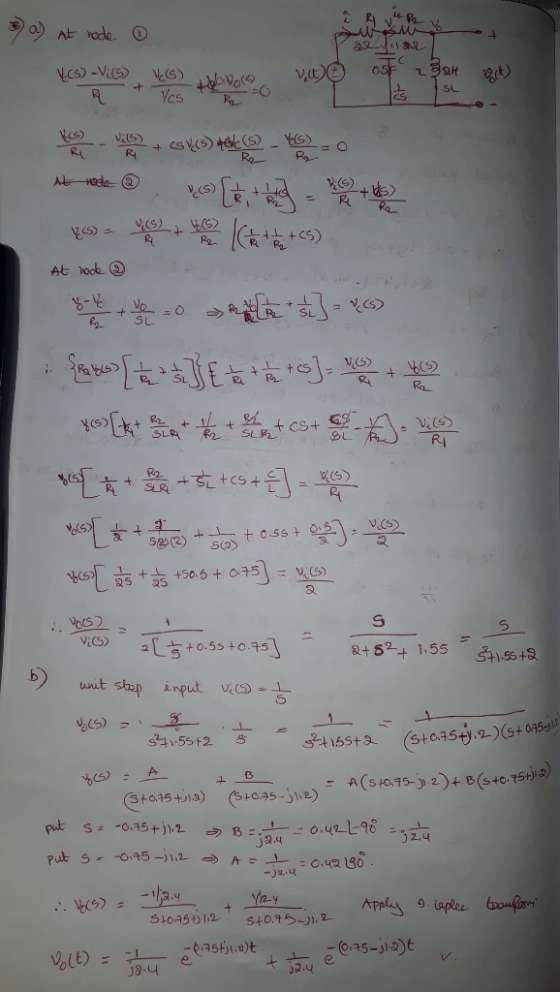
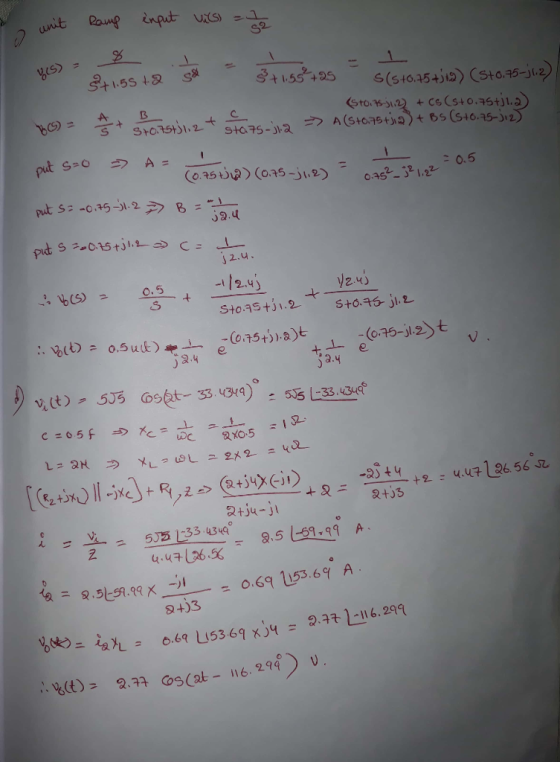
 Problem 4.1 For the circuit shown in Fig. 4.1, there is no initial energy storage. Draw and label the circuit in the s- domain and use it to determine H(s)=V_(s)/Vsrc(s). Using H(s) and given: (a) vsrc(t)= e'u(t) V, find vo(t) using the inverse Laplace Transforms. (b) vsrc(t)=2 cos 2t V, determine the steady state output volt). 0.502 122 1н + USRC 1 F V, 22 VO Fig. 4.1
(i) Find the transfer function G(s) = Vo(s)/Vi(s) of this system using electrical impedances. Express the...
 (i) Find the transfer function G(s) = Vo(s)/Vi(s) of this system using electrical impedances. Express the transfer function as a ratio of two s polynomials. (ii) Plot the output voltage v, as a function of time by means of the transfer function determined at (i) for an input voltage vi= 120e0.18 Volt, R2 = 110 9, R2 = 900, R3 = 100 0, L = 3H and C= 80-106 F. Use MATLAB's step command to plot volt). Also use Simulink...
Problem 3 A unity feedback system has the loop transfer function G(s) = Kata) s(s +...
 Problem 3 A unity feedback system has the loop transfer function G(s) = Kata) s(s + (a) Find the breakway and entry points on the real axis. (b) Find the gain and the roots when the real part of the complex roots is located at -2 (c) Sketch the root locus. Problem 4 The forward path G(s) of a unity feedback system with input R(s) and output Y (s) is given by G(o) 106I) (a) What is the type of...
Circuit Analysis in the s-Domain 15.3. The initial voltage across the capacitor in the circuit shown in Figure P15.3 is v(0) 1 V, and the initial current through the inductor is i(0)0 mA Find th...
 Circuit Analysis in the s-Domain 15.3. The initial voltage across the capacitor in the circuit shown in Figure P15.3 is v(0) 1 V, and the initial current through the inductor is i(0)0 mA Find the voltage vo (t) across the capacitor for t 2 0 Figure P15.3 50 mH 1 kS2 V. Volt) T 0.1 μF The circuit in the s-domain is shown below. R2 Va 1k 0.05s 1/(sC)-1e7/s Vo R1 2k V (0-ys 5/s 1/s 1 format long; 2...
 V.(5) V (5 Using the figure given below, realize the transfer function C2 S + 1000 2(5 + 4000) where G = 8 uF. C R2 Vi VO + w R References eBook & Resources Section Break Difficulty: Medium value: 10.00 points Find the values of R1 and R2. 12. The value of R1 = The value of R2 = Ω.
 For the circuit shown in Figure 1, determine (a) The transfer function H(s) Vo(s)/V(s) 1 (b). The impulse response h(t) given that R,-5Q, R2-2Q, L,-1 mH, and L2 = 2 mH Ri L R2 Figure 1.
 Determine the complex transfer function T(s) = V/V; for the circuit shown below. Specify it as a function of the complex frequency, s, and the symbols for the resistors and capacitor. On the attached graph, plot the magnitude of the complex transfer function T(jw) in decibels as a function of the frequency f of the source as f varies from 1 Hz to 1 MHz. Assume that the op amp is ideal. Use as the numerical values for the resistors...
 The transfer function relating Z(s) to the input U(s) is given
below: It can be shown that the ILT of Z (s) is of the form Z(t)
Find C1, C2, r1 r2 r3 , and W
Problem 1: (5Points) The transfer function relating Z(s) to the input U(s) is given below: St S It can be shown that the ILT of Z (s) is of the form rt Find C1, C2» T['T2'3' Problem 2: (20 Points) The DE for a...
The transfer function relating Z(s) to the input U(s) is given
below: It can be shown that the ILT of Z (s) is of the form Z(t)
Find C1, C2, r1 r2 r3 , and W
Problem 1: (5Points) The transfer function relating Z(s) to the input U(s) is given below: St S It can be shown that the ILT of Z (s) is of the form rt Find C1, C2» T['T2'3' Problem 2: (20 Points) The DE for a...
 5. (5 points) Find current i(0 in the sinusoidal steady state using the superposition principle. i(t) R2 1 ohm R1 1 ohm cos(t) A V1 2V L1 2H 6. (5 points) The switch is closed at r-0 after being open for a long time Find i(t) for O t=0 i(t) R1 R2 1 ohm 1A 1H 1 ohm
 using mesh analysis method
Whe Find the transfer function output for the electrical circuit below input 2H 2221F 0000 222 22 222 v(t) 232 + vo 21 VLt) 1F 2H WE 0000 llll VL(1) (a) (b)
using mesh analysis method
Whe Find the transfer function output for the electrical circuit below input 2H 2221F 0000 222 22 222 v(t) 232 + vo 21 VLt) 1F 2H WE 0000 llll VL(1) (a) (b)
 Problem 4.1 For the circuit shown in Fig. 4.1, there is no initial energy storage. Draw and label the circuit in the s- domain and use it to determine H(s)=V_(s)/Vsrc(s). Using H(s) and given: (a) vsrc(t)= e'u(t) V, find vo(t) using the inverse Laplace Transforms. (b) vsrc(t)=2 cos 2t V, determine the steady state output volt). 0.502 122 1н + USRC 1 F V, 22 VO Fig. 4.1
 (i) Find the transfer function G(s) = Vo(s)/Vi(s) of this system using electrical impedances. Express the transfer function as a ratio of two s polynomials. (ii) Plot the output voltage v, as a function of time by means of the transfer function determined at (i) for an input voltage vi= 120e0.18 Volt, R2 = 110 9, R2 = 900, R3 = 100 0, L = 3H and C= 80-106 F. Use MATLAB's step command to plot volt). Also use Simulink...
 Problem 3 A unity feedback system has the loop transfer function G(s) = Kata) s(s + (a) Find the breakway and entry points on the real axis. (b) Find the gain and the roots when the real part of the complex roots is located at -2 (c) Sketch the root locus. Problem 4 The forward path G(s) of a unity feedback system with input R(s) and output Y (s) is given by G(o) 106I) (a) What is the type of...
 Circuit Analysis in the s-Domain 15.3. The initial voltage across the capacitor in the circuit shown in Figure P15.3 is v(0) 1 V, and the initial current through the inductor is i(0)0 mA Find the voltage vo (t) across the capacitor for t 2 0 Figure P15.3 50 mH 1 kS2 V. Volt) T 0.1 μF The circuit in the s-domain is shown below. R2 Va 1k 0.05s 1/(sC)-1e7/s Vo R1 2k V (0-ys 5/s 1/s 1 format long; 2...
Most questions answered within 3 hours.
-
Where is the error in this code sequence?
String s1 = "Hello";
String s2 = "ello";...
asked 10 months ago -
Financial data for Joel de Paris, Inc., for last year
follow:
Joel de Paris, Inc.
Balance...
asked 10 months ago -
Consider this reaction:
Al2(SO4)3 (aq)+ BaCl3
(aq) Al2Cl6 (aq)- +
3BaSO4(s) . What is the...
asked 10 months ago -
Suppose that Savneet is considering increasing her
recent random sample from 20 car rentals to 40...
asked 10 months ago -
Trucks arrive at an unloading terminal at an average rate of 120
per hour.
Trucks arrive...
asked 10 months ago -
Why are methanol and ethanol completely soluble in water while
octanol is not very little soluble....
asked 10 months ago -
A facilities manager at a university reads in a research report
that the mean amount of...
asked 10 months ago -
When the CuSO4 is rehydrated by adding water to the anhydrous
compound, is this an endothermic...
asked 10 months ago -
A ray of sunlight is passing from diamond into crown glass; the
angle of incidence is...
asked 10 months ago -
A block of mass 0.249 kg is placed on top of a light, vertical
spring of...
asked 10 months ago -
how do the kidneys compensate in the presences of acidosis
a) trigger hyperventilate
b) reserve acid...
asked 10 months ago -
Question 501 pts
The rental rate of capital to the firm increases. Which of the
following...
asked 10 months ago