A conducting sphere with a charge of 0.0020 C is brought into contact with a second...
Homework Answers

Add Answer to:
A
conducting sphere with a charge of 0.0020 C is brought into contact
with a second...
A positively charged sphere (A) brought close, without touching, to a neutral conducting sphere (B). Sphere...
 A positively charged
sphere (A) brought close, without touching, to a neutral conducting
sphere (B). Sphere B connected to the ground through a wire.
What is the type of
electric charge on sphere B, after removing the grounding wire?
A positively charged sphere (A) brought close, without touching, to a neutral conducting sphere (B). Sphere B connected to the ground through a wire. A B + What is the type of electric charge on sphere B, after removing the grounding...
A positively charged
sphere (A) brought close, without touching, to a neutral conducting
sphere (B). Sphere B connected to the ground through a wire.
What is the type of
electric charge on sphere B, after removing the grounding wire?
A positively charged sphere (A) brought close, without touching, to a neutral conducting sphere (B). Sphere B connected to the ground through a wire. A B + What is the type of electric charge on sphere B, after removing the grounding...
6) A small conducting sphere is charged to-22μΟ. Then a second identical sphere (which initially has...
 6) A small conducting sphere is charged to-22μΟ. Then a second identical sphere (which initially has zero charge) is brought into contact with the charged sphere. After the charge equilibrates, the two spheres are separated by 0.52 m. What is the force between them?
Two conducting spheres are brought into contact, as shown: -1C +2C. depict the transfer of charged....
Two conducting spheres are brought into contact, as shown: -1C +2C. depict the transfer of charged. State the final charge on each sphere.
III. Spheres +0 Two neutral conducting spheres, A and B, are supported by insulating stands. The...
 III. Spheres +0 Two neutral conducting spheres, A and B, are supported by insulating stands. The spheres are touching each other, and a particle (for example, a pith ball) with a positive +Q charge is brought near sphere A as shown i. Is there a net force on the particle with the+ charge at this time? Explain. Without touching the metal spheres, the person holding the base of sphere B now pulls it 4 centimeters to the right. ii. Is...
A hollow metal sphere carries a charge of 8.0 μC. A second hollow metal sphere with...
A hollow metal sphere carries a charge of 8.0 μC. A second hollow metal sphere with a radius 1.25 times that of the first carries a charge of 10.0 μC. The two spheres are brought into contact with each other, then separated. The first sphere now has a charge of ? μC The second sphere now has a charge of ? μC
A hollow metal sphere carries a charge of 5.5 μC. A second hollow metal sphere with...
A hollow metal sphere carries a charge of 5.5 μC. A second hollow metal sphere with a radius 2.25 times that of the first carries a charge of 15.5 μC. The two spheres are brought into contact with each other, then separated. The first sphere now has a charge of ___ μC. The second sphere now has a charge of ___ μC
23.1 An uncharged metal sphere, A, is on an insulated base. A second sphere, B, of...
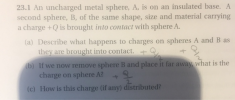 23.1 An uncharged metal sphere, A, is on an insulated base. A second sphere, B, of the same shape, size and material carrying (a) Describe what happens to charges on spheres A and B as b) If we now remove sphere B and place it far away what is the a charge +Q is brought into contact with sphere A. they are brought into contact.Q charge on sphere A? (c) How is this charge (if any) distributed?
In the figure below, a point charge q is brought near a neutral conducting sphere. Is...
 In the figure below, a point charge q is brought near a neutral
conducting sphere. Is the force of between the sphere and the
charge:
A. Zero
B. Attractive
C. Repulsive
D. Out of the page
E. Into the page
DU A. (5 pts) table abovell! In the figure belov, a point charge q is brought near a neutral conducting sphere. Is the force of between the sphere and the charge: ro B. Attractive C. Repulsive D. Out of the...
In the figure below, a point charge q is brought near a neutral
conducting sphere. Is the force of between the sphere and the
charge:
A. Zero
B. Attractive
C. Repulsive
D. Out of the page
E. Into the page
DU A. (5 pts) table abovell! In the figure belov, a point charge q is brought near a neutral conducting sphere. Is the force of between the sphere and the charge: ro B. Attractive C. Repulsive D. Out of the...
CL-3. Two identical conducting spheres are held on insulating stands with their centers 0 shown below....
 CL-3. Two identical conducting spheres are held on insulating stands with their centers 0 shown below. Sphere A Sphere B 0.300m While in this position each sphere repels the other with a force of 1.60N. The two spheres are brought into contact with each other and allowed to reach electrostatic equilibrium (for which they have equal final charges). The spheres are then returned to their original separation where they are now found to repel each other with a force of...
Three identical metallic conducting spheres carry the following charges: q1 = +7.8 μC, q2 = −1.4...
Three identical metallic conducting spheres carry the following charges: q1 = +7.8 μC, q2 = −1.4 μC, and q3 = −4.0 μC. The spheres that carry the charges q1 and q2 are brought into contact. Then they are separated. After that, one of those two spheres is brought into contact with the third sphere that carries the charge q3. What is the final charge on the third sphere?
 A positively charged
sphere (A) brought close, without touching, to a neutral conducting
sphere (B). Sphere B connected to the ground through a wire.
What is the type of
electric charge on sphere B, after removing the grounding wire?
A positively charged sphere (A) brought close, without touching, to a neutral conducting sphere (B). Sphere B connected to the ground through a wire. A B + What is the type of electric charge on sphere B, after removing the grounding...
A positively charged
sphere (A) brought close, without touching, to a neutral conducting
sphere (B). Sphere B connected to the ground through a wire.
What is the type of
electric charge on sphere B, after removing the grounding wire?
A positively charged sphere (A) brought close, without touching, to a neutral conducting sphere (B). Sphere B connected to the ground through a wire. A B + What is the type of electric charge on sphere B, after removing the grounding...
 6) A small conducting sphere is charged to-22μΟ. Then a second identical sphere (which initially has zero charge) is brought into contact with the charged sphere. After the charge equilibrates, the two spheres are separated by 0.52 m. What is the force between them?
 III. Spheres +0 Two neutral conducting spheres, A and B, are supported by insulating stands. The spheres are touching each other, and a particle (for example, a pith ball) with a positive +Q charge is brought near sphere A as shown i. Is there a net force on the particle with the+ charge at this time? Explain. Without touching the metal spheres, the person holding the base of sphere B now pulls it 4 centimeters to the right. ii. Is...
 23.1 An uncharged metal sphere, A, is on an insulated base. A second sphere, B, of the same shape, size and material carrying (a) Describe what happens to charges on spheres A and B as b) If we now remove sphere B and place it far away what is the a charge +Q is brought into contact with sphere A. they are brought into contact.Q charge on sphere A? (c) How is this charge (if any) distributed?
 In the figure below, a point charge q is brought near a neutral
conducting sphere. Is the force of between the sphere and the
charge:
A. Zero
B. Attractive
C. Repulsive
D. Out of the page
E. Into the page
DU A. (5 pts) table abovell! In the figure belov, a point charge q is brought near a neutral conducting sphere. Is the force of between the sphere and the charge: ro B. Attractive C. Repulsive D. Out of the...
In the figure below, a point charge q is brought near a neutral
conducting sphere. Is the force of between the sphere and the
charge:
A. Zero
B. Attractive
C. Repulsive
D. Out of the page
E. Into the page
DU A. (5 pts) table abovell! In the figure belov, a point charge q is brought near a neutral conducting sphere. Is the force of between the sphere and the charge: ro B. Attractive C. Repulsive D. Out of the...
 CL-3. Two identical conducting spheres are held on insulating stands with their centers 0 shown below. Sphere A Sphere B 0.300m While in this position each sphere repels the other with a force of 1.60N. The two spheres are brought into contact with each other and allowed to reach electrostatic equilibrium (for which they have equal final charges). The spheres are then returned to their original separation where they are now found to repel each other with a force of...
Most questions answered within 3 hours.
-
Where is the error in this code sequence?
String s1 = "Hello";
String s2 = "ello";...
asked 11 months ago -
Financial data for Joel de Paris, Inc., for last year
follow:
Joel de Paris, Inc.
Balance...
asked 11 months ago -
Consider this reaction:
Al2(SO4)3 (aq)+ BaCl3
(aq) Al2Cl6 (aq)- +
3BaSO4(s) . What is the...
asked 11 months ago -
Suppose that Savneet is considering increasing her
recent random sample from 20 car rentals to 40...
asked 11 months ago -
Trucks arrive at an unloading terminal at an average rate of 120
per hour.
Trucks arrive...
asked 11 months ago -
Why are methanol and ethanol completely soluble in water while
octanol is not very little soluble....
asked 11 months ago -
A facilities manager at a university reads in a research report
that the mean amount of...
asked 11 months ago -
When the CuSO4 is rehydrated by adding water to the anhydrous
compound, is this an endothermic...
asked 11 months ago -
A ray of sunlight is passing from diamond into crown glass; the
angle of incidence is...
asked 11 months ago -
A block of mass 0.249 kg is placed on top of a light, vertical
spring of...
asked 11 months ago -
how do the kidneys compensate in the presences of acidosis
a) trigger hyperventilate
b) reserve acid...
asked 11 months ago -
Question 501 pts
The rental rate of capital to the firm increases. Which of the
following...
asked 11 months ago