
Homework Answers
Add Answer to:
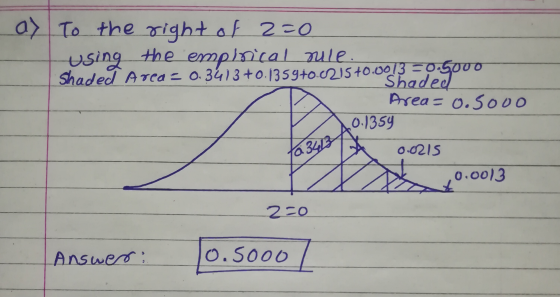
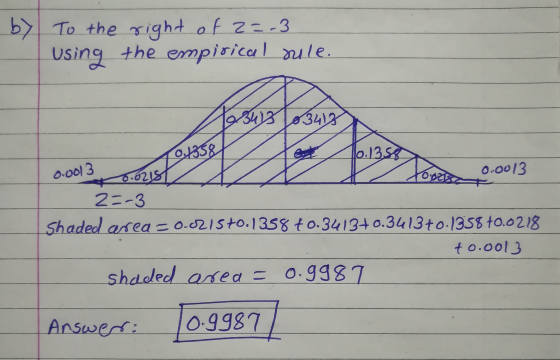
Using the areas in Figure (the Empirical Rule), find the areas; (a) To the right of...
Use the Empirical rule to determine the following areas as the probabilities A| B |C 21....
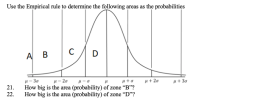 Use the Empirical rule to determine the following areas as the probabilities A| B |C 21. How big is the area (probability) of zone "B"? 22. How big is the area (probability) of zone "D"
The area under the normal curve between Z= -1.0 and Z = -2.0 is A) 0.3413 B) 0.1359...
The area under the normal curve between Z= -1.0 and Z = -2.0 is A) 0.3413 B) 0.1359 C) 0.4772 D) 0.0228 2. Find Z if the area to the right of Z is 0.67 A) 0.9100 B) 0.0421 C) -0.4500 D) -0.390
1. It is inappropriate to apply the Empirical Rule to a population that is right-skewed a....
 1. It is inappropriate to apply the Empirical Rule to a population that is right-skewed a. True b. False 2. A frequency distribution usually has equal class/bin widths. a. True b. False 3. Measurements from a sample are called a, statistics. b. inferences parameters d. variables 4. Automobile exhaust emission of CO2 (milligrams per mile) is data. a. nominal b. ordinal c. interval d. ratio
The Empirical Rule is also known as the 68-95-99.7 Rule. Use the Z-score table to find...
The Empirical Rule is also known as the 68-95-99.7 Rule. Use the Z-score table to find what each of these numbers really is. To assist you, include a sketch and a probability expression for each case. Please show your work, thanks.
Use the Empirical rule to determine the following areas as the probabilities 21 How big is...
 Use the Empirical rule to determine the following areas as the probabilities 21 How big is the area (probability) of zone "B"7 22. How big is the area (probability) of zone "D"? The mean height of males 20 years or older is 68 inches with a standard deviation of 3.53 inches. The mean height of females 20 years or older is 62 inches with a standard deviation of 2.53 inches. While a male is 75 inches tall, a female is...
please help on both 1.) We learned in section 6.1 that the Empirical Rule (a.k.a 68-95-99.7...
please help on both 1.) We learned in section 6.1 that the Empirical Rule (a.k.a 68-95-99.7 rule) is a good estimate of probability within a specific number of standard deviations from the mean for any normal distribution. We know that this rule only provides a good estimate and that it is not very precise. With use of the Normalcdf function in our calculator, we can find exact values. For example, when using the Empirical Rule 95% is expected to be...
Verify the empirical rule by using Table A, software, or a calculator to show that for...
Verify the empirical rule by using Table A, software, or a calculator to show that for a normal distribution, the probability (rounded to two decimal places) within a. 1 standard deviation of the mean equals 0.68. b. 2 standard deviations of the mean equals 0.95. c. 3 standard deviations of the mean is very close to 1.00. I need the copy and paste your R command and output
1) In a problem, what lets you know to use the Empirical Rule 68% - 95%-...
 1) In a problem, what lets you know to use the Empirical Rule 68% - 95%- 99.76? Remember, Empirical Rule is a shortcut for X-Z-Table problems and X -Z-Table problems. 2) What key word(s) in a problem tell you to use the Normal Distribution X~ N (4, o)? 3) What key word(s) in a problem tell you to use The Sampling Distribution of the Sample Mean X~ N
Find the indicated probability by using the special addition rule. 36) The age distribution of students...
 Find the indicated probability by using the special addition rule. 36) The age distribution of students at a community college is given below 36) Under 21 21-25 26-30 31-35 Over 35 401 420 216 58 24 1119 student from the community college is selected at random. Find the probabity that the student A) 0.052 is between 26 and 35 inclusive. Round approximations to three decimal places B) 0.193 C) 274 D) 0.245 37) A relative frequency distribution is given below...
Magnetism: Find the missing using the 1st right hand rule e) 8osT
 Magnetism: Find the missing using the 1st right hand
rule
e) 8osT
Magnetism: Find the missing using the 1st right hand
rule
e) 8osT
 Use the Empirical rule to determine the following areas as the probabilities A| B |C 21. How big is the area (probability) of zone "B"? 22. How big is the area (probability) of zone "D"
 1. It is inappropriate to apply the Empirical Rule to a population that is right-skewed a. True b. False 2. A frequency distribution usually has equal class/bin widths. a. True b. False 3. Measurements from a sample are called a, statistics. b. inferences parameters d. variables 4. Automobile exhaust emission of CO2 (milligrams per mile) is data. a. nominal b. ordinal c. interval d. ratio
 Use the Empirical rule to determine the following areas as the probabilities 21 How big is the area (probability) of zone "B"7 22. How big is the area (probability) of zone "D"? The mean height of males 20 years or older is 68 inches with a standard deviation of 3.53 inches. The mean height of females 20 years or older is 62 inches with a standard deviation of 2.53 inches. While a male is 75 inches tall, a female is...
 1) In a problem, what lets you know to use the Empirical Rule 68% - 95%- 99.76? Remember, Empirical Rule is a shortcut for X-Z-Table problems and X -Z-Table problems. 2) What key word(s) in a problem tell you to use the Normal Distribution X~ N (4, o)? 3) What key word(s) in a problem tell you to use The Sampling Distribution of the Sample Mean X~ N
 Find the indicated probability by using the special addition rule. 36) The age distribution of students at a community college is given below 36) Under 21 21-25 26-30 31-35 Over 35 401 420 216 58 24 1119 student from the community college is selected at random. Find the probabity that the student A) 0.052 is between 26 and 35 inclusive. Round approximations to three decimal places B) 0.193 C) 274 D) 0.245 37) A relative frequency distribution is given below...
 Magnetism: Find the missing using the 1st right hand
rule
e) 8osT
Magnetism: Find the missing using the 1st right hand
rule
e) 8osT
Most questions answered within 3 hours.
-
Where is the error in this code sequence?
String s1 = "Hello";
String s2 = "ello";...
asked 10 months ago -
Financial data for Joel de Paris, Inc., for last year
follow:
Joel de Paris, Inc.
Balance...
asked 10 months ago -
Consider this reaction:
Al2(SO4)3 (aq)+ BaCl3
(aq) Al2Cl6 (aq)- +
3BaSO4(s) . What is the...
asked 10 months ago -
Suppose that Savneet is considering increasing her
recent random sample from 20 car rentals to 40...
asked 10 months ago -
Trucks arrive at an unloading terminal at an average rate of 120
per hour.
Trucks arrive...
asked 10 months ago -
Why are methanol and ethanol completely soluble in water while
octanol is not very little soluble....
asked 10 months ago -
A facilities manager at a university reads in a research report
that the mean amount of...
asked 10 months ago -
When the CuSO4 is rehydrated by adding water to the anhydrous
compound, is this an endothermic...
asked 10 months ago -
A ray of sunlight is passing from diamond into crown glass; the
angle of incidence is...
asked 10 months ago -
A block of mass 0.249 kg is placed on top of a light, vertical
spring of...
asked 10 months ago -
how do the kidneys compensate in the presences of acidosis
a) trigger hyperventilate
b) reserve acid...
asked 10 months ago -
Question 501 pts
The rental rate of capital to the firm increases. Which of the
following...
asked 10 months ago