Using Figure 10.1 as a model, illustrate the result of each operation in the sequence PUSH(S,...
Using Figure 10.1 as a model, illustrate the result of each operation in the sequence PUSH(S, 4), PUS(S, 1), PUSH(S, 3), POP(S), PUSH(S, 8), and POP(S) on an initially empty stack S stored in array S [1… 6].
Homework Answers
ok we have a stack of size 6 which is initially empty.
1. operation push(s,4)
stack will look like
4
2)
push(s,1)
stack will look like
1
4
3)
push(s,3)
stack will look like
3
1
4
4)
pop(s)
stack will look like
1
4
5) push (s,8)
stack will look like
8
1
4
6)
pop(s)
stack will look like
1
4
Finally stack will have two values
1
4
Add Answer to:
Using Figure 10.1 as a model, illustrate the result of each
operation in the sequence PUSH(S,...
Data Structures and Algorithm Analysis illustrate the result of each operation in the sequence PUSH(S, 4),...
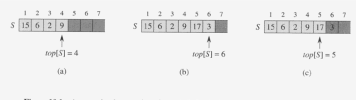 Data Structures and Algorithm Analysis
illustrate the result of each operation in the sequence PUSH(S,
4), PUSH(S, 2), POP(), PUSH(S, 3), PUSH(S, 9), POP(), and PUSH(S,
0) on an initially empty stack S stored in array S[1..6].
1 2 3 4 5 6 7 1 2 3 4 5 6 7 15 6 2 9 17 3 S15 6 29 173 top[S] = 4 top[S] = 6 top[S] = 5
Data Structures and Algorithm Analysis
illustrate the result of each operation in the sequence PUSH(S,
4), PUSH(S, 2), POP(), PUSH(S, 3), PUSH(S, 9), POP(), and PUSH(S,
0) on an initially empty stack S stored in array S[1..6].
1 2 3 4 5 6 7 1 2 3 4 5 6 7 15 6 2 9 17 3 S15 6 29 173 top[S] = 4 top[S] = 6 top[S] = 5
3. (15 points) Using Figure 6.3 as a model, illustrate the operation of BUILD-MAX-HEAP on the...
 3. (15 points) Using Figure 6.3 as a model, illustrate the operation of BUILD-MAX-HEAP on the array A = (3,2,15,9, 70, 18,5, 33, 8).
Problem solving manually 2. Using Figure 2.4 as a model, illustrate the operation of merge sort...
 Problem solving manually
2. Using Figure 2.4 as a model, illustrate the operation of merge sort on the array A = 〈11, 9, 13, 2, 7, 8, 3, 11, 5〉.
Problem solving manually
2. Using Figure 2.4 as a model, illustrate the operation of merge sort on the array A = 〈11, 9, 13, 2, 7, 8, 3, 11, 5〉.
Use Figure 6.4 as a model, illustrate the operation of HEAPSORT on the array A =...
 Use Figure 6.4 as a model, illustrate the operation of HEAPSORT
on the array
A = <4, 10, 7, 25, 8, 3>. Show all intermediate steps how the
heap is transformed.
6.4/
91|11|016 | 8|4|||7|V (9) 09
Use Figure 6.4 as a model, illustrate the operation of HEAPSORT
on the array
A = <4, 10, 7, 25, 8, 3>. Show all intermediate steps how the
heap is transformed.
6.4/
91|11|016 | 8|4|||7|V (9) 09
Define a class DoubleStack which implements two stacks of objects of type Object using a single...
 Define a class DoubleStack which implements two stacks of objects of type Object using a single shared array, so that the push and pop operations specify which of the two stacks is involved in the operation (as described below). (a) Specify necessary instance variables and write a constructor “DoubleStack(int n)” that takes integer n and creates an empty DoubleStack object with the shared array with room for n elements (2 pt); b) Write methods "boolean push(int i, Object o)" and...
(ii) [6 marks] Assume that we have an empty stack S and an empty queue Q....
 (ii) [6 marks] Assume that we have an empty stack S and an empty queue Q. Given a series of stack operations on S as below: Push(S,10), Push(S, 7), Push(S, 23), Pop(S), Push(S, 9), Pop(S), Pop(S) Output the element returned by each Pop operation. Given a series of queue operations on Q as below: Enqueue(0,10),Enqueue(Q,20), Enqueue(0,33), Dequeue(Q), Enqueue(Q,55), Dequeue(Q), Dequeue(Q) Output the element returned by each Dequeue operation. (iii) [8 marks] Given an empty binary search tree T, draw the...
Backtracking is a computing algorithm using stack to “remember” user-generated events when using a program. A...
Backtracking is a computing algorithm using stack to “remember” user-generated events when using a program. A user event may be “pressing the Enter key on keyboard” or “clicking a mouse button”. Stack is a data structure with the Last-In-First-Out property (LIFO). If we push the aforesaid user events into a stack, a computer program using that data structure can “rewind” user events by popping them out of stack one at a time. This backtracking feature is available as Edit ->...
Please help with program this. Thank you so much in advance! Create a Java program which...
 Please help with program this. Thank you so much in advance!
Create a Java program which implements a simple stack machine. The machine has 6 instructions Push operand Puts a value on the stack. The operand is either a floating point literal or one of 10 memory locations designated MO M9 Pop operand Pops the value on the top of the stack and moves it to the memory location MO-M9 Add Pops the top two values off the stack, performs...
Please help with program this. Thank you so much in advance!
Create a Java program which implements a simple stack machine. The machine has 6 instructions Push operand Puts a value on the stack. The operand is either a floating point literal or one of 10 memory locations designated MO M9 Pop operand Pops the value on the top of the stack and moves it to the memory location MO-M9 Add Pops the top two values off the stack, performs...
Consider the following C code which implements a stack; int data[100]; int sp=0; void push(int n)...
Consider the following C code which implements a stack; int data[100]; int sp=0; void push(int n) {data[sp++}=n;} int pop() {return(data{data[--sp]);} For the following questions, show the contents of the data array, as well as the value of sp, in the spaces provided (after all the shown instructions are executed). If the contents are unpredictable, indicate this with "?" Assume the statements are executed in order, i.e., the statements in part (b) are executed after the statements in (a) and so...
//stack_exception.h #ifndef STACK_EXCEPTION #define STACK_EXCEPTION #include <string> using namespace std; class Stack_Exception { public: Stack_Exception(string what)...
//stack_exception.h #ifndef STACK_EXCEPTION #define STACK_EXCEPTION #include <string> using namespace std; class Stack_Exception { public: Stack_Exception(string what) : what(what) {} string getWhat() {return what;} private: string what; }; #endif //stack_test_app.cpp #include <iostream> #include <sstream> #include <string> #include "stack.h" using namespace std; /********************************************* * The 'contains' function template goes here * *********************************************/ int main() { cout << boolalpha; cout << "--- stack of int" << endl; Stack<int> si; cout << "si intially " << si << endl; ...
 Data Structures and Algorithm Analysis
illustrate the result of each operation in the sequence PUSH(S,
4), PUSH(S, 2), POP(), PUSH(S, 3), PUSH(S, 9), POP(), and PUSH(S,
0) on an initially empty stack S stored in array S[1..6].
1 2 3 4 5 6 7 1 2 3 4 5 6 7 15 6 2 9 17 3 S15 6 29 173 top[S] = 4 top[S] = 6 top[S] = 5
Data Structures and Algorithm Analysis
illustrate the result of each operation in the sequence PUSH(S,
4), PUSH(S, 2), POP(), PUSH(S, 3), PUSH(S, 9), POP(), and PUSH(S,
0) on an initially empty stack S stored in array S[1..6].
1 2 3 4 5 6 7 1 2 3 4 5 6 7 15 6 2 9 17 3 S15 6 29 173 top[S] = 4 top[S] = 6 top[S] = 5
 3. (15 points) Using Figure 6.3 as a model, illustrate the operation of BUILD-MAX-HEAP on the array A = (3,2,15,9, 70, 18,5, 33, 8).
 Problem solving manually
2. Using Figure 2.4 as a model, illustrate the operation of merge sort on the array A = 〈11, 9, 13, 2, 7, 8, 3, 11, 5〉.
Problem solving manually
2. Using Figure 2.4 as a model, illustrate the operation of merge sort on the array A = 〈11, 9, 13, 2, 7, 8, 3, 11, 5〉.
 Use Figure 6.4 as a model, illustrate the operation of HEAPSORT
on the array
A = <4, 10, 7, 25, 8, 3>. Show all intermediate steps how the
heap is transformed.
6.4/
91|11|016 | 8|4|||7|V (9) 09
Use Figure 6.4 as a model, illustrate the operation of HEAPSORT
on the array
A = <4, 10, 7, 25, 8, 3>. Show all intermediate steps how the
heap is transformed.
6.4/
91|11|016 | 8|4|||7|V (9) 09
 Define a class DoubleStack which implements two stacks of objects of type Object using a single shared array, so that the push and pop operations specify which of the two stacks is involved in the operation (as described below). (a) Specify necessary instance variables and write a constructor “DoubleStack(int n)” that takes integer n and creates an empty DoubleStack object with the shared array with room for n elements (2 pt); b) Write methods "boolean push(int i, Object o)" and...
 (ii) [6 marks] Assume that we have an empty stack S and an empty queue Q. Given a series of stack operations on S as below: Push(S,10), Push(S, 7), Push(S, 23), Pop(S), Push(S, 9), Pop(S), Pop(S) Output the element returned by each Pop operation. Given a series of queue operations on Q as below: Enqueue(0,10),Enqueue(Q,20), Enqueue(0,33), Dequeue(Q), Enqueue(Q,55), Dequeue(Q), Dequeue(Q) Output the element returned by each Dequeue operation. (iii) [8 marks] Given an empty binary search tree T, draw the...
 Please help with program this. Thank you so much in advance!
Create a Java program which implements a simple stack machine. The machine has 6 instructions Push operand Puts a value on the stack. The operand is either a floating point literal or one of 10 memory locations designated MO M9 Pop operand Pops the value on the top of the stack and moves it to the memory location MO-M9 Add Pops the top two values off the stack, performs...
Please help with program this. Thank you so much in advance!
Create a Java program which implements a simple stack machine. The machine has 6 instructions Push operand Puts a value on the stack. The operand is either a floating point literal or one of 10 memory locations designated MO M9 Pop operand Pops the value on the top of the stack and moves it to the memory location MO-M9 Add Pops the top two values off the stack, performs...
Most questions answered within 3 hours.
-
Where is the error in this code sequence?
String s1 = "Hello";
String s2 = "ello";...
asked 10 months ago -
Financial data for Joel de Paris, Inc., for last year
follow:
Joel de Paris, Inc.
Balance...
asked 10 months ago -
Consider this reaction:
Al2(SO4)3 (aq)+ BaCl3
(aq) Al2Cl6 (aq)- +
3BaSO4(s) . What is the...
asked 10 months ago -
Suppose that Savneet is considering increasing her
recent random sample from 20 car rentals to 40...
asked 10 months ago -
Trucks arrive at an unloading terminal at an average rate of 120
per hour.
Trucks arrive...
asked 10 months ago -
Why are methanol and ethanol completely soluble in water while
octanol is not very little soluble....
asked 10 months ago -
A facilities manager at a university reads in a research report
that the mean amount of...
asked 10 months ago -
When the CuSO4 is rehydrated by adding water to the anhydrous
compound, is this an endothermic...
asked 10 months ago -
A ray of sunlight is passing from diamond into crown glass; the
angle of incidence is...
asked 10 months ago -
A block of mass 0.249 kg is placed on top of a light, vertical
spring of...
asked 10 months ago -
how do the kidneys compensate in the presences of acidosis
a) trigger hyperventilate
b) reserve acid...
asked 10 months ago -
Question 501 pts
The rental rate of capital to the firm increases. Which of the
following...
asked 10 months ago