
Homework Answers
Solution:
Note that one 's' variable is missing in the denominator
Kindly let me know in case of query
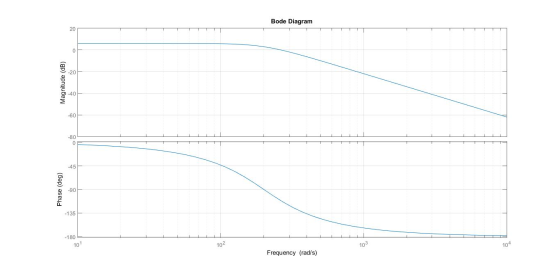
The Transfer Function is:
H(s) = 2x40000/(s^2+2*0.707*200+40000)
Matlab Code:
clc;clear all;close all;
syms s; % defining system variable
K=2; %
num=40000; % Numerator Coefficients
den=sym2poly(s^2+2*0.707*200*s+40000); % Extracting the denominator
coefficients
H=tf(num,den); % Transfer Function H(s)
bode(K*H);
grid on;
Bode Plot:
Add Answer to:
40k Draw the Bode Plot of the following transfer function: H(s) = 2 52 + 2...
5. Draw the magnitude characteristic of the Bode plot of the following transfer function: H(s)10(10s +11...
 5. Draw the magnitude characteristic of the Bode plot of the following transfer function: H(s)10(10s +11 (S + 200)2 Identify the poles and zeros Sketch the magnitude plot. The y-axis should be in dB. The x-axis should logarithmic, but labeled in rad/sec e) f) g) Use MATLAB to draw the complete Bode plot and check your answer. h) If the input current is VIN(t)-10 cos(t+35"),what is the output voltage. Use your MATLAB Bode plot to answer this.
3. Draw the Bode plot (magnitude and phase) for the transfer function H(s) of a CT...
 3. Draw the Bode plot (magnitude and phase) for the transfer function H(s) of a CT LTI given by H(s) 4000 only the asymptotic plot of the terms that make up the transfer function but also show the composite plot that adds all the terms that make up the transfer function. S+2000s+10 where the ROC includes the ja axis. Show
4. Draw the magnitude characteristic of the Bode plot of the following transfer function: 10s H...
 4. Draw the magnitude characteristic of the Bode plot of the following transfer function: 10s H (s) =-= (s+1)(s+102 L7n Identify the poles and zeros Sketch the magnitude plot. The y-axis should be in dB. The x-axis should logarithmic, but labeled in rad/sec Use MATLAB to draw the complete Bode plot and check your answer. If the input current is un(t) = 2 cos(20t + 5°), what is the output voltage. Use your MATLAB Bode plot to answer this a)...
please show full working. Q2. Draw the Bode plot (both magnitude and angle) for the following transfer function 200 Gω...
 please show full working.
Q2. Draw the Bode plot (both magnitude and angle) for the following transfer function 200 Gω + 1) H(w) 0ω + 40) Gω + 200) All slopes and breakpoints should be shown clearly on the plots
Q2. Draw the Bode plot (both magnitude and angle) for the following transfer function 200 Gω + 1) H(w) 0ω + 40) Gω + 200) All slopes and breakpoints should be shown clearly on the plots
please show full working.
Q2. Draw the Bode plot (both magnitude and angle) for the following transfer function 200 Gω + 1) H(w) 0ω + 40) Gω + 200) All slopes and breakpoints should be shown clearly on the plots
Q2. Draw the Bode plot (both magnitude and angle) for the following transfer function 200 Gω + 1) H(w) 0ω + 40) Gω + 200) All slopes and breakpoints should be shown clearly on the plots
Draw the bode diagram for the following transfer function · Draw the Bode Diagram for the...
 Draw the bode diagram for the following transfer
function
· Draw the Bode Diagram for the following transfer function: H(s) = 100/(s + 30)
Draw the bode diagram for the following transfer
function
· Draw the Bode Diagram for the following transfer function: H(s) = 100/(s + 30)
Find the transfer function H(s) for the circuit below. Make s=jw and plot the Bode plot...
 Find the transfer function H(s) for the circuit below. Make s=jw
and plot the Bode plot (magnitude and phase response) for the
transfer function.
C = out 페
Find the transfer function H(s) for the circuit below. Make s=jw
and plot the Bode plot (magnitude and phase response) for the
transfer function.
C = out 페
Problem 1: Hand sketch the Bode plot for the transfer function G(s) = 5–10 (1) If...
 Problem 1: Hand sketch the Bode plot for the transfer function G(s) = 5–10 (1) If Y(s) = G($)U(s), where U (s) = L (u(t)), what is lim+ y(t)? Problem 2: Hand sketch the Bode plot for the transfer function GS) = 52+ 10s + 900
Find the transfer function of the given bode plot if K = 10, ωί = 15,...
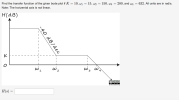 Find the transfer function of the given bode plot if K = 10, ωί = 15, Note: The horizental axis is not linear = 150, a 3 = 200, and a4 = 632. All units are in rads. H(dB) 2 3 4 H(s) =
The transfer function of the given physical system is 2500 Gp(s)-T-1000 Part 3 1. Frequency response (a) Draw the bode...
 The transfer function of the given physical system is 2500 Gp(s)-T-1000 Part 3 1. Frequency response (a) Draw the bode plot of open-loop transfer function when K (b) Use bode plot of open-loop transfer function to determine the type of system (do not use transfer function) (c) For what input the system will have constant steady-state error (d) for the unit input in item (c) calculate the constant steady-state error.(Use bode plot to calculate the error.) (e) Design a lead...
i) Draw the Bode plots (hand sketch, magnitude and phase!) for the following transfer function. Plot...
 i) Draw the Bode plots (hand sketch, magnitude and phase!) for the following transfer function. Plot over the range 0.1 to 1000 rad/s HS 10,000 (s) = s* + 20s 10,000 ii) what are the Q and Bw for this circuit? iii) Design and draw a circuit (including values) that would yield this transfer function. It should use a 100mH inductor , , Qano
 5. Draw the magnitude characteristic of the Bode plot of the following transfer function: H(s)10(10s +11 (S + 200)2 Identify the poles and zeros Sketch the magnitude plot. The y-axis should be in dB. The x-axis should logarithmic, but labeled in rad/sec e) f) g) Use MATLAB to draw the complete Bode plot and check your answer. h) If the input current is VIN(t)-10 cos(t+35"),what is the output voltage. Use your MATLAB Bode plot to answer this.
 3. Draw the Bode plot (magnitude and phase) for the transfer function H(s) of a CT LTI given by H(s) 4000 only the asymptotic plot of the terms that make up the transfer function but also show the composite plot that adds all the terms that make up the transfer function. S+2000s+10 where the ROC includes the ja axis. Show
 4. Draw the magnitude characteristic of the Bode plot of the following transfer function: 10s H (s) =-= (s+1)(s+102 L7n Identify the poles and zeros Sketch the magnitude plot. The y-axis should be in dB. The x-axis should logarithmic, but labeled in rad/sec Use MATLAB to draw the complete Bode plot and check your answer. If the input current is un(t) = 2 cos(20t + 5°), what is the output voltage. Use your MATLAB Bode plot to answer this a)...
 please show full working.
Q2. Draw the Bode plot (both magnitude and angle) for the following transfer function 200 Gω + 1) H(w) 0ω + 40) Gω + 200) All slopes and breakpoints should be shown clearly on the plots
Q2. Draw the Bode plot (both magnitude and angle) for the following transfer function 200 Gω + 1) H(w) 0ω + 40) Gω + 200) All slopes and breakpoints should be shown clearly on the plots
please show full working.
Q2. Draw the Bode plot (both magnitude and angle) for the following transfer function 200 Gω + 1) H(w) 0ω + 40) Gω + 200) All slopes and breakpoints should be shown clearly on the plots
Q2. Draw the Bode plot (both magnitude and angle) for the following transfer function 200 Gω + 1) H(w) 0ω + 40) Gω + 200) All slopes and breakpoints should be shown clearly on the plots
 Draw the bode diagram for the following transfer
function
· Draw the Bode Diagram for the following transfer function: H(s) = 100/(s + 30)
Draw the bode diagram for the following transfer
function
· Draw the Bode Diagram for the following transfer function: H(s) = 100/(s + 30)
 Find the transfer function H(s) for the circuit below. Make s=jw
and plot the Bode plot (magnitude and phase response) for the
transfer function.
C = out 페
Find the transfer function H(s) for the circuit below. Make s=jw
and plot the Bode plot (magnitude and phase response) for the
transfer function.
C = out 페
 Problem 1: Hand sketch the Bode plot for the transfer function G(s) = 5–10 (1) If Y(s) = G($)U(s), where U (s) = L (u(t)), what is lim+ y(t)? Problem 2: Hand sketch the Bode plot for the transfer function GS) = 52+ 10s + 900
 Find the transfer function of the given bode plot if K = 10, ωί = 15, Note: The horizental axis is not linear = 150, a 3 = 200, and a4 = 632. All units are in rads. H(dB) 2 3 4 H(s) =
 The transfer function of the given physical system is 2500 Gp(s)-T-1000 Part 3 1. Frequency response (a) Draw the bode plot of open-loop transfer function when K (b) Use bode plot of open-loop transfer function to determine the type of system (do not use transfer function) (c) For what input the system will have constant steady-state error (d) for the unit input in item (c) calculate the constant steady-state error.(Use bode plot to calculate the error.) (e) Design a lead...
 i) Draw the Bode plots (hand sketch, magnitude and phase!) for the following transfer function. Plot over the range 0.1 to 1000 rad/s HS 10,000 (s) = s* + 20s 10,000 ii) what are the Q and Bw for this circuit? iii) Design and draw a circuit (including values) that would yield this transfer function. It should use a 100mH inductor , , Qano
Most questions answered within 3 hours.
-
Where is the error in this code sequence?
String s1 = "Hello";
String s2 = "ello";...
asked 10 months ago -
Financial data for Joel de Paris, Inc., for last year
follow:
Joel de Paris, Inc.
Balance...
asked 10 months ago -
Consider this reaction:
Al2(SO4)3 (aq)+ BaCl3
(aq) Al2Cl6 (aq)- +
3BaSO4(s) . What is the...
asked 10 months ago -
Suppose that Savneet is considering increasing her
recent random sample from 20 car rentals to 40...
asked 10 months ago -
Trucks arrive at an unloading terminal at an average rate of 120
per hour.
Trucks arrive...
asked 10 months ago -
Why are methanol and ethanol completely soluble in water while
octanol is not very little soluble....
asked 10 months ago -
A facilities manager at a university reads in a research report
that the mean amount of...
asked 10 months ago -
When the CuSO4 is rehydrated by adding water to the anhydrous
compound, is this an endothermic...
asked 10 months ago -
A ray of sunlight is passing from diamond into crown glass; the
angle of incidence is...
asked 10 months ago -
A block of mass 0.249 kg is placed on top of a light, vertical
spring of...
asked 10 months ago -
how do the kidneys compensate in the presences of acidosis
a) trigger hyperventilate
b) reserve acid...
asked 10 months ago -
Question 501 pts
The rental rate of capital to the firm increases. Which of the
following...
asked 10 months ago