
Homework Answers
Add Answer to:
14-2. The copper shaft is subjected to the axial loads shown. Determine the displacement of end...
The copper shaft is subjected to the axial loads shown in (Figure 1). Figure < 1...
 The copper shaft is subjected to the axial loads shown in (Figure 1). Figure < 1 of 1 Part A Determine the displacement of end A with respect to end D if the diameters of each segment are d AB = 19 mm, dec = 27 mm, dcp = 14 mm Take Ecu = 126 GPa. Express your answer to three significant figures and include the appropriate units. Enter negative value in the case of contraction and positive value in...
Question # 3 A shaft is subjected to the shown axial loads. The Modulus of Elasticity...
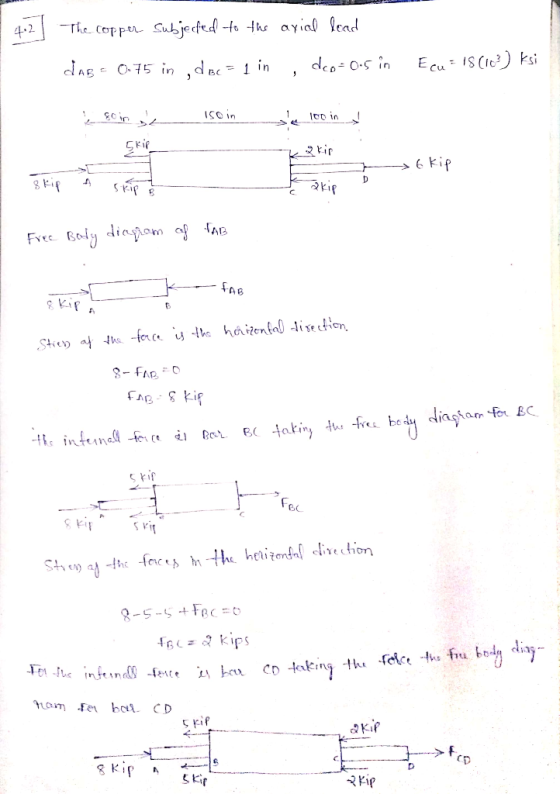
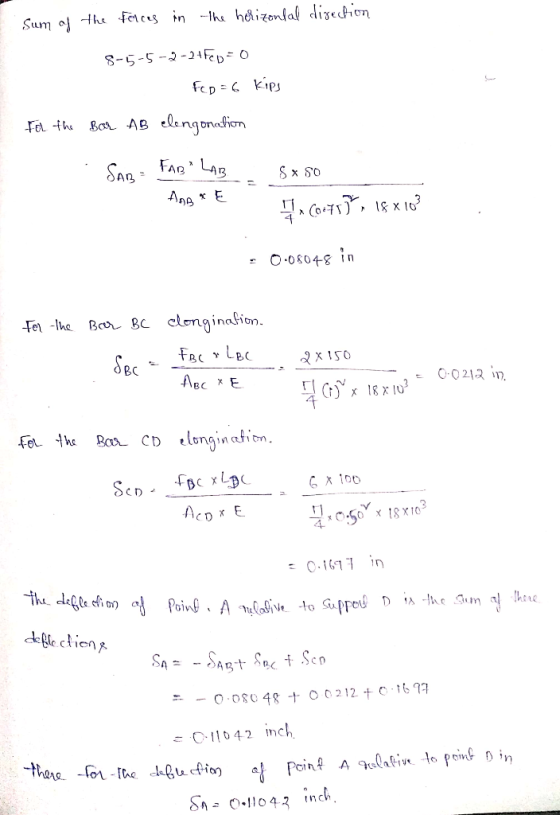
 Question # 3 A shaft is subjected to the shown axial loads. The Modulus of Elasticity is 18 x 10 psi. The diameters of rod sections are: das 0.75in,. dac-1 in., and de- 0.5 in. Determine the displacement of end A with respect to end D 80in.. ㅡ 150 in.. 100in. 5 kip 2 kip 6 kip A 5 kipB С 2kip l,
Part A Determine the displacement of end A with respect to and D if the diameters...
 Part A Determine the displacement of end A with respect to and D if the diameters of each segment are dam = 19 mm, dec = 26 mm, dcp = 14 mm. Take Ec= 126 GPa. the case contraction and positive Express your answer to three significant figures and include the appropriate units. Enter negative value value in the case of elongation. ? Value Units 225 The copper shaft is subjected to the axial loads shown in (Figure 1). Figure...
Problem 1 The composite shaft, consisting of aluminum, copper, and steel sections, is subjected to the loading shown. Determine the displacement of end A with respect to end D and the normal stress i...
 Problem 1 The composite shaft, consisting of aluminum, copper, and steel sections, is subjected to the loading shown. Determine the displacement of end A with respect to end D and the normal stress in each section. The cross- sectional area and modulus of elasticity for each section are shown in the figure. Neglect the size of the collars at B and C. Aluminum Copper 18(00)ksi E-29(10') ksi Steel -1010') ksi AB-0,09 in AcD 0.06 in Авс 0.1 2 i 2...
Determine the displacement of end A with respect to end D if the diameters of each...
 Determine the displacement of end A with respect to end D if the
diameters of each segment are dAB = 0.80 in ., dBC = 1.1 in ., and
dCD = 0.55 in . Take Ecu= 18x10^3ksi.
150 in. -80 in... 5 kip -100 in. 2 kip 8 kip 6 kip А D 5 kip B C 2 kip
Determine the displacement of end A with respect to end D if the
diameters of each segment are dAB = 0.80 in ., dBC = 1.1 in ., and
dCD = 0.55 in . Take Ecu= 18x10^3ksi.
150 in. -80 in... 5 kip -100 in. 2 kip 8 kip 6 kip А D 5 kip B C 2 kip
The composite shaft, consisting of aluminum, copper, and steel sections, is subjected to the loading shown....
 The composite shaft, consisting of aluminum, copper, and steel sections, is subjected to the loading shown. Determine the displacement of end A with respect to end D and the normal stress in each section. The cross-sectional Aluminum Соpper Steel E=10(10') ksi AAB 0.09 in2 Eg=18(10') ksi ARc 0.12 in2 E-29(10) ksi ACD 0.06 in 1.75 kip 3.50 kip 1.50 kip 2.00 kip area and modulus of elasticity for each section are shown in the figure. Neglect the size of the...
The composite shaft, consisting of aluminum, copper, and steel sections, is subjected to the loading shown. The cross-se...
 The composite shaft, consisting of aluminum, copper, and steel
sections, is subjected to the loading shown. The cross-sectional
areas of sections AB, BC , and CD are
AAB = 0.08 in2 , ABC = 0.15
in2 , and ACD = 0.05 in2 ,
respectively. The modulus of elasticity for each section are shown
in the figure. Neglect the size of the collars at B and C.
(Figure 1)
Part A
Determine the normal stress in section AB.
Express your answer...
The composite shaft, consisting of aluminum, copper, and steel
sections, is subjected to the loading shown. The cross-sectional
areas of sections AB, BC , and CD are
AAB = 0.08 in2 , ABC = 0.15
in2 , and ACD = 0.05 in2 ,
respectively. The modulus of elasticity for each section are shown
in the figure. Neglect the size of the collars at B and C.
(Figure 1)
Part A
Determine the normal stress in section AB.
Express your answer...
The composite shaft, consisting of aluminum, copper, and steel sections, is subjected to the loading shown....
 The composite shaft, consisting of aluminum, copper, and steel sections, is subjected to the loading shown. The cross-sectional areas of sections AB, BC ,and CD are AAB 0.10 in2 , ABC 0.11 in2 , and AcD =0.07 in2 , respectively. The modulus of elasticity for each section are shown in the figure. Neglect the size of the collars at B and C Part A Determine the displacement of B with respect to C of the composite shaft. Express your answer...
The composite shaft, consisting of aluminum, copper, and steel sections, is subjected to the loading shown....
 The composite shaft, consisting of aluminum, copper, and steel sections, is subjected to the loading shown. The cross-sectional areas of sections AB, BC ,and CD are AAB 0.10 in2 , ABC 0.11 in2 , and AcD =0.07 in2 , respectively. The modulus of elasticity for each section are shown in the figure. Neglect the size of the collars at B and C Part A Determine the displacement of B with respect to C of the composite shaft. Express your answer...
Q4. The composite shaft, consisting of aluminum, copper, and steel sections, is subjected to the loading...
 Q4. The composite shaft, consisting of aluminum, copper, and steel sections, is subjected to the loading shown in the figure below. (Hint: tension is positive, compression is negative) (20 pts) Aluminum Copper E = 10(10) ksi Wec. = 18(10) ksi A =0.09 in? Ac 0.12 in Steel E, = 29(10-) ksi Acp = 0.06 in- 4.50 kip -1.75 kip 3.00 kip 2.50 kip B4.50 kip -12 in.- 1.75 kip -16 in. 18 in a. Determine the internal axial load distributions...
 The copper shaft is subjected to the axial loads shown in (Figure 1). Figure < 1 of 1 Part A Determine the displacement of end A with respect to end D if the diameters of each segment are d AB = 19 mm, dec = 27 mm, dcp = 14 mm Take Ecu = 126 GPa. Express your answer to three significant figures and include the appropriate units. Enter negative value in the case of contraction and positive value in...
 Question # 3 A shaft is subjected to the shown axial loads. The Modulus of Elasticity is 18 x 10 psi. The diameters of rod sections are: das 0.75in,. dac-1 in., and de- 0.5 in. Determine the displacement of end A with respect to end D 80in.. ㅡ 150 in.. 100in. 5 kip 2 kip 6 kip A 5 kipB С 2kip l,
 Part A Determine the displacement of end A with respect to and D if the diameters of each segment are dam = 19 mm, dec = 26 mm, dcp = 14 mm. Take Ec= 126 GPa. the case contraction and positive Express your answer to three significant figures and include the appropriate units. Enter negative value value in the case of elongation. ? Value Units 225 The copper shaft is subjected to the axial loads shown in (Figure 1). Figure...
 Problem 1 The composite shaft, consisting of aluminum, copper, and steel sections, is subjected to the loading shown. Determine the displacement of end A with respect to end D and the normal stress in each section. The cross- sectional area and modulus of elasticity for each section are shown in the figure. Neglect the size of the collars at B and C. Aluminum Copper 18(00)ksi E-29(10') ksi Steel -1010') ksi AB-0,09 in AcD 0.06 in Авс 0.1 2 i 2...
 Determine the displacement of end A with respect to end D if the
diameters of each segment are dAB = 0.80 in ., dBC = 1.1 in ., and
dCD = 0.55 in . Take Ecu= 18x10^3ksi.
150 in. -80 in... 5 kip -100 in. 2 kip 8 kip 6 kip А D 5 kip B C 2 kip
Determine the displacement of end A with respect to end D if the
diameters of each segment are dAB = 0.80 in ., dBC = 1.1 in ., and
dCD = 0.55 in . Take Ecu= 18x10^3ksi.
150 in. -80 in... 5 kip -100 in. 2 kip 8 kip 6 kip А D 5 kip B C 2 kip
 The composite shaft, consisting of aluminum, copper, and steel sections, is subjected to the loading shown. Determine the displacement of end A with respect to end D and the normal stress in each section. The cross-sectional Aluminum Соpper Steel E=10(10') ksi AAB 0.09 in2 Eg=18(10') ksi ARc 0.12 in2 E-29(10) ksi ACD 0.06 in 1.75 kip 3.50 kip 1.50 kip 2.00 kip area and modulus of elasticity for each section are shown in the figure. Neglect the size of the...
 The composite shaft, consisting of aluminum, copper, and steel
sections, is subjected to the loading shown. The cross-sectional
areas of sections AB, BC , and CD are
AAB = 0.08 in2 , ABC = 0.15
in2 , and ACD = 0.05 in2 ,
respectively. The modulus of elasticity for each section are shown
in the figure. Neglect the size of the collars at B and C.
(Figure 1)
Part A
Determine the normal stress in section AB.
Express your answer...
The composite shaft, consisting of aluminum, copper, and steel
sections, is subjected to the loading shown. The cross-sectional
areas of sections AB, BC , and CD are
AAB = 0.08 in2 , ABC = 0.15
in2 , and ACD = 0.05 in2 ,
respectively. The modulus of elasticity for each section are shown
in the figure. Neglect the size of the collars at B and C.
(Figure 1)
Part A
Determine the normal stress in section AB.
Express your answer...
 The composite shaft, consisting of aluminum, copper, and steel sections, is subjected to the loading shown. The cross-sectional areas of sections AB, BC ,and CD are AAB 0.10 in2 , ABC 0.11 in2 , and AcD =0.07 in2 , respectively. The modulus of elasticity for each section are shown in the figure. Neglect the size of the collars at B and C Part A Determine the displacement of B with respect to C of the composite shaft. Express your answer...
 The composite shaft, consisting of aluminum, copper, and steel sections, is subjected to the loading shown. The cross-sectional areas of sections AB, BC ,and CD are AAB 0.10 in2 , ABC 0.11 in2 , and AcD =0.07 in2 , respectively. The modulus of elasticity for each section are shown in the figure. Neglect the size of the collars at B and C Part A Determine the displacement of B with respect to C of the composite shaft. Express your answer...
 Q4. The composite shaft, consisting of aluminum, copper, and steel sections, is subjected to the loading shown in the figure below. (Hint: tension is positive, compression is negative) (20 pts) Aluminum Copper E = 10(10) ksi Wec. = 18(10) ksi A =0.09 in? Ac 0.12 in Steel E, = 29(10-) ksi Acp = 0.06 in- 4.50 kip -1.75 kip 3.00 kip 2.50 kip B4.50 kip -12 in.- 1.75 kip -16 in. 18 in a. Determine the internal axial load distributions...
Most questions answered within 3 hours.
-
Where is the error in this code sequence?
String s1 = "Hello";
String s2 = "ello";...
asked 11 months ago -
Financial data for Joel de Paris, Inc., for last year
follow:
Joel de Paris, Inc.
Balance...
asked 11 months ago -
Consider this reaction:
Al2(SO4)3 (aq)+ BaCl3
(aq) Al2Cl6 (aq)- +
3BaSO4(s) . What is the...
asked 11 months ago -
Suppose that Savneet is considering increasing her
recent random sample from 20 car rentals to 40...
asked 11 months ago -
Trucks arrive at an unloading terminal at an average rate of 120
per hour.
Trucks arrive...
asked 11 months ago -
Why are methanol and ethanol completely soluble in water while
octanol is not very little soluble....
asked 11 months ago -
A facilities manager at a university reads in a research report
that the mean amount of...
asked 11 months ago -
When the CuSO4 is rehydrated by adding water to the anhydrous
compound, is this an endothermic...
asked 11 months ago -
A ray of sunlight is passing from diamond into crown glass; the
angle of incidence is...
asked 11 months ago -
A block of mass 0.249 kg is placed on top of a light, vertical
spring of...
asked 11 months ago -
how do the kidneys compensate in the presences of acidosis
a) trigger hyperventilate
b) reserve acid...
asked 11 months ago -
Question 501 pts
The rental rate of capital to the firm increases. Which of the
following...
asked 11 months ago