What frequencies will a 1.65 m long tube produce in the audible range (20 Hz -...
What frequencies will a 1.65 m long tube produce in the audible range (20 Hz - 20,000 Hz) at 17.0°C for the following cases?
(a) the tube is closed at one end
lowest frequency
Hz
second lowest frequency
Hz
highest frequency (rounded to the nearest Hz)
Hz
(b) the tube is open at both ends
lowest frequency
Hz
second lowest frequency
Hz
highest frequency (rounded to the nearest Hz)
Hz
Homework Answers
1) for tube closed at one end

the first ocsillation will occur when lambda = 4L
the second oscilation will occur when lambda = (4/3)*L
similarly ,the 5th and 7 th harmonics will ocuur at (4/5)*L and (4/7)*L respectively
now, given length of tube =1.65 m
the speed of sound at given temperatutre = 341.77 m/s
a) now,
lowest frequency will be at first harmonics,
so,lamda=4L
=4*1.65
=6.6m
b)second lowest frequency will be at lambda= (4/3) *L
= 2.2 m
so frequency = speed/lambda=341.77/2.2 = 155.35 Hz
c) the highest frequency would be near to 20000 Hz
2) in this case
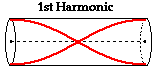
for first harmonics, lambda=2L
2nd harmonics will be lambda=(2/2)*L
3nd harmonics will be lambda=(2/3)*L
and so in
a) the lowest frequency will be in first hrmonics
Lambda= 2L = 3.3 m
so velocity = speed /lambda=341.77/3.3 =103.56 HZ
b) second lowest frequency =
lambda =L
so,
frequency = speed / lambda= 341.77/1.65
=207.133 Hz
c) highest frequency will be near higher audible range
Add Answer to:
What frequencies will a 1.65 m long tube produce in the audible
range (20 Hz -...
What frequencies (in Hz) will a 1.90 m long tube produce in the audible range (20...
 What frequencies (in Hz) will a 1.90 m long tube produce in the audible range (20 Hz - 20,000 Hz) at 18.0°C for the following cases? (a) the tube is closed at one end Hz Hz Hz lowest frequency second lowest frequency highest frequency (rounded to the nearest Hz) (b) the tube is open at both ends Hz Hz Hz lowest frequency second lowest frequency highest frequency (rounded to the nearest Hz)
What frequencies (in Hz) will a 1.75 m long tube produce in the audible range (20...
What frequencies (in Hz) will a 1.75 m long tube produce in the audible range (20 Hz - 20,000 Hz) at 25.0°C for the following cases? a) the tube is closed at one end lowest frequency second lowest frequency highest frequency b) the tube is open at both ends lowest frequency Hz second lowest frequency Hz highest frequency
You have two air columns that are each 2.130 m long. One column is open at...
You have two air columns that are each 2.130 m long. One column is open at both ends and the other is closed at one end. You wish to determine the frequencies you can produce in the audible range (20 Hz–20,000 Hz) on a day when the temperature of the air is at 22.00°C. (Give your answers to at least four significant figures. Assume that the speed of sound at 0° C is exactly 331 m/s.) (a) in the column that...
A 2.39-m long organ pipe acts as a closed-end resonator that produces several different harmonic frequencies...
A 2.39-m long organ pipe acts as a closed-end resonator that produces several different harmonic frequencies in the audible range from 20 Hz to 20,000 Hz. Assuming the speed of sound is 343 m/s, determine the 5th highest frequency that the pipe can produce.
An engineer measures the frequencies of the audible standing waves in an organ pipe. He finds...
An engineer measures the frequencies of the audible standing waves in an organ pipe. He finds two adjacent tones at 420 and 540 Hz. (a) On the basis of this discovery, the engineer computes the pipe's fundamental frequency. What is its value (in Hz)? Hz (b) Is the pipe open at both ends or only one? open at both ends open at only one end (c) The air within the pipe has a temperature of 20°C and is at atmospheric...
SOLUTION (A) Find the frequencies if the pipe is open at both ends. _V 343 m/s...
 SOLUTION (A) Find the frequencies if the pipe is open at both ends. _V 343 m/s Substitute into whole harmonics equation, with n = 1. 11-222(2.46 m) = 69.7 Hz Multiply to find the second and third harmonics. 12 - 27 - 139 Hz 13 = 3f7 - 209 Hz (B) How many harmonics lle between 20 Hz and 20000 Hz for this pipe? 343 m/s Set the frequency in the harmonics equation equal to 2.00 x 10⁴ Hz and...
One of the harmonic frequencies of tube A with two open ends is 710 Hz. The...
One of the harmonic frequencies of tube A with two open ends is 710 Hz. The next-highest harmonic frequency is 781 Hz. (a) What harmonic frequency is next highest after the harmonic frequency 355 Hz? (b) What is the number of this next-highest harmonic? One of the harmonic frequencies of tube B with only one open end is 4847 Hz. The next-highest harmonic frequency is 5109 Hz. (c) What harmonic frequency is next highest after the harmonic frequency 2489 Hz?...
If the fundamental frequency of a tube is 840 Hz, and the speed of sound is...
 If the fundamental frequency of a tube is 840 Hz, and the speed
of sound is 343 m/s, determine the length of the tube (in m) for
each of the following cases.
If the fundamental frequency of a tube is 840 Hz, and the speed of sound is 343 m/s, determine the length of the tube (in m) for each of the following cases. (a) the tube is closed at one end m (b) the tube is open at both...
If the fundamental frequency of a tube is 840 Hz, and the speed
of sound is 343 m/s, determine the length of the tube (in m) for
each of the following cases.
If the fundamental frequency of a tube is 840 Hz, and the speed of sound is 343 m/s, determine the length of the tube (in m) for each of the following cases. (a) the tube is closed at one end m (b) the tube is open at both...
Problem 3: A certain pipe has resonant frequencies of 234 Hz, 390 Hz, and 546 Hz,...
 Problem 3: A certain pipe has resonant frequencies of 234 Hz, 390 Hz, and 546 Hz, with no other resonant frequencies between these values. (Hint: The lower frequency is not necessarily the pipe fundamental frequency) (a) Show that the difference of frequency between two adjacent harmonics has the same expression for a pipe open at both ends as for a pipe closed at one end (b) How long is this pipe? (c) Is this a pipe open at both ends...
If the fundamental frequency of tube is 671 HZ, and the speed of sound is 343...
 If the fundamental frequency of tube is 671 HZ, and the speed of sound is 343 mys, determine the length of the tube (in m) for each of the following cases. (a) the tube is closed at one end (b) the tube is open at both ends Need Help? Read
 What frequencies (in Hz) will a 1.90 m long tube produce in the audible range (20 Hz - 20,000 Hz) at 18.0°C for the following cases? (a) the tube is closed at one end Hz Hz Hz lowest frequency second lowest frequency highest frequency (rounded to the nearest Hz) (b) the tube is open at both ends Hz Hz Hz lowest frequency second lowest frequency highest frequency (rounded to the nearest Hz)
 SOLUTION (A) Find the frequencies if the pipe is open at both ends. _V 343 m/s Substitute into whole harmonics equation, with n = 1. 11-222(2.46 m) = 69.7 Hz Multiply to find the second and third harmonics. 12 - 27 - 139 Hz 13 = 3f7 - 209 Hz (B) How many harmonics lle between 20 Hz and 20000 Hz for this pipe? 343 m/s Set the frequency in the harmonics equation equal to 2.00 x 10⁴ Hz and...
 If the fundamental frequency of a tube is 840 Hz, and the speed
of sound is 343 m/s, determine the length of the tube (in m) for
each of the following cases.
If the fundamental frequency of a tube is 840 Hz, and the speed of sound is 343 m/s, determine the length of the tube (in m) for each of the following cases. (a) the tube is closed at one end m (b) the tube is open at both...
If the fundamental frequency of a tube is 840 Hz, and the speed
of sound is 343 m/s, determine the length of the tube (in m) for
each of the following cases.
If the fundamental frequency of a tube is 840 Hz, and the speed of sound is 343 m/s, determine the length of the tube (in m) for each of the following cases. (a) the tube is closed at one end m (b) the tube is open at both...
 Problem 3: A certain pipe has resonant frequencies of 234 Hz, 390 Hz, and 546 Hz, with no other resonant frequencies between these values. (Hint: The lower frequency is not necessarily the pipe fundamental frequency) (a) Show that the difference of frequency between two adjacent harmonics has the same expression for a pipe open at both ends as for a pipe closed at one end (b) How long is this pipe? (c) Is this a pipe open at both ends...
 If the fundamental frequency of tube is 671 HZ, and the speed of sound is 343 mys, determine the length of the tube (in m) for each of the following cases. (a) the tube is closed at one end (b) the tube is open at both ends Need Help? Read
Most questions answered within 3 hours.
-
Where is the error in this code sequence?
String s1 = "Hello";
String s2 = "ello";...
asked 11 months ago -
Financial data for Joel de Paris, Inc., for last year
follow:
Joel de Paris, Inc.
Balance...
asked 11 months ago -
Consider this reaction:
Al2(SO4)3 (aq)+ BaCl3
(aq) Al2Cl6 (aq)- +
3BaSO4(s) . What is the...
asked 11 months ago -
Suppose that Savneet is considering increasing her
recent random sample from 20 car rentals to 40...
asked 11 months ago -
Trucks arrive at an unloading terminal at an average rate of 120
per hour.
Trucks arrive...
asked 11 months ago -
Why are methanol and ethanol completely soluble in water while
octanol is not very little soluble....
asked 11 months ago -
A facilities manager at a university reads in a research report
that the mean amount of...
asked 11 months ago -
When the CuSO4 is rehydrated by adding water to the anhydrous
compound, is this an endothermic...
asked 11 months ago -
A ray of sunlight is passing from diamond into crown glass; the
angle of incidence is...
asked 11 months ago -
A block of mass 0.249 kg is placed on top of a light, vertical
spring of...
asked 11 months ago -
how do the kidneys compensate in the presences of acidosis
a) trigger hyperventilate
b) reserve acid...
asked 11 months ago -
Question 501 pts
The rental rate of capital to the firm increases. Which of the
following...
asked 11 months ago