![1] You fire a 50 gram arrow that moves at an unknown speed. It hits and embeds in a 450 gram block that slides on an air track. At the end, the block runs into and compresses a 4000 N/m spring 0.2m. (Friction ignored) (i) Draw a labelled sketch before the spring gets compressed. Circle the system you choose (ii) Draw a labelled sketch after the spring gets compressed. Circle the system you choose (iii) Use conservation of linear momentum before the spring gets compressed to relate initial velocity of the arrow and common velocity of arrow-block (iv) Draw energy bar chart when the arrow-block runs into and compresses the spring (v) Use work-energy principle to find the common velocity of arrow-block. (vi) Find the initial velocity of the arrow with which it hits the block.](http://img.homeworklib.com/questions/0c053200-5f6e-11eb-80d2-639adf3481be.png?x-oss-process=image/resize,w_560)
Homework Answers

Add Answer to:
1] You fire a 50 gram arrow that moves at an unknown speed. It hits and...
PROBLEM 2 (5 points). Momentum and Mechanical Energy conservation A rifle bullet with mass 150 g...
 PROBLEM 2 (5 points). Momentum and Mechanical Energy conservation A rifle bullet with mass 150 g strikes and embeds itself in a block with mass 1000 g that rests on a frictionless, horizontal surface and is attached to a coil spring. The initial velocity of the bullet was 700 m/s. The impact compresses the springy a distance x. The spring constant is 550 N/m. The spring is ideal. a) Find the magnitude of the block's velocity (with the bullet stuck...
answer is B (16/1) need work/explanation 13. A 40-gram (40g) steel pellet moving at 40 hits...
 answer is B (16/1) need work/explanation
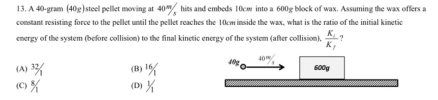
13. A 40-gram (40g) steel pellet moving at 40 hits and embeds 10cm into a 600g block of war. Assuming the wax offers a constant resisting force to the pellet until the pellet reaches the 10cm inside the wax, what is the ratio of the initial kinetic energy of the system (before collision) to the final kinetic energy of the system (after collision), 40m 40g (B) 1% 600g (A) 32 (c) % (DX
answer is B (16/1) need work/explanation
13. A 40-gram (40g) steel pellet moving at 40 hits and embeds 10cm into a 600g block of war. Assuming the wax offers a constant resisting force to the pellet until the pellet reaches the 10cm inside the wax, what is the ratio of the initial kinetic energy of the system (before collision) to the final kinetic energy of the system (after collision), 40m 40g (B) 1% 600g (A) 32 (c) % (DX
1. A 1200kg car traveling at 11.0 m/s runs into a 920kg car traveling in the...
1. A 1200kg car traveling at 11.0 m/s runs into a 920kg car traveling in the same direction at 5.00 m/s. After the collision the 1200kg car has slowed to 8.00 m/s. a) what is the final velocity of the 920kg car? 2. A bullet mass of m=0.0010kg embeds itself in a wooden block with mass M=0.999kg, which then compresses a spring (k=230 N/m) by a distance x=0.050m before coming to rest. The coefficient of kinetic friction between the block...
2m 20 1m You have built an enormous spring-loaded Hot Wheels track that will propel a 50 gram toy...
 2m 20 1m You have built an enormous spring-loaded Hot Wheels track that will propel a 50 gram toy car through a loop and launch it across the room. The spring constant is 800 N/m, the spring launcher has an initial spring displacement of 5 cm. What is the maximum radius R of the loop such that the car moves around the loop without falling off at the top, so that the toy car can make to the end point...
OAL Combine the concepts of conservation of energy and conservation of momentum in inelastic collisions. In...
OAL Combine the concepts of conservation of energy and conservation of momentum in inelastic collisions. In figure a, a bullet and a wooden block are shown in two configurations. In the first configuration, the block, labeled m2, hangs vertically from a ceiling. A bullet, labeled m1, approaches the block horizontally from the left. A rightward arrow points from the bullet and is labeled vector v1i. A rightward arrow, shorter than the first, points from the block and is labeled vector...
1) A block of mass m = 0.52 kg is attached to a spring with force...
 1) A block of mass m = 0.52 kg is attached to a spring with
force constant 119 N/m is free to move on a frictionless,
horizontal surface as in the figure below. The block is released
from rest after the spring is stretched a distance A = 0.13 m.
(Indicate the direction with the sign of your answer. Assume that
the positive direction is to the right.)
(a) At that instant, find the force on the block. N
(b)...
1) A block of mass m = 0.52 kg is attached to a spring with
force constant 119 N/m is free to move on a frictionless,
horizontal surface as in the figure below. The block is released
from rest after the spring is stretched a distance A = 0.13 m.
(Indicate the direction with the sign of your answer. Assume that
the positive direction is to the right.)
(a) At that instant, find the force on the block. N
(b)...
MEC311 Term Test, 2019w 2. 145%) This problem is about using work-energy and impulse-momentum principles. You must answ...
 MEC311 Term Test, 2019w 2. 145%) This problem is about using work-energy and impulse-momentum principles. You must answer according to the notations and coordinate systems set up for you Answers based on other coordinate sysfem or notations will not be marked. Consider a sticky ball of weight Ws 0.1 [lb] located on an incline of angle 0-30-deg. The ball is initially placed on top of a compressed linear spring of spring constant k 10 [lb/ft]; see figure. It is released...
Your design requires that the magnitude of the work done by this device to be equal...
 Your design requires that the magnitude of the work done by this
device to be equal to ??, where ?? ? ?, from the initial contact to
the maximum compression of the bumper spring. What is the magnitude
of ?? Important Hint: Δ?, the maximum compression, will change with
the energy dissipation device.
2, Figure 1: Figure 2: Consider the model above for an elastic collision used to design bumpers on cars. Car 1 with the bumper (a spring) has...
Your design requires that the magnitude of the work done by this
device to be equal to ??, where ?? ? ?, from the initial contact to
the maximum compression of the bumper spring. What is the magnitude
of ?? Important Hint: Δ?, the maximum compression, will change with
the energy dissipation device.
2, Figure 1: Figure 2: Consider the model above for an elastic collision used to design bumpers on cars. Car 1 with the bumper (a spring) has...
Please answer ALL parts in SIMPLEST FORM! NO explanations are needed, THANK YOU!!! Problem 1 (50...
 Please answer ALL parts in SIMPLEST FORM! NO explanations are
needed, THANK YOU!!!
Problem 1 (50 points) masses mA 2 kg and mg -1 kg are connected by a small pulley. Mass ma is on an inclined plane at angle θ π/4 radians, and ms is allowed to hang freely (a) Suppose the string has length potential energy of the system as a function of the height of mass ma? (b) Find the acceleration of mass ma (either which way...
Please answer ALL parts in SIMPLEST FORM! NO explanations are
needed, THANK YOU!!!
Problem 1 (50 points) masses mA 2 kg and mg -1 kg are connected by a small pulley. Mass ma is on an inclined plane at angle θ π/4 radians, and ms is allowed to hang freely (a) Suppose the string has length potential energy of the system as a function of the height of mass ma? (b) Find the acceleration of mass ma (either which way...
Please answer ALL parts in SIMPLEST FORM! NO explanations are needed, THANK YOU!!! Problem 1 (50...
 Please answer ALL parts in SIMPLEST FORM! NO explanations are
needed, THANK YOU!!!
Problem 1 (50 points) masses mA -2 kg and mg 1 kg are connected by a small pulley. Mass ma is on an inclined plane at angle 8-/4 radians, and ma is allowed to hang freely (a) Suppose the string has length potential energy of the system as a function of the height of mass mg? (b) Find the acceleration of mass ma (either which way the...
Please answer ALL parts in SIMPLEST FORM! NO explanations are
needed, THANK YOU!!!
Problem 1 (50 points) masses mA -2 kg and mg 1 kg are connected by a small pulley. Mass ma is on an inclined plane at angle 8-/4 radians, and ma is allowed to hang freely (a) Suppose the string has length potential energy of the system as a function of the height of mass mg? (b) Find the acceleration of mass ma (either which way the...
 PROBLEM 2 (5 points). Momentum and Mechanical Energy conservation A rifle bullet with mass 150 g strikes and embeds itself in a block with mass 1000 g that rests on a frictionless, horizontal surface and is attached to a coil spring. The initial velocity of the bullet was 700 m/s. The impact compresses the springy a distance x. The spring constant is 550 N/m. The spring is ideal. a) Find the magnitude of the block's velocity (with the bullet stuck...
 answer is B (16/1) need work/explanation
13. A 40-gram (40g) steel pellet moving at 40 hits and embeds 10cm into a 600g block of war. Assuming the wax offers a constant resisting force to the pellet until the pellet reaches the 10cm inside the wax, what is the ratio of the initial kinetic energy of the system (before collision) to the final kinetic energy of the system (after collision), 40m 40g (B) 1% 600g (A) 32 (c) % (DX
answer is B (16/1) need work/explanation
13. A 40-gram (40g) steel pellet moving at 40 hits and embeds 10cm into a 600g block of war. Assuming the wax offers a constant resisting force to the pellet until the pellet reaches the 10cm inside the wax, what is the ratio of the initial kinetic energy of the system (before collision) to the final kinetic energy of the system (after collision), 40m 40g (B) 1% 600g (A) 32 (c) % (DX
 2m 20 1m You have built an enormous spring-loaded Hot Wheels track that will propel a 50 gram toy car through a loop and launch it across the room. The spring constant is 800 N/m, the spring launcher has an initial spring displacement of 5 cm. What is the maximum radius R of the loop such that the car moves around the loop without falling off at the top, so that the toy car can make to the end point...
 1) A block of mass m = 0.52 kg is attached to a spring with
force constant 119 N/m is free to move on a frictionless,
horizontal surface as in the figure below. The block is released
from rest after the spring is stretched a distance A = 0.13 m.
(Indicate the direction with the sign of your answer. Assume that
the positive direction is to the right.)
(a) At that instant, find the force on the block. N
(b)...
1) A block of mass m = 0.52 kg is attached to a spring with
force constant 119 N/m is free to move on a frictionless,
horizontal surface as in the figure below. The block is released
from rest after the spring is stretched a distance A = 0.13 m.
(Indicate the direction with the sign of your answer. Assume that
the positive direction is to the right.)
(a) At that instant, find the force on the block. N
(b)...
 MEC311 Term Test, 2019w 2. 145%) This problem is about using work-energy and impulse-momentum principles. You must answer according to the notations and coordinate systems set up for you Answers based on other coordinate sysfem or notations will not be marked. Consider a sticky ball of weight Ws 0.1 [lb] located on an incline of angle 0-30-deg. The ball is initially placed on top of a compressed linear spring of spring constant k 10 [lb/ft]; see figure. It is released...
 Your design requires that the magnitude of the work done by this
device to be equal to ??, where ?? ? ?, from the initial contact to
the maximum compression of the bumper spring. What is the magnitude
of ?? Important Hint: Δ?, the maximum compression, will change with
the energy dissipation device.
2, Figure 1: Figure 2: Consider the model above for an elastic collision used to design bumpers on cars. Car 1 with the bumper (a spring) has...
Your design requires that the magnitude of the work done by this
device to be equal to ??, where ?? ? ?, from the initial contact to
the maximum compression of the bumper spring. What is the magnitude
of ?? Important Hint: Δ?, the maximum compression, will change with
the energy dissipation device.
2, Figure 1: Figure 2: Consider the model above for an elastic collision used to design bumpers on cars. Car 1 with the bumper (a spring) has...
 Please answer ALL parts in SIMPLEST FORM! NO explanations are
needed, THANK YOU!!!
Problem 1 (50 points) masses mA 2 kg and mg -1 kg are connected by a small pulley. Mass ma is on an inclined plane at angle θ π/4 radians, and ms is allowed to hang freely (a) Suppose the string has length potential energy of the system as a function of the height of mass ma? (b) Find the acceleration of mass ma (either which way...
Please answer ALL parts in SIMPLEST FORM! NO explanations are
needed, THANK YOU!!!
Problem 1 (50 points) masses mA 2 kg and mg -1 kg are connected by a small pulley. Mass ma is on an inclined plane at angle θ π/4 radians, and ms is allowed to hang freely (a) Suppose the string has length potential energy of the system as a function of the height of mass ma? (b) Find the acceleration of mass ma (either which way...
 Please answer ALL parts in SIMPLEST FORM! NO explanations are
needed, THANK YOU!!!
Problem 1 (50 points) masses mA -2 kg and mg 1 kg are connected by a small pulley. Mass ma is on an inclined plane at angle 8-/4 radians, and ma is allowed to hang freely (a) Suppose the string has length potential energy of the system as a function of the height of mass mg? (b) Find the acceleration of mass ma (either which way the...
Please answer ALL parts in SIMPLEST FORM! NO explanations are
needed, THANK YOU!!!
Problem 1 (50 points) masses mA -2 kg and mg 1 kg are connected by a small pulley. Mass ma is on an inclined plane at angle 8-/4 radians, and ma is allowed to hang freely (a) Suppose the string has length potential energy of the system as a function of the height of mass mg? (b) Find the acceleration of mass ma (either which way the...
Most questions answered within 3 hours.
-
Where is the error in this code sequence?
String s1 = "Hello";
String s2 = "ello";...
asked 10 months ago -
Financial data for Joel de Paris, Inc., for last year
follow:
Joel de Paris, Inc.
Balance...
asked 10 months ago -
Consider this reaction:
Al2(SO4)3 (aq)+ BaCl3
(aq) Al2Cl6 (aq)- +
3BaSO4(s) . What is the...
asked 10 months ago -
Suppose that Savneet is considering increasing her
recent random sample from 20 car rentals to 40...
asked 10 months ago -
Trucks arrive at an unloading terminal at an average rate of 120
per hour.
Trucks arrive...
asked 10 months ago -
Why are methanol and ethanol completely soluble in water while
octanol is not very little soluble....
asked 10 months ago -
A facilities manager at a university reads in a research report
that the mean amount of...
asked 10 months ago -
When the CuSO4 is rehydrated by adding water to the anhydrous
compound, is this an endothermic...
asked 10 months ago -
A ray of sunlight is passing from diamond into crown glass; the
angle of incidence is...
asked 10 months ago -
A block of mass 0.249 kg is placed on top of a light, vertical
spring of...
asked 10 months ago -
how do the kidneys compensate in the presences of acidosis
a) trigger hyperventilate
b) reserve acid...
asked 10 months ago -
Question 501 pts
The rental rate of capital to the firm increases. Which of the
following...
asked 10 months ago