
Homework Answers
Add Answer to:
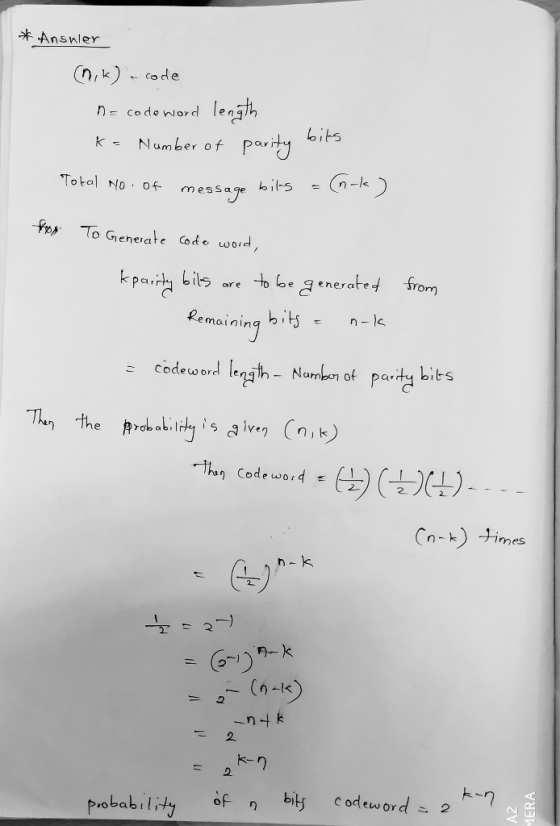
o Problem 2. Consider an (n, k)-code. Randomly choose n bits, each of which assumes bit...
Consider the following code mapping for k = 2 bits of information with n = 5....
Consider the following code mapping for k = 2 bits of information with n = 5. How many errors at maximum can this code correct? What are the generator and parith check matrices of the code? (Enough to provide one valid parity check matrix). Information bits Codeword 00 00000 01 00111 10 11100 11 11011
Clarence Clueless has settled on a code that takes 2 bits, and transmits a codeword created...
Clarence Clueless has settled on a code that takes 2 bits, and transmits a codeword created by repeating the bit pair 3 times. a) How many valid codewords are in this code? b) If a maximal likelihood decoder is used, and 1 0 1 0 0 0 is received, what is the most likely valid codeword to have been sent? c) What two bit input to the transmitter would have caused this most likely valid codeword to...
Say you have an n block of bits message. You split it to 8 bits each (assume that 8 divides n). For each of the 8 bit we...
Say you have an n block of bits message. You split it to 8 bits each (assume that 8 divides n). For each of the 8 bit we choose a permutation of the bits. How many different codes could come out of this? Explain or prove the correctness of your analysis.
Consider a binary communication channel transmitting coded words of n bits each. Assume that the probability...
Consider a binary communication channel transmitting coded words of n bits each. Assume that the probability of successful transmission of a single bit is p (and the probability of an error is q=1-p), and that the code is capable of correcting up to e (where e>= 0) errors. If we assume that the transmission of successive bits is independent, then what is the probability of successful word transmission? Hint: the word is successfully transmitted if there are e or fewer...
All that is needed is to fill in that one area that says "Student provides missing...
 All that is needed is to fill in that one area that says
"Student provides missing code to compare computed
hammingCode[] bits to the codeword[] bits
to determine the incorrect bit." in the code below.
THAT IS ALL THAT IS NEEDED PLUS SCREENSHOT OF COMPILED OUTPUT
AFTERWARDS.
Please TAKE SCREENSHOT of the compiled output
which should look similar to the sample one provided.
//------------------------------------------------------
// Problem #6
// Problem6.c
//------------------------------------------------------
#include <stdio.h>
#include <stdlib.h>
#include <stdbool.h>
#include <string.h>
#include <math.h>...
All that is needed is to fill in that one area that says
"Student provides missing code to compare computed
hammingCode[] bits to the codeword[] bits
to determine the incorrect bit." in the code below.
THAT IS ALL THAT IS NEEDED PLUS SCREENSHOT OF COMPILED OUTPUT
AFTERWARDS.
Please TAKE SCREENSHOT of the compiled output
which should look similar to the sample one provided.
//------------------------------------------------------
// Problem #6
// Problem6.c
//------------------------------------------------------
#include <stdio.h>
#include <stdlib.h>
#include <stdbool.h>
#include <string.h>
#include <math.h>...
Therom 1.8.2 n choose k = (n choose n-k) n choose k = (n-1 choose K)...
 Therom 1.8.2
n choose k = (n choose n-k)
n choose k = (n-1 choose K) + (n-1 choose K-1)
2n = summation of (n choose i )
please use the induction method
(a) (10 pts) Show that the following equality holds: n +1 + 2 Hint: If you proceed by induction, you might want to use Theorem 1.8.2. If you search for a combinatorial proof, consider the set X - (i,j, k): 0 S i,j< k< n) (b) (10...
Therom 1.8.2
n choose k = (n choose n-k)
n choose k = (n-1 choose K) + (n-1 choose K-1)
2n = summation of (n choose i )
please use the induction method
(a) (10 pts) Show that the following equality holds: n +1 + 2 Hint: If you proceed by induction, you might want to use Theorem 1.8.2. If you search for a combinatorial proof, consider the set X - (i,j, k): 0 S i,j< k< n) (b) (10...
2. Exercise 2. Consider the sequence (xn)n≥1 defined by xn = Xn k=1 cos(k) k +...
 2.
Exercise 2. Consider the sequence (xn)n≥1 defined by xn = Xn k=1
cos(k) k + n2 = cos(1) 1 + n2 + cos(2) 2 + n2 + · · · + cos(n) n +
n2 . (a) Use the triangle inequality to prove that |xn| ≤ n 1 + n2
for all n ≥ 1. (b) Use (a) and the -definition of limit to show
that limn→∞ xn = 0.
Exercise 2. Consider the sequence (In)n> defined by cos(k)...
2.
Exercise 2. Consider the sequence (xn)n≥1 defined by xn = Xn k=1
cos(k) k + n2 = cos(1) 1 + n2 + cos(2) 2 + n2 + · · · + cos(n) n +
n2 . (a) Use the triangle inequality to prove that |xn| ≤ n 1 + n2
for all n ≥ 1. (b) Use (a) and the -definition of limit to show
that limn→∞ xn = 0.
Exercise 2. Consider the sequence (In)n> defined by cos(k)...
boxes, n 2, and for each k E {1,...,n} the k-th box contains k watches. In...
 boxes, n 2, and for each k E {1,...,n} the k-th box contains k watches. In We have every box each watch is defective with probability independently of the other watches in the box. We choose a box randomly. Given that there are no defective watches in it compute the probability that this was the second box
boxes, n 2, and for each k E {1,...,n} the k-th box contains k watches. In We have every box each watch is...
boxes, n 2, and for each k E {1,...,n} the k-th box contains k watches. In We have every box each watch is defective with probability independently of the other watches in the box. We choose a box randomly. Given that there are no defective watches in it compute the probability that this was the second box
boxes, n 2, and for each k E {1,...,n} the k-th box contains k watches. In We have every box each watch is...
Problem 5 5.a Consider the following identity. For all positive integers n and k with n...
 Problem 5 5.a Consider the following identity. For all positive integers n and k with n 2k, (n choose k) + (n choose k-1) = (n+1 choose k). This can be demonstrated either algebraically or via a story proof. To prove the identity algebraically, we can write (n choose k) + (n choose k-1) = n!/[k!(n-k)!] + n!/[(k-1)!(n-k+1)!] = [(n-k+1)n! + (k)n!]/[k!(n-k+1)!] [n!(n+1)/k!(n-k+1)!] = (n+1 choose k). Which of the following is a story proof of the identity? Consider a...
 All that is needed is to fill in that one area that says
"Student provides missing code to compare computed
hammingCode[] bits to the codeword[] bits
to determine the incorrect bit." in the code below.
THAT IS ALL THAT IS NEEDED PLUS SCREENSHOT OF COMPILED OUTPUT
AFTERWARDS.
Please TAKE SCREENSHOT of the compiled output
which should look similar to the sample one provided.
//------------------------------------------------------
// Problem #6
// Problem6.c
//------------------------------------------------------
#include <stdio.h>
#include <stdlib.h>
#include <stdbool.h>
#include <string.h>
#include <math.h>...
All that is needed is to fill in that one area that says
"Student provides missing code to compare computed
hammingCode[] bits to the codeword[] bits
to determine the incorrect bit." in the code below.
THAT IS ALL THAT IS NEEDED PLUS SCREENSHOT OF COMPILED OUTPUT
AFTERWARDS.
Please TAKE SCREENSHOT of the compiled output
which should look similar to the sample one provided.
//------------------------------------------------------
// Problem #6
// Problem6.c
//------------------------------------------------------
#include <stdio.h>
#include <stdlib.h>
#include <stdbool.h>
#include <string.h>
#include <math.h>...
 Therom 1.8.2
n choose k = (n choose n-k)
n choose k = (n-1 choose K) + (n-1 choose K-1)
2n = summation of (n choose i )
please use the induction method
(a) (10 pts) Show that the following equality holds: n +1 + 2 Hint: If you proceed by induction, you might want to use Theorem 1.8.2. If you search for a combinatorial proof, consider the set X - (i,j, k): 0 S i,j< k< n) (b) (10...
Therom 1.8.2
n choose k = (n choose n-k)
n choose k = (n-1 choose K) + (n-1 choose K-1)
2n = summation of (n choose i )
please use the induction method
(a) (10 pts) Show that the following equality holds: n +1 + 2 Hint: If you proceed by induction, you might want to use Theorem 1.8.2. If you search for a combinatorial proof, consider the set X - (i,j, k): 0 S i,j< k< n) (b) (10...
 2.
Exercise 2. Consider the sequence (xn)n≥1 defined by xn = Xn k=1
cos(k) k + n2 = cos(1) 1 + n2 + cos(2) 2 + n2 + · · · + cos(n) n +
n2 . (a) Use the triangle inequality to prove that |xn| ≤ n 1 + n2
for all n ≥ 1. (b) Use (a) and the -definition of limit to show
that limn→∞ xn = 0.
Exercise 2. Consider the sequence (In)n> defined by cos(k)...
2.
Exercise 2. Consider the sequence (xn)n≥1 defined by xn = Xn k=1
cos(k) k + n2 = cos(1) 1 + n2 + cos(2) 2 + n2 + · · · + cos(n) n +
n2 . (a) Use the triangle inequality to prove that |xn| ≤ n 1 + n2
for all n ≥ 1. (b) Use (a) and the -definition of limit to show
that limn→∞ xn = 0.
Exercise 2. Consider the sequence (In)n> defined by cos(k)...
 boxes, n 2, and for each k E {1,...,n} the k-th box contains k watches. In We have every box each watch is defective with probability independently of the other watches in the box. We choose a box randomly. Given that there are no defective watches in it compute the probability that this was the second box
boxes, n 2, and for each k E {1,...,n} the k-th box contains k watches. In We have every box each watch is...
boxes, n 2, and for each k E {1,...,n} the k-th box contains k watches. In We have every box each watch is defective with probability independently of the other watches in the box. We choose a box randomly. Given that there are no defective watches in it compute the probability that this was the second box
boxes, n 2, and for each k E {1,...,n} the k-th box contains k watches. In We have every box each watch is...
 Problem 5 5.a Consider the following identity. For all positive integers n and k with n 2k, (n choose k) + (n choose k-1) = (n+1 choose k). This can be demonstrated either algebraically or via a story proof. To prove the identity algebraically, we can write (n choose k) + (n choose k-1) = n!/[k!(n-k)!] + n!/[(k-1)!(n-k+1)!] = [(n-k+1)n! + (k)n!]/[k!(n-k+1)!] [n!(n+1)/k!(n-k+1)!] = (n+1 choose k). Which of the following is a story proof of the identity? Consider a...
Most questions answered within 3 hours.
-
Where is the error in this code sequence?
String s1 = "Hello";
String s2 = "ello";...
asked 11 months ago -
Financial data for Joel de Paris, Inc., for last year
follow:
Joel de Paris, Inc.
Balance...
asked 11 months ago -
Consider this reaction:
Al2(SO4)3 (aq)+ BaCl3
(aq) Al2Cl6 (aq)- +
3BaSO4(s) . What is the...
asked 11 months ago -
Suppose that Savneet is considering increasing her
recent random sample from 20 car rentals to 40...
asked 11 months ago -
Trucks arrive at an unloading terminal at an average rate of 120
per hour.
Trucks arrive...
asked 11 months ago -
Why are methanol and ethanol completely soluble in water while
octanol is not very little soluble....
asked 11 months ago -
A facilities manager at a university reads in a research report
that the mean amount of...
asked 11 months ago -
When the CuSO4 is rehydrated by adding water to the anhydrous
compound, is this an endothermic...
asked 11 months ago -
A ray of sunlight is passing from diamond into crown glass; the
angle of incidence is...
asked 11 months ago -
A block of mass 0.249 kg is placed on top of a light, vertical
spring of...
asked 11 months ago -
how do the kidneys compensate in the presences of acidosis
a) trigger hyperventilate
b) reserve acid...
asked 11 months ago -
Question 501 pts
The rental rate of capital to the firm increases. Which of the
following...
asked 11 months ago