
Homework Answers
Add Answer to:
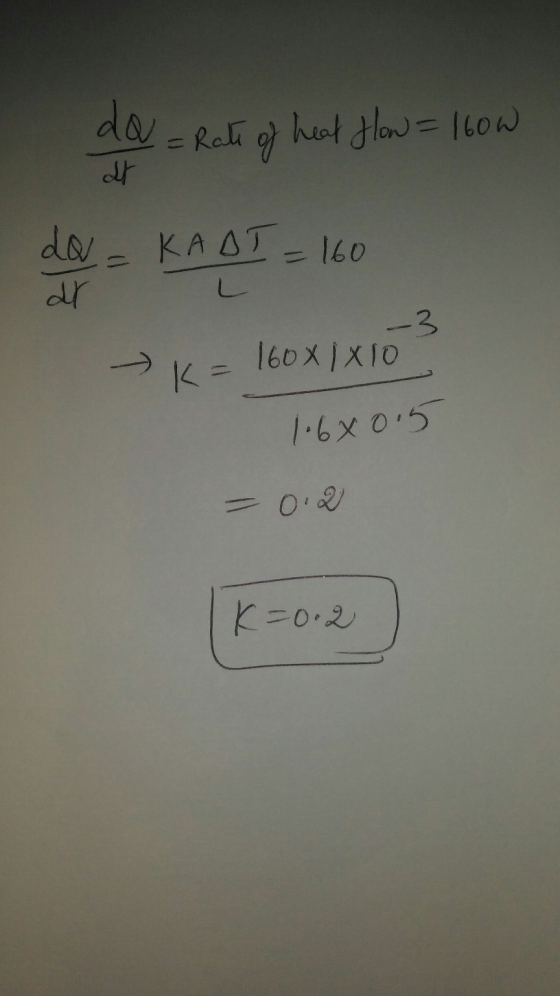
Suppose 160 W of heat flows by conduction from the blood capillaries beneath the skin to...
Suppose that l50 W of heat flows by conduction from the blood capillaries beneath the skin...
 Suppose that l50 W of heat flows by conduction from the blood capillaries beneath the skin to the body's surface area of 1.5 m^2. If the temperature difference is 0.5 degree C, estimate the average distance of the capillaries below the skin surface.
Constants Suppose 180 W of heat flows by conduction from the blood capillaries beneath the skin...
 Constants Suppose 180 W of heat flows by conduction from the blood capillaries beneath the skin to the body's surface area of 1.6 m². Part A If the temperature difference is 0.50°C, estimate the average distance of capillaries below the skin surface. Express your answer to two significant figures and include the appropriate units. Value mm Submit Request Answer
Chapter 13, Problem 01 The amount of heat per second conducted from the blood capillaries beneath...
Chapter 13, Problem 01 The amount of heat per second conducted from the blood capillaries beneath the skin to the surface is 280 J/s. The energy is transferred a distance of 2.1 × 10⁻³ m through a body whose surface area is 1.8 m2. Assuming that the thermal conductivity is that of body fat, determine the temperature difference between the capillaries and the surface of the skin. Chapter 13, Problem 02 In an electrically heated home, the temperature of the...
The heat exchanger in a heat lung machine is constructed so that blood flows through an...
 The heat exchanger in a heat lung machine is constructed so
that blood flows through an array of tubes controlled temperature
water circulated through an outer exterior shell.
e heat exchanger in a heat lung machine is constructed so that blood flows through an array of tubes with controlled temperature water circulated through an outer exterior shell. Although the temperature of the blood varies as it passed through the heat exchanger, during the cool down cycle when a patient is...
The heat exchanger in a heat lung machine is constructed so
that blood flows through an array of tubes controlled temperature
water circulated through an outer exterior shell.
e heat exchanger in a heat lung machine is constructed so that blood flows through an array of tubes with controlled temperature water circulated through an outer exterior shell. Although the temperature of the blood varies as it passed through the heat exchanger, during the cool down cycle when a patient is...
(a) What is the rate of heat conduction (in W) through the 2.00 cm thick fur...
(a) What is the rate of heat conduction (in W) through the 2.00 cm thick fur of a large animal having a 1.30 m2 surface area? Assume that the animal's skin temperature is 30.0°C, that the air temperature is −6.50°C, and that fur has the same thermal conductivity as air. (Assume the thermal conductivity of air is 0.023 J/(s · m · °C).) W (b) What food intake (in kcal) will the animal need in one day to replace this...
PLEASE ANSWER a,b,c Heat Conduction Heat conduction occurs through any material, represented here by a rectangular...
 PLEASE ANSWER a,b,c
Heat Conduction Heat conduction occurs through any material, represented here by a rectangular bar, whether window glass or walrus blubber. The temperature of the material is T2 on the left and T1 on the right, where T2 is greater than T1. The rate of heat transfer by conduction is directly proportional to the surface area A, the temperature difference T2 - T1, and the substance's conductivity k. The rate of heat transfer is inversely proportional to the...
PLEASE ANSWER a,b,c
Heat Conduction Heat conduction occurs through any material, represented here by a rectangular bar, whether window glass or walrus blubber. The temperature of the material is T2 on the left and T1 on the right, where T2 is greater than T1. The rate of heat transfer by conduction is directly proportional to the surface area A, the temperature difference T2 - T1, and the substance's conductivity k. The rate of heat transfer is inversely proportional to the...
Consider the rate of heat conduction through a double-paned window that has a 1.45-m2 area and...
 Consider
the rate of heat conduction through a double-paned window that has
a 1.45-m2 area and is made of two panes of
0.715-cm-thick glass separated by a 1.25-cm air gap. You can ignore
the increased heat transfer in the air gap due to convection.
Calculate the rate of heat conduction through this window, in
watts, given that the inside surface temperature is 15.0°C, while
the outside temperature is -10.0°C. Make the assumption that the
temperature differences across the two glass...
Consider
the rate of heat conduction through a double-paned window that has
a 1.45-m2 area and is made of two panes of
0.715-cm-thick glass separated by a 1.25-cm air gap. You can ignore
the increased heat transfer in the air gap due to convection.
Calculate the rate of heat conduction through this window, in
watts, given that the inside surface temperature is 15.0°C, while
the outside temperature is -10.0°C. Make the assumption that the
temperature differences across the two glass...
Heat conduction occurs through any material, represented here by a rectangular bar, whether window glass or...
 Heat conduction occurs through any material, represented here by a rectangular bar, whether window glass or walrus blubber. The temperature of the material is T2 on the left and T1 on the right, where T2 is greater than T1. The rate of heat transfer by conduction is directly proportional to the surface area A, the temperature difference T2 - T1, and the substance's conductivity k. The rate of heat transfer is inversely proportional to the thickness d. Q kA (T2-T)...
By conduction 2000 W is transferred through a 0.5-m2 section of a 4-cm-thick insulating material. Determine...
By conduction 2000 W is transferred through a 0.5-m2 section of a 4-cm-thick insulating material. Determine the temperature difference across the insulating layer if the thermal conductivity is 0.2 W/(m • °C). Answer: 800°C
Heat conduction occurs through any material, represented here by a rectangular bar, whether window glass or...
 Heat conduction occurs through any material, represented here by a rectangular bar, whether window glass or walrus blubber. The temperature of the material is T2 on the left and T1 on the right, where T2 is greater than T1. The rate of heat transfer by conduction is directly proportional to the surface area A, the temperature difference T2 - T1, and the substance's conductivity k. The rate of heat transfer is inversely proportional to the thickness d. Q kA (T2-T)...
 Suppose that l50 W of heat flows by conduction from the blood capillaries beneath the skin to the body's surface area of 1.5 m^2. If the temperature difference is 0.5 degree C, estimate the average distance of the capillaries below the skin surface.
 Constants Suppose 180 W of heat flows by conduction from the blood capillaries beneath the skin to the body's surface area of 1.6 m². Part A If the temperature difference is 0.50°C, estimate the average distance of capillaries below the skin surface. Express your answer to two significant figures and include the appropriate units. Value mm Submit Request Answer
 The heat exchanger in a heat lung machine is constructed so
that blood flows through an array of tubes controlled temperature
water circulated through an outer exterior shell.
e heat exchanger in a heat lung machine is constructed so that blood flows through an array of tubes with controlled temperature water circulated through an outer exterior shell. Although the temperature of the blood varies as it passed through the heat exchanger, during the cool down cycle when a patient is...
The heat exchanger in a heat lung machine is constructed so
that blood flows through an array of tubes controlled temperature
water circulated through an outer exterior shell.
e heat exchanger in a heat lung machine is constructed so that blood flows through an array of tubes with controlled temperature water circulated through an outer exterior shell. Although the temperature of the blood varies as it passed through the heat exchanger, during the cool down cycle when a patient is...
 PLEASE ANSWER a,b,c
Heat Conduction Heat conduction occurs through any material, represented here by a rectangular bar, whether window glass or walrus blubber. The temperature of the material is T2 on the left and T1 on the right, where T2 is greater than T1. The rate of heat transfer by conduction is directly proportional to the surface area A, the temperature difference T2 - T1, and the substance's conductivity k. The rate of heat transfer is inversely proportional to the...
PLEASE ANSWER a,b,c
Heat Conduction Heat conduction occurs through any material, represented here by a rectangular bar, whether window glass or walrus blubber. The temperature of the material is T2 on the left and T1 on the right, where T2 is greater than T1. The rate of heat transfer by conduction is directly proportional to the surface area A, the temperature difference T2 - T1, and the substance's conductivity k. The rate of heat transfer is inversely proportional to the...
 Consider
the rate of heat conduction through a double-paned window that has
a 1.45-m2 area and is made of two panes of
0.715-cm-thick glass separated by a 1.25-cm air gap. You can ignore
the increased heat transfer in the air gap due to convection.
Calculate the rate of heat conduction through this window, in
watts, given that the inside surface temperature is 15.0°C, while
the outside temperature is -10.0°C. Make the assumption that the
temperature differences across the two glass...
Consider
the rate of heat conduction through a double-paned window that has
a 1.45-m2 area and is made of two panes of
0.715-cm-thick glass separated by a 1.25-cm air gap. You can ignore
the increased heat transfer in the air gap due to convection.
Calculate the rate of heat conduction through this window, in
watts, given that the inside surface temperature is 15.0°C, while
the outside temperature is -10.0°C. Make the assumption that the
temperature differences across the two glass...
 Heat conduction occurs through any material, represented here by a rectangular bar, whether window glass or walrus blubber. The temperature of the material is T2 on the left and T1 on the right, where T2 is greater than T1. The rate of heat transfer by conduction is directly proportional to the surface area A, the temperature difference T2 - T1, and the substance's conductivity k. The rate of heat transfer is inversely proportional to the thickness d. Q kA (T2-T)...
 Heat conduction occurs through any material, represented here by a rectangular bar, whether window glass or walrus blubber. The temperature of the material is T2 on the left and T1 on the right, where T2 is greater than T1. The rate of heat transfer by conduction is directly proportional to the surface area A, the temperature difference T2 - T1, and the substance's conductivity k. The rate of heat transfer is inversely proportional to the thickness d. Q kA (T2-T)...
Most questions answered within 3 hours.
-
Where is the error in this code sequence?
String s1 = "Hello";
String s2 = "ello";...
asked 11 months ago -
Financial data for Joel de Paris, Inc., for last year
follow:
Joel de Paris, Inc.
Balance...
asked 11 months ago -
Consider this reaction:
Al2(SO4)3 (aq)+ BaCl3
(aq) Al2Cl6 (aq)- +
3BaSO4(s) . What is the...
asked 11 months ago -
Suppose that Savneet is considering increasing her
recent random sample from 20 car rentals to 40...
asked 11 months ago -
Trucks arrive at an unloading terminal at an average rate of 120
per hour.
Trucks arrive...
asked 11 months ago -
Why are methanol and ethanol completely soluble in water while
octanol is not very little soluble....
asked 11 months ago -
A facilities manager at a university reads in a research report
that the mean amount of...
asked 11 months ago -
When the CuSO4 is rehydrated by adding water to the anhydrous
compound, is this an endothermic...
asked 11 months ago -
A ray of sunlight is passing from diamond into crown glass; the
angle of incidence is...
asked 11 months ago -
A block of mass 0.249 kg is placed on top of a light, vertical
spring of...
asked 11 months ago -
how do the kidneys compensate in the presences of acidosis
a) trigger hyperventilate
b) reserve acid...
asked 11 months ago -
Question 501 pts
The rental rate of capital to the firm increases. Which of the
following...
asked 11 months ago