 PLEASE ANSWER a,b,c
Homework Answers

Add Answer to:
PLEASE ANSWER a,b,c
Heat Conduction Heat conduction occurs through any material, represented here by a rectangular...
Heat conduction occurs through any material, represented here by a rectangular bar, whether window glass or...
 Heat conduction occurs through any material, represented here by a rectangular bar, whether window glass or walrus blubber. The temperature of the material is T2 on the left and T1 on the right, where T2 is greater than T1. The rate of heat transfer by conduction is directly proportional to the surface area A, the temperature difference T2 - T1, and the substance's conductivity k. The rate of heat transfer is inversely proportional to the thickness d. Q kA (T2-T)...
Heat conduction occurs through any material, represented here by a rectangular bar, whether window glass or...
 Heat conduction occurs through any material, represented here by a rectangular bar, whether window glass or walrus blubber. The temperature of the material is T2 on the left and T1 on the right, where T2 is greater than T1. The rate of heat transfer by conduction is directly proportional to the surface area A, the temperature difference T2 - T1, and the substance's conductivity k. The rate of heat transfer is inversely proportional to the thickness d. Q kA (T2-T)...
PLEASE ANSWER ALL PARTS OF THE QUESTION: Case1, Case 2: a,b ••• Weekly Comprehensive Assign ® V Weekly Comprehensive Ass...
 PLEASE ANSWER ALL PARTS OF THE
QUESTION: Case1, Case 2: a,b
••• Weekly Comprehensive Assign ® V Weekly Comprehensive Assign X + a pp varafy.com/lti/v1p1?custom assignment_revision_resource_id=5dcf22405b33ca000406f4ae&custom_attempt_penalties=0&cust... Q € > c S # D Heat Conduction Heat conduction occurs through any material, represented here by a rectangular bar, whether window glass or walrus blubber. The temperature of the material is T2 on the left and T1 on the right, where T2 is greater than T1. The rate of heat transfer by...
PLEASE ANSWER ALL PARTS OF THE
QUESTION: Case1, Case 2: a,b
••• Weekly Comprehensive Assign ® V Weekly Comprehensive Assign X + a pp varafy.com/lti/v1p1?custom assignment_revision_resource_id=5dcf22405b33ca000406f4ae&custom_attempt_penalties=0&cust... Q € > c S # D Heat Conduction Heat conduction occurs through any material, represented here by a rectangular bar, whether window glass or walrus blubber. The temperature of the material is T2 on the left and T1 on the right, where T2 is greater than T1. The rate of heat transfer by...
Write a program using a collection of functions to solve simple conduction problems using various forms...
Write a program using a collection of functions to solve simple conduction problems using various forms of the formula H = k * A * (T2-T1)/X H = k * A * (T2-T1)/X Temperature on the other side is 274 K. H = 755.0 W T2 = 298 K k = 0.800 W/m-k T1 = 274 K A = 0.120 m^2 X=0.003 m where H is the rate of heat transfer in watts, k is the coefficient of thermal conductivity...
Compare the rate of heat conduction through a 12 cm thick wall that has an area...
Compare the rate of heat conduction through a 12 cm thick wall that has an area of 15 m2 and a thermal conductivity twice that of glass wool, k=0.042, with the rate of heat conduction through a window, k=0.84, that is 0.8 cm thick and that has an area of 2.75 m2, assuming a temperature difference of 12 °C across each. (a) What is the heat transfer rate through the wall? QtQt = unit (b) What is the heat transfer rate...
Can someone convert this to C programming language? #include using namespace std; class phyfor { public:...
Can someone convert this to C programming language? #include using namespace std; class phyfor { public: void calcH//fucntion to calulate rate of heat transfer { double K,A,T1,T2,X,H; cout<<"Coefficient of thermal conductivity (W/m-K) : "<>K; cout<<"Cross-sectional area of conductor (m^2) : "<>A; cout<<"Temperature on one side (K) : "<>T2; cout<<"Temperature on other side (K) : "<>T1; cout<<"Thickness of conductor (m) : "<>X; H=K*A*(T2-T1)/X; cout<<"Rate of heat transfer (watts) : "<>H; cout<<"Cross-sectional area of conductor (m^2) : "<>A; cout<<"Temperature on one side...
find the rate of conduction in the room given: External Temperature (T2): 26˚C or 299.15K Average...
find the rate of conduction in the room given: External Temperature (T2): 26˚C or 299.15K Average Temp Room (T1): 19.8˚C or 292.95K Wall thickness (d): .283m Thermal conductivity (k): 1.04 W/m˚C Area (m2): 3.75 m2
ent material has the thermal conductivity k and thickness L. The temperature the material is of the form: distribution along the x-direction, T(x) in + Bx2 + C, where A, a, B, and C are constants...
 ent material has the thermal conductivity k and thickness L. The temperature the material is of the form: distribution along the x-direction, T(x) in + Bx2 + C, where A, a, B, and C are constants. The irradiation is fully the material and can be characterized by a uniform volumetric heat generation, W/m3). Assuming 1D steady-state conduction and constant properties. xpressions for the conduction heat fluxes (alx) at the top and bottom surfaces; absorbed by (4 points) (b) Derive an...
only answer 4,5! only answer 4, 5! PROBLEM 2 Heat Conduction In nuclear power plants, heat...
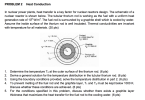 only answer 4,5!
only answer 4, 5!
PROBLEM 2 Heat Conduction In nuclear power plants, heat transfer is a key factor for nuclear reactors design. The schematic of a nuclear reactor is shown below. The tubular thorium rod is working as the fuel with a uniform heat generation rate of 108 W/m3. The fuel rod is surrounded by a graphite shell which is cooled by water Assume the inside surface of the thorium rod is well insulated. Thermal conductivities are...
only answer 4,5!
only answer 4, 5!
PROBLEM 2 Heat Conduction In nuclear power plants, heat transfer is a key factor for nuclear reactors design. The schematic of a nuclear reactor is shown below. The tubular thorium rod is working as the fuel with a uniform heat generation rate of 108 W/m3. The fuel rod is surrounded by a graphite shell which is cooled by water Assume the inside surface of the thorium rod is well insulated. Thermal conductivities are...
Heat Transfer A cylindrical shaped electric heater is embedded in a block of material. Determine (in...
 Heat Transfer
A cylindrical shaped electric heater is embedded in a block of material. Determine (in degrees C) the temperature T1. givens are tabled below, where q represents the rate of the electrical heat generation, and the thermal conductivity k and temperature T2 for the block. D(mm) L(mm) q(W k(W/mK) T2 (°C) 4 915198 Electric Heater
Heat Transfer
A cylindrical shaped electric heater is embedded in a block of material. Determine (in degrees C) the temperature T1. givens are tabled below, where q represents the rate of the electrical heat generation, and the thermal conductivity k and temperature T2 for the block. D(mm) L(mm) q(W k(W/mK) T2 (°C) 4 915198 Electric Heater
 Heat conduction occurs through any material, represented here by a rectangular bar, whether window glass or walrus blubber. The temperature of the material is T2 on the left and T1 on the right, where T2 is greater than T1. The rate of heat transfer by conduction is directly proportional to the surface area A, the temperature difference T2 - T1, and the substance's conductivity k. The rate of heat transfer is inversely proportional to the thickness d. Q kA (T2-T)...
 Heat conduction occurs through any material, represented here by a rectangular bar, whether window glass or walrus blubber. The temperature of the material is T2 on the left and T1 on the right, where T2 is greater than T1. The rate of heat transfer by conduction is directly proportional to the surface area A, the temperature difference T2 - T1, and the substance's conductivity k. The rate of heat transfer is inversely proportional to the thickness d. Q kA (T2-T)...
 PLEASE ANSWER ALL PARTS OF THE
QUESTION: Case1, Case 2: a,b
••• Weekly Comprehensive Assign ® V Weekly Comprehensive Assign X + a pp varafy.com/lti/v1p1?custom assignment_revision_resource_id=5dcf22405b33ca000406f4ae&custom_attempt_penalties=0&cust... Q € > c S # D Heat Conduction Heat conduction occurs through any material, represented here by a rectangular bar, whether window glass or walrus blubber. The temperature of the material is T2 on the left and T1 on the right, where T2 is greater than T1. The rate of heat transfer by...
PLEASE ANSWER ALL PARTS OF THE
QUESTION: Case1, Case 2: a,b
••• Weekly Comprehensive Assign ® V Weekly Comprehensive Assign X + a pp varafy.com/lti/v1p1?custom assignment_revision_resource_id=5dcf22405b33ca000406f4ae&custom_attempt_penalties=0&cust... Q € > c S # D Heat Conduction Heat conduction occurs through any material, represented here by a rectangular bar, whether window glass or walrus blubber. The temperature of the material is T2 on the left and T1 on the right, where T2 is greater than T1. The rate of heat transfer by...
 ent material has the thermal conductivity k and thickness L. The temperature the material is of the form: distribution along the x-direction, T(x) in + Bx2 + C, where A, a, B, and C are constants. The irradiation is fully the material and can be characterized by a uniform volumetric heat generation, W/m3). Assuming 1D steady-state conduction and constant properties. xpressions for the conduction heat fluxes (alx) at the top and bottom surfaces; absorbed by (4 points) (b) Derive an...
 only answer 4,5!
only answer 4, 5!
PROBLEM 2 Heat Conduction In nuclear power plants, heat transfer is a key factor for nuclear reactors design. The schematic of a nuclear reactor is shown below. The tubular thorium rod is working as the fuel with a uniform heat generation rate of 108 W/m3. The fuel rod is surrounded by a graphite shell which is cooled by water Assume the inside surface of the thorium rod is well insulated. Thermal conductivities are...
only answer 4,5!
only answer 4, 5!
PROBLEM 2 Heat Conduction In nuclear power plants, heat transfer is a key factor for nuclear reactors design. The schematic of a nuclear reactor is shown below. The tubular thorium rod is working as the fuel with a uniform heat generation rate of 108 W/m3. The fuel rod is surrounded by a graphite shell which is cooled by water Assume the inside surface of the thorium rod is well insulated. Thermal conductivities are...
 Heat Transfer
A cylindrical shaped electric heater is embedded in a block of material. Determine (in degrees C) the temperature T1. givens are tabled below, where q represents the rate of the electrical heat generation, and the thermal conductivity k and temperature T2 for the block. D(mm) L(mm) q(W k(W/mK) T2 (°C) 4 915198 Electric Heater
Heat Transfer
A cylindrical shaped electric heater is embedded in a block of material. Determine (in degrees C) the temperature T1. givens are tabled below, where q represents the rate of the electrical heat generation, and the thermal conductivity k and temperature T2 for the block. D(mm) L(mm) q(W k(W/mK) T2 (°C) 4 915198 Electric Heater
Most questions answered within 3 hours.
-
Where is the error in this code sequence?
String s1 = "Hello";
String s2 = "ello";...
asked 11 months ago -
Financial data for Joel de Paris, Inc., for last year
follow:
Joel de Paris, Inc.
Balance...
asked 11 months ago -
Consider this reaction:
Al2(SO4)3 (aq)+ BaCl3
(aq) Al2Cl6 (aq)- +
3BaSO4(s) . What is the...
asked 11 months ago -
Suppose that Savneet is considering increasing her
recent random sample from 20 car rentals to 40...
asked 11 months ago -
Trucks arrive at an unloading terminal at an average rate of 120
per hour.
Trucks arrive...
asked 11 months ago -
Why are methanol and ethanol completely soluble in water while
octanol is not very little soluble....
asked 11 months ago -
A facilities manager at a university reads in a research report
that the mean amount of...
asked 11 months ago -
When the CuSO4 is rehydrated by adding water to the anhydrous
compound, is this an endothermic...
asked 11 months ago -
A ray of sunlight is passing from diamond into crown glass; the
angle of incidence is...
asked 11 months ago -
A block of mass 0.249 kg is placed on top of a light, vertical
spring of...
asked 11 months ago -
how do the kidneys compensate in the presences of acidosis
a) trigger hyperventilate
b) reserve acid...
asked 11 months ago -
Question 501 pts
The rental rate of capital to the firm increases. Which of the
following...
asked 11 months ago