f(x) = cos(x) DEFINED [0, pi], what will be the maximum error if f(x) 10th and...
f(x) = cos(x) DEFINED [0, pi], what will be the maximum error if f(x) 10th and 15th degree interpolating polynomials in MATLAB
Homework Answers
Request Answer!
We need at least 10 more requests to produce the answer.
0 / 10 have requested this problem solution
The more requests, the faster the answer.
Add Answer to:
f(x) = cos(x) DEFINED [0, pi], what will be the maximum error if
f(x) 10th and...
for the function f(x)=cos(x) define within [0, pi], what will be the maximum error if f...
for the function f(x)=cos(x) define within [0, pi], what will be the maximum error if f is approximated by 10th and 15th degree interpolating polynomials. Solve this in MatLab
Compute the minimum square error for f(x) = |x|/pi (-pi<x<pi) and trigonometric polynomials if degree 1,2,3,4,5
Compute the minimum square error for f(x) = |x|/pi (-pi<x<pi) and trigonometric polynomials if degree 1,2,3,4,5
1. (Taylor Polynomial for cos(ax)) For f(x)cos(ar) do the following. (a) Find the Taylor polynomials T(x) about 0 for f...
 1. (Taylor Polynomial for cos(ax)) For f(x)cos(ar) do the following. (a) Find the Taylor polynomials T(x) about 0 for f(x) for n 1,2,3,4,5 (b) Based on the pattern in part (a), if n is an even number what is the relation between Tn (x) and TR+1()? (c) You might want to approximate cos(az) for all in 0 xS /2 by a Taylor polynomial about 0. Use the Taylor polynomial of order 3 to approximate f(0.25) when a -2, i.e. f(x)...
(b) Consider the Chebyschev interpolation points in the interval1,1 x,-cos lKjS n 2n The Chebysch...
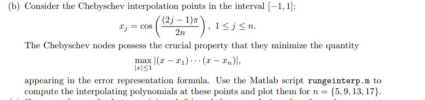 (b) Consider the Chebyschev interpolation points in the interval1,1 x,-cos lKjS n 2n The Chebyschev nodes possess the crucial property that they minimize the quantity max l(z (- appearing in the error representation formula. Use the Matlab script rungeinterp.m to compute the interpolating polynomials at these points and plot them for n 5,9, 13, 17
(b) Consider the Chebyschev interpolation points in the interval1,1 x,-cos lKjS n 2n The Chebyschev nodes possess the crucial property that they minimize the quantity...
(b) Consider the Chebyschev interpolation points in the interval1,1 x,-cos lKjS n 2n The Chebyschev nodes possess the crucial property that they minimize the quantity max l(z (- appearing in the error representation formula. Use the Matlab script rungeinterp.m to compute the interpolating polynomials at these points and plot them for n 5,9, 13, 17
(b) Consider the Chebyschev interpolation points in the interval1,1 x,-cos lKjS n 2n The Chebyschev nodes possess the crucial property that they minimize the quantity...
3. Consider the function f(x) = cos(x) in the interval [0,8]. You are given the following 3 point...
 3. Consider the function f(x) = cos(x) in the interval [0,8]. You are given the following 3 points of this function: 10.5403 2 -0.4161 6 0.9602 (a) (2 points) Calculate the quadratic Lagrange interpolating polynomial as the sum of the Lo(x), L1(x), L2(x) polynomials we defined in class. The final answer should be in the form P)a2 bx c, but with a, b, c known. DELIVERABLES: All your work in constructing the polynomial. This is to be done by hand...
let f:[-pi,pi] -> R be definded by the function f(x) { -2 if -pi<x<0 2 if...
 let f:[-pi,pi] -> R be definded by the function f(x) { -2
if -pi<x<0 2 if 0<x<pi
a) find the fourier series of f and describe its convergence
to f
b) explain why you can integrate the fourier series of f term
by term to obtain a series representation of F(x) =|2x| for x in
[-pi,pi] and give the series representation
DO - - - 1. Let f: [-T, 1] + R be defined by the function S-2 if-A53 <0...
let f:[-pi,pi] -> R be definded by the function f(x) { -2
if -pi<x<0 2 if 0<x<pi
a) find the fourier series of f and describe its convergence
to f
b) explain why you can integrate the fourier series of f term
by term to obtain a series representation of F(x) =|2x| for x in
[-pi,pi] and give the series representation
DO - - - 1. Let f: [-T, 1] + R be defined by the function S-2 if-A53 <0...
The graph of f is shown to the right. The function F(x) is defined by for . a) Find F(0) and F(3). b) Find F'(1). c) For what value of x does F(x) have its maximum value? What is this maximum val...
 The graph of f is shown to the right. The function F(x) is
defined by
for .
a) Find F(0) and F(3).
b) Find F'(1).
c) For what value of x does F(x) have its maximum value? What is
this maximum value?
d) Sketch a possible graph of F. Do not attempt to find a
formula for F. (You could, but it is more work than necessary.)
We were unable to transcribe this imageWe were unable to transcribe this image9-3....
The graph of f is shown to the right. The function F(x) is
defined by
for .
a) Find F(0) and F(3).
b) Find F'(1).
c) For what value of x does F(x) have its maximum value? What is
this maximum value?
d) Sketch a possible graph of F. Do not attempt to find a
formula for F. (You could, but it is more work than necessary.)
We were unable to transcribe this imageWe were unable to transcribe this image9-3....
Need help converting the following code from Matlab into Python: N=2048; fs=4.9; t=0:1/fs:(N-1)/fs; fs1=200; t1=0:1/fs1:(N-1)/fs1; x2=0.5+0.6366.*cos(2.*pi.*t1)+0.1273.*cos(10.*pi.*t1)-0.0909.*cos(14.*pi.*t1);...
Need help converting the following code from Matlab into Python: N=2048; fs=4.9; t=0:1/fs:(N-1)/fs; fs1=200; t1=0:1/fs1:(N-1)/fs1; x2=0.5+0.6366.*cos(2.*pi.*t1)+0.1273.*cos(10.*pi.*t1)-0.0909.*cos(14.*pi.*t1); x=0.5+0.6366.*cos(2.*pi.*t)+0.1273.*cos(10.*pi.*t)-0.0909.*cos(14.*pi.*t); X=fftshift(fft(x)); f=linspace(-fs/2,fs/2,N); plot(f,abs(X)./N); xlabel('f'); ylabel('|F(f)|'); title('magnitude spectrum of sampled signal'); x1=ifft(fftshift(X)); figure plot(t(1:100),x1(1:100)); xlabel('t'); ylabel('f(t)'); title('f(t) obtained by inverse transform'); figure plot(t1(1:1000),x2(1:1000)); xlabel('t'); ylabel('f(t)'); title('original f(t)');
Find the integral using matlab quad inbuilt for function (x^2)*cos(x)+3*sin(x)*tan(x) for 0 to pi/4
Find the integral using matlab quad inbuilt for function (x^2)*cos(x)+3*sin(x)*tan(x) for 0 to pi/4
l. (Taylor Polynonial for cos(ar)) Fr f(z) = cos(ar) do the following. (a) Find the Taylor polynomials T.(r) about O fo...
 l. (Taylor Polynonial for cos(ar)) Fr f(z) = cos(ar) do the following. (a) Find the Taylor polynomials T.(r) about O for f(x) for n 1,2,3,4,5 (b) Based on the pattern in part (a), if n is an even number what is the relation between T(r) and TR+1(r)? (c) You might want to approximate cs(ar) for all x in。Ś π/2 by a Taylor polynomial about 0. Use the Taylor polynomial of order 3 to approximate f(0.25) when a-2, i.e. f(x)-cos(2x). d)...
 1. (Taylor Polynomial for cos(ax)) For f(x)cos(ar) do the following. (a) Find the Taylor polynomials T(x) about 0 for f(x) for n 1,2,3,4,5 (b) Based on the pattern in part (a), if n is an even number what is the relation between Tn (x) and TR+1()? (c) You might want to approximate cos(az) for all in 0 xS /2 by a Taylor polynomial about 0. Use the Taylor polynomial of order 3 to approximate f(0.25) when a -2, i.e. f(x)...
 (b) Consider the Chebyschev interpolation points in the interval1,1 x,-cos lKjS n 2n The Chebyschev nodes possess the crucial property that they minimize the quantity max l(z (- appearing in the error representation formula. Use the Matlab script rungeinterp.m to compute the interpolating polynomials at these points and plot them for n 5,9, 13, 17
(b) Consider the Chebyschev interpolation points in the interval1,1 x,-cos lKjS n 2n The Chebyschev nodes possess the crucial property that they minimize the quantity...
(b) Consider the Chebyschev interpolation points in the interval1,1 x,-cos lKjS n 2n The Chebyschev nodes possess the crucial property that they minimize the quantity max l(z (- appearing in the error representation formula. Use the Matlab script rungeinterp.m to compute the interpolating polynomials at these points and plot them for n 5,9, 13, 17
(b) Consider the Chebyschev interpolation points in the interval1,1 x,-cos lKjS n 2n The Chebyschev nodes possess the crucial property that they minimize the quantity...
 3. Consider the function f(x) = cos(x) in the interval [0,8]. You are given the following 3 points of this function: 10.5403 2 -0.4161 6 0.9602 (a) (2 points) Calculate the quadratic Lagrange interpolating polynomial as the sum of the Lo(x), L1(x), L2(x) polynomials we defined in class. The final answer should be in the form P)a2 bx c, but with a, b, c known. DELIVERABLES: All your work in constructing the polynomial. This is to be done by hand...
 let f:[-pi,pi] -> R be definded by the function f(x) { -2
if -pi<x<0 2 if 0<x<pi
a) find the fourier series of f and describe its convergence
to f
b) explain why you can integrate the fourier series of f term
by term to obtain a series representation of F(x) =|2x| for x in
[-pi,pi] and give the series representation
DO - - - 1. Let f: [-T, 1] + R be defined by the function S-2 if-A53 <0...
let f:[-pi,pi] -> R be definded by the function f(x) { -2
if -pi<x<0 2 if 0<x<pi
a) find the fourier series of f and describe its convergence
to f
b) explain why you can integrate the fourier series of f term
by term to obtain a series representation of F(x) =|2x| for x in
[-pi,pi] and give the series representation
DO - - - 1. Let f: [-T, 1] + R be defined by the function S-2 if-A53 <0...
 The graph of f is shown to the right. The function F(x) is
defined by
for .
a) Find F(0) and F(3).
b) Find F'(1).
c) For what value of x does F(x) have its maximum value? What is
this maximum value?
d) Sketch a possible graph of F. Do not attempt to find a
formula for F. (You could, but it is more work than necessary.)
We were unable to transcribe this imageWe were unable to transcribe this image9-3....
The graph of f is shown to the right. The function F(x) is
defined by
for .
a) Find F(0) and F(3).
b) Find F'(1).
c) For what value of x does F(x) have its maximum value? What is
this maximum value?
d) Sketch a possible graph of F. Do not attempt to find a
formula for F. (You could, but it is more work than necessary.)
We were unable to transcribe this imageWe were unable to transcribe this image9-3....
 l. (Taylor Polynonial for cos(ar)) Fr f(z) = cos(ar) do the following. (a) Find the Taylor polynomials T.(r) about O for f(x) for n 1,2,3,4,5 (b) Based on the pattern in part (a), if n is an even number what is the relation between T(r) and TR+1(r)? (c) You might want to approximate cs(ar) for all x in。Ś π/2 by a Taylor polynomial about 0. Use the Taylor polynomial of order 3 to approximate f(0.25) when a-2, i.e. f(x)-cos(2x). d)...
Most questions answered within 3 hours.
-
Where is the error in this code sequence?
String s1 = "Hello";
String s2 = "ello";...
asked 11 months ago -
Financial data for Joel de Paris, Inc., for last year
follow:
Joel de Paris, Inc.
Balance...
asked 11 months ago -
Consider this reaction:
Al2(SO4)3 (aq)+ BaCl3
(aq) Al2Cl6 (aq)- +
3BaSO4(s) . What is the...
asked 11 months ago -
Suppose that Savneet is considering increasing her
recent random sample from 20 car rentals to 40...
asked 11 months ago -
Trucks arrive at an unloading terminal at an average rate of 120
per hour.
Trucks arrive...
asked 11 months ago -
Why are methanol and ethanol completely soluble in water while
octanol is not very little soluble....
asked 11 months ago -
A facilities manager at a university reads in a research report
that the mean amount of...
asked 11 months ago -
When the CuSO4 is rehydrated by adding water to the anhydrous
compound, is this an endothermic...
asked 11 months ago -
A ray of sunlight is passing from diamond into crown glass; the
angle of incidence is...
asked 11 months ago -
A block of mass 0.249 kg is placed on top of a light, vertical
spring of...
asked 11 months ago -
how do the kidneys compensate in the presences of acidosis
a) trigger hyperventilate
b) reserve acid...
asked 11 months ago -
Question 501 pts
The rental rate of capital to the firm increases. Which of the
following...
asked 11 months ago