Compute the minimum square error for f(x) = |x|/pi (-pi<x<pi) and trigonometric polynomials if degree 1,2,3,4,5
Homework Answers
 Summary
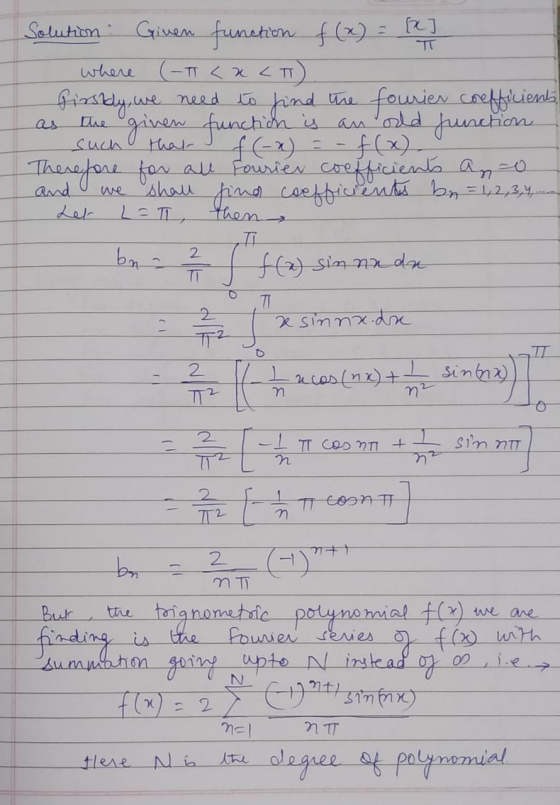
:Since the given function is an odd function,we first find the
Fourier coefficients and then we find the Fourier series of f(x)
with summation going up to N instead of infinity.Here N is the
degree of polynomial.
Summary
:Since the given function is an odd function,we first find the
Fourier coefficients and then we find the Fourier series of f(x)
with summation going up to N instead of infinity.Here N is the
degree of polynomial.
Add Answer to:
Compute the minimum square error for f(x) = |x|/pi (-pi<x<pi)
and trigonometric polynomials if degree 1,2,3,4,5
f(x) = cos(x) DEFINED [0, pi], what will be the maximum error if f(x) 10th and...
f(x) = cos(x) DEFINED [0, pi], what will be the maximum error if f(x) 10th and 15th degree interpolating polynomials in MATLAB
for the function f(x)=cos(x) define within [0, pi], what will be the maximum error if f...
for the function f(x)=cos(x) define within [0, pi], what will be the maximum error if f is approximated by 10th and 15th degree interpolating polynomials. Solve this in MatLab
For the given functions f(x), letxo-1지 = 1.25, and x2 = 1.6. Construct interpolation polynomials of degree at most one and at most two to approximate f (1.4), and find the absolute error. f (x)-sin...
 For the given functions f(x), letxo-1지 = 1.25, and x2 = 1.6. Construct interpolation polynomials of degree at most one and at most two to approximate f (1.4), and find the absolute error. f (x)-sin π.x
For the given functions f(x), letxo-1지 = 1.25, and x2 = 1.6. Construct interpolation polynomials of degree at most one and at most two to approximate f (1.4), and find the absolute error. f (x)-sin π.x
For the given functions f(x), letxo-1지 = 1.25, and x2 = 1.6. Construct interpolation polynomials of degree at most one and at most two to approximate f (1.4), and find the absolute error. f (x)-sin π.x
1. (Taylor Polynomial for cos(ax)) For f(x)cos(ar) do the following. (a) Find the Taylor polynomials T(x) about 0 for f...
 1. (Taylor Polynomial for cos(ax)) For f(x)cos(ar) do the following. (a) Find the Taylor polynomials T(x) about 0 for f(x) for n 1,2,3,4,5 (b) Based on the pattern in part (a), if n is an even number what is the relation between Tn (x) and TR+1()? (c) You might want to approximate cos(az) for all in 0 xS /2 by a Taylor polynomial about 0. Use the Taylor polynomial of order 3 to approximate f(0.25) when a -2, i.e. f(x)...
vi) Consider the following polynomials in the vector space of polynomials of degree 3 or less, P3. Pi(x) 12 +3r2 +a3 P2(x) 132 Pa(r) 1242 P4(z) = 1-r + 3r2 + 2r3 Which of the following statements...
 vi) Consider the following polynomials in the vector space of polynomials of degree 3 or less, P3. Pi(x) 12 +3r2 +a3 P2(x) 132 Pa(r) 1242 P4(z) = 1-r + 3r2 + 2r3 Which of the following statements are true and which are false? Explain your answer. a) The set {Pi, P2,P3} is a basis for P3. b) The set {Pi,P2, p3,P4,P5} İs a linearly independent set in P3.
vi) Consider the following polynomials in the vector space of polynomials of...
vi) Consider the following polynomials in the vector space of polynomials of degree 3 or less, P3. Pi(x) 12 +3r2 +a3 P2(x) 132 Pa(r) 1242 P4(z) = 1-r + 3r2 + 2r3 Which of the following statements are true and which are false? Explain your answer. a) The set {Pi, P2,P3} is a basis for P3. b) The set {Pi,P2, p3,P4,P5} İs a linearly independent set in P3.
vi) Consider the following polynomials in the vector space of polynomials of...
Matlab: a) Write a program to compute the first-degree and third-degree polynomials that fit the data,...
 Matlab:
a) Write a program to compute the first-degree and third-degree
polynomials that fit the data, displaying the polynomial
coefficients. Remember to include text to describe the displayed
coefficients.
(b) Compute and display (including what the information is) the
sum of the squares for each curve fit.
(c) Plot the data and the two curve fits on a
single plot, for 101 values of A in the range 0 ?
A ? 9. Choose different line styles for each curve...
Matlab:
a) Write a program to compute the first-degree and third-degree
polynomials that fit the data, displaying the polynomial
coefficients. Remember to include text to describe the displayed
coefficients.
(b) Compute and display (including what the information is) the
sum of the squares for each curve fit.
(c) Plot the data and the two curve fits on a
single plot, for 101 values of A in the range 0 ?
A ? 9. Choose different line styles for each curve...
For the function f(x) = e 2x, which of the following polynomials is the 2nd degree...
 For the function f(x) = e 2x, which of the following polynomials is the 2nd degree Taylor polynomial for f(2') at the point I = 0? 1) P(x) = 1-2+x2 2) P2 (3)=1-23 +22 3) P3(x) = 1 - 2.c + 2x2 4) P4(x) = 1 + 2x + 2x2 O Polynomial in 3) Polynomial in 1) O Polynomial in 2) O Polynomial in 4)
3. Let Po(x) respectively. Find the monic Legendre polynomials of degree 2, 3 and 4 using...
 3. Let Po(x) respectively. Find the monic Legendre polynomials of degree 2, 3 and 4 using the orthogonality relation f P(x)Pm(x)dx = 0, mn and m,n E N. 1 and P1(x) = x be two Legendre polynomials of degree 0 and 1,
3. Let Po(x) respectively. Find the monic Legendre polynomials of degree 2, 3 and 4 using the orthogonality relation f P(x)Pm(x)dx = 0, mn and m,n E N. 1 and P1(x) = x be two Legendre polynomials of...
3. Let Po(x) respectively. Find the monic Legendre polynomials of degree 2, 3 and 4 using the orthogonality relation f P(x)Pm(x)dx = 0, mn and m,n E N. 1 and P1(x) = x be two Legendre polynomials of degree 0 and 1,
3. Let Po(x) respectively. Find the monic Legendre polynomials of degree 2, 3 and 4 using the orthogonality relation f P(x)Pm(x)dx = 0, mn and m,n E N. 1 and P1(x) = x be two Legendre polynomials of...
PLEASE USE PYTHON training error should strictly decrease as the degree of the hypothesis polynomials increases....
PLEASE USE PYTHON training error should strictly decrease as the degree of the hypothesis polynomials increases. That is because any high degree polynomial can "simulate" a lower degree polynomial by making it's high order coefficients zero. Thus nothing is lost and something might be gained by increasing the degree. But the code below shows that in-sample error actually starts to increase on our dataset for polynomials of very high degree. Why do you think this happens? CODE BELOW: ## Numerical...
Suppose that F is a field and f and g are polynomials of degree at most...
 Suppose that F is a field and f and g are polynomials of degree at most n, for some n e N. Show that if f (a) = g(a) for n + 1 different elements a of F, then f-3. HINT: look at the roots of f-g.
 For the given functions f(x), letxo-1지 = 1.25, and x2 = 1.6. Construct interpolation polynomials of degree at most one and at most two to approximate f (1.4), and find the absolute error. f (x)-sin π.x
For the given functions f(x), letxo-1지 = 1.25, and x2 = 1.6. Construct interpolation polynomials of degree at most one and at most two to approximate f (1.4), and find the absolute error. f (x)-sin π.x
For the given functions f(x), letxo-1지 = 1.25, and x2 = 1.6. Construct interpolation polynomials of degree at most one and at most two to approximate f (1.4), and find the absolute error. f (x)-sin π.x
 1. (Taylor Polynomial for cos(ax)) For f(x)cos(ar) do the following. (a) Find the Taylor polynomials T(x) about 0 for f(x) for n 1,2,3,4,5 (b) Based on the pattern in part (a), if n is an even number what is the relation between Tn (x) and TR+1()? (c) You might want to approximate cos(az) for all in 0 xS /2 by a Taylor polynomial about 0. Use the Taylor polynomial of order 3 to approximate f(0.25) when a -2, i.e. f(x)...
 vi) Consider the following polynomials in the vector space of polynomials of degree 3 or less, P3. Pi(x) 12 +3r2 +a3 P2(x) 132 Pa(r) 1242 P4(z) = 1-r + 3r2 + 2r3 Which of the following statements are true and which are false? Explain your answer. a) The set {Pi, P2,P3} is a basis for P3. b) The set {Pi,P2, p3,P4,P5} İs a linearly independent set in P3.
vi) Consider the following polynomials in the vector space of polynomials of...
vi) Consider the following polynomials in the vector space of polynomials of degree 3 or less, P3. Pi(x) 12 +3r2 +a3 P2(x) 132 Pa(r) 1242 P4(z) = 1-r + 3r2 + 2r3 Which of the following statements are true and which are false? Explain your answer. a) The set {Pi, P2,P3} is a basis for P3. b) The set {Pi,P2, p3,P4,P5} İs a linearly independent set in P3.
vi) Consider the following polynomials in the vector space of polynomials of...
 Matlab:
a) Write a program to compute the first-degree and third-degree
polynomials that fit the data, displaying the polynomial
coefficients. Remember to include text to describe the displayed
coefficients.
(b) Compute and display (including what the information is) the
sum of the squares for each curve fit.
(c) Plot the data and the two curve fits on a
single plot, for 101 values of A in the range 0 ?
A ? 9. Choose different line styles for each curve...
Matlab:
a) Write a program to compute the first-degree and third-degree
polynomials that fit the data, displaying the polynomial
coefficients. Remember to include text to describe the displayed
coefficients.
(b) Compute and display (including what the information is) the
sum of the squares for each curve fit.
(c) Plot the data and the two curve fits on a
single plot, for 101 values of A in the range 0 ?
A ? 9. Choose different line styles for each curve...
 For the function f(x) = e 2x, which of the following polynomials is the 2nd degree Taylor polynomial for f(2') at the point I = 0? 1) P(x) = 1-2+x2 2) P2 (3)=1-23 +22 3) P3(x) = 1 - 2.c + 2x2 4) P4(x) = 1 + 2x + 2x2 O Polynomial in 3) Polynomial in 1) O Polynomial in 2) O Polynomial in 4)
 3. Let Po(x) respectively. Find the monic Legendre polynomials of degree 2, 3 and 4 using the orthogonality relation f P(x)Pm(x)dx = 0, mn and m,n E N. 1 and P1(x) = x be two Legendre polynomials of degree 0 and 1,
3. Let Po(x) respectively. Find the monic Legendre polynomials of degree 2, 3 and 4 using the orthogonality relation f P(x)Pm(x)dx = 0, mn and m,n E N. 1 and P1(x) = x be two Legendre polynomials of...
3. Let Po(x) respectively. Find the monic Legendre polynomials of degree 2, 3 and 4 using the orthogonality relation f P(x)Pm(x)dx = 0, mn and m,n E N. 1 and P1(x) = x be two Legendre polynomials of degree 0 and 1,
3. Let Po(x) respectively. Find the monic Legendre polynomials of degree 2, 3 and 4 using the orthogonality relation f P(x)Pm(x)dx = 0, mn and m,n E N. 1 and P1(x) = x be two Legendre polynomials of...
 Suppose that F is a field and f and g are polynomials of degree at most n, for some n e N. Show that if f (a) = g(a) for n + 1 different elements a of F, then f-3. HINT: look at the roots of f-g.
Most questions answered within 3 hours.
-
Where is the error in this code sequence?
String s1 = "Hello";
String s2 = "ello";...
asked 11 months ago -
Financial data for Joel de Paris, Inc., for last year
follow:
Joel de Paris, Inc.
Balance...
asked 11 months ago -
Consider this reaction:
Al2(SO4)3 (aq)+ BaCl3
(aq) Al2Cl6 (aq)- +
3BaSO4(s) . What is the...
asked 11 months ago -
Suppose that Savneet is considering increasing her
recent random sample from 20 car rentals to 40...
asked 11 months ago -
Trucks arrive at an unloading terminal at an average rate of 120
per hour.
Trucks arrive...
asked 11 months ago -
Why are methanol and ethanol completely soluble in water while
octanol is not very little soluble....
asked 11 months ago -
A facilities manager at a university reads in a research report
that the mean amount of...
asked 11 months ago -
When the CuSO4 is rehydrated by adding water to the anhydrous
compound, is this an endothermic...
asked 11 months ago -
A ray of sunlight is passing from diamond into crown glass; the
angle of incidence is...
asked 11 months ago -
A block of mass 0.249 kg is placed on top of a light, vertical
spring of...
asked 11 months ago -
how do the kidneys compensate in the presences of acidosis
a) trigger hyperventilate
b) reserve acid...
asked 11 months ago -
Question 501 pts
The rental rate of capital to the firm increases. Which of the
following...
asked 11 months ago