
Homework Answers

![2-37 at hat. yy*(2) 2-1 oft X(2)(-1) 2-1.2-! → -*(2) 2-2 3+ X(2) [21-2-2] 4-61 (2-1) X(2) [24-2-23 = - X(z) [ z so QX (2) [21](http://img.homeworklib.com/questions/edaa20e0-61f7-11eb-8f8b-078d38700617.png?x-oss-process=image/resize,w_560)
![e) [ Consider delay unit = P = z] X(2) > 3 yr Yz) x2 B D fénye) At point 17 YC2) 2-1 27 22 24 (2) 3.-) X(z) +402)2+1 +22-242](http://img.homeworklib.com/questions/ee993bb0-61f7-11eb-98da-57b72e1f9e89.png?x-oss-process=image/resize,w_560)
Add Answer to:
Question 4. (a) Determine the difference equations that relate the input and output variables for the...
Question 5 Following differential equations defines input-output relationships of a system with y as output and...
 Question 5 Following differential equations defines input-output relationships of a system with y as output and r as inputs. d’yı + dy 2 + y, + 5 y, = 10 r, dt ? dt. dy 2 + 1 + 7y, = 8r2 dt dt at a) Define suitable state variables and find the state equation and output equation. [8marks] b) Find system matrix (A), input matrix (B) and output matrix (C). [5marks] c) Draw the state space diagram and find...
c(s), A system has a block diagram as shown. The input is R(s) and the output...
 c(s), A system has a block diagram as shown. The input is R(s) and the output is C(s). a) Using only the block diagram reduction method", find the transfer function of the system. b) Determine the characteristic function and the order of the system. c) Find the characteristic roots of the system. d) Find the natural frequency of the system. e) Find the damped natural frequency of the system. 8 * NOTE: All stages of block diagram reduction must be...
Question # 3 Two systems are defined by the following difference equations, for each system find...
 Question # 3 Two systems are defined by the following difference equations, for each system find the impulse response, determine whether the filter is FIR or IR and draw the block diagram of each system. a) y(n)x(n) + 0.5x(n 1) 0.8x(n - 2) b) y(n)- x(n) + 0.5y(n -1)
b) Consider a simple difference equation ln)- x(n)+ax(n-D), where n7 is the input, y(n) is the output and D is a delay....
 b) Consider a simple difference equation ln)- x(n)+ax(n-D), where n7 is the input, y(n) is the output and D is a delay. Draw a block diagram of this filter and give a physical interpretation. Find its impulse response and transfer function. Calculate the zeros of the transfer function in terms of z Find the corresponding frequency response as well as the minimum and maximum values of the magnitude of the frequency response function.
b) Consider a simple difference equation ln)-...
b) Consider a simple difference equation ln)- x(n)+ax(n-D), where n7 is the input, y(n) is the output and D is a delay. Draw a block diagram of this filter and give a physical interpretation. Find its impulse response and transfer function. Calculate the zeros of the transfer function in terms of z Find the corresponding frequency response as well as the minimum and maximum values of the magnitude of the frequency response function.
b) Consider a simple difference equation ln)-...
Part 4 (1 point) 01 Question (6 points) Determine whether the following changes cause short-run aggregate...
 Part 4 (1 point) 01 Question (6 points) Determine whether the following changes cause short-run aggregate supply curve to shift to the right, shift to the left, or remain unchanged. The price level decreases. The short-run aggregate supply curve will 1st attempt Choose one: A. shift to the right. B. shift to the left C. remain unchanged. Part 1 (1 point) Se The price level increases. The short-run aggregate supply curve will Part 5 (1 point) Choose one: A. shift...
Please answer ALL parts to this digital signal processing question: Please show your working The figure below repr...
 Please answer ALL parts to this digital signal processing question:
Please show your working
The figure below represents a biquadratic digital filter in state-variable realisation form: Unit delay delay win-2 The values of the multipliers are as follows Answer the following questions, giving answers to four decimal places. PART 1 Determine the time domain equations that relate the input r[n] to the intermediate system variable ton and the output yin] to the intermediate system variable and complete the following: PART...
Please answer ALL parts to this digital signal processing question:
Please show your working
The figure below represents a biquadratic digital filter in state-variable realisation form: Unit delay delay win-2 The values of the multipliers are as follows Answer the following questions, giving answers to four decimal places. PART 1 Determine the time domain equations that relate the input r[n] to the intermediate system variable ton and the output yin] to the intermediate system variable and complete the following: PART...
Could you please help with the following parts: a. b. c. A system has the impulse response of. If the following signal is input into this system: Enter the output of this system (y[지) into the bla...
 Could you please help with the following parts:
a.
b.
c.
A system has the impulse response of. If the following signal is input into this system: Enter the output of this system (y[지) into the blank space provided (use π = pi in equations, eg. 1 +2cos(0.5pin) = 12 cos(0.5Tn)) The magnitude response of a discrete-time filter is plotted between the range-4T ώ +6x and is shown below. 10 -2 0 Normalised Radian frequency x Tm What type of...
Could you please help with the following parts:
a.
b.
c.
A system has the impulse response of. If the following signal is input into this system: Enter the output of this system (y[지) into the blank space provided (use π = pi in equations, eg. 1 +2cos(0.5pin) = 12 cos(0.5Tn)) The magnitude response of a discrete-time filter is plotted between the range-4T ώ +6x and is shown below. 10 -2 0 Normalised Radian frequency x Tm What type of...
Determine the spectrum for each of the two signals. Give your answer as two separate plots....
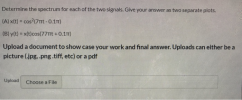 Determine the spectrum for each of the two signals. Give your answer as two separate plots. (A) x(t) = cos(71Tt -0.17) (B) y(t) = x(t)cos(777t +0.17) Upload a document to show case your work and final answer. Uploads can either be a picture jpg, .png .tiff, etc) or a pdf Upload Choose a File Question 8 20 pts Two LTI systems are implemented by the following direct and transposed direct form block diagrams, respectively. Write the two difference equations based...
4 C(s) حرام | A system has a block diagram as shown. The input is "R(s)...
 4 C(s) حرام | A system has a block diagram as shown. The input is "R(s) and the output is C(s). a) Using only the block diagram reduction method, R(S) find the transfer function of the system. b) Determine the characteristic function and the order of the system c) Find the characteristic roots of the system. d) Find the natural frequency of the system. e) Find the damped natural frequency of the system. 8 * NOTE: All stages of block...
help plzzz Question 4-(12 marks) At 20°C, an input of 0 m3/s to a flow transmitter produces an output of 4 mA and an...
 help plzzz
Question 4-(12 marks) At 20°C, an input of 0 m3/s to a flow transmitter produces an output of 4 mA and an input of 15 m3/s produces an output of 20 mA. The transmitter has a thermal zero shift of 0.0015 mA/C and a thermal sensitivity shift of 4 x 10 (mA/( m3/s)/ C. Determine the following: (a) The sensitivity of the transmitter at 20°C. (b) The output from the transmitter at an input flow rate of 10...
help plzzz
Question 4-(12 marks) At 20°C, an input of 0 m3/s to a flow transmitter produces an output of 4 mA and an input of 15 m3/s produces an output of 20 mA. The transmitter has a thermal zero shift of 0.0015 mA/C and a thermal sensitivity shift of 4 x 10 (mA/( m3/s)/ C. Determine the following: (a) The sensitivity of the transmitter at 20°C. (b) The output from the transmitter at an input flow rate of 10...
 Question 5 Following differential equations defines input-output relationships of a system with y as output and r as inputs. d’yı + dy 2 + y, + 5 y, = 10 r, dt ? dt. dy 2 + 1 + 7y, = 8r2 dt dt at a) Define suitable state variables and find the state equation and output equation. [8marks] b) Find system matrix (A), input matrix (B) and output matrix (C). [5marks] c) Draw the state space diagram and find...
 c(s), A system has a block diagram as shown. The input is R(s) and the output is C(s). a) Using only the block diagram reduction method", find the transfer function of the system. b) Determine the characteristic function and the order of the system. c) Find the characteristic roots of the system. d) Find the natural frequency of the system. e) Find the damped natural frequency of the system. 8 * NOTE: All stages of block diagram reduction must be...
 Question # 3 Two systems are defined by the following difference equations, for each system find the impulse response, determine whether the filter is FIR or IR and draw the block diagram of each system. a) y(n)x(n) + 0.5x(n 1) 0.8x(n - 2) b) y(n)- x(n) + 0.5y(n -1)
 b) Consider a simple difference equation ln)- x(n)+ax(n-D), where n7 is the input, y(n) is the output and D is a delay. Draw a block diagram of this filter and give a physical interpretation. Find its impulse response and transfer function. Calculate the zeros of the transfer function in terms of z Find the corresponding frequency response as well as the minimum and maximum values of the magnitude of the frequency response function.
b) Consider a simple difference equation ln)-...
b) Consider a simple difference equation ln)- x(n)+ax(n-D), where n7 is the input, y(n) is the output and D is a delay. Draw a block diagram of this filter and give a physical interpretation. Find its impulse response and transfer function. Calculate the zeros of the transfer function in terms of z Find the corresponding frequency response as well as the minimum and maximum values of the magnitude of the frequency response function.
b) Consider a simple difference equation ln)-...
 Part 4 (1 point) 01 Question (6 points) Determine whether the following changes cause short-run aggregate supply curve to shift to the right, shift to the left, or remain unchanged. The price level decreases. The short-run aggregate supply curve will 1st attempt Choose one: A. shift to the right. B. shift to the left C. remain unchanged. Part 1 (1 point) Se The price level increases. The short-run aggregate supply curve will Part 5 (1 point) Choose one: A. shift...
 Please answer ALL parts to this digital signal processing question:
Please show your working
The figure below represents a biquadratic digital filter in state-variable realisation form: Unit delay delay win-2 The values of the multipliers are as follows Answer the following questions, giving answers to four decimal places. PART 1 Determine the time domain equations that relate the input r[n] to the intermediate system variable ton and the output yin] to the intermediate system variable and complete the following: PART...
Please answer ALL parts to this digital signal processing question:
Please show your working
The figure below represents a biquadratic digital filter in state-variable realisation form: Unit delay delay win-2 The values of the multipliers are as follows Answer the following questions, giving answers to four decimal places. PART 1 Determine the time domain equations that relate the input r[n] to the intermediate system variable ton and the output yin] to the intermediate system variable and complete the following: PART...
 Could you please help with the following parts:
a.
b.
c.
A system has the impulse response of. If the following signal is input into this system: Enter the output of this system (y[지) into the blank space provided (use π = pi in equations, eg. 1 +2cos(0.5pin) = 12 cos(0.5Tn)) The magnitude response of a discrete-time filter is plotted between the range-4T ώ +6x and is shown below. 10 -2 0 Normalised Radian frequency x Tm What type of...
Could you please help with the following parts:
a.
b.
c.
A system has the impulse response of. If the following signal is input into this system: Enter the output of this system (y[지) into the blank space provided (use π = pi in equations, eg. 1 +2cos(0.5pin) = 12 cos(0.5Tn)) The magnitude response of a discrete-time filter is plotted between the range-4T ώ +6x and is shown below. 10 -2 0 Normalised Radian frequency x Tm What type of...
 Determine the spectrum for each of the two signals. Give your answer as two separate plots. (A) x(t) = cos(71Tt -0.17) (B) y(t) = x(t)cos(777t +0.17) Upload a document to show case your work and final answer. Uploads can either be a picture jpg, .png .tiff, etc) or a pdf Upload Choose a File Question 8 20 pts Two LTI systems are implemented by the following direct and transposed direct form block diagrams, respectively. Write the two difference equations based...
 4 C(s) حرام | A system has a block diagram as shown. The input is "R(s) and the output is C(s). a) Using only the block diagram reduction method, R(S) find the transfer function of the system. b) Determine the characteristic function and the order of the system c) Find the characteristic roots of the system. d) Find the natural frequency of the system. e) Find the damped natural frequency of the system. 8 * NOTE: All stages of block...
 help plzzz
Question 4-(12 marks) At 20°C, an input of 0 m3/s to a flow transmitter produces an output of 4 mA and an input of 15 m3/s produces an output of 20 mA. The transmitter has a thermal zero shift of 0.0015 mA/C and a thermal sensitivity shift of 4 x 10 (mA/( m3/s)/ C. Determine the following: (a) The sensitivity of the transmitter at 20°C. (b) The output from the transmitter at an input flow rate of 10...
help plzzz
Question 4-(12 marks) At 20°C, an input of 0 m3/s to a flow transmitter produces an output of 4 mA and an input of 15 m3/s produces an output of 20 mA. The transmitter has a thermal zero shift of 0.0015 mA/C and a thermal sensitivity shift of 4 x 10 (mA/( m3/s)/ C. Determine the following: (a) The sensitivity of the transmitter at 20°C. (b) The output from the transmitter at an input flow rate of 10...
Most questions answered within 3 hours.
-
Where is the error in this code sequence?
String s1 = "Hello";
String s2 = "ello";...
asked 10 months ago -
Financial data for Joel de Paris, Inc., for last year
follow:
Joel de Paris, Inc.
Balance...
asked 10 months ago -
Consider this reaction:
Al2(SO4)3 (aq)+ BaCl3
(aq) Al2Cl6 (aq)- +
3BaSO4(s) . What is the...
asked 10 months ago -
Suppose that Savneet is considering increasing her
recent random sample from 20 car rentals to 40...
asked 10 months ago -
Trucks arrive at an unloading terminal at an average rate of 120
per hour.
Trucks arrive...
asked 10 months ago -
Why are methanol and ethanol completely soluble in water while
octanol is not very little soluble....
asked 10 months ago -
A facilities manager at a university reads in a research report
that the mean amount of...
asked 10 months ago -
When the CuSO4 is rehydrated by adding water to the anhydrous
compound, is this an endothermic...
asked 10 months ago -
A ray of sunlight is passing from diamond into crown glass; the
angle of incidence is...
asked 10 months ago -
A block of mass 0.249 kg is placed on top of a light, vertical
spring of...
asked 10 months ago -
how do the kidneys compensate in the presences of acidosis
a) trigger hyperventilate
b) reserve acid...
asked 10 months ago -
Question 501 pts
The rental rate of capital to the firm increases. Which of the
following...
asked 10 months ago