A light unstretched/uncompressed spring with spring constant k rests vertically on the bottom of a beaker...
A light unstretched/uncompressed spring with spring constant k rests vertically on the bottom of a beaker that contains a fluid of density ?f ?(Figure 1) . A block of wood with mass m and density ? is connected to the spring and the spring-block system is allowed to come to static equilibrium. (?f> ?)
A) Write an expression for the elongation distance d of the spring in the new equilibrium position. Write your answer in terms of m, k, ?f, ?, and any aprropriate constants.

Homework Answers
forces acting on block of mass m
weight of the body Fw=mg acting down wards
the volume of block v, we know that 

the buoyancy force acting on the block 

 acting upwards
if the elongation of the spring x=d and spring constant k
the spring force Fs=kx=kd develop opposite to elongation (down wards)
the given system is in equilibrium.then 


the elongation of spring 
Add Answer to:
A light unstretched/uncompressed spring with spring constant
k rests vertically on the bottom of a beaker...
A light spring of constant 177 N/m rests vertically on the bottom of a large beaker...
A light spring of constant 177 N/m rests vertically on the bottom of a large beaker of water. A 4.42 kg block of wood of density 669 kg/m3 is connected to the top of the spring and the block-spring system is allowed to come to static equilibrium. What is the elongation ∆L of the spring? The acceleration of gravity is 9.8 m/s 2 . Answer in units of cm.
A light spring of constant k = 75.0 N/m is attached vertically to a table (figure...
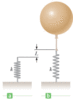 A light spring of constant k = 75.0 N/m is attached
vertically to a table (figure (a)). A 2.10-g balloon is filled with
helium (density = 0.179 kg/m3) to a volume of 4.00
m3 and is then connected to the spring, causing the
spring to stretch as shown in figure (b). Determine the extension
distance L when the balloon is in equilibrium. (The
density of air is 1.29 kg/m3.)
m
A light spring of constant k = 75.0 N/m is attached
vertically to a table (figure (a)). A 2.10-g balloon is filled with
helium (density = 0.179 kg/m3) to a volume of 4.00
m3 and is then connected to the spring, causing the
spring to stretch as shown in figure (b). Determine the extension
distance L when the balloon is in equilibrium. (The
density of air is 1.29 kg/m3.)
m
A light spring of constant k = 75.0 N/m is attached vertically to a table (figure...
 A light spring of constant k = 75.0 N/m is attached vertically to a table (figure (a)). A 3.00-g balloon is filled with helium (density = 0.179 kg/m”) to a volume of 4.75 m3 and is then connected to the spring, causing the spring to stretch as shown in figure (b). Determine the extension distance L when the balloon is in equilibrium. (The density of air is 1.29 kg/m3.) o de colores y en and is then comes to e
A light spring with a spring constant k = 316 N/m is attached to a vertical...
A light spring with a spring constant k = 316 N/m is attached to a vertical wall at one end and a block with a mass m = 0.462 kg at the other end. The block rests on a horizontal frictionless surface and is initially at the equilibrium length of the spring. The block is then displaced from the equilibrium position of the spring in such a manner as to stretch the spring by an amount A = 0.190 m...
My roles ASKO and is then connected to the A light spring of constant k = 100 N/m is attached vertically to a table...
 My roles ASKO and is then connected to the A light spring of constant k = 100 N/m is attached vertically to a table (figure (a)). A 2.90-balloon is filled with helium (density -0.179 kg/m) to a volume of 3.75 m spring, causing the spring to stretch as shown in figure (b). Determine the extension distance when the balloon is in equilibrium (The density of air is 1.29 km) www Need Help?
A block with mass M rests on a frictionless surface and is connected to a horizontal spring of force constant k. The oth...
A block with mass M rests on a frictionless surface and is connected to a horizontal spring of force constant k. The other end of the spring is attached to a wall. A second block with mass m rests on top of the first block. The coefficient of static friction between the a blocks is μs. a) Find the maximum amplitude of oscillation such that the top block will not slip on the bottom block. b) Suppose the coefficient of...
A spring is suspended vertically from a fixed support. The spring has spring constant k=24 N m −1 k=24 N m−1 . An object...
 A spring is suspended vertically from a fixed support. The
spring has spring constant k=24 N m −1 k=24 N m−1 . An object of
mass m= 1 4 kg m=14 kg is attached to the bottom of the spring. The
subject is subject to damping with damping constant β N m −1 s β N
m−1 s . Let y(t) y(t) be the displacement in metres at the end of
the spring below its equilibrium position, at time t...
A spring is suspended vertically from a fixed support. The
spring has spring constant k=24 N m −1 k=24 N m−1 . An object of
mass m= 1 4 kg m=14 kg is attached to the bottom of the spring. The
subject is subject to damping with damping constant β N m −1 s β N
m−1 s . Let y(t) y(t) be the displacement in metres at the end of
the spring below its equilibrium position, at time t...
Problem 6: A block of mass m rests against a spring with a spring constant of...
 Problem 6: A block of mass m rests against a spring with a spring constant of k on an inclined plane which makes an angle of 0 degrees with the horizontal. Assume the spring has been compressed a distance d from its neutral position. Refer to the figure. Idl м tus Ctheexpertt eted eted eted eted eted Set your coordinates to have the x-axis along the surface of the plane, with up the plane as positive, and the y-axis normal...
A 223 g block connected to a light spring with a force constant of k =...
A 223 g block connected to a light spring with a force constant of k = 5 N/m is free to oscillate on a horizontal, frictionless surface. The block is displaced 3 cm from equilibrium and released from rest. a) Find the period of its motion. (Recall that the period, T, and frequency, f, are inverses of each other.) b) Determine the maximum acceleration of the block.
A spring with spring constant k is positioned vertically and then compressed from its equilibrium length...
 A spring with spring constant k is positioned vertically and then compressed from its equilibrium length by a distance Delta y (Figure 1). A ball of mass m is placed on top of the spring, and is launched into the air when the spring is released (this setup is similar to the projectile launcher seen earlier in the semester). The ball travels to a maximum height h_max. Using the Work-Kinetic Energy theorem, determine h_max in terms of the given variables...
 A light spring of constant k = 75.0 N/m is attached
vertically to a table (figure (a)). A 2.10-g balloon is filled with
helium (density = 0.179 kg/m3) to a volume of 4.00
m3 and is then connected to the spring, causing the
spring to stretch as shown in figure (b). Determine the extension
distance L when the balloon is in equilibrium. (The
density of air is 1.29 kg/m3.)
m
A light spring of constant k = 75.0 N/m is attached
vertically to a table (figure (a)). A 2.10-g balloon is filled with
helium (density = 0.179 kg/m3) to a volume of 4.00
m3 and is then connected to the spring, causing the
spring to stretch as shown in figure (b). Determine the extension
distance L when the balloon is in equilibrium. (The
density of air is 1.29 kg/m3.)
m
 A light spring of constant k = 75.0 N/m is attached vertically to a table (figure (a)). A 3.00-g balloon is filled with helium (density = 0.179 kg/m”) to a volume of 4.75 m3 and is then connected to the spring, causing the spring to stretch as shown in figure (b). Determine the extension distance L when the balloon is in equilibrium. (The density of air is 1.29 kg/m3.) o de colores y en and is then comes to e
 My roles ASKO and is then connected to the A light spring of constant k = 100 N/m is attached vertically to a table (figure (a)). A 2.90-balloon is filled with helium (density -0.179 kg/m) to a volume of 3.75 m spring, causing the spring to stretch as shown in figure (b). Determine the extension distance when the balloon is in equilibrium (The density of air is 1.29 km) www Need Help?
 A spring is suspended vertically from a fixed support. The
spring has spring constant k=24 N m −1 k=24 N m−1 . An object of
mass m= 1 4 kg m=14 kg is attached to the bottom of the spring. The
subject is subject to damping with damping constant β N m −1 s β N
m−1 s . Let y(t) y(t) be the displacement in metres at the end of
the spring below its equilibrium position, at time t...
A spring is suspended vertically from a fixed support. The
spring has spring constant k=24 N m −1 k=24 N m−1 . An object of
mass m= 1 4 kg m=14 kg is attached to the bottom of the spring. The
subject is subject to damping with damping constant β N m −1 s β N
m−1 s . Let y(t) y(t) be the displacement in metres at the end of
the spring below its equilibrium position, at time t...
 Problem 6: A block of mass m rests against a spring with a spring constant of k on an inclined plane which makes an angle of 0 degrees with the horizontal. Assume the spring has been compressed a distance d from its neutral position. Refer to the figure. Idl м tus Ctheexpertt eted eted eted eted eted Set your coordinates to have the x-axis along the surface of the plane, with up the plane as positive, and the y-axis normal...
 A spring with spring constant k is positioned vertically and then compressed from its equilibrium length by a distance Delta y (Figure 1). A ball of mass m is placed on top of the spring, and is launched into the air when the spring is released (this setup is similar to the projectile launcher seen earlier in the semester). The ball travels to a maximum height h_max. Using the Work-Kinetic Energy theorem, determine h_max in terms of the given variables...
Most questions answered within 3 hours.
-
Where is the error in this code sequence?
String s1 = "Hello";
String s2 = "ello";...
asked 10 months ago -
Financial data for Joel de Paris, Inc., for last year
follow:
Joel de Paris, Inc.
Balance...
asked 10 months ago -
Consider this reaction:
Al2(SO4)3 (aq)+ BaCl3
(aq) Al2Cl6 (aq)- +
3BaSO4(s) . What is the...
asked 10 months ago -
Suppose that Savneet is considering increasing her
recent random sample from 20 car rentals to 40...
asked 10 months ago -
Trucks arrive at an unloading terminal at an average rate of 120
per hour.
Trucks arrive...
asked 10 months ago -
Why are methanol and ethanol completely soluble in water while
octanol is not very little soluble....
asked 10 months ago -
A facilities manager at a university reads in a research report
that the mean amount of...
asked 10 months ago -
When the CuSO4 is rehydrated by adding water to the anhydrous
compound, is this an endothermic...
asked 10 months ago -
A ray of sunlight is passing from diamond into crown glass; the
angle of incidence is...
asked 10 months ago -
A block of mass 0.249 kg is placed on top of a light, vertical
spring of...
asked 10 months ago -
how do the kidneys compensate in the presences of acidosis
a) trigger hyperventilate
b) reserve acid...
asked 10 months ago -
Question 501 pts
The rental rate of capital to the firm increases. Which of the
following...
asked 10 months ago