
Homework Answers
Theorem of work and energy says:
the sum of all jobs acting on a body is equal to the kinetic energy
vaciacion experiencing

the reference is considered lower
Part A
The forces that do work on the ball are:
work done by the weight.

where:
mass ball

acceleration of gravity

variation of height

Finally
 organizing
Work done by the spring force

the net work on the ball is

but also net work is equal to the change in kinetic energy
 It is zero. at the bottom starts from rest at the top and stays
momentarily at rest
It is zero. at the bottom starts from rest at the top and stays
momentarily at rest

expression for 


finally

part B
It applies the theorem of work and energy again.
In this case the
The forces that do work on the ball are:
work done by the weight.
where:
mass ball
acceleration of gravity
variation of height

Finally

Work done by the spring force
the net work on the ball is

but also net work is equal to the change in kinetic energy
 the velocity is zero at the start
now

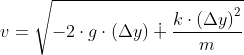
expression for the velocity


simplifying
Add Answer to:
A spring with spring constant k is positioned vertically and then compressed from its equilibrium length...
A ball of mass m is pushed out by a compressed spring of spring constant k....
 A ball of mass m is pushed out by a compressed spring of spring
constant k. Both the ball and the spring are on a table (see the
diagram below). The other end of the spring is fixed to the table,
and the spring is initially compressed by x. The ball moves toward
a wedge at the edge of the table and then launches off the wedge
and falls on the ground. The heights of the table and the wedge...
A ball of mass m is pushed out by a compressed spring of spring
constant k. Both the ball and the spring are on a table (see the
diagram below). The other end of the spring is fixed to the table,
and the spring is initially compressed by x. The ball moves toward
a wedge at the edge of the table and then launches off the wedge
and falls on the ground. The heights of the table and the wedge...
2. Consider the following physical situation: A spring that obeys Hooke's Law and has a known/given spring constant k has been compressed to half of its equilibrium length. It's anchored at o...
 2. Consider the following physical situation: A spring that obeys Hooke's Law and has a known/given spring constant k has been compressed to half of its equilibrium length. It's anchored at one end while the other end pushes (but is not attached to) a block of mass m in the horizontal direction. The block is initially held in place. Once released, the block accelerates to the right and achieves a final speed of ve at the point when it leaves...
A spring with spring constant k and equilibrium length rho degree hangs from the ceiling. A...
 A spring with spring constant k and equilibrium length rho degree hangs from the ceiling. A block of mass m is attached to the spring and released from rest at a distance of rho degree from the ceiling (i.e. the equilibrium length of the spring), as shown in figure on right. The block then undergoes simple harmonic motion. Sketch the vertical position of the block as a function of time, including three full oscillation periods. hat is the maximum sped...
A massless spring with a spring constant k = 22.0 N/m is hanging vertically from the...
A massless spring with a spring constant k = 22.0 N/m is hanging vertically from the ceiling neither stretched nor compressed as shown in part (1). A 0.45-kg ball is attached to its free end, then slowly lowered to its equilibrium (E) position (2). Finally, the ball is pulled down a distance of 15.0 cm before being released (3). a) Using the provided information derive the algebraic expression for the stretched distance in the spring while at equilibrium. b) Calculate...
A block of mass m sits at rest against a spring, which has spring constant k...
A block of mass m sits at rest against a spring, which has spring constant k and is compressed an amount of deltax from its equilibrium length. The spring is released, and the block slides along the smooth ground before reaching a ramp that makes an angle theta with respect to the ground. a) What is the maximum distance along the length of the ramp that the block will slide? GIve your answer in terms of the variables given. b)...
A horizontal spring of spring constant k = 125N/m is resting at its equilibrium length. One end o...
A horizontal spring of spring constant k = 125N/m is resting at its equilibrium length. One end of the spring is attached to a wall, and the other end is attached to a mass M = 200g. The whole system is immersed in a viscous fluid with linear drag coefficient b = 0.1 kg/s. The mass is pulled 10cm from its equilibrium position and released from rest. (a) (0.5 pt) What would be the oscillation period if the system were...
6. Consider a horizontal spring with spring constant k. A block with mass m is pushed far to the left against the spring until the spring is compressed a distance r relative to its relaxed length. A...
 6. Consider a horizontal spring with spring constant k. A block with mass m is pushed far to the left against the spring until the spring is compressed a distance r relative to its relaxed length. A second block, which is stationary and also has a mass m, is located to the right of the spring im rrm a) We release the first block from rest. Due to the force from the spring, it slides to the right and eventually...
Assignment:-GCA-CH07A work-KE Theory Pg12 SCALE-UP Table: Station: A block of mass M is launched up a...
 Assignment:-GCA-CH07A work-KE Theory Pg12 SCALE-UP Table: Station: A block of mass M is launched up a rough plane that makes an angle θ with the horizontal by placing (not attached) it against a massless spring compressed by a distance d and releasing it from rest (see "Initial stage" in the figure at right). The block slides a distance L (>d) up the plane and comes off the plane with an unknown speed v (see "Final stage" in the figure at...
MEC311 Term Test, 2019w 2. 145%) This problem is about using work-energy and impulse-momentum principles. You must answ...
 MEC311 Term Test, 2019w 2. 145%) This problem is about using work-energy and impulse-momentum principles. You must answer according to the notations and coordinate systems set up for you Answers based on other coordinate sysfem or notations will not be marked. Consider a sticky ball of weight Ws 0.1 [lb] located on an incline of angle 0-30-deg. The ball is initially placed on top of a compressed linear spring of spring constant k 10 [lb/ft]; see figure. It is released...
TRIAL 1 600 2.610 9.91 o.2 0.39 2.62 43 Average Result: The average speed of the given ball is ve...
 TRIAL 1 600 2.610 9.91 o.2 0.39 2.62 43 Average Result: The average speed of the given ball is velas hralels 1) Pull the penduum to the side, insert the ball into the gun, and compress and latch the gun spring Release the pendulum so that it hangs vertically 2) Fire the gun. The pendulum will latch near the highest point of its swing. Measure ne height ha·the vertical distance from the pendulum platform to the center of the ball...
 A ball of mass m is pushed out by a compressed spring of spring
constant k. Both the ball and the spring are on a table (see the
diagram below). The other end of the spring is fixed to the table,
and the spring is initially compressed by x. The ball moves toward
a wedge at the edge of the table and then launches off the wedge
and falls on the ground. The heights of the table and the wedge...
A ball of mass m is pushed out by a compressed spring of spring
constant k. Both the ball and the spring are on a table (see the
diagram below). The other end of the spring is fixed to the table,
and the spring is initially compressed by x. The ball moves toward
a wedge at the edge of the table and then launches off the wedge
and falls on the ground. The heights of the table and the wedge...
 2. Consider the following physical situation: A spring that obeys Hooke's Law and has a known/given spring constant k has been compressed to half of its equilibrium length. It's anchored at one end while the other end pushes (but is not attached to) a block of mass m in the horizontal direction. The block is initially held in place. Once released, the block accelerates to the right and achieves a final speed of ve at the point when it leaves...
 A spring with spring constant k and equilibrium length rho degree hangs from the ceiling. A block of mass m is attached to the spring and released from rest at a distance of rho degree from the ceiling (i.e. the equilibrium length of the spring), as shown in figure on right. The block then undergoes simple harmonic motion. Sketch the vertical position of the block as a function of time, including three full oscillation periods. hat is the maximum sped...
 6. Consider a horizontal spring with spring constant k. A block with mass m is pushed far to the left against the spring until the spring is compressed a distance r relative to its relaxed length. A second block, which is stationary and also has a mass m, is located to the right of the spring im rrm a) We release the first block from rest. Due to the force from the spring, it slides to the right and eventually...
 Assignment:-GCA-CH07A work-KE Theory Pg12 SCALE-UP Table: Station: A block of mass M is launched up a rough plane that makes an angle θ with the horizontal by placing (not attached) it against a massless spring compressed by a distance d and releasing it from rest (see "Initial stage" in the figure at right). The block slides a distance L (>d) up the plane and comes off the plane with an unknown speed v (see "Final stage" in the figure at...
 MEC311 Term Test, 2019w 2. 145%) This problem is about using work-energy and impulse-momentum principles. You must answer according to the notations and coordinate systems set up for you Answers based on other coordinate sysfem or notations will not be marked. Consider a sticky ball of weight Ws 0.1 [lb] located on an incline of angle 0-30-deg. The ball is initially placed on top of a compressed linear spring of spring constant k 10 [lb/ft]; see figure. It is released...
 TRIAL 1 600 2.610 9.91 o.2 0.39 2.62 43 Average Result: The average speed of the given ball is velas hralels 1) Pull the penduum to the side, insert the ball into the gun, and compress and latch the gun spring Release the pendulum so that it hangs vertically 2) Fire the gun. The pendulum will latch near the highest point of its swing. Measure ne height ha·the vertical distance from the pendulum platform to the center of the ball...
Most questions answered within 3 hours.
-
Where is the error in this code sequence?
String s1 = "Hello";
String s2 = "ello";...
asked 10 months ago -
Financial data for Joel de Paris, Inc., for last year
follow:
Joel de Paris, Inc.
Balance...
asked 10 months ago -
Consider this reaction:
Al2(SO4)3 (aq)+ BaCl3
(aq) Al2Cl6 (aq)- +
3BaSO4(s) . What is the...
asked 10 months ago -
Suppose that Savneet is considering increasing her
recent random sample from 20 car rentals to 40...
asked 10 months ago -
Trucks arrive at an unloading terminal at an average rate of 120
per hour.
Trucks arrive...
asked 10 months ago -
Why are methanol and ethanol completely soluble in water while
octanol is not very little soluble....
asked 10 months ago -
A facilities manager at a university reads in a research report
that the mean amount of...
asked 10 months ago -
When the CuSO4 is rehydrated by adding water to the anhydrous
compound, is this an endothermic...
asked 10 months ago -
A ray of sunlight is passing from diamond into crown glass; the
angle of incidence is...
asked 10 months ago -
A block of mass 0.249 kg is placed on top of a light, vertical
spring of...
asked 10 months ago -
how do the kidneys compensate in the presences of acidosis
a) trigger hyperventilate
b) reserve acid...
asked 10 months ago -
Question 501 pts
The rental rate of capital to the firm increases. Which of the
following...
asked 10 months ago