Homework Answers
Request Answer!
We need at least 10 more requests to produce the answer.
0 / 10 have requested this problem solution
The more requests, the faster the answer.
Contrast and compare elastic and inelastic collisions. Question 4 options: Both elastic and inelastic collisions have...
 Contrast and compare elastic and inelastic collisions.
Question 4 options:
Both elastic and inelastic collisions have conservation of
momentum if there are no outside forces. They are different in that
elastic collisions bounce and inelastic collisions stick, and
kinetic energy is conserved in inelastic collisions.
They are basically the same thing, except the units are
different.
Elastic collisions do not have conservation of momentum and
inelastic collisions have conservation of momentum if there are no
outside forces. They are different...
Contrast and compare elastic and inelastic collisions.
Question 4 options:
Both elastic and inelastic collisions have conservation of
momentum if there are no outside forces. They are different in that
elastic collisions bounce and inelastic collisions stick, and
kinetic energy is conserved in inelastic collisions.
They are basically the same thing, except the units are
different.
Elastic collisions do not have conservation of momentum and
inelastic collisions have conservation of momentum if there are no
outside forces. They are different...
The perfectly competitive firm's demand curve is: Perfectly elastic. Relatively elastic Perfectly inelastic. Relatively inelastic Statement...
 The perfectly competitive firm's demand curve is: Perfectly elastic. Relatively elastic Perfectly inelastic. Relatively inelastic Statement 1: In the long run, firms in a monopolistically competitive industry will be producing that quantity that maximize social surplus. Statement 2: In the long run, firms in a monopolistically competitive industry will be producing at the minimum of its ATC curve. Statement (1) is true; statement (2) is false. Statements (1) and (2) are both true. Statement (1) is false; statement (2) is...
To determine if the demand for a good is inelastic, elastic, or unit elastic between two...
To determine if the demand for a good is inelastic, elastic, or unit elastic between two prices, a seller might raise the price to see what happens to total revenue: If total revenue rises, demand is
Consider four types of collisions: inelastic, totally inelastic, elastic and explosive. (a) For which of these...
 Consider four types of collisions: inelastic, totally inelastic, elastic and explosive. (a) For which of these collision types is total linear momentum conserved? Do you need anything special for the momentum to stay constant? Explain! (b) For which of these types of collisions is kinetic energy the same before and after the collision? For each type, if the final kinetic energy is different than the initial, state whether kinetic energy has increased or decreased, and what other types of energy...
Calculate for each graph the elasticity of demand. Then, evaluate if unit elastic, inelastic or elastic,...
 Calculate for each graph the elasticity of demand. Then,
evaluate if unit elastic, inelastic or elastic, why?
A) B) C) 17 09 34 13 1a 130 38 137
Calculate for each graph the elasticity of demand. Then,
evaluate if unit elastic, inelastic or elastic, why?
A) B) C) 17 09 34 13 1a 130 38 137
Is the demand for Good X elastic? inelastic? or unit elastic? based on the following demand...
Is the demand for Good X elastic? inelastic? or unit elastic? based on the following demand function for Good X? ln Qd = 40 - 0.75 ln Px +2.3 ln Py - 4.5 ln M where Px is the price of Good X, Py is the price of Good Y and M is consumer income.
C Relatively elastic Relatively inelastic Unit elastic 26. Which of the following is true of an...
 C Relatively elastic Relatively inelastic Unit elastic 26. Which of the following is true of an economy's production possibilities curve? It shows the combinations of any two resources that can be used to produce and efficient leve of b It shows the alternative combinations of goods that can be produced by fully employing scar dIt is bowed in (convex to the origin) because of changing levels of technology output b it shows the alternative combinations of goods that can be...
explain elastic demand , inelastic demand and unit elastic demand with curve and example for each
explain elastic demand , inelastic demand and unit elastic demand with curve and example for each
a. Calculate price elasticity given the following information. Is the curve elastic, inelastic or unitary elastic?...
a. Calculate price elasticity given the following information. Is the curve elastic, inelastic or unitary elastic? Original Quantity: 16125 lbs of sugar New Quantity: 4000 lbs of sugar Original Price: $0.99/lb New Price: $3.99lb b. (6 pts) Given the elasticity calculated in part a, will the seller increase or decrease their revenue if they increase the price of sugar? c. (8 pts) Explain the determinants of elasticity.
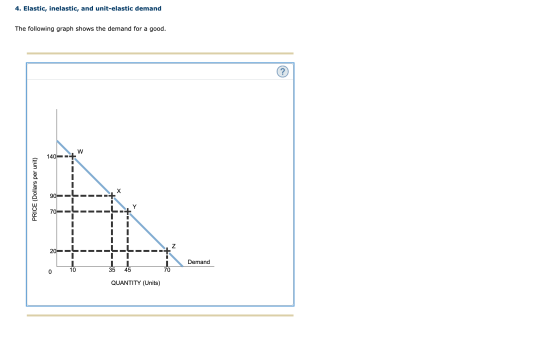
4. Elastic, inelastic, and unit-elastic demand The following graph shows the demand for a good. w...
 4. Elastic, inelastic, and unit-elastic
demand
The following graph shows the demand for a good.
w 140ー- 140一 Lu 70-L--+ 50一一 Z 20m- Demand QUANTITY (Units) 2 4 +--Lil 21 Q X LILI (1jun」ad sie-log) 30-yd
4. Elastic, inelastic, and unit-elastic
demand
The following graph shows the demand for a good.
w 140ー- 140一 Lu 70-L--+ 50一一 Z 20m- Demand QUANTITY (Units) 2 4 +--Lil 21 Q X LILI (1jun」ad sie-log) 30-yd
 Contrast and compare elastic and inelastic collisions.
Question 4 options:
Both elastic and inelastic collisions have conservation of
momentum if there are no outside forces. They are different in that
elastic collisions bounce and inelastic collisions stick, and
kinetic energy is conserved in inelastic collisions.
They are basically the same thing, except the units are
different.
Elastic collisions do not have conservation of momentum and
inelastic collisions have conservation of momentum if there are no
outside forces. They are different...
Contrast and compare elastic and inelastic collisions.
Question 4 options:
Both elastic and inelastic collisions have conservation of
momentum if there are no outside forces. They are different in that
elastic collisions bounce and inelastic collisions stick, and
kinetic energy is conserved in inelastic collisions.
They are basically the same thing, except the units are
different.
Elastic collisions do not have conservation of momentum and
inelastic collisions have conservation of momentum if there are no
outside forces. They are different...
 The perfectly competitive firm's demand curve is: Perfectly elastic. Relatively elastic Perfectly inelastic. Relatively inelastic Statement 1: In the long run, firms in a monopolistically competitive industry will be producing that quantity that maximize social surplus. Statement 2: In the long run, firms in a monopolistically competitive industry will be producing at the minimum of its ATC curve. Statement (1) is true; statement (2) is false. Statements (1) and (2) are both true. Statement (1) is false; statement (2) is...
 Consider four types of collisions: inelastic, totally inelastic, elastic and explosive. (a) For which of these collision types is total linear momentum conserved? Do you need anything special for the momentum to stay constant? Explain! (b) For which of these types of collisions is kinetic energy the same before and after the collision? For each type, if the final kinetic energy is different than the initial, state whether kinetic energy has increased or decreased, and what other types of energy...
 Calculate for each graph the elasticity of demand. Then,
evaluate if unit elastic, inelastic or elastic, why?
A) B) C) 17 09 34 13 1a 130 38 137
Calculate for each graph the elasticity of demand. Then,
evaluate if unit elastic, inelastic or elastic, why?
A) B) C) 17 09 34 13 1a 130 38 137
 C Relatively elastic Relatively inelastic Unit elastic 26. Which of the following is true of an economy's production possibilities curve? It shows the combinations of any two resources that can be used to produce and efficient leve of b It shows the alternative combinations of goods that can be produced by fully employing scar dIt is bowed in (convex to the origin) because of changing levels of technology output b it shows the alternative combinations of goods that can be...
 4. Elastic, inelastic, and unit-elastic
demand
The following graph shows the demand for a good.
w 140ー- 140一 Lu 70-L--+ 50一一 Z 20m- Demand QUANTITY (Units) 2 4 +--Lil 21 Q X LILI (1jun」ad sie-log) 30-yd
4. Elastic, inelastic, and unit-elastic
demand
The following graph shows the demand for a good.
w 140ー- 140一 Lu 70-L--+ 50一一 Z 20m- Demand QUANTITY (Units) 2 4 +--Lil 21 Q X LILI (1jun」ad sie-log) 30-yd
Most questions answered within 3 hours.
-
Where is the error in this code sequence?
String s1 = "Hello";
String s2 = "ello";...
asked 11 months ago -
Financial data for Joel de Paris, Inc., for last year
follow:
Joel de Paris, Inc.
Balance...
asked 11 months ago -
Consider this reaction:
Al2(SO4)3 (aq)+ BaCl3
(aq) Al2Cl6 (aq)- +
3BaSO4(s) . What is the...
asked 11 months ago -
Suppose that Savneet is considering increasing her
recent random sample from 20 car rentals to 40...
asked 11 months ago -
Trucks arrive at an unloading terminal at an average rate of 120
per hour.
Trucks arrive...
asked 11 months ago -
Why are methanol and ethanol completely soluble in water while
octanol is not very little soluble....
asked 11 months ago -
A facilities manager at a university reads in a research report
that the mean amount of...
asked 11 months ago -
When the CuSO4 is rehydrated by adding water to the anhydrous
compound, is this an endothermic...
asked 11 months ago -
A ray of sunlight is passing from diamond into crown glass; the
angle of incidence is...
asked 11 months ago -
A block of mass 0.249 kg is placed on top of a light, vertical
spring of...
asked 11 months ago -
how do the kidneys compensate in the presences of acidosis
a) trigger hyperventilate
b) reserve acid...
asked 11 months ago -
Question 501 pts
The rental rate of capital to the firm increases. Which of the
following...
asked 11 months ago