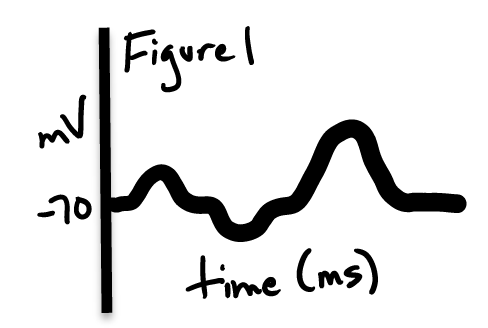
What can causes the graded potential in this action potential graph? There are two presynaptic neurons and one postsynaptic neuron
Homework Answers
Request Answer!
We need at least 10 more requests to produce the answer.
0 / 10 have requested this problem solution
The more requests, the faster the answer.
Add Answer to:
What can causes the graded potential in this action potential
graph? There are two presynaptic neurons...
Action Potential Action Potential (AP) arises in presynaptic neuron Travels to Causes End of presynaptic neuron...
 Action Potential Action Potential (AP) arises in presynaptic neuron Travels to Causes End of presynaptic neuron Leads to 2 Located in Excitatory Postsynaptic Potential begins at 6 Cl-gates open I s When Causing Depolarization to +30mV next opening 10 Nonmyelinated axons Myelinated axons Current spreads through each segment Current spreads by---- 11 Action Potential Word Bank ŠMU Auso Neurotransmitters bind to receptors K+ gates Ca++ gates open Hyperpolarization Saltatory Release of Neurotransmitters Postsynaptic neuron Repolarization -55mV Na+ gates open Inhibitory...
Fifteen different presynaptic neurons synapse on a single postsynaptic neuron. The postsynaptic neuron has a RMP...
 Fifteen different presynaptic neurons synapse on a single postsynaptic neuron. The postsynaptic neuron has a RMP of -70 mV. At the trigger zone, 14 of the presynaptic neurons produce excitatory postsynaptic potentials of 2 mV each, and the other one produces an inhibitory postsynaptic potential of 9 mV. The threshold for the postsynaptic neuron is -50 mV. Will action potentials be produced in the postsynaptic neuron? Is this an example of temporal summation or spatial summation? Explain your answers.
Complete the following sentences regarding impulse processing. nuclei presynaptic neuron divergence postsynaptic neurons action potential convergence...
Complete the following sentences regarding impulse processing. nuclei presynaptic neuron divergence postsynaptic neurons action potential convergence neuronal pools facilitation 1. Neurons are organized into ____________ which can make multiple synaptic connections to receive and transmit information in the brain. 2. For example, any single neuron in the group may receive information from more than one ____________ . 3. This is called ____________ and makes it possible for impulses to have an additive effect or to collect a variety of sensory information. 4. An impulse from...
4. Draw a synapse between 2 neurons. Label the following: Presynaptic neuron, Postsynaptic neuron, Synaptic vesicles,...
 4. Draw a synapse between 2 neurons. Label the following: Presynaptic neuron, Postsynaptic neuron, Synaptic vesicles, Voltage-regulated calcium channel, Chemical-regulated sodium channel. 5. Draw a diagram of the preganglionic neuron, postganglionic neuron, and effector for both Sympathetic Nervous System and Parasympathetic Nervous System. indicate which neurotransmitter is released by each neuron and label the receptors at all locations for the neurotransmitter. 6. Which cells have a resting membrane potential? Which cells can have an action potential? 7. Circle which of...
Very broadly speaking, how many presynaptic neurons synapse on a postsynaptic neuron? (one, a few or...
Very broadly speaking, how many presynaptic neurons synapse on a postsynaptic neuron? (one, a few or many)
Very broadly speaking, how many presynaptic neurons synapse on a postsynaptic neuron? (one, a few or...
Very broadly speaking, how many presynaptic neurons synapse on a postsynaptic neuron? (one, a few or many)
Ldlicu upon 16 What is the difference between a graded potential and an action potential? Where...
 Ldlicu upon 16 What is the difference between a graded potential and an action potential? Where would a praded potential occur in the neuron? An action potential? 16. The most widely used inhibitory neurotransmitter is This neurotransmitter opens up ion channels in the postsynaptic membrane. Ions rush (in/out) and bring the cell (closer to/further from) threshold level. 17. Label the following diagram with these terms: depolarization, repolarization, hyperpolarization, Na gates open, Na' gates closed, K gates open, K' gates closed,...
What is a synapse? Is the presynaptic cell always a neuron? Is the postsynaptic cell always...
 What is a synapse? Is the presynaptic cell always a neuron? Is the postsynaptic cell always a neuron? If not, what other cell type could it be? Assuming both the pre- and post-synaptic cells are neurons, which one releases active neurotransmitters into the synaptic cleft between them? 8. What are the three major functional classes of neurons that we discussed? Which is/ are found in the Peripheral Nervous System (PNS) and which is/are found in the Central Nerous System (CNS)?
Universidad ue Europea Action potential in neurons Dendrites Neurons (nerve cells) are the core components of...
 Universidad ue Europea Action potential in neurons Dendrites Neurons (nerve cells) are the core components of the nervous system. They provide critical functions such as control ling muscle activity, sensing thinking, remembering, and regulating glandular secretions. Soma Electrical signals and chemical messengers are used to transmit and receive information between them. The neurons consist of: Nclen Asos The cell body (soma) and its processes Dendrites: the branched projections of a neuron that act to propagate the electrochemical stimulation received from...
READ THIS WELL: If you answer with something stupid/inccorect (e.g. telling me what a depolarizat...
READ THIS WELL: If you answer with something stupid/inccorect (e.g. telling me what a depolarization is or telling me that a small postsynaptic cell helps a signal carry, I'll give you no credit) One property of electrical synapses is that the postsynaptic neuron tends to be smaller than the presynaptic neuron. Based on what you know about the relationship between neuron size and input resistance, what is the advantage of this arrangement? Please answer this in terms of Ohm's law...
 Action Potential Action Potential (AP) arises in presynaptic neuron Travels to Causes End of presynaptic neuron Leads to 2 Located in Excitatory Postsynaptic Potential begins at 6 Cl-gates open I s When Causing Depolarization to +30mV next opening 10 Nonmyelinated axons Myelinated axons Current spreads through each segment Current spreads by---- 11 Action Potential Word Bank ŠMU Auso Neurotransmitters bind to receptors K+ gates Ca++ gates open Hyperpolarization Saltatory Release of Neurotransmitters Postsynaptic neuron Repolarization -55mV Na+ gates open Inhibitory...
 Fifteen different presynaptic neurons synapse on a single postsynaptic neuron. The postsynaptic neuron has a RMP of -70 mV. At the trigger zone, 14 of the presynaptic neurons produce excitatory postsynaptic potentials of 2 mV each, and the other one produces an inhibitory postsynaptic potential of 9 mV. The threshold for the postsynaptic neuron is -50 mV. Will action potentials be produced in the postsynaptic neuron? Is this an example of temporal summation or spatial summation? Explain your answers.
 4. Draw a synapse between 2 neurons. Label the following: Presynaptic neuron, Postsynaptic neuron, Synaptic vesicles, Voltage-regulated calcium channel, Chemical-regulated sodium channel. 5. Draw a diagram of the preganglionic neuron, postganglionic neuron, and effector for both Sympathetic Nervous System and Parasympathetic Nervous System. indicate which neurotransmitter is released by each neuron and label the receptors at all locations for the neurotransmitter. 6. Which cells have a resting membrane potential? Which cells can have an action potential? 7. Circle which of...
 Ldlicu upon 16 What is the difference between a graded potential and an action potential? Where would a praded potential occur in the neuron? An action potential? 16. The most widely used inhibitory neurotransmitter is This neurotransmitter opens up ion channels in the postsynaptic membrane. Ions rush (in/out) and bring the cell (closer to/further from) threshold level. 17. Label the following diagram with these terms: depolarization, repolarization, hyperpolarization, Na gates open, Na' gates closed, K gates open, K' gates closed,...
 What is a synapse? Is the presynaptic cell always a neuron? Is the postsynaptic cell always a neuron? If not, what other cell type could it be? Assuming both the pre- and post-synaptic cells are neurons, which one releases active neurotransmitters into the synaptic cleft between them? 8. What are the three major functional classes of neurons that we discussed? Which is/ are found in the Peripheral Nervous System (PNS) and which is/are found in the Central Nerous System (CNS)?
 Universidad ue Europea Action potential in neurons Dendrites Neurons (nerve cells) are the core components of the nervous system. They provide critical functions such as control ling muscle activity, sensing thinking, remembering, and regulating glandular secretions. Soma Electrical signals and chemical messengers are used to transmit and receive information between them. The neurons consist of: Nclen Asos The cell body (soma) and its processes Dendrites: the branched projections of a neuron that act to propagate the electrochemical stimulation received from...
Most questions answered within 3 hours.
-
Where is the error in this code sequence?
String s1 = "Hello";
String s2 = "ello";...
asked 10 months ago -
Financial data for Joel de Paris, Inc., for last year
follow:
Joel de Paris, Inc.
Balance...
asked 10 months ago -
Consider this reaction:
Al2(SO4)3 (aq)+ BaCl3
(aq) Al2Cl6 (aq)- +
3BaSO4(s) . What is the...
asked 10 months ago -
Suppose that Savneet is considering increasing her
recent random sample from 20 car rentals to 40...
asked 10 months ago -
Trucks arrive at an unloading terminal at an average rate of 120
per hour.
Trucks arrive...
asked 10 months ago -
Why are methanol and ethanol completely soluble in water while
octanol is not very little soluble....
asked 10 months ago -
A facilities manager at a university reads in a research report
that the mean amount of...
asked 10 months ago -
When the CuSO4 is rehydrated by adding water to the anhydrous
compound, is this an endothermic...
asked 10 months ago -
A ray of sunlight is passing from diamond into crown glass; the
angle of incidence is...
asked 10 months ago -
A block of mass 0.249 kg is placed on top of a light, vertical
spring of...
asked 10 months ago -
how do the kidneys compensate in the presences of acidosis
a) trigger hyperventilate
b) reserve acid...
asked 10 months ago -
Question 501 pts
The rental rate of capital to the firm increases. Which of the
following...
asked 10 months ago