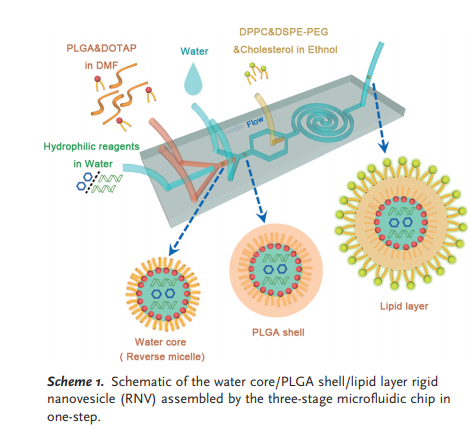
inlets for water sheaths and one straight channel. 3) The third stage has one center inlet for DPPC, DSPE-PEG, and cholesterol in ethanol and a spiral channel (Scheme 1 and Figure S1 in the Supporting Information). In this work, the flow rate ratio (FR) of side inlets to middle inlet at different stages is optimized for synthesis of RNV, and the production rate of RNV is 114 mgmin¢1 by the microfluidic chip (Supporting Information). The transmission electron microscopy (TEM) image of an assembled RNV collected from the outlet shows a hollow core–shell structure with a bright water core and an intact PLGA shell (Figure 1A). We use the positively charged DOTAP to form the reverse micelle as well as the inner surface of PLGA shell because DOTAP can interact with the negatively charged siRNA, thus ensuring an efficient encapsulation of siRNA inside the water core. Meanwhile, the lipids (DPPC, DSPE-PEG, and cholesterol) are assembled onto the outer surface of PLGA shell in the third stage of microfluidic chip, in order to achieve a longterm stabilization and a long circulation time. We first encapsulate hydrophilic reagents, such a
tell me why this happen in easier way and what is the principle ??what is PLGA use here????
and why reverse micelle formed??? and PLGA shell is oil phase???
Homework Answers
- PLGA - poly lactic co glycolic acid is used here because it can be easily taken up by the cells.
- If it is coupled with cancer drug can be effective in the treatment of cancer.
- Moreover , when PLGA is coupled with hydrophobic interior it is taken up by the cells easily compared to PLGA - lipid combination.
- When the drugs, nucleic acids and other hydrophilic reagents in treatment of anti cancer when injected have lifetime only for a short period.
- That is why the drugs are coupled with PLGA given in cancer treatment.
- The PLGA has outer lipid core which makes increased circulation time.
- Reverse micelles are formed because the outer region of the micelles which interacts with water when present in hydropilic surface and also at the same time contains hydrophobic drug inside it.
- This is the condition of the human body and micelles should stay in hydrophilic environment and should excert action .
- That is why reverse micelles are formed.
- Inside the PLGA shell it contains hydrophobic drugs and hence these drugs cannot interact with hydrophilic particles and hence the PLGA is in oil phase.
Add Answer to:
inlets for water sheaths and one straight channel. 3) The third
stage has one center inlet...
Most questions answered within 3 hours.
-
Where is the error in this code sequence?
String s1 = "Hello";
String s2 = "ello";...
asked 10 months ago -
Financial data for Joel de Paris, Inc., for last year
follow:
Joel de Paris, Inc.
Balance...
asked 10 months ago -
Consider this reaction:
Al2(SO4)3 (aq)+ BaCl3
(aq) Al2Cl6 (aq)- +
3BaSO4(s) . What is the...
asked 10 months ago -
Suppose that Savneet is considering increasing her
recent random sample from 20 car rentals to 40...
asked 10 months ago -
Trucks arrive at an unloading terminal at an average rate of 120
per hour.
Trucks arrive...
asked 10 months ago -
Why are methanol and ethanol completely soluble in water while
octanol is not very little soluble....
asked 10 months ago -
A facilities manager at a university reads in a research report
that the mean amount of...
asked 10 months ago -
When the CuSO4 is rehydrated by adding water to the anhydrous
compound, is this an endothermic...
asked 10 months ago -
A ray of sunlight is passing from diamond into crown glass; the
angle of incidence is...
asked 10 months ago -
A block of mass 0.249 kg is placed on top of a light, vertical
spring of...
asked 10 months ago -
how do the kidneys compensate in the presences of acidosis
a) trigger hyperventilate
b) reserve acid...
asked 10 months ago -
Question 501 pts
The rental rate of capital to the firm increases. Which of the
following...
asked 10 months ago