Provide the missing compounds for each step in the following
synthesis. Please use Br as your leaving group, should you require
one. Be sure to show stereochemistry explicitly where necessary,
using wedges and dashes.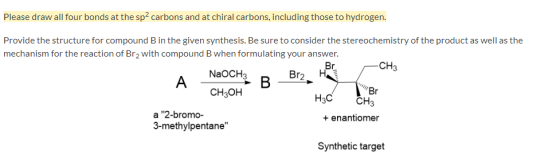

Homework Answers

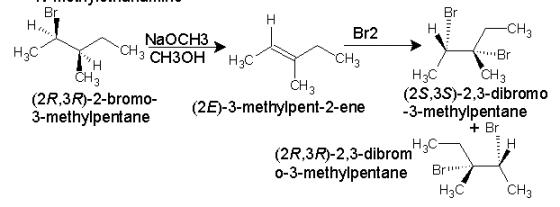
The first step 2-Bromo-3-methyl pentane undergoes elimination reaction via E2 mechanism. Which gives the product B: 2E-3-methylpent-2-ene. Upon bromination of "B" it gives a mixture of enantiomers as it goes via cyclic bromonium ion intermediate.
Add Answer to:
Provide the missing compounds for each step in the following
synthesis. Please use Br as your...
provide the missing reagent(s) for the following synthesis problems. if more than one step is required,...
 provide the missing reagent(s) for the following synthesis
problems. if more than one step is required, be sure to number the
reagents to indicate which ones go in each step. if there is more
than one step, please draw each synthetic step separately and
provide the product of each step.
I OH Br you - 5.
provide the missing reagent(s) for the following synthesis
problems. if more than one step is required, be sure to number the
reagents to indicate which ones go in each step. if there is more
than one step, please draw each synthetic step separately and
provide the product of each step.
I OH Br you - 5.
please explain the work 1. Predict the major organic product for each of the following elimination...
 please explain the work
1. Predict the major organic product for each of the following elimination reactions, and indicate whether each one occurs via the E1 or the E2 mechanism. Be sure to clearly indicate the proper stereochemical relationships between groups (if appropriate), and write the word "racemic" under any compound that is formed as a racemic mixture. Br H3CY CH3 NaOCH3. CH3OH OH يلي H2SO4 ما H3c OTS KOt-Bu t-BuOH AgNO3 H20 Ph HC, NaOH H2O OH H2SO4
please explain the work
1. Predict the major organic product for each of the following elimination reactions, and indicate whether each one occurs via the E1 or the E2 mechanism. Be sure to clearly indicate the proper stereochemical relationships between groups (if appropriate), and write the word "racemic" under any compound that is formed as a racemic mixture. Br H3CY CH3 NaOCH3. CH3OH OH يلي H2SO4 ما H3c OTS KOt-Bu t-BuOH AgNO3 H20 Ph HC, NaOH H2O OH H2SO4
please answer questions 5-8 Question 5 What is the systematic name of the following compound? Br CH3 CEC CH2 CCH...
 please answer questions 5-8
Question 5 What is the systematic name of the following compound? Br CH3 CEC CH2 CCH3 Cнз 2-bromo-2-methyl-4-hexyne 3-bromo-5-heptyne 5-bromo-2-heptyne 5-bromo-5,5-dimethylhexyne 5-bromo-5-methyl-2-hexyne Question 6 What is the hybridization of the carbons numbered 1 and 2, respectively? -CH CH-C CH 1 2 sp, sp sp, sp2 sp2 sp2 Osp2. sp sp3 sp2 Question 7 The carbon-carbon triple bond of an alkyne is composed of three a bonds Othree Tt bonds two o bonds and one Tt bond...
please answer questions 5-8
Question 5 What is the systematic name of the following compound? Br CH3 CEC CH2 CCH3 Cнз 2-bromo-2-methyl-4-hexyne 3-bromo-5-heptyne 5-bromo-2-heptyne 5-bromo-5,5-dimethylhexyne 5-bromo-5-methyl-2-hexyne Question 6 What is the hybridization of the carbons numbered 1 and 2, respectively? -CH CH-C CH 1 2 sp, sp sp, sp2 sp2 sp2 Osp2. sp sp3 sp2 Question 7 The carbon-carbon triple bond of an alkyne is composed of three a bonds Othree Tt bonds two o bonds and one Tt bond...
please explain the work for both questions please 1. Predict the major organic product for each...
 please explain the work for both questions please
1. Predict the major organic product for each of the following elimination reactions, and indicate whether each one occurs via the E1 or the E2 mechanism. Be sure to clearly indicate the proper stereochemical relationships between groups (if appropriate), and write the word “racemic” under any compound that is formed as a racemic mixture. Br AgNO3 H2O KOt-Bu H3CCH3 H36Br t-BuOH OTS NaOCH3 CH3OH CH3 NaOH H20 2. Draw all possible E2...
please explain the work for both questions please
1. Predict the major organic product for each of the following elimination reactions, and indicate whether each one occurs via the E1 or the E2 mechanism. Be sure to clearly indicate the proper stereochemical relationships between groups (if appropriate), and write the word “racemic” under any compound that is formed as a racemic mixture. Br AgNO3 H2O KOt-Bu H3CCH3 H36Br t-BuOH OTS NaOCH3 CH3OH CH3 NaOH H20 2. Draw all possible E2...
6. Provide the IUPAC names for the compounds below Name: 7. Draw the following: cis-1-isobutyl-2-propyleyclopentane 8....
 6. Provide the IUPAC names for the compounds below Name: 7. Draw the following: cis-1-isobutyl-2-propyleyclopentane 8. Label the indicated atoms in the structure below as 1º, 2º, 3º, or 4º. PB A A B co 9. Draw Newman projections for the day-diethylane about the C4CS bond, Circle the most stable conforme if you need additional space, please feel free to the backside of this paper 10. Draw the chair conformation and ring-flip for the given compound. Calculate the sterie strain...
Can you please answer all of them? Section B: Free Response (you must show your work...
 Can you please answer all of them?
Section B: Free Response (you must show your work for full credit) 1. Draw Frost circle diagrams for each compound shown. Assume that all atoms in the ring are sp2 hybridized. Populate the pi electrons in the corresponding MO's. Identify the compound as aromatic or antiaromatic. (5 pts) 2. What is the Hückel number of pi electrons for the molecule shown below? How many pi electron pairs does it have? Would you expect...
Can you please answer all of them?
Section B: Free Response (you must show your work for full credit) 1. Draw Frost circle diagrams for each compound shown. Assume that all atoms in the ring are sp2 hybridized. Populate the pi electrons in the corresponding MO's. Identify the compound as aromatic or antiaromatic. (5 pts) 2. What is the Hückel number of pi electrons for the molecule shown below? How many pi electron pairs does it have? Would you expect...
Please complete for Tuesday, we will go through the questions and mark them in class. pg 156 - 4.23,...
 Please complete for Tuesday, we will go through the questions and mark them in class. pg 156 - 4.23, 4.24, 4.26 pg 170 - 4.29, 4.31, pg 171-4.36 pg 175 - 4.59 pg 176- 4.74, 4.75, 4.80 pg 177-4.81, 4.82 pg 188- 5.1, 5.4, 5.5, 5.6, 5.11 - Using Table 5.1 pg 198-5.22, 5.25 pg 203 - 5.29 pg 206 - 5.37 pg 209 - 5.39 pg 2.14 5.61 pg 235-6.11, 6.14, 6.16 156 CHAPTER 4 Introduction to Organic Compounds...
 provide the missing reagent(s) for the following synthesis
problems. if more than one step is required, be sure to number the
reagents to indicate which ones go in each step. if there is more
than one step, please draw each synthetic step separately and
provide the product of each step.
I OH Br you - 5.
provide the missing reagent(s) for the following synthesis
problems. if more than one step is required, be sure to number the
reagents to indicate which ones go in each step. if there is more
than one step, please draw each synthetic step separately and
provide the product of each step.
I OH Br you - 5.
 please explain the work
1. Predict the major organic product for each of the following elimination reactions, and indicate whether each one occurs via the E1 or the E2 mechanism. Be sure to clearly indicate the proper stereochemical relationships between groups (if appropriate), and write the word "racemic" under any compound that is formed as a racemic mixture. Br H3CY CH3 NaOCH3. CH3OH OH يلي H2SO4 ما H3c OTS KOt-Bu t-BuOH AgNO3 H20 Ph HC, NaOH H2O OH H2SO4
please explain the work
1. Predict the major organic product for each of the following elimination reactions, and indicate whether each one occurs via the E1 or the E2 mechanism. Be sure to clearly indicate the proper stereochemical relationships between groups (if appropriate), and write the word "racemic" under any compound that is formed as a racemic mixture. Br H3CY CH3 NaOCH3. CH3OH OH يلي H2SO4 ما H3c OTS KOt-Bu t-BuOH AgNO3 H20 Ph HC, NaOH H2O OH H2SO4
 please answer questions 5-8
Question 5 What is the systematic name of the following compound? Br CH3 CEC CH2 CCH3 Cнз 2-bromo-2-methyl-4-hexyne 3-bromo-5-heptyne 5-bromo-2-heptyne 5-bromo-5,5-dimethylhexyne 5-bromo-5-methyl-2-hexyne Question 6 What is the hybridization of the carbons numbered 1 and 2, respectively? -CH CH-C CH 1 2 sp, sp sp, sp2 sp2 sp2 Osp2. sp sp3 sp2 Question 7 The carbon-carbon triple bond of an alkyne is composed of three a bonds Othree Tt bonds two o bonds and one Tt bond...
please answer questions 5-8
Question 5 What is the systematic name of the following compound? Br CH3 CEC CH2 CCH3 Cнз 2-bromo-2-methyl-4-hexyne 3-bromo-5-heptyne 5-bromo-2-heptyne 5-bromo-5,5-dimethylhexyne 5-bromo-5-methyl-2-hexyne Question 6 What is the hybridization of the carbons numbered 1 and 2, respectively? -CH CH-C CH 1 2 sp, sp sp, sp2 sp2 sp2 Osp2. sp sp3 sp2 Question 7 The carbon-carbon triple bond of an alkyne is composed of three a bonds Othree Tt bonds two o bonds and one Tt bond...
 please explain the work for both questions please
1. Predict the major organic product for each of the following elimination reactions, and indicate whether each one occurs via the E1 or the E2 mechanism. Be sure to clearly indicate the proper stereochemical relationships between groups (if appropriate), and write the word “racemic” under any compound that is formed as a racemic mixture. Br AgNO3 H2O KOt-Bu H3CCH3 H36Br t-BuOH OTS NaOCH3 CH3OH CH3 NaOH H20 2. Draw all possible E2...
please explain the work for both questions please
1. Predict the major organic product for each of the following elimination reactions, and indicate whether each one occurs via the E1 or the E2 mechanism. Be sure to clearly indicate the proper stereochemical relationships between groups (if appropriate), and write the word “racemic” under any compound that is formed as a racemic mixture. Br AgNO3 H2O KOt-Bu H3CCH3 H36Br t-BuOH OTS NaOCH3 CH3OH CH3 NaOH H20 2. Draw all possible E2...
 6. Provide the IUPAC names for the compounds below Name: 7. Draw the following: cis-1-isobutyl-2-propyleyclopentane 8. Label the indicated atoms in the structure below as 1º, 2º, 3º, or 4º. PB A A B co 9. Draw Newman projections for the day-diethylane about the C4CS bond, Circle the most stable conforme if you need additional space, please feel free to the backside of this paper 10. Draw the chair conformation and ring-flip for the given compound. Calculate the sterie strain...
 Can you please answer all of them?
Section B: Free Response (you must show your work for full credit) 1. Draw Frost circle diagrams for each compound shown. Assume that all atoms in the ring are sp2 hybridized. Populate the pi electrons in the corresponding MO's. Identify the compound as aromatic or antiaromatic. (5 pts) 2. What is the Hückel number of pi electrons for the molecule shown below? How many pi electron pairs does it have? Would you expect...
Can you please answer all of them?
Section B: Free Response (you must show your work for full credit) 1. Draw Frost circle diagrams for each compound shown. Assume that all atoms in the ring are sp2 hybridized. Populate the pi electrons in the corresponding MO's. Identify the compound as aromatic or antiaromatic. (5 pts) 2. What is the Hückel number of pi electrons for the molecule shown below? How many pi electron pairs does it have? Would you expect...
 Please complete for Tuesday, we will go through the questions and mark them in class. pg 156 - 4.23, 4.24, 4.26 pg 170 - 4.29, 4.31, pg 171-4.36 pg 175 - 4.59 pg 176- 4.74, 4.75, 4.80 pg 177-4.81, 4.82 pg 188- 5.1, 5.4, 5.5, 5.6, 5.11 - Using Table 5.1 pg 198-5.22, 5.25 pg 203 - 5.29 pg 206 - 5.37 pg 209 - 5.39 pg 2.14 5.61 pg 235-6.11, 6.14, 6.16 156 CHAPTER 4 Introduction to Organic Compounds...
Most questions answered within 3 hours.
-
Where is the error in this code sequence?
String s1 = "Hello";
String s2 = "ello";...
asked 10 months ago -
Financial data for Joel de Paris, Inc., for last year
follow:
Joel de Paris, Inc.
Balance...
asked 10 months ago -
Consider this reaction:
Al2(SO4)3 (aq)+ BaCl3
(aq) Al2Cl6 (aq)- +
3BaSO4(s) . What is the...
asked 10 months ago -
Suppose that Savneet is considering increasing her
recent random sample from 20 car rentals to 40...
asked 10 months ago -
Trucks arrive at an unloading terminal at an average rate of 120
per hour.
Trucks arrive...
asked 10 months ago -
Why are methanol and ethanol completely soluble in water while
octanol is not very little soluble....
asked 10 months ago -
A facilities manager at a university reads in a research report
that the mean amount of...
asked 10 months ago -
When the CuSO4 is rehydrated by adding water to the anhydrous
compound, is this an endothermic...
asked 10 months ago -
A ray of sunlight is passing from diamond into crown glass; the
angle of incidence is...
asked 10 months ago -
A block of mass 0.249 kg is placed on top of a light, vertical
spring of...
asked 10 months ago -
how do the kidneys compensate in the presences of acidosis
a) trigger hyperventilate
b) reserve acid...
asked 10 months ago -
Question 501 pts
The rental rate of capital to the firm increases. Which of the
following...
asked 10 months ago