It is said that walking at a comfortable speed
2. It is said that walking at a comfortable speed involves a pendulum-like motion of your legs. We want to see how good this claim is quantitatively.
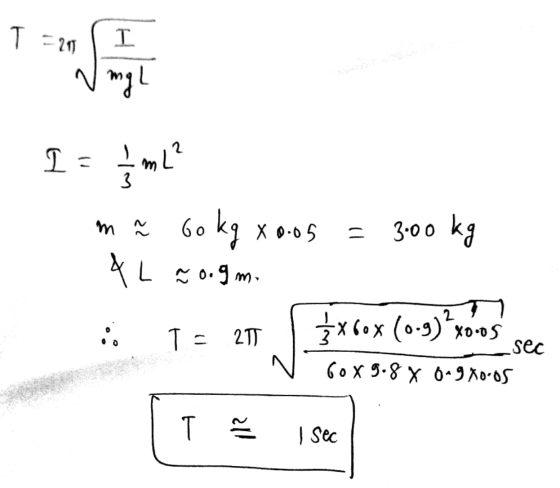
(A) First we are going to predict your gait. The legs are not a SIMPLE pendulum, in that all the mass is not concentrated at your foot, but is distributed. For such a pendulum the period T is given by the equation T = 2π √(I/mgL) where I is the moment of inertia. m is the mass of the pendulum; L is its length. As you recall, for a uniform rod, I=1/3 mL 2 This is a tough estimation because you know your leg has more mass at the thigh than the ankles, but for the moment, it's going to be our best guess. Now m is not your whole mass, but the mass of your leg, which is typically about 5% of your m. So, with a ruler and a scale, make a PREDICTION of the period of your leg as it swings in a walking motion.
(B) CHECK your prediction! Time yourself (or do it with a friend, more fun) walking 20 steps. Now there's just one more little trick here. If you watch carefully, a "step" is only half a cycle, since the leg must then swing back. So 20 steps = 10 cycles. Take the time you measure for 20 steps, divide by 10, and see if you are any where near the prediction from part A.
Note that because of your length of leg and weight, everybody can have a different answer to this question!
Homework Answers
Pendulum Clocks Are Very Important...
 1. Pendulum clocks are very important for the history of exploration. Accurate time was the best way to determine one's longitude, since the time of sunrise or sunset depends sensitively on your longitude. In this regard, the great enemy of accuracy was thermal expansion of the pendulum used for the chronometer. We are considering a large mass attached at the end of a brass rod. The mass at the end is much greater than the mass of the rod, so we...
Many aspects of a gymnast's motion can be modeled by representing the gymnast by four segments consisting of arms, torso (including the head), highs, and lower legs, as in the figure below Thigh...
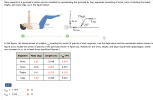 Many aspects of a gymnast's motion can be modeled by representing the gymnast by four segments consisting of arms, torso (including the head), highs, and lower legs, as in the figure below Thigh Leg rm Torso In the figure, (b) shows arrows of lengths rca locating the center of gravity of each segment. Use the data below and the coordinate system shown in figure (b) to locate the center of gravity of the gymnast shown in figure (a). Masses for...
An elephant's legs have a reasonably uniform cross section from top to bottom, and they are...
An elephant's legs have a reasonably uniform cross section from top to bottom, and they are quite long, pivoting high on the animal's body. When an elephant moves at a walk, it uses very little energy to bring its legs forward, simply allowing them to swing like pendulums. For fluid walking motion, this time should be half the time for a complete stride; as soon as the right leg finishes swinging forward, the elephant plants the right foot and begins...
a) Look at example 15.9 (in the ppt lecture for chapter 15, slides 82-84) in which...
 a) Look at example 15.9 (in the ppt lecture for chapter 15, slides 82-84) in which a leg is modelled as a physical pendulum. Measure your own arm, and using the same kind of model, estimate the natural period of oscillation for swinging your arms as you walk. b) Now estimate the period of oscillation of your arm if you are carrying a heavy briefcase. You can pick the measure of the arm c) Observe other people (or have a...
As you walk, the upper part of your body moves up and down with approximately simple harmonic motion. The smaller the amplitude of this motion the smaller the force you put on your joints and, of course, the more graceful is your walk. If you managed to
As you walk, the upper part of your body moves up and down with approximately simple harmonic motion. The smaller the amplitude of this motion the smaller the force you put on your joints and, of course, the more graceful is your walk. If you managed to develop your walk so that you have kept the amplitude down to 1.60 cm, what is the maximum acceleration of your body, in units of g = 9.80 m/s2, when you are walking at your...
Xosin(ot) Shown in the figure below is a rigid pendulum bar of I= 1 m and...
 Xosin(ot) Shown in the figure below is a rigid pendulum bar of I= 1 m and mass m, 1 kg attached to a roller, of mass m, = 0.2 kg, whose motion is described by X, sin(@t), Xo = 1 [m]. Model the pendulum bar as a uniform slender rod which has a moment of inertia with respect to its mass centre Ig given by m1/12. Use tangential-normal coordinate system to analyze the dynamics of the pendulum bar and use...
11. + -12 points SerCP10 8.P.016. 0/4 Submissions Used My Notes + Ask Your Teacher Many...
 11. + -12 points SerCP10 8.P.016. 0/4 Submissions Used My Notes + Ask Your Teacher Many of the elements in horizontal-bar exercises can be modeled by representing the gymnast by four segments consisting of arms, torso (including the head), thighs, and lower legs, as shown in Figure b. Inertial parameters for a particular gymnast are as follows. Segment Mass(kg) Arms 6.87 Torso 34.40 Thighs 13.30 Legs 7.36 Length (m) 0.530 0.601 0.374 cg (m) 0.239 0.337 0.151 1(kg • m)...
please guys this is one question with 2 parts. A student sits on a freely rotating...
 please guys this is one question with 2
parts.
A student sits on a freely rotating stool holding two dumbbells, each of mass 3.05 kg (see figure below). When his arms are extended horizontally (Figure a), the dumbbells are 1.07 m from the axis of rotation and the student rotates with an angular speed of 0.740 rad's. The moment of inertia of the student plus stool is 2.57 kg: m2 and is assumed to be constant. The student pulls the...
please guys this is one question with 2
parts.
A student sits on a freely rotating stool holding two dumbbells, each of mass 3.05 kg (see figure below). When his arms are extended horizontally (Figure a), the dumbbells are 1.07 m from the axis of rotation and the student rotates with an angular speed of 0.740 rad's. The moment of inertia of the student plus stool is 2.57 kg: m2 and is assumed to be constant. The student pulls the...
The Hominins Beginning in the late Miocene and into the early Pliocene, upright walking tendencies began to develop amon...
The Hominins Beginning in the late Miocene and into the early Pliocene, upright walking tendencies began to develop among the hominin tribe. Upright walking tendencies slowly transformed into obligate bipedalism during the pliocene within the hominin lineage. This shift in locomotor strategy is notably marked by the gradual change in arm to leg ratio that we see when comparing early and later hominins. Early hominins have short legs and very long arms while later hominins have longer legs and short...
Many aspects of a gymnast's motion can be modeled by representing the gymnast by four segments...
 Many aspects of a gymnast's motion can be modeled by
representing the gymnast by four segments consisting of arms, torso
(including the head), thighs, and lower legs, as in the figure
below.
Figures a and b
describe a gymnast's motion as he swings about a bar.
A side-view of the gymnast as he swings about the bar. The
gymnast's back is horizontal, his arms are vertical, his thighs are
at an angle of 60° to the horizontal, and his lower...
Many aspects of a gymnast's motion can be modeled by
representing the gymnast by four segments consisting of arms, torso
(including the head), thighs, and lower legs, as in the figure
below.
Figures a and b
describe a gymnast's motion as he swings about a bar.
A side-view of the gymnast as he swings about the bar. The
gymnast's back is horizontal, his arms are vertical, his thighs are
at an angle of 60° to the horizontal, and his lower...
 Many aspects of a gymnast's motion can be modeled by representing the gymnast by four segments consisting of arms, torso (including the head), highs, and lower legs, as in the figure below Thigh Leg rm Torso In the figure, (b) shows arrows of lengths rca locating the center of gravity of each segment. Use the data below and the coordinate system shown in figure (b) to locate the center of gravity of the gymnast shown in figure (a). Masses for...
 a) Look at example 15.9 (in the ppt lecture for chapter 15, slides 82-84) in which a leg is modelled as a physical pendulum. Measure your own arm, and using the same kind of model, estimate the natural period of oscillation for swinging your arms as you walk. b) Now estimate the period of oscillation of your arm if you are carrying a heavy briefcase. You can pick the measure of the arm c) Observe other people (or have a...
 Xosin(ot) Shown in the figure below is a rigid pendulum bar of I= 1 m and mass m, 1 kg attached to a roller, of mass m, = 0.2 kg, whose motion is described by X, sin(@t), Xo = 1 [m]. Model the pendulum bar as a uniform slender rod which has a moment of inertia with respect to its mass centre Ig given by m1/12. Use tangential-normal coordinate system to analyze the dynamics of the pendulum bar and use...
 11. + -12 points SerCP10 8.P.016. 0/4 Submissions Used My Notes + Ask Your Teacher Many of the elements in horizontal-bar exercises can be modeled by representing the gymnast by four segments consisting of arms, torso (including the head), thighs, and lower legs, as shown in Figure b. Inertial parameters for a particular gymnast are as follows. Segment Mass(kg) Arms 6.87 Torso 34.40 Thighs 13.30 Legs 7.36 Length (m) 0.530 0.601 0.374 cg (m) 0.239 0.337 0.151 1(kg • m)...
 please guys this is one question with 2
parts.
A student sits on a freely rotating stool holding two dumbbells, each of mass 3.05 kg (see figure below). When his arms are extended horizontally (Figure a), the dumbbells are 1.07 m from the axis of rotation and the student rotates with an angular speed of 0.740 rad's. The moment of inertia of the student plus stool is 2.57 kg: m2 and is assumed to be constant. The student pulls the...
please guys this is one question with 2
parts.
A student sits on a freely rotating stool holding two dumbbells, each of mass 3.05 kg (see figure below). When his arms are extended horizontally (Figure a), the dumbbells are 1.07 m from the axis of rotation and the student rotates with an angular speed of 0.740 rad's. The moment of inertia of the student plus stool is 2.57 kg: m2 and is assumed to be constant. The student pulls the...
 Many aspects of a gymnast's motion can be modeled by
representing the gymnast by four segments consisting of arms, torso
(including the head), thighs, and lower legs, as in the figure
below.
Figures a and b
describe a gymnast's motion as he swings about a bar.
A side-view of the gymnast as he swings about the bar. The
gymnast's back is horizontal, his arms are vertical, his thighs are
at an angle of 60° to the horizontal, and his lower...
Many aspects of a gymnast's motion can be modeled by
representing the gymnast by four segments consisting of arms, torso
(including the head), thighs, and lower legs, as in the figure
below.
Figures a and b
describe a gymnast's motion as he swings about a bar.
A side-view of the gymnast as he swings about the bar. The
gymnast's back is horizontal, his arms are vertical, his thighs are
at an angle of 60° to the horizontal, and his lower...
Most questions answered within 3 hours.
-
Where is the error in this code sequence?
String s1 = "Hello";
String s2 = "ello";...
asked 10 months ago -
Financial data for Joel de Paris, Inc., for last year
follow:
Joel de Paris, Inc.
Balance...
asked 10 months ago -
Consider this reaction:
Al2(SO4)3 (aq)+ BaCl3
(aq) Al2Cl6 (aq)- +
3BaSO4(s) . What is the...
asked 10 months ago -
Suppose that Savneet is considering increasing her
recent random sample from 20 car rentals to 40...
asked 10 months ago -
Trucks arrive at an unloading terminal at an average rate of 120
per hour.
Trucks arrive...
asked 10 months ago -
Why are methanol and ethanol completely soluble in water while
octanol is not very little soluble....
asked 10 months ago -
A facilities manager at a university reads in a research report
that the mean amount of...
asked 10 months ago -
When the CuSO4 is rehydrated by adding water to the anhydrous
compound, is this an endothermic...
asked 10 months ago -
A ray of sunlight is passing from diamond into crown glass; the
angle of incidence is...
asked 10 months ago -
A block of mass 0.249 kg is placed on top of a light, vertical
spring of...
asked 10 months ago -
how do the kidneys compensate in the presences of acidosis
a) trigger hyperventilate
b) reserve acid...
asked 10 months ago -
Question 501 pts
The rental rate of capital to the firm increases. Which of the
following...
asked 10 months ago