
Homework Answers
Add Answer to:
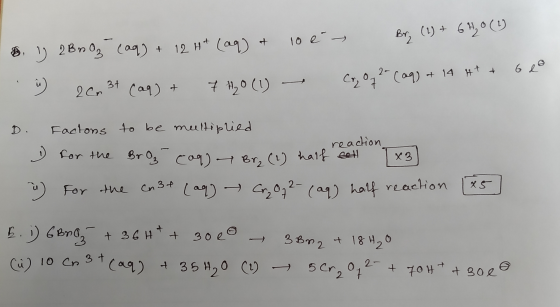
D. Factors to be multiplied (write the digits): i. For the Broz (aq) + Brą(1) half...
Use the following half-reactions to write 3 spontaneous reactions, calculate E°cell for each reaction, what is...
 Use the following half-reactions to write 3 spontaneous
reactions, calculate E°cell for each reaction, what is
the n number (number of electrons transferred).
Au+ (aq) + e− → Au
(s) E° = 1.69
V
N2O (g) + 2H+ (aq) + 2 e− →
N2 (g) + H2O (l) E° =
1.77 V
Cr3+ (aq) + 3 e− → Cr
(s) E° = -0.74 V
Question 7 0.36 pts Use the following half-reactions to write 3 spontaneous reactions, calculate Eºcell for...
Use the following half-reactions to write 3 spontaneous
reactions, calculate E°cell for each reaction, what is
the n number (number of electrons transferred).
Au+ (aq) + e− → Au
(s) E° = 1.69
V
N2O (g) + 2H+ (aq) + 2 e− →
N2 (g) + H2O (l) E° =
1.77 V
Cr3+ (aq) + 3 e− → Cr
(s) E° = -0.74 V
Question 7 0.36 pts Use the following half-reactions to write 3 spontaneous reactions, calculate Eºcell for...
Write the half-reactions and the net ionic equations for these complete redox reactions 4 2NaCl (aq) + Br: (I) Cl:...
 Write the half-reactions and the net ionic equations for these complete redox reactions 4 2NaCl (aq) + Br: (I) Cl: (g)2NaBr (aq) a) Oxidation half-reaction: Reduction half-reaction: CrCls (aq)+ Au (s) AuCl3(aq) Cr (s) - b) Oxidation half-reaction: Reduction half-reaction: Identify the oxidizing agent and the reducing agent in these complete redox reactions: 5. 5SO2-2Mn2+ 5so +3H2O a) 2MnO, +6H A) MnO B) So2 C) Mn2 D) SO E) H Oxidizing agent: b) 5Fe2 (aq) + MnO4 (ag) +8H'(aq)-5Fe (ag)+...
1. (a) Balance the following half-reactions by the ion-electron half-reaction method: (i) (acid solution) HSO3- (aq)...
 1. (a) Balance the following half-reactions by the ion-electron half-reaction method: (i) (acid solution) HSO3- (aq) → SO42- (aq) (ii) (acid solution) Pu(OH)4 (8) ► Pu+ (aq) (iii) (base solution) CN- (aq) → OCN- (aq) (iv) (base solution) RhO42- (aq) → Rh,03 (s) (b) Which of the above equations are oxidation half-reactions? (c) Give the formulas of the reactants that become oxidized in the course of the reactic Balance the following redox equations by the ion-electron half-reaction method: (a) (acid...
2. Balance the following reaction that occurs in acid, using the half-reaction method. I-1(aq) + CrO4-1(aq)...
2. Balance the following reaction that occurs in acid, using the half-reaction method. I-1(aq) + CrO4-1(aq) --> I2(s) + Cr+3(aq) When this reaction is balanced, there will be (?) H+(aq) and (?) H2O(l) in the final balanced equation. (Enter numbers without the plus sign.)
Part III: Oxidation and Reduction of H2O2 1. Reduction of H2O2: H2O2(aq) + Cr(OH)3(S) (BASIC) •...
 Part III: Oxidation and Reduction of H2O2 1. Reduction of H2O2: H2O2(aq) + Cr(OH)3(S) (BASIC) • Observations · Evidence of the oxidation of Cr3+ • Reduction Half Reaction • Oxidation Half Reaction • Overall Balanced Redox Reaction · Explain occurrence or non-occurrence of reaction by calculating cell. 2. Oxidation of H2O2: H2O2(aq) + FeCl3(aq) • Observations • Evidence of the oxidation of H2O2 • Reduction Half Reaction • Oxidation Half Reaction • Overall Balanced Redox Reaction • Explain occurrence or...
Consider the following half-reactions: Half-reaction E° (V) F2(g) +2e - →2F (aq) 2.870V 2H*(aq) + 2e...
 Consider the following half-reactions: Half-reaction E° (V) F2(g) +2e - →2F (aq) 2.870V 2H*(aq) + 2e - H2(g) 0.000V Cr3+ (aq) + 3e — Cr(s) -0.740V (1) The strongest oxidizing agent is: enter formula (2) The weakest oxidizing agent is: (3) The weakest reducing agent is: (4) The strongest reducing agent is: (5) Will F2(g) oxidize Cr(s) to Cr3+ (aq)? (6) Which species can be oxidized by H(aq)? If none, leave box blank.
1. (a) Balance the following half-reactions by the ion-electron half-reaction method: (i) (acid solution) BiO;- (aq)...
 1. (a) Balance the following half-reactions by the ion-electron half-reaction method: (i) (acid solution) BiO;- (aq) → BIO+ (aq) (ii) (acid solution) C002 (s) → Co2+ (aq) (iii) (base solution) Cr(OH).- (aq) → CrO2- (aq) (iv) (base solution) TeO 2- (aq) → H.Te0.2- (aq) (b) Which of the above equations are oxidation half-reactions? (c) Give the formulas of the reactants that become oxidized in the course of the reaction.
Given the following half-cell potentials, i. Zn2+ + 2 e– → Zn (E° = –0.76 V)...
Given the following half-cell potentials, i. Zn2+ + 2 e– → Zn (E° = –0.76 V) ii. Cr3+ + 3 e– → Cr (E° = –0.74 V) determine the cell potential whose overall redox reaction under standard conditions is 3 Zn(s) + 2 Cr3+(aq) → 3 Zn2+(aq) + 2 Cr(s): * A. –0.80 V B. –0.02 V C. +0.02 V D. +0.80 V
10. You want to know the standard reduction potential for the Cr* (aq)|Cr(s) half- reaction Cr3...
 10. You want to know the standard reduction potential for the Cr* (aq)|Cr(s) half- reaction Cr3 + (aq) + 3e-→ Cr(s) y, your textbook only lists the following data for chromium: Cr3+ (aq) + e-→ Cr2+ (aq) Cr2+ (aq) + 2e-→ Cr(s) E' =-0.424 V E' =-0.900 V What is the standard reduction potential for the Cr (a)Cr(s) half-reaction at 25 °C? A)-0.741 V B)-1.324 V C) 0.382V D)-0.141 V E) 0.476 V
Table 20.2 Half-reaction E° (V) Cr3+ (aq) + 3e- → Cr (s) -0.74 Fe2+ (aq) +...
 Table 20.2 Half-reaction E° (V) Cr3+ (aq) + 3e- → Cr (s) -0.74 Fe2+ (aq) + 2e- Fe () -0.440 Fe3+ (aq) + e- → Fe2+ (s) +0.771 Sn4+ (aq) + 2e- Sn2+ (aq) +0.154 The standard cell potential (Eºcell) for the voltaic cell based on the reaction below is V. Cr (s) + 3Fe3+ (aq) + 3Fe2+ (aq) + Cr3+ (aq) A) -1.45 B) +2.99 C) +1.51 D) +3.05 E) +1.57
 Use the following half-reactions to write 3 spontaneous
reactions, calculate E°cell for each reaction, what is
the n number (number of electrons transferred).
Au+ (aq) + e− → Au
(s) E° = 1.69
V
N2O (g) + 2H+ (aq) + 2 e− →
N2 (g) + H2O (l) E° =
1.77 V
Cr3+ (aq) + 3 e− → Cr
(s) E° = -0.74 V
Question 7 0.36 pts Use the following half-reactions to write 3 spontaneous reactions, calculate Eºcell for...
Use the following half-reactions to write 3 spontaneous
reactions, calculate E°cell for each reaction, what is
the n number (number of electrons transferred).
Au+ (aq) + e− → Au
(s) E° = 1.69
V
N2O (g) + 2H+ (aq) + 2 e− →
N2 (g) + H2O (l) E° =
1.77 V
Cr3+ (aq) + 3 e− → Cr
(s) E° = -0.74 V
Question 7 0.36 pts Use the following half-reactions to write 3 spontaneous reactions, calculate Eºcell for...
 Write the half-reactions and the net ionic equations for these complete redox reactions 4 2NaCl (aq) + Br: (I) Cl: (g)2NaBr (aq) a) Oxidation half-reaction: Reduction half-reaction: CrCls (aq)+ Au (s) AuCl3(aq) Cr (s) - b) Oxidation half-reaction: Reduction half-reaction: Identify the oxidizing agent and the reducing agent in these complete redox reactions: 5. 5SO2-2Mn2+ 5so +3H2O a) 2MnO, +6H A) MnO B) So2 C) Mn2 D) SO E) H Oxidizing agent: b) 5Fe2 (aq) + MnO4 (ag) +8H'(aq)-5Fe (ag)+...
 1. (a) Balance the following half-reactions by the ion-electron half-reaction method: (i) (acid solution) HSO3- (aq) → SO42- (aq) (ii) (acid solution) Pu(OH)4 (8) ► Pu+ (aq) (iii) (base solution) CN- (aq) → OCN- (aq) (iv) (base solution) RhO42- (aq) → Rh,03 (s) (b) Which of the above equations are oxidation half-reactions? (c) Give the formulas of the reactants that become oxidized in the course of the reactic Balance the following redox equations by the ion-electron half-reaction method: (a) (acid...
 Part III: Oxidation and Reduction of H2O2 1. Reduction of H2O2: H2O2(aq) + Cr(OH)3(S) (BASIC) • Observations · Evidence of the oxidation of Cr3+ • Reduction Half Reaction • Oxidation Half Reaction • Overall Balanced Redox Reaction · Explain occurrence or non-occurrence of reaction by calculating cell. 2. Oxidation of H2O2: H2O2(aq) + FeCl3(aq) • Observations • Evidence of the oxidation of H2O2 • Reduction Half Reaction • Oxidation Half Reaction • Overall Balanced Redox Reaction • Explain occurrence or...
 Consider the following half-reactions: Half-reaction E° (V) F2(g) +2e - →2F (aq) 2.870V 2H*(aq) + 2e - H2(g) 0.000V Cr3+ (aq) + 3e — Cr(s) -0.740V (1) The strongest oxidizing agent is: enter formula (2) The weakest oxidizing agent is: (3) The weakest reducing agent is: (4) The strongest reducing agent is: (5) Will F2(g) oxidize Cr(s) to Cr3+ (aq)? (6) Which species can be oxidized by H(aq)? If none, leave box blank.
 1. (a) Balance the following half-reactions by the ion-electron half-reaction method: (i) (acid solution) BiO;- (aq) → BIO+ (aq) (ii) (acid solution) C002 (s) → Co2+ (aq) (iii) (base solution) Cr(OH).- (aq) → CrO2- (aq) (iv) (base solution) TeO 2- (aq) → H.Te0.2- (aq) (b) Which of the above equations are oxidation half-reactions? (c) Give the formulas of the reactants that become oxidized in the course of the reaction.
 10. You want to know the standard reduction potential for the Cr* (aq)|Cr(s) half- reaction Cr3 + (aq) + 3e-→ Cr(s) y, your textbook only lists the following data for chromium: Cr3+ (aq) + e-→ Cr2+ (aq) Cr2+ (aq) + 2e-→ Cr(s) E' =-0.424 V E' =-0.900 V What is the standard reduction potential for the Cr (a)Cr(s) half-reaction at 25 °C? A)-0.741 V B)-1.324 V C) 0.382V D)-0.141 V E) 0.476 V
 Table 20.2 Half-reaction E° (V) Cr3+ (aq) + 3e- → Cr (s) -0.74 Fe2+ (aq) + 2e- Fe () -0.440 Fe3+ (aq) + e- → Fe2+ (s) +0.771 Sn4+ (aq) + 2e- Sn2+ (aq) +0.154 The standard cell potential (Eºcell) for the voltaic cell based on the reaction below is V. Cr (s) + 3Fe3+ (aq) + 3Fe2+ (aq) + Cr3+ (aq) A) -1.45 B) +2.99 C) +1.51 D) +3.05 E) +1.57
Most questions answered within 3 hours.
-
Where is the error in this code sequence?
String s1 = "Hello";
String s2 = "ello";...
asked 10 months ago -
Financial data for Joel de Paris, Inc., for last year
follow:
Joel de Paris, Inc.
Balance...
asked 10 months ago -
Consider this reaction:
Al2(SO4)3 (aq)+ BaCl3
(aq) Al2Cl6 (aq)- +
3BaSO4(s) . What is the...
asked 10 months ago -
Suppose that Savneet is considering increasing her
recent random sample from 20 car rentals to 40...
asked 10 months ago -
Trucks arrive at an unloading terminal at an average rate of 120
per hour.
Trucks arrive...
asked 10 months ago -
Why are methanol and ethanol completely soluble in water while
octanol is not very little soluble....
asked 10 months ago -
A facilities manager at a university reads in a research report
that the mean amount of...
asked 10 months ago -
When the CuSO4 is rehydrated by adding water to the anhydrous
compound, is this an endothermic...
asked 10 months ago -
A ray of sunlight is passing from diamond into crown glass; the
angle of incidence is...
asked 10 months ago -
A block of mass 0.249 kg is placed on top of a light, vertical
spring of...
asked 10 months ago -
how do the kidneys compensate in the presences of acidosis
a) trigger hyperventilate
b) reserve acid...
asked 10 months ago -
Question 501 pts
The rental rate of capital to the firm increases. Which of the
following...
asked 10 months ago