
Homework Answers


please prove part (b) use complex analysis and calculus of residue -dx neif a> 0 5....
 please prove part (b) use complex analysis and calculus of
residue
-dx neif a> 0 5. (a) x2+1 (b) For any real number a > 0, cos x dx ne"/a. a Hint: This is the real part of the integral obtained by replacing cos x by e
please prove part (b) use complex analysis and calculus of
residue
-dx neif a> 0 5. (a) x2+1 (b) For any real number a > 0, cos x dx ne"/a. a Hint: This is the real part of the integral obtained by replacing cos x by e
5. (a) Show that the following improper real integral is absolutely convergent cos 2x dr I...
 5. (a) Show that the following improper real integral is absolutely convergent cos 2x dr I (1+?}% " (b) If CR is the semicircle of radius R in the upper half plane with centre at z = 0, show carefully that e2iz lim R00JCR (1+ z2)2 d% = 0 (c) Use residue calculus to evaluate the real integral I of part (a)
5. (a) Show that the following improper real integral is absolutely convergent cos 2x dr I (1+?}% "...
5. (a) Show that the following improper real integral is absolutely convergent cos 2x dr I (1+?}% " (b) If CR is the semicircle of radius R in the upper half plane with centre at z = 0, show carefully that e2iz lim R00JCR (1+ z2)2 d% = 0 (c) Use residue calculus to evaluate the real integral I of part (a)
5. (a) Show that the following improper real integral is absolutely convergent cos 2x dr I (1+?}% "...
1. Using the identity: eimø = cos(m) + i sin(m) show that m is real and...
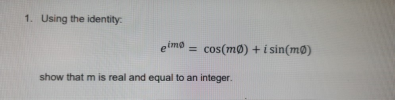 1. Using the identity: eimø = cos(m) + i sin(m) show that m is real and equal to an integer.
4. Evaluate the following integrals using the Residue Theorem. Justify your calculations, show th...
 4. Evaluate the following integrals using the Residue Theorem. Justify your calculations, show the work. (10 points each) a) 12 cos a + 13 2 da b) (x2 +6x + 10)2 x sin 2x 24 13 da: c)
4. Evaluate the following integrals using the Residue Theorem. Justify your calculations, show the work. (10 points each) a) 12 cos a + 13 2 da b) (x2 +6x + 10)2 x sin 2x 24 13 da: c)
4. Evaluate the following integrals using the Residue Theorem. Justify your calculations, show the work. (10 points each) a) 12 cos a + 13 2 da b) (x2 +6x + 10)2 x sin 2x 24 13 da: c)
15. Using that sin' (2) = cos(x), cos' (2) = - sin() show that arccot (0)...
 15. Using that sin' (2) = cos(x), cos' (2) = - sin() show that arccot (0) = 1 +22
Solve 8 sin? (w) – 10 sin(w) + 3 = 0 for all solutions ( <w...
 Solve 8 sin? (w) – 10 sin(w) + 3 = 0 for all solutions ( <w < 27 W = Preview
Using Integral Calculus b * W- Sa f(x) dx using Integral calculus 4. A rope is...
 Using Integral Calculus
b * W- Sa f(x) dx using Integral calculus 4. A rope is being unwound and the force of gravity on the rope is 12.0 N/m. When 20 m have been unwound, how much work is done by gravity to unwind another 30 m? (6 marks)
Using Integral Calculus
b * W- Sa f(x) dx using Integral calculus 4. A rope is being unwound and the force of gravity on the rope is 12.0 N/m. When 20 m have been unwound, how much work is done by gravity to unwind another 30 m? (6 marks)
Please answer with all steps. Thanks Given "x4 3 cos + 7 sin t 0.75_dt F(x) =let, d, G(x) =1 dt 5t0.75 0 Using the Fundamental Theorem of Calculus Part II, calculate the limit Lim Given "...
 Please answer with all steps. Thanks
Given "x4 3 cos + 7 sin t 0.75_dt F(x) =let, d, G(x) =1 dt 5t0.75 0 Using the Fundamental Theorem of Calculus Part II, calculate the limit Lim
Given "x4 3 cos + 7 sin t 0.75_dt F(x) =let, d, G(x) =1 dt 5t0.75 0 Using the Fundamental Theorem of Calculus Part II, calculate the limit Lim
Please answer with all steps. Thanks
Given "x4 3 cos + 7 sin t 0.75_dt F(x) =let, d, G(x) =1 dt 5t0.75 0 Using the Fundamental Theorem of Calculus Part II, calculate the limit Lim
Given "x4 3 cos + 7 sin t 0.75_dt F(x) =let, d, G(x) =1 dt 5t0.75 0 Using the Fundamental Theorem of Calculus Part II, calculate the limit Lim
Given that W = - Spdv and pvy = constant for an adiabatic process, show using...
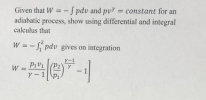 Given that W = - Spdv and pvy = constant for an adiabatic process, show using differential and integral calculus that W=-S, pdv gives on integration
1. Let ab and f E C[a, b], and let E(0, ))- - (co +c)w(a) da for some weight function w(x) >0. (a) Use calculus to w...
 1. Let ab and f E C[a, b], and let E(0, ))- - (co +c)w(a) da for some weight function w(x) >0. (a) Use calculus to write down a linear system for the critical point of E(co, c1). (b) Is the solution of this linear system the same as that of the normal equations arising from the use of Theorem 2 on page 395 to optimize co, ci under the norm 1/2 ? (c) Use your results to find the...
 please prove part (b) use complex analysis and calculus of
residue
-dx neif a> 0 5. (a) x2+1 (b) For any real number a > 0, cos x dx ne"/a. a Hint: This is the real part of the integral obtained by replacing cos x by e
please prove part (b) use complex analysis and calculus of
residue
-dx neif a> 0 5. (a) x2+1 (b) For any real number a > 0, cos x dx ne"/a. a Hint: This is the real part of the integral obtained by replacing cos x by e
 5. (a) Show that the following improper real integral is absolutely convergent cos 2x dr I (1+?}% " (b) If CR is the semicircle of radius R in the upper half plane with centre at z = 0, show carefully that e2iz lim R00JCR (1+ z2)2 d% = 0 (c) Use residue calculus to evaluate the real integral I of part (a)
5. (a) Show that the following improper real integral is absolutely convergent cos 2x dr I (1+?}% "...
5. (a) Show that the following improper real integral is absolutely convergent cos 2x dr I (1+?}% " (b) If CR is the semicircle of radius R in the upper half plane with centre at z = 0, show carefully that e2iz lim R00JCR (1+ z2)2 d% = 0 (c) Use residue calculus to evaluate the real integral I of part (a)
5. (a) Show that the following improper real integral is absolutely convergent cos 2x dr I (1+?}% "...
 1. Using the identity: eimø = cos(m) + i sin(m) show that m is real and equal to an integer.
 4. Evaluate the following integrals using the Residue Theorem. Justify your calculations, show the work. (10 points each) a) 12 cos a + 13 2 da b) (x2 +6x + 10)2 x sin 2x 24 13 da: c)
4. Evaluate the following integrals using the Residue Theorem. Justify your calculations, show the work. (10 points each) a) 12 cos a + 13 2 da b) (x2 +6x + 10)2 x sin 2x 24 13 da: c)
4. Evaluate the following integrals using the Residue Theorem. Justify your calculations, show the work. (10 points each) a) 12 cos a + 13 2 da b) (x2 +6x + 10)2 x sin 2x 24 13 da: c)
 15. Using that sin' (2) = cos(x), cos' (2) = - sin() show that arccot (0) = 1 +22
 Solve 8 sin? (w) – 10 sin(w) + 3 = 0 for all solutions ( <w < 27 W = Preview
 Using Integral Calculus
b * W- Sa f(x) dx using Integral calculus 4. A rope is being unwound and the force of gravity on the rope is 12.0 N/m. When 20 m have been unwound, how much work is done by gravity to unwind another 30 m? (6 marks)
Using Integral Calculus
b * W- Sa f(x) dx using Integral calculus 4. A rope is being unwound and the force of gravity on the rope is 12.0 N/m. When 20 m have been unwound, how much work is done by gravity to unwind another 30 m? (6 marks)
 Please answer with all steps. Thanks
Given "x4 3 cos + 7 sin t 0.75_dt F(x) =let, d, G(x) =1 dt 5t0.75 0 Using the Fundamental Theorem of Calculus Part II, calculate the limit Lim
Given "x4 3 cos + 7 sin t 0.75_dt F(x) =let, d, G(x) =1 dt 5t0.75 0 Using the Fundamental Theorem of Calculus Part II, calculate the limit Lim
Please answer with all steps. Thanks
Given "x4 3 cos + 7 sin t 0.75_dt F(x) =let, d, G(x) =1 dt 5t0.75 0 Using the Fundamental Theorem of Calculus Part II, calculate the limit Lim
Given "x4 3 cos + 7 sin t 0.75_dt F(x) =let, d, G(x) =1 dt 5t0.75 0 Using the Fundamental Theorem of Calculus Part II, calculate the limit Lim
 Given that W = - Spdv and pvy = constant for an adiabatic process, show using differential and integral calculus that W=-S, pdv gives on integration
 1. Let ab and f E C[a, b], and let E(0, ))- - (co +c)w(a) da for some weight function w(x) >0. (a) Use calculus to write down a linear system for the critical point of E(co, c1). (b) Is the solution of this linear system the same as that of the normal equations arising from the use of Theorem 2 on page 395 to optimize co, ci under the norm 1/2 ? (c) Use your results to find the...
Most questions answered within 3 hours.
-
Where is the error in this code sequence?
String s1 = "Hello";
String s2 = "ello";...
asked 10 months ago -
Financial data for Joel de Paris, Inc., for last year
follow:
Joel de Paris, Inc.
Balance...
asked 10 months ago -
Consider this reaction:
Al2(SO4)3 (aq)+ BaCl3
(aq) Al2Cl6 (aq)- +
3BaSO4(s) . What is the...
asked 10 months ago -
Suppose that Savneet is considering increasing her
recent random sample from 20 car rentals to 40...
asked 10 months ago -
Trucks arrive at an unloading terminal at an average rate of 120
per hour.
Trucks arrive...
asked 10 months ago -
Why are methanol and ethanol completely soluble in water while
octanol is not very little soluble....
asked 10 months ago -
A facilities manager at a university reads in a research report
that the mean amount of...
asked 10 months ago -
When the CuSO4 is rehydrated by adding water to the anhydrous
compound, is this an endothermic...
asked 10 months ago -
A ray of sunlight is passing from diamond into crown glass; the
angle of incidence is...
asked 10 months ago -
A block of mass 0.249 kg is placed on top of a light, vertical
spring of...
asked 10 months ago -
how do the kidneys compensate in the presences of acidosis
a) trigger hyperventilate
b) reserve acid...
asked 10 months ago -
Question 501 pts
The rental rate of capital to the firm increases. Which of the
following...
asked 10 months ago