
Homework Answers
Add Answer to:
The graph shows the effects of an expansionary monetary policy, which, over time, results in shifts...
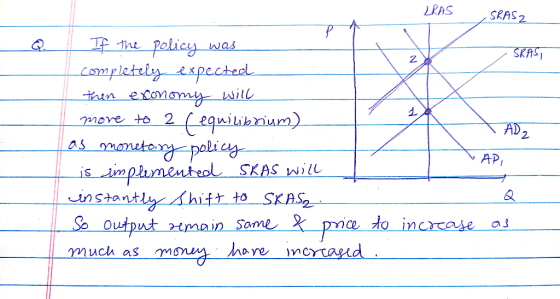
The graph shows the effects of an expansionary monetary policy, which, over time, results in shifts of both the aggregate demand curve (AD1 to AD2) and the short-run aggregate supply curve (SRAS1 to SRAS2).
 The graph shows the effects of an expansionary monetary policy, which, over time, results in shifts of both the aggregate demand curve (AD1 to AD2) and the short-run aggregate supply curve (SRAS1 to SRAS2).If the dot indicates the economy's initial equilibrium state, place a second dot to show the economy's new equilibrium in the short run, given that the monetary policy move was completely expected.
Refer to figure above, An expansionary fiscal policy would be most effective in raising output with little or no inflation when the aggregate demand curve shifts from
 1. Refer to figure above, An expansionary fiscal policy would be most effective in raising output with little or no inflation when the aggregate demand curve shifts from a. AD1 to AD2.b. AD3 to AD4.c. AD5 to AD6.d. AD1 to AD6.
Refer to the above diagram, in which Qf is the full-employment output. An expansionary fiscal policy...
 Refer to the above diagram, in which Qf is the
full-employment output. An expansionary fiscal policy would be most
appropriate if the economy's present aggregate demand curve were
at:
Question 3 options:
AD0.
AD2.
AD3.
None of these.
AD3 AS AD AD, AD C3 Real GDP
Refer to the above diagram, in which Qf is the
full-employment output. An expansionary fiscal policy would be most
appropriate if the economy's present aggregate demand curve were
at:
Question 3 options:
AD0.
AD2.
AD3.
None of these.
AD3 AS AD AD, AD C3 Real GDP
1) of the Central Bank of Kuwait puts in place an expansionary monetary policy, its decision...
 1) of the Central Bank of Kuwait puts in place an expansionary monetary policy, its decision is based on A) the fact that the economy is at ful employment B) Expectation of excessive inflation in the future C) the fact that the economy is in an expansion D) Unemployment level is high 2) When the interest rate is set at a very low rate A) the opportunity cost of holding money is very low B) the money demand will shift...
Help with graph, fill in the blanks and drop downs.Drop Downs:1. more/less2. higher/lower...
 Help with graph, fill in the blanks and drop downs.Drop Downs:1. more/less2. higher/lower3. (short-run change in output):no change/decrease/increase4. (long-run change in price level):same/lower/higher than/as initial expectations5. (long-run change in output):no change/decrease/increase4. The rational expectations model Suppose the U.S. economy is in equilibrium at a potential output of $10 trillion so that unemployment is at the natural rate. At the beginning of the year, the Federal Reserve announces that its monetary policy will aim to maintain output at potential output and sustain...
ePage(s) 997-998 31.1. What is the effect of monetary policy in the short run? Place in...
 ePage(s) 997-998 31.1. What is the effect of monetary policy in the short run? Place in order the events that occur in the short run when the Federal Reserve enacts expansionary monetary policy. As the Fed buys bonds, new money enters the loanable funds market: Market equilibrium shifts toward more money being lent at a lower interest rate The increased borrowing leads to increased investme and purchasing of goods and The aggregate der
Beginning from a position of long-run equilibrium, an expansionary monetary policy by the Bank of Canada...
Beginning from a position of long-run equilibrium, an expansionary monetary policy by the Bank of Canada causes A) an increase in the level of potential output B) a fall in the general price level C) an increase in most market interest rates D) aggregate demand for goods and services to exceed potential output E) aggregate demand for goods and services to fall short of potential output
6. The long-run effects of monetary policy Aa Aa The following graphs show an economy that is cur...
 6. The long-run effects of monetary policy The following graphs show an economy that is currently in long-run equilibrium. The first graph shows the aggregate demand (AD) and long-run aggregate supply (LRAS) curves. The second shows the long-run (LR) and short-run (SR) Phillips curves. The point on each graph shows the economy's current position. According to the graphs, potential output in this economy is _______ and the natural rate of unemployment is _______ .Suppose the central bank of the economy decreases the...
Chapter 9 Part 2: Homework Problems Done 9. (Figure: Determining SRAS Shifts 2) Aggregate Output (Q)...
 Chapter 9 Part 2: Homework Problems Done 9. (Figure: Determining SRAS Shifts 2) Aggregate Output (Q) Which of the following might cause a change in short-run aggregate supply? Unions successfully negotiate higher wages. Consumer incomes decrease. Businesses are increasingly optimistic about the future. Taxes on businesses increase. Start: 4:2S PM Aggregate Price Level (P) Done Chapter 9 Part 2: Homework Problems 11. (Figure: Shifting SRAS and AD) 200 180 SRAS 160 140 120 AD2 100 80 a 6아- AD 40아-...
1. Using the monetary policy tool the Fed employs most often, the Fed closes an inflationary...
1. Using the monetary policy tool the Fed employs most often, the Fed closes an inflationary gap. Describe the steps the economy goes through to move to the new equilibrium output and price level. Use graphs with your answer and be sure to label everything completely. 2.Explain and show on a graph the short-run and long-run equilibrium changes in the AD/AS model from expansionary monetary policy. How does this support an anti-monetary policy stance? 3. What is the equation of...
 Refer to the above diagram, in which Qf is the
full-employment output. An expansionary fiscal policy would be most
appropriate if the economy's present aggregate demand curve were
at:
Question 3 options:
AD0.
AD2.
AD3.
None of these.
AD3 AS AD AD, AD C3 Real GDP
Refer to the above diagram, in which Qf is the
full-employment output. An expansionary fiscal policy would be most
appropriate if the economy's present aggregate demand curve were
at:
Question 3 options:
AD0.
AD2.
AD3.
None of these.
AD3 AS AD AD, AD C3 Real GDP
 1) of the Central Bank of Kuwait puts in place an expansionary monetary policy, its decision is based on A) the fact that the economy is at ful employment B) Expectation of excessive inflation in the future C) the fact that the economy is in an expansion D) Unemployment level is high 2) When the interest rate is set at a very low rate A) the opportunity cost of holding money is very low B) the money demand will shift...
 Help with graph, fill in the blanks and drop downs.Drop Downs:1. more/less2. higher/lower3. (short-run change in output):no change/decrease/increase4. (long-run change in price level):same/lower/higher than/as initial expectations5. (long-run change in output):no change/decrease/increase4. The rational expectations model Suppose the U.S. economy is in equilibrium at a potential output of $10 trillion so that unemployment is at the natural rate. At the beginning of the year, the Federal Reserve announces that its monetary policy will aim to maintain output at potential output and sustain...
 ePage(s) 997-998 31.1. What is the effect of monetary policy in the short run? Place in order the events that occur in the short run when the Federal Reserve enacts expansionary monetary policy. As the Fed buys bonds, new money enters the loanable funds market: Market equilibrium shifts toward more money being lent at a lower interest rate The increased borrowing leads to increased investme and purchasing of goods and The aggregate der
 Chapter 9 Part 2: Homework Problems Done 9. (Figure: Determining SRAS Shifts 2) Aggregate Output (Q) Which of the following might cause a change in short-run aggregate supply? Unions successfully negotiate higher wages. Consumer incomes decrease. Businesses are increasingly optimistic about the future. Taxes on businesses increase. Start: 4:2S PM Aggregate Price Level (P) Done Chapter 9 Part 2: Homework Problems 11. (Figure: Shifting SRAS and AD) 200 180 SRAS 160 140 120 AD2 100 80 a 6아- AD 40아-...
Most questions answered within 3 hours.
-
Where is the error in this code sequence?
String s1 = "Hello";
String s2 = "ello";...
asked 11 months ago -
Financial data for Joel de Paris, Inc., for last year
follow:
Joel de Paris, Inc.
Balance...
asked 11 months ago -
Consider this reaction:
Al2(SO4)3 (aq)+ BaCl3
(aq) Al2Cl6 (aq)- +
3BaSO4(s) . What is the...
asked 11 months ago -
Suppose that Savneet is considering increasing her
recent random sample from 20 car rentals to 40...
asked 11 months ago -
Trucks arrive at an unloading terminal at an average rate of 120
per hour.
Trucks arrive...
asked 11 months ago -
Why are methanol and ethanol completely soluble in water while
octanol is not very little soluble....
asked 11 months ago -
A facilities manager at a university reads in a research report
that the mean amount of...
asked 11 months ago -
When the CuSO4 is rehydrated by adding water to the anhydrous
compound, is this an endothermic...
asked 11 months ago -
A ray of sunlight is passing from diamond into crown glass; the
angle of incidence is...
asked 11 months ago -
A block of mass 0.249 kg is placed on top of a light, vertical
spring of...
asked 11 months ago -
how do the kidneys compensate in the presences of acidosis
a) trigger hyperventilate
b) reserve acid...
asked 11 months ago -
Question 501 pts
The rental rate of capital to the firm increases. Which of the
following...
asked 11 months ago