
Homework Answers

Add Answer to:
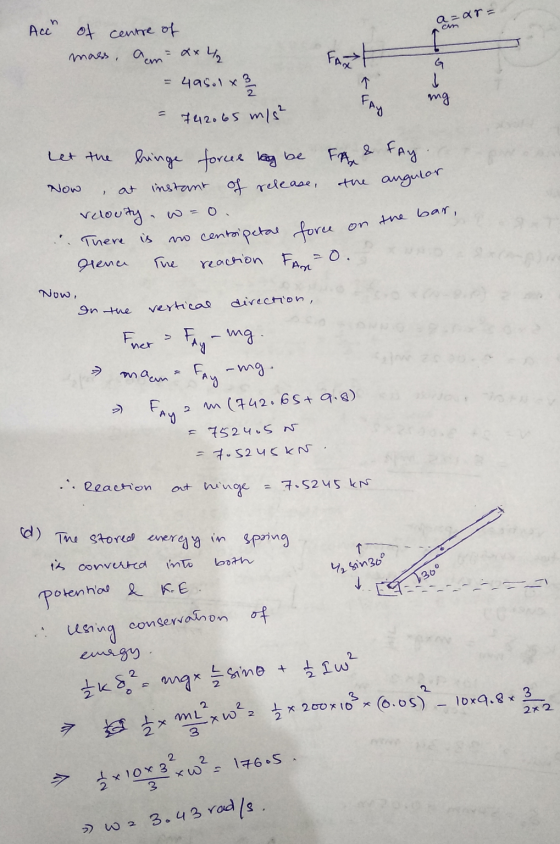
D L/2 G L/2 B MO A uniform slender rod of mass M=10 kg and length...
A uniform rod with a mass of m = 1.85 kg and a length of l...
 A uniform rod with a mass of m = 1.85 kg and a length
of l = 2.32 m is attached to a horizontal surface with a
hinge. The rod can rotate around the hinge without friction. (See
figure.)
The rod is held at rest at an angle of ? = 65.8° with respect to
the horizontal surface.
1) What is the angular acceleration of the rod, when it is
released?
2) What is the angular speed of the rod,...
A uniform rod with a mass of m = 1.85 kg and a length
of l = 2.32 m is attached to a horizontal surface with a
hinge. The rod can rotate around the hinge without friction. (See
figure.)
The rod is held at rest at an angle of ? = 65.8° with respect to
the horizontal surface.
1) What is the angular acceleration of the rod, when it is
released?
2) What is the angular speed of the rod,...
[7.] A uniform rod with mass M, length L, and moment of inertial with respect to...
 [7.] A uniform rod with mass M, length L, and moment of inertial with respect to the center of mass Icm = MLis hinged at one end (point P) so that it can rotate, without friction, around a horizontal axis. The rod is initially held at rest forming an angle with the vertical (see figure) and then released. a) Find the moment of inertia Ip of the rod with respect to point P. b) Find the magnitude of the angular...
A uniform rod with a mass of m = 1.73 kg and a length of l...
 A uniform rod with a mass of m = 1.73 kg and a length of l = 2.44 m is attached to a horizontal surface with a hinge. The rod can rotate around the hinge without friction. (See figure.) Initially the rod is held at rest at an angle of 0 = 70.3° with respect to the horizontal surface. Then the rod is released. What is the angular speed of the rod, when it lands on the horizontal surface? 7.56rad/s...
A slender, uniform metal rod of mass M and length l is pivoted without friction about an axis through its midpoint and p...
 A slender, uniform metal rod of mass M and length l is pivoted
without friction about an axis through its midpoint and
perpendicular to the rod. A horizontal spring, assumed massless and
with force constant k, is attached to the lower end of the rod,
with the other end of the spring attached to a rigid support.
(Figure 1)
2. Find the torque τ due to the spring. Assume that θ is small
enough that the spring remains effectively horizontal...
A slender, uniform metal rod of mass M and length l is pivoted
without friction about an axis through its midpoint and
perpendicular to the rod. A horizontal spring, assumed massless and
with force constant k, is attached to the lower end of the rod,
with the other end of the spring attached to a rigid support.
(Figure 1)
2. Find the torque τ due to the spring. Assume that θ is small
enough that the spring remains effectively horizontal...
Problem 4 A uniform slender rod of length L- 3 m and mass 2 kg rotates freely (no friction) about...
 Problem 4 A uniform slender rod of length L- 3 m and mass 2 kg rotates freely (no friction) about hinge at A. Att- 0, the initial angle is B 30 and the initial angular velocity SQUARED is 4.9 rads/s in the counter-clockwise direction. a) What are the hinge reaction forces, acceleration of the center of mass, angular velocity (squared) and angular acceleration as functions of B, b) what are the hinge reaction forces, acceleration of the center of mass...
The uniform slender rod contains a 4-kg uniform rod with the center of mass at point...
 The uniform slender rod contains a 4-kg uniform rod with the center of mass at point G is suspended from a hinge at C. The rod is at rest in a vertical position when point B is subjected to a force of P = 75 N, and a moment M = 50 Nm, the length of the rod is 1 m and r = 0.225m. Determine the reactions at the pin C and the initial angular acceleration of the rod....
A uniform rod of length L (2.00 m) and mass M (5.00 Kg) is free to...
 A uniform rod of length L (2.00 m) and mass M (5.00 Kg) is free to rotate on a frictionless pin passing through one end. The rod is released from rest in the horizontal position, (a) What is its angular speed when the rod reaches its lowest position? (b) What arc the linear speed of the center of mass and that of the lowest point on the rod when it is in the vertical position?
Learning Goal: To study the undamped vibration of a rigid body. A slender, uniform metal rod...
 Learning Goal:
To study the undamped vibration of a rigid body.
A slender, uniform metal rod of mass m and length
l is pivoted without friction about an axis through its
midpoint and in a direction that is perpendicular to the rod. A
massless horizontal spring, with spring constant k, is
attached to the lower end of the rod; the other end of the spring
is attached to a rigid support. (Figure 1)
Part C) What is ωn, the angular...
Learning Goal:
To study the undamped vibration of a rigid body.
A slender, uniform metal rod of mass m and length
l is pivoted without friction about an axis through its
midpoint and in a direction that is perpendicular to the rod. A
massless horizontal spring, with spring constant k, is
attached to the lower end of the rod; the other end of the spring
is attached to a rigid support. (Figure 1)
Part C) What is ωn, the angular...
The pendulum consists of a 7-kg slender rod with length (L) of 1.2 m and it...
 The pendulum consists of a 7-kg slender rod with length (L) of 1.2 m and it is fixed to a 16-kg disk with radius of 0.3 m. If the spring has an un-stretched length of 0.2 m and stiffness of 200 N/m, determine the angular velocity of the pendulum when it is released from rest and rotates clockwise 90° from the position shown. The roller at C allows the spring to always remain vertical. At θ-00, the stretched length of...
M,R a = 0 14. A body consisted of an uniform rod of mass m and length L, and a disk of mass M and radius R can rotate a...
 M,R a = 0 14. A body consisted of an uniform rod of mass m and length L, and a disk of mass M and radius R can rotate about the axis z. At the beginning the body is in the horizontal position and rests. On the body acts only the gravity force. Determine the linear momentum P, and the angular momentum K relatively to point O when the body is in the vertical position, as shown. m. X P2=?...
 A uniform rod with a mass of m = 1.85 kg and a length
of l = 2.32 m is attached to a horizontal surface with a
hinge. The rod can rotate around the hinge without friction. (See
figure.)
The rod is held at rest at an angle of ? = 65.8° with respect to
the horizontal surface.
1) What is the angular acceleration of the rod, when it is
released?
2) What is the angular speed of the rod,...
A uniform rod with a mass of m = 1.85 kg and a length
of l = 2.32 m is attached to a horizontal surface with a
hinge. The rod can rotate around the hinge without friction. (See
figure.)
The rod is held at rest at an angle of ? = 65.8° with respect to
the horizontal surface.
1) What is the angular acceleration of the rod, when it is
released?
2) What is the angular speed of the rod,...
 [7.] A uniform rod with mass M, length L, and moment of inertial with respect to the center of mass Icm = MLis hinged at one end (point P) so that it can rotate, without friction, around a horizontal axis. The rod is initially held at rest forming an angle with the vertical (see figure) and then released. a) Find the moment of inertia Ip of the rod with respect to point P. b) Find the magnitude of the angular...
 A uniform rod with a mass of m = 1.73 kg and a length of l = 2.44 m is attached to a horizontal surface with a hinge. The rod can rotate around the hinge without friction. (See figure.) Initially the rod is held at rest at an angle of 0 = 70.3° with respect to the horizontal surface. Then the rod is released. What is the angular speed of the rod, when it lands on the horizontal surface? 7.56rad/s...
 A slender, uniform metal rod of mass M and length l is pivoted
without friction about an axis through its midpoint and
perpendicular to the rod. A horizontal spring, assumed massless and
with force constant k, is attached to the lower end of the rod,
with the other end of the spring attached to a rigid support.
(Figure 1)
2. Find the torque τ due to the spring. Assume that θ is small
enough that the spring remains effectively horizontal...
A slender, uniform metal rod of mass M and length l is pivoted
without friction about an axis through its midpoint and
perpendicular to the rod. A horizontal spring, assumed massless and
with force constant k, is attached to the lower end of the rod,
with the other end of the spring attached to a rigid support.
(Figure 1)
2. Find the torque τ due to the spring. Assume that θ is small
enough that the spring remains effectively horizontal...
 Problem 4 A uniform slender rod of length L- 3 m and mass 2 kg rotates freely (no friction) about hinge at A. Att- 0, the initial angle is B 30 and the initial angular velocity SQUARED is 4.9 rads/s in the counter-clockwise direction. a) What are the hinge reaction forces, acceleration of the center of mass, angular velocity (squared) and angular acceleration as functions of B, b) what are the hinge reaction forces, acceleration of the center of mass...
 The uniform slender rod contains a 4-kg uniform rod with the center of mass at point G is suspended from a hinge at C. The rod is at rest in a vertical position when point B is subjected to a force of P = 75 N, and a moment M = 50 Nm, the length of the rod is 1 m and r = 0.225m. Determine the reactions at the pin C and the initial angular acceleration of the rod....
 A uniform rod of length L (2.00 m) and mass M (5.00 Kg) is free to rotate on a frictionless pin passing through one end. The rod is released from rest in the horizontal position, (a) What is its angular speed when the rod reaches its lowest position? (b) What arc the linear speed of the center of mass and that of the lowest point on the rod when it is in the vertical position?
 Learning Goal:
To study the undamped vibration of a rigid body.
A slender, uniform metal rod of mass m and length
l is pivoted without friction about an axis through its
midpoint and in a direction that is perpendicular to the rod. A
massless horizontal spring, with spring constant k, is
attached to the lower end of the rod; the other end of the spring
is attached to a rigid support. (Figure 1)
Part C) What is ωn, the angular...
Learning Goal:
To study the undamped vibration of a rigid body.
A slender, uniform metal rod of mass m and length
l is pivoted without friction about an axis through its
midpoint and in a direction that is perpendicular to the rod. A
massless horizontal spring, with spring constant k, is
attached to the lower end of the rod; the other end of the spring
is attached to a rigid support. (Figure 1)
Part C) What is ωn, the angular...
 The pendulum consists of a 7-kg slender rod with length (L) of 1.2 m and it is fixed to a 16-kg disk with radius of 0.3 m. If the spring has an un-stretched length of 0.2 m and stiffness of 200 N/m, determine the angular velocity of the pendulum when it is released from rest and rotates clockwise 90° from the position shown. The roller at C allows the spring to always remain vertical. At θ-00, the stretched length of...
 M,R a = 0 14. A body consisted of an uniform rod of mass m and length L, and a disk of mass M and radius R can rotate about the axis z. At the beginning the body is in the horizontal position and rests. On the body acts only the gravity force. Determine the linear momentum P, and the angular momentum K relatively to point O when the body is in the vertical position, as shown. m. X P2=?...
Most questions answered within 3 hours.
-
Where is the error in this code sequence?
String s1 = "Hello";
String s2 = "ello";...
asked 11 months ago -
Financial data for Joel de Paris, Inc., for last year
follow:
Joel de Paris, Inc.
Balance...
asked 11 months ago -
Consider this reaction:
Al2(SO4)3 (aq)+ BaCl3
(aq) Al2Cl6 (aq)- +
3BaSO4(s) . What is the...
asked 11 months ago -
Suppose that Savneet is considering increasing her
recent random sample from 20 car rentals to 40...
asked 11 months ago -
Trucks arrive at an unloading terminal at an average rate of 120
per hour.
Trucks arrive...
asked 11 months ago -
Why are methanol and ethanol completely soluble in water while
octanol is not very little soluble....
asked 11 months ago -
A facilities manager at a university reads in a research report
that the mean amount of...
asked 11 months ago -
When the CuSO4 is rehydrated by adding water to the anhydrous
compound, is this an endothermic...
asked 11 months ago -
A ray of sunlight is passing from diamond into crown glass; the
angle of incidence is...
asked 11 months ago -
A block of mass 0.249 kg is placed on top of a light, vertical
spring of...
asked 11 months ago -
how do the kidneys compensate in the presences of acidosis
a) trigger hyperventilate
b) reserve acid...
asked 11 months ago -
Question 501 pts
The rental rate of capital to the firm increases. Which of the
following...
asked 11 months ago