
Homework Answers

Add Answer to:
8. Consider the following surfaces: Si: p=4sing and Spiral. a- Convert the equation of S, to...
1. Consider the conic C in the Euclidean plane described by the following equation: (a) Convert this equation into homogeneous coordinates. b) Express this homogeneous equation using a symmetric...
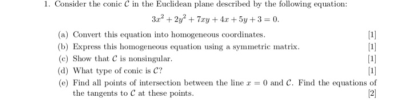 1. Consider the conic C in the Euclidean plane described by the following equation: (a) Convert this equation into homogeneous coordinates. b) Express this homogeneous equation using a symmetric matrix (c) Show that C is nonsingular. (d) What type of conic is C? (e) Find all points of intersection between the line 0 and C. Find the equations of the tangents to C at these points. 12)
1. Consider the conic C in the Euclidean plane described by the following...
1. Consider the conic C in the Euclidean plane described by the following equation: (a) Convert this equation into homogeneous coordinates. b) Express this homogeneous equation using a symmetric matrix (c) Show that C is nonsingular. (d) What type of conic is C? (e) Find all points of intersection between the line 0 and C. Find the equations of the tangents to C at these points. 12)
1. Consider the conic C in the Euclidean plane described by the following...
• 1.104 A point P moves on the "Spiral of Archimedes" at constant speed 2 m/s....
 • 1.104 A point P moves on the "Spiral of Archimedes" at constant speed 2 m/s. (See Figure P1.104.) The equation of the spiral is r = 38. Find the acceleration of P when 8 = 180° Figure P1.104
Answer each of the following question about the given the 3-dimensional surfaces x + y² +22...
 Answer each of the following question about the given the 3-dimensional surfaces x + y² +22 = 20 and 2 = x² + y². (2 pt) A) What quadric surfaces are represented by these equations? Give any details you can. x² + y2 + z = 20 := x2 + y2 (2 pt) B Make a sketch, nothing fancy just a sketch, of these surfaces and identify the space curve of intersection and describe this space curve in your own...
1. For the following equation, find the center, vertices, foci, transverse axis, and asymptotes, ...
 1. For the following equation, find the center, vertices, foci, transverse axis, and asymptotes, and sketch the graph: 2. Consider the set of parametric equations (a) Graph in the following window: TMIN--3.74, TMAX- 3.74, TSTEP = 0.02, XMIN =-10, XMAX = 10, YMIN =-7, YMAX = 7, Sketch the graph. (b) At, find (x, y) and dy/dx. Write the equations of the lines tangent to and normal to the graph at (c) Find the length of the curve from to...
(1) Consider the function a, )1)( 2)2 (a) Find the level curves of /(x,y) for heights 0, 1 /2, 1,...
 level curves and parametric equation
(1) Consider the function a, )1)( 2)2 (a) Find the level curves of /(x,y) for heights 0, 1 /2, 1, and 2, and plot them on the same 2D Aaph. Use that information, as well as any other information you think you midt need, tereketch the surface f(x,y). (b) Find the parametric equation of the intersection of r2y4 with -f(r,y and sketch that parametric curve on the graph from part (a)
(1) Consider the function...
level curves and parametric equation
(1) Consider the function a, )1)( 2)2 (a) Find the level curves of /(x,y) for heights 0, 1 /2, 1, and 2, and plot them on the same 2D Aaph. Use that information, as well as any other information you think you midt need, tereketch the surface f(x,y). (b) Find the parametric equation of the intersection of r2y4 with -f(r,y and sketch that parametric curve on the graph from part (a)
(1) Consider the function...
2z = 0 and let L denote the line with parametric equations Let P denote the...
 2z = 0 and let L denote the line with parametric equations Let P denote the plane with equation y=-2t1 z t3 Answer in the form (a,b,c) Find the point of intersection of P and L: Find the angle of intersection of P and L: degrees Answer in degrees with an absolute error of less than 0.1°
1. Consider the points A(4,0,0), B(0,3,0),C(0,0,5), and P(1,2,8). a. Write the equation of the plane passing...
 1. Consider the points A(4,0,0), B(0,3,0),C(0,0,5), and P(1,2,8). a. Write the equation of the plane passing through the points A, B, and C. b. Write parametric equations of a line passing through point P and orthogonal to the plane described in part a. c. Find the exact distance between point and the plane described in part a.
Q6 Equation 10 Points Consider the points P = (1,2,3), Q = (4,5,6), and R =...
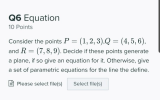 Q6 Equation 10 Points Consider the points P = (1,2,3), Q = (4,5,6), and R = (7,8,9). Decide if these points generate a plane, if so give an equation for it. Otherwise, give a set of parametric equations for the line the define. Please select file(s) Select file(s)
4. Consider the plane P represented by the equation 2r + 3y-82 0 (a) Find a...
 4. Consider the plane P represented by the equation 2r + 3y-82 0 (a) Find a basis for P. (b) Find a basis for the intersection of P with XZ- plane. (c) Find the basis for the intersection ofP with Y- axis.
I cannot get i) or j) 3. (20 marks) Consider the parallel lines L, : x=...
 I cannot get i) or j)
3. (20 marks) Consider the parallel lines L, : x= -3 +8 2 [1] and L2: x = 0 + [2] 4. and 11 [3 -21 the planes P1 : 3x + 2y + 2z = -7 and P2 : 2.x – 2y - 2 = 11. (a) Find the equation of a plane in standard form containing both L, and L. (b) Find an equation of the line of intersection of P, and...
I cannot get i) or j)
3. (20 marks) Consider the parallel lines L, : x= -3 +8 2 [1] and L2: x = 0 + [2] 4. and 11 [3 -21 the planes P1 : 3x + 2y + 2z = -7 and P2 : 2.x – 2y - 2 = 11. (a) Find the equation of a plane in standard form containing both L, and L. (b) Find an equation of the line of intersection of P, and...
 1. Consider the conic C in the Euclidean plane described by the following equation: (a) Convert this equation into homogeneous coordinates. b) Express this homogeneous equation using a symmetric matrix (c) Show that C is nonsingular. (d) What type of conic is C? (e) Find all points of intersection between the line 0 and C. Find the equations of the tangents to C at these points. 12)
1. Consider the conic C in the Euclidean plane described by the following...
1. Consider the conic C in the Euclidean plane described by the following equation: (a) Convert this equation into homogeneous coordinates. b) Express this homogeneous equation using a symmetric matrix (c) Show that C is nonsingular. (d) What type of conic is C? (e) Find all points of intersection between the line 0 and C. Find the equations of the tangents to C at these points. 12)
1. Consider the conic C in the Euclidean plane described by the following...
 • 1.104 A point P moves on the "Spiral of Archimedes" at constant speed 2 m/s. (See Figure P1.104.) The equation of the spiral is r = 38. Find the acceleration of P when 8 = 180° Figure P1.104
 Answer each of the following question about the given the 3-dimensional surfaces x + y² +22 = 20 and 2 = x² + y². (2 pt) A) What quadric surfaces are represented by these equations? Give any details you can. x² + y2 + z = 20 := x2 + y2 (2 pt) B Make a sketch, nothing fancy just a sketch, of these surfaces and identify the space curve of intersection and describe this space curve in your own...
 1. For the following equation, find the center, vertices, foci, transverse axis, and asymptotes, and sketch the graph: 2. Consider the set of parametric equations (a) Graph in the following window: TMIN--3.74, TMAX- 3.74, TSTEP = 0.02, XMIN =-10, XMAX = 10, YMIN =-7, YMAX = 7, Sketch the graph. (b) At, find (x, y) and dy/dx. Write the equations of the lines tangent to and normal to the graph at (c) Find the length of the curve from to...
 level curves and parametric equation
(1) Consider the function a, )1)( 2)2 (a) Find the level curves of /(x,y) for heights 0, 1 /2, 1, and 2, and plot them on the same 2D Aaph. Use that information, as well as any other information you think you midt need, tereketch the surface f(x,y). (b) Find the parametric equation of the intersection of r2y4 with -f(r,y and sketch that parametric curve on the graph from part (a)
(1) Consider the function...
level curves and parametric equation
(1) Consider the function a, )1)( 2)2 (a) Find the level curves of /(x,y) for heights 0, 1 /2, 1, and 2, and plot them on the same 2D Aaph. Use that information, as well as any other information you think you midt need, tereketch the surface f(x,y). (b) Find the parametric equation of the intersection of r2y4 with -f(r,y and sketch that parametric curve on the graph from part (a)
(1) Consider the function...
 2z = 0 and let L denote the line with parametric equations Let P denote the plane with equation y=-2t1 z t3 Answer in the form (a,b,c) Find the point of intersection of P and L: Find the angle of intersection of P and L: degrees Answer in degrees with an absolute error of less than 0.1°
 1. Consider the points A(4,0,0), B(0,3,0),C(0,0,5), and P(1,2,8). a. Write the equation of the plane passing through the points A, B, and C. b. Write parametric equations of a line passing through point P and orthogonal to the plane described in part a. c. Find the exact distance between point and the plane described in part a.
 Q6 Equation 10 Points Consider the points P = (1,2,3), Q = (4,5,6), and R = (7,8,9). Decide if these points generate a plane, if so give an equation for it. Otherwise, give a set of parametric equations for the line the define. Please select file(s) Select file(s)
 4. Consider the plane P represented by the equation 2r + 3y-82 0 (a) Find a basis for P. (b) Find a basis for the intersection of P with XZ- plane. (c) Find the basis for the intersection ofP with Y- axis.
 I cannot get i) or j)
3. (20 marks) Consider the parallel lines L, : x= -3 +8 2 [1] and L2: x = 0 + [2] 4. and 11 [3 -21 the planes P1 : 3x + 2y + 2z = -7 and P2 : 2.x – 2y - 2 = 11. (a) Find the equation of a plane in standard form containing both L, and L. (b) Find an equation of the line of intersection of P, and...
I cannot get i) or j)
3. (20 marks) Consider the parallel lines L, : x= -3 +8 2 [1] and L2: x = 0 + [2] 4. and 11 [3 -21 the planes P1 : 3x + 2y + 2z = -7 and P2 : 2.x – 2y - 2 = 11. (a) Find the equation of a plane in standard form containing both L, and L. (b) Find an equation of the line of intersection of P, and...
Most questions answered within 3 hours.
-
Where is the error in this code sequence?
String s1 = "Hello";
String s2 = "ello";...
asked 10 months ago -
Financial data for Joel de Paris, Inc., for last year
follow:
Joel de Paris, Inc.
Balance...
asked 10 months ago -
Consider this reaction:
Al2(SO4)3 (aq)+ BaCl3
(aq) Al2Cl6 (aq)- +
3BaSO4(s) . What is the...
asked 10 months ago -
Suppose that Savneet is considering increasing her
recent random sample from 20 car rentals to 40...
asked 10 months ago -
Trucks arrive at an unloading terminal at an average rate of 120
per hour.
Trucks arrive...
asked 10 months ago -
Why are methanol and ethanol completely soluble in water while
octanol is not very little soluble....
asked 10 months ago -
A facilities manager at a university reads in a research report
that the mean amount of...
asked 10 months ago -
When the CuSO4 is rehydrated by adding water to the anhydrous
compound, is this an endothermic...
asked 10 months ago -
A ray of sunlight is passing from diamond into crown glass; the
angle of incidence is...
asked 10 months ago -
A block of mass 0.249 kg is placed on top of a light, vertical
spring of...
asked 10 months ago -
how do the kidneys compensate in the presences of acidosis
a) trigger hyperventilate
b) reserve acid...
asked 10 months ago -
Question 501 pts
The rental rate of capital to the firm increases. Which of the
following...
asked 10 months ago