
Homework Answers
Add Answer to:
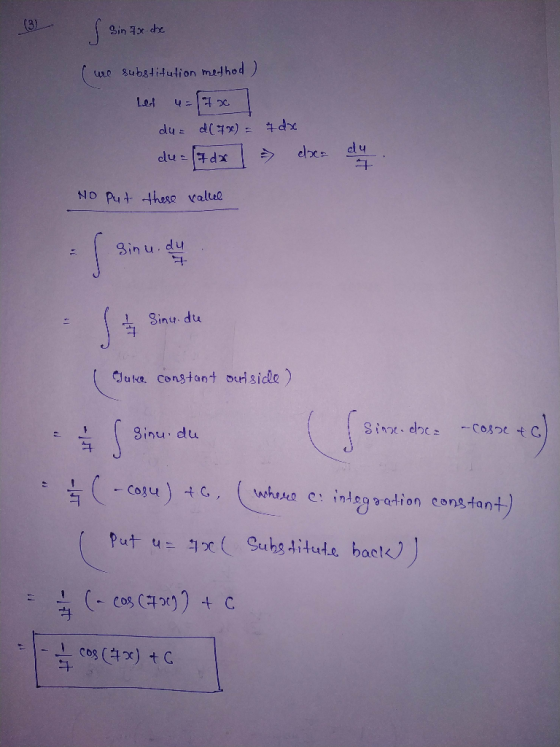
3. sin 7x dx du = Now rewrite the original integral in terms of u ONLY:...
EXAMPLE 2 Find sin$(7x) cos”7x) dx. SOLUTION We could convert cos?(7x) to 1 - sin?(7x), but...
 EXAMPLE 2 Find sin$(7x) cos”7x) dx. SOLUTION We could convert cos?(7x) to 1 - sin?(7x), but we would be left with an expression in terms of sin(7x) with no extra cos(7x) factor. Instead, we separate a single sine factor and rewrite the remaining sin" (7x) factor in terms of cos(7x): sin'(7x) cos”(7x) = (sinº(7x))2 cos(7x) sin(7x) = (1 - Cos?(7x))2 cos?(7x) sin(7x). in (7x) cos?(7x) and ich is which? Substituting u = cos(7x), we have du = -sin (3x) X...
Evaluate the integral sec 2(7x-2) dx Determine a change of variables from x to u. Choose...
 Evaluate the integral sec 2(7x-2) dx Determine a change of variables from x to u. Choose the correct choice below. O A. u= sec (7x - 2) tan (7x - 2) O B. u=tan (7x-2) O c. u= sec (7x - 2) OD. u = 7x-2 Write the integral in terms of u. sec?(7x+2) dx = S du Evaluate the integral sec2(7x-2) dx = 0
6. Find the general indefinite integral: J (u + 4)(2u +1)du I a. (3x dx conto...
 6. Find the general indefinite integral: J (u + 4)(2u +1)du I a. (3x dx conto de ton of b. [VF (82 +31 + 2)dx cinco T() = f(x) d. Sx dx (a=-1) sin x-e' +2 de 188
Tutorial Exercise Evaluate the integral using the substitution rule. sin(x) 1/3 1* dx cos(x) Step 1...
 Tutorial Exercise Evaluate the integral using the substitution rule. sin(x) 1/3 1* dx cos(x) Step 1 of 4 To integrate using substitution, choose u to be some function in the integrand whose derivative (or some constant multiple of whose derivative) is a factor of the integrand. Rewriting a quotient as a product can help to identify u and its derivative. 70/3 1." sin(x) dx = L" (cos(x) since) dx cos?(X) Notice that do (cos(x)) = and this derivative is a...
a. Evaluate the integra 2.22 (2:+ 1) dx by two methods, as prompted below. A. First...
 a. Evaluate the integra 2.22 (2:+ 1) dx by two methods, as prompted below. A. First Method: Rewrite the integral by multiplying out the integrand: | 28? (z° +1) dx = | 223 +2 % du Then evaluate the resulting integral term-by-term: | 2.7° (zº+1) dx = (x+1)+c a B. Second Method: Rewrite the integral by using the substitution w = 2° +1: | 27° (z" + 1) dx = | +0 . dw Evaluate this integral (and back-substitute for...
1- 2- Tutorial Exercise Evaluate the indefinite integral. Jerez 42 + ex dx Step 1 We...
 1-
2-
Tutorial Exercise Evaluate the indefinite integral. Jerez 42 + ex dx Step 1 We must decide what to choose for u. If u = f(x), then du = f'(x) dx, and so it is helpful to look for some expression in Jerez 42 + ex dx for which the derivative is also present. We see that 42 + ex is part of this integral, and the derivative of 42 + ex is ex et which is also present....
1-
2-
Tutorial Exercise Evaluate the indefinite integral. Jerez 42 + ex dx Step 1 We must decide what to choose for u. If u = f(x), then du = f'(x) dx, and so it is helpful to look for some expression in Jerez 42 + ex dx for which the derivative is also present. We see that 42 + ex is part of this integral, and the derivative of 42 + ex is ex et which is also present....
1. Begin by making the substitution u=ex . The resulting integral should be ripe for a trig substitution. 2. Make a cho...
 1. Begin by making the substitution u=ex . The resulting
integral should be ripe for a trig substitution.
2. Make a choice of trig substitution based on the ±a2±b2u2 term
you see after the substitution. With the right choice, after
substituting and rewriting using sin/cos, you should again have
something fairly nice to solve as a trig integral.
3. The substitution sin(2θ)=2sin(θ)cos(θ) is useful after you
integrate.
4. Don’t forget to back substitute (through several
substitutions!) until everything is in...
1. Begin by making the substitution u=ex . The resulting
integral should be ripe for a trig substitution.
2. Make a choice of trig substitution based on the ±a2±b2u2 term
you see after the substitution. With the right choice, after
substituting and rewriting using sin/cos, you should again have
something fairly nice to solve as a trig integral.
3. The substitution sin(2θ)=2sin(θ)cos(θ) is useful after you
integrate.
4. Don’t forget to back substitute (through several
substitutions!) until everything is in...
Consider the following boundary value problem: du du dx dx u=-e* sin(x) Discretize the ODE using...
 Consider the following boundary value problem: du du dx dx u=-e* sin(x) Discretize the ODE using backward second-order accurate scheme for both derivatives. The second order finite accuracy difference for the derivatives are given by: 2h (3)-1(1,2)-45 (7.1)+31(x) 8 (*)== (4.5) +41 (1.2) -51 (3.1) +2f (x) h?
1 (a) Consider the integral dx. e32 e-91 + e-6x +1 Make the substitution u =...
 1 (a) Consider the integral dx. e32 e-91 + e-6x +1 Make the substitution u = e-34 and rewrite the integral in terms of u only. DO NOT attempt to evaluate the integral. (b) Let f(x) be a function with the properties that f(0) = 1, f(2) = 2, xf(x) dx = 4 and f(x) dx = 1. / 0 Use this information to find a se xf'(2) dr.
EXAMPLE 3 Find dx. 13 - 2x² SOLUTION Let u = 3 - 2x. Then du...
 EXAMPLE 3 Find dx. 13 - 2x² SOLUTION Let u = 3 - 2x. Then du dx, so x dx du and 1 3 = 2x2 dx = = 1.I tu du 1 wrz du (27ū)+c 11 Il + C (in terms of x).
 EXAMPLE 2 Find sin$(7x) cos”7x) dx. SOLUTION We could convert cos?(7x) to 1 - sin?(7x), but we would be left with an expression in terms of sin(7x) with no extra cos(7x) factor. Instead, we separate a single sine factor and rewrite the remaining sin" (7x) factor in terms of cos(7x): sin'(7x) cos”(7x) = (sinº(7x))2 cos(7x) sin(7x) = (1 - Cos?(7x))2 cos?(7x) sin(7x). in (7x) cos?(7x) and ich is which? Substituting u = cos(7x), we have du = -sin (3x) X...
 Evaluate the integral sec 2(7x-2) dx Determine a change of variables from x to u. Choose the correct choice below. O A. u= sec (7x - 2) tan (7x - 2) O B. u=tan (7x-2) O c. u= sec (7x - 2) OD. u = 7x-2 Write the integral in terms of u. sec?(7x+2) dx = S du Evaluate the integral sec2(7x-2) dx = 0
 6. Find the general indefinite integral: J (u + 4)(2u +1)du I a. (3x dx conto de ton of b. [VF (82 +31 + 2)dx cinco T() = f(x) d. Sx dx (a=-1) sin x-e' +2 de 188
 Tutorial Exercise Evaluate the integral using the substitution rule. sin(x) 1/3 1* dx cos(x) Step 1 of 4 To integrate using substitution, choose u to be some function in the integrand whose derivative (or some constant multiple of whose derivative) is a factor of the integrand. Rewriting a quotient as a product can help to identify u and its derivative. 70/3 1." sin(x) dx = L" (cos(x) since) dx cos?(X) Notice that do (cos(x)) = and this derivative is a...
 a. Evaluate the integra 2.22 (2:+ 1) dx by two methods, as prompted below. A. First Method: Rewrite the integral by multiplying out the integrand: | 28? (z° +1) dx = | 223 +2 % du Then evaluate the resulting integral term-by-term: | 2.7° (zº+1) dx = (x+1)+c a B. Second Method: Rewrite the integral by using the substitution w = 2° +1: | 27° (z" + 1) dx = | +0 . dw Evaluate this integral (and back-substitute for...
 1-
2-
Tutorial Exercise Evaluate the indefinite integral. Jerez 42 + ex dx Step 1 We must decide what to choose for u. If u = f(x), then du = f'(x) dx, and so it is helpful to look for some expression in Jerez 42 + ex dx for which the derivative is also present. We see that 42 + ex is part of this integral, and the derivative of 42 + ex is ex et which is also present....
1-
2-
Tutorial Exercise Evaluate the indefinite integral. Jerez 42 + ex dx Step 1 We must decide what to choose for u. If u = f(x), then du = f'(x) dx, and so it is helpful to look for some expression in Jerez 42 + ex dx for which the derivative is also present. We see that 42 + ex is part of this integral, and the derivative of 42 + ex is ex et which is also present....
 1. Begin by making the substitution u=ex . The resulting
integral should be ripe for a trig substitution.
2. Make a choice of trig substitution based on the ±a2±b2u2 term
you see after the substitution. With the right choice, after
substituting and rewriting using sin/cos, you should again have
something fairly nice to solve as a trig integral.
3. The substitution sin(2θ)=2sin(θ)cos(θ) is useful after you
integrate.
4. Don’t forget to back substitute (through several
substitutions!) until everything is in...
1. Begin by making the substitution u=ex . The resulting
integral should be ripe for a trig substitution.
2. Make a choice of trig substitution based on the ±a2±b2u2 term
you see after the substitution. With the right choice, after
substituting and rewriting using sin/cos, you should again have
something fairly nice to solve as a trig integral.
3. The substitution sin(2θ)=2sin(θ)cos(θ) is useful after you
integrate.
4. Don’t forget to back substitute (through several
substitutions!) until everything is in...
 Consider the following boundary value problem: du du dx dx u=-e* sin(x) Discretize the ODE using backward second-order accurate scheme for both derivatives. The second order finite accuracy difference for the derivatives are given by: 2h (3)-1(1,2)-45 (7.1)+31(x) 8 (*)== (4.5) +41 (1.2) -51 (3.1) +2f (x) h?
 1 (a) Consider the integral dx. e32 e-91 + e-6x +1 Make the substitution u = e-34 and rewrite the integral in terms of u only. DO NOT attempt to evaluate the integral. (b) Let f(x) be a function with the properties that f(0) = 1, f(2) = 2, xf(x) dx = 4 and f(x) dx = 1. / 0 Use this information to find a se xf'(2) dr.
 EXAMPLE 3 Find dx. 13 - 2x² SOLUTION Let u = 3 - 2x. Then du dx, so x dx du and 1 3 = 2x2 dx = = 1.I tu du 1 wrz du (27ū)+c 11 Il + C (in terms of x).
Most questions answered within 3 hours.
-
Where is the error in this code sequence?
String s1 = "Hello";
String s2 = "ello";...
asked 10 months ago -
Financial data for Joel de Paris, Inc., for last year
follow:
Joel de Paris, Inc.
Balance...
asked 10 months ago -
Consider this reaction:
Al2(SO4)3 (aq)+ BaCl3
(aq) Al2Cl6 (aq)- +
3BaSO4(s) . What is the...
asked 10 months ago -
Suppose that Savneet is considering increasing her
recent random sample from 20 car rentals to 40...
asked 10 months ago -
Trucks arrive at an unloading terminal at an average rate of 120
per hour.
Trucks arrive...
asked 10 months ago -
Why are methanol and ethanol completely soluble in water while
octanol is not very little soluble....
asked 10 months ago -
A facilities manager at a university reads in a research report
that the mean amount of...
asked 10 months ago -
When the CuSO4 is rehydrated by adding water to the anhydrous
compound, is this an endothermic...
asked 10 months ago -
A ray of sunlight is passing from diamond into crown glass; the
angle of incidence is...
asked 10 months ago -
A block of mass 0.249 kg is placed on top of a light, vertical
spring of...
asked 10 months ago -
how do the kidneys compensate in the presences of acidosis
a) trigger hyperventilate
b) reserve acid...
asked 10 months ago -
Question 501 pts
The rental rate of capital to the firm increases. Which of the
following...
asked 10 months ago