Please answer as many as possible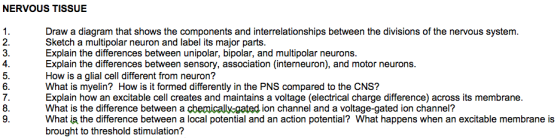
Homework Answers


Add Answer to:
Please answer as many as possible
NERVOUS TISSUE Draw a diagram that shows the components and...
What nervous system cell conducts the impulses making all nervous system functions possible? glial cell Schwann...
 What nervous system cell conducts the impulses making all nervous system functions possible? glial cell Schwann cell neuron neuroglial cell p 4 of 14 Which of the following is NOT a glial cell? macrophage oligodendrocyte astrocyte microglia p5 of 14 All neurons consist of a cell body and at least two kinds of fibers. They are: one dendrite and one axon hillock only and only one dendrite one axon dendrite and one or more axons one axon and one or...
KEY TERMS March the numbered form with the definition that is it be definition the responding...
 KEY TERMS March the numbered form with the definition that is it be definition the responding sumber in front of the appropriate 40. excitatory postsynaptic potential 21. resting potential 22 on leakage channels 23. equilibrium potential -24 graded potential 25. gated ion channels 26. depolarization 27. hyperpolarization Sensory neurons 2. central nervous system 3. motor neurons 4. intercurons 5. peripheral nervous system 6. somatic motor neurons *7. autonomic motor neurons 8. sympathetic 9. parasympathetic 10. cell body all dendrites 12....
1. The main receptive surface of neuron at a synapse for nerve Impulse transmission is: a....
 1. The main receptive surface of neuron at a synapse for nerve Impulse transmission is: a. Axon neurotransmitter receptors b. Dendrite neurotransmitter receptors C. Nissl bodies receptors d. Axon terminal receptors 2. Two types of cells in nervous system are: a. Axons & dendrites b. Motor and sensory neurons c. Neurons & neuroglia d. Schwann cells & microglia 3. Myelin is rich in : a. Lipids b. Carbohydrates c. Nucleic acids d. Salts 4. Synaptic knobs are at end of:...
3. Label each of the parts of a neuron below. Include the axon, axon terminal, dend...
 3. Label each of the parts of a neuron below. Include the axon, axon terminal, dend on below. Include the axon, axon terminal, dendrite, cell body, myelin sheath, and nucleus. bul 4. Which portion of the neuron receives incoming signals? Which part conducts signals away from the cell body? 5. Compare the function of sensory neurons, motor neurons, and interneurons 6. Label depolarization, hyperpolarization, peak action potential, resting potential, Na/K ATP pump. +30 Membrane potential (mv) Time 8. What are...
Efer Figure2 to answer questions 18-21: 8. produce the myelin sheaths of neurons in the central F...
 efer Figure2 to answer questions 18-21: 8. produce the myelin sheaths of neurons in the central Figure 2 nervous system. 19 form the Blood Brain Barrier 20._ are responsible for neurotransmitter release. 21 have ligand gated ion channels that are activated by neurotransmitters 22. Functionally, which cellular location is the neuron's "decision- making site" as to whether or not an action potential will be initiated? A axonal membrane B. axon hillock C. dendritic membrane D. presynaptic membrane 23. Calcium and...
Question 1: Draw, label, and explain the anatomical and physiological differences between a multipolar, bipolar and...
 Question 1: Draw, label, and explain the anatomical and physiological differences between a multipolar, bipolar and unipolar neuron. Be sure to include soma, axon, and dendrite(s) in your explanation image. Question 2: Explain what is occurring in this graph: +30 mV E mv 23 K Nat Nat kt Sodium gates dose Nat Nat Potassium gates open Depolarization Active sodium and potassium pumps Nyt 10 -55 mySeteteshold Repolarization Rest potential -70 myStimulus NS (1 Not Na+ K+ -90 mV Hyperpolarization Question...
For each multiple choice, what is the answer and why? 5. Myelin A) is only found...
 For
each multiple choice, what is the answer and why?
5. Myelin A) is only found in the peripheral nervous system B) is secreted from the axon terminals of autonomic neurons. C) is a carbohydrate within the membranes of some neuroglia. D) is a chemical present in the plasma membrane of neurons. E) influences the rate of conduction of an electrical signal down an axon. 6. Which of the following organs/structures is (are) innervated by somatic motor nerves? (only ONE...
For
each multiple choice, what is the answer and why?
5. Myelin A) is only found in the peripheral nervous system B) is secreted from the axon terminals of autonomic neurons. C) is a carbohydrate within the membranes of some neuroglia. D) is a chemical present in the plasma membrane of neurons. E) influences the rate of conduction of an electrical signal down an axon. 6. Which of the following organs/structures is (are) innervated by somatic motor nerves? (only ONE...
Neuron Signaling and Muscle Contraction 1) “Dissect” the various parts of an action potential by describing...
Neuron Signaling and Muscle Contraction 1) “Dissect” the various parts of an action potential by describing the status (active or nonactive) of the voltage-gated sodium channel, voltage-gated potassium channel, sodium/potassium pump, and overall voltage and/ or voltage range (in millivolts, or mV) for each of the following. A) Resting membrane (prior to the initiation of an action potential) B) just before threshold to just after threshold (Depolarization) C) Rising phase of the action potential D) Falling phase of the action...
Please help me with several of these questions, thank you very much. 1. During the propagation...
Please help me with several of these questions, thank you very much. 1. During the propagation of an action potential along the axon of a neuron, what is happening at the leading edge (the front) of the region of depolarization as it moves down the axon? a. Ligand-gated Na+channels are opening. b. Voltage-gated Na+channels are opening. c. Ligand-gated K+channels are opening. d. Voltage-gated Na+channels have become inactive and refractory. e. Voltage-gated Na+channels are closing. 2. During transcellular transport of glucose...
Bio 152 mideterm paper. 12. Name and explain the 3 types of movement across a plasma...
 Bio
152 mideterm paper.
12. Name and explain the 3 types of movement across a plasma membrane, Circle the letter of the type that keeps a resting neuron at-70mV. How does the cell do this? 13. List the 3 types of Functional neurons and their purposes * 14. In your own words, describe how an Action Potential (AP) gets started. * 15. List the steps necessary for chemical information transmission across a synapse. Start your description where the AP reaches...
Bio
152 mideterm paper.
12. Name and explain the 3 types of movement across a plasma membrane, Circle the letter of the type that keeps a resting neuron at-70mV. How does the cell do this? 13. List the 3 types of Functional neurons and their purposes * 14. In your own words, describe how an Action Potential (AP) gets started. * 15. List the steps necessary for chemical information transmission across a synapse. Start your description where the AP reaches...
 What nervous system cell conducts the impulses making all nervous system functions possible? glial cell Schwann cell neuron neuroglial cell p 4 of 14 Which of the following is NOT a glial cell? macrophage oligodendrocyte astrocyte microglia p5 of 14 All neurons consist of a cell body and at least two kinds of fibers. They are: one dendrite and one axon hillock only and only one dendrite one axon dendrite and one or more axons one axon and one or...
 KEY TERMS March the numbered form with the definition that is it be definition the responding sumber in front of the appropriate 40. excitatory postsynaptic potential 21. resting potential 22 on leakage channels 23. equilibrium potential -24 graded potential 25. gated ion channels 26. depolarization 27. hyperpolarization Sensory neurons 2. central nervous system 3. motor neurons 4. intercurons 5. peripheral nervous system 6. somatic motor neurons *7. autonomic motor neurons 8. sympathetic 9. parasympathetic 10. cell body all dendrites 12....
 1. The main receptive surface of neuron at a synapse for nerve Impulse transmission is: a. Axon neurotransmitter receptors b. Dendrite neurotransmitter receptors C. Nissl bodies receptors d. Axon terminal receptors 2. Two types of cells in nervous system are: a. Axons & dendrites b. Motor and sensory neurons c. Neurons & neuroglia d. Schwann cells & microglia 3. Myelin is rich in : a. Lipids b. Carbohydrates c. Nucleic acids d. Salts 4. Synaptic knobs are at end of:...
 3. Label each of the parts of a neuron below. Include the axon, axon terminal, dend on below. Include the axon, axon terminal, dendrite, cell body, myelin sheath, and nucleus. bul 4. Which portion of the neuron receives incoming signals? Which part conducts signals away from the cell body? 5. Compare the function of sensory neurons, motor neurons, and interneurons 6. Label depolarization, hyperpolarization, peak action potential, resting potential, Na/K ATP pump. +30 Membrane potential (mv) Time 8. What are...
 efer Figure2 to answer questions 18-21: 8. produce the myelin sheaths of neurons in the central Figure 2 nervous system. 19 form the Blood Brain Barrier 20._ are responsible for neurotransmitter release. 21 have ligand gated ion channels that are activated by neurotransmitters 22. Functionally, which cellular location is the neuron's "decision- making site" as to whether or not an action potential will be initiated? A axonal membrane B. axon hillock C. dendritic membrane D. presynaptic membrane 23. Calcium and...
 Question 1: Draw, label, and explain the anatomical and physiological differences between a multipolar, bipolar and unipolar neuron. Be sure to include soma, axon, and dendrite(s) in your explanation image. Question 2: Explain what is occurring in this graph: +30 mV E mv 23 K Nat Nat kt Sodium gates dose Nat Nat Potassium gates open Depolarization Active sodium and potassium pumps Nyt 10 -55 mySeteteshold Repolarization Rest potential -70 myStimulus NS (1 Not Na+ K+ -90 mV Hyperpolarization Question...
 For
each multiple choice, what is the answer and why?
5. Myelin A) is only found in the peripheral nervous system B) is secreted from the axon terminals of autonomic neurons. C) is a carbohydrate within the membranes of some neuroglia. D) is a chemical present in the plasma membrane of neurons. E) influences the rate of conduction of an electrical signal down an axon. 6. Which of the following organs/structures is (are) innervated by somatic motor nerves? (only ONE...
For
each multiple choice, what is the answer and why?
5. Myelin A) is only found in the peripheral nervous system B) is secreted from the axon terminals of autonomic neurons. C) is a carbohydrate within the membranes of some neuroglia. D) is a chemical present in the plasma membrane of neurons. E) influences the rate of conduction of an electrical signal down an axon. 6. Which of the following organs/structures is (are) innervated by somatic motor nerves? (only ONE...
 Bio
152 mideterm paper.
12. Name and explain the 3 types of movement across a plasma membrane, Circle the letter of the type that keeps a resting neuron at-70mV. How does the cell do this? 13. List the 3 types of Functional neurons and their purposes * 14. In your own words, describe how an Action Potential (AP) gets started. * 15. List the steps necessary for chemical information transmission across a synapse. Start your description where the AP reaches...
Bio
152 mideterm paper.
12. Name and explain the 3 types of movement across a plasma membrane, Circle the letter of the type that keeps a resting neuron at-70mV. How does the cell do this? 13. List the 3 types of Functional neurons and their purposes * 14. In your own words, describe how an Action Potential (AP) gets started. * 15. List the steps necessary for chemical information transmission across a synapse. Start your description where the AP reaches...
Most questions answered within 3 hours.
-
Where is the error in this code sequence?
String s1 = "Hello";
String s2 = "ello";...
asked 11 months ago -
Financial data for Joel de Paris, Inc., for last year
follow:
Joel de Paris, Inc.
Balance...
asked 11 months ago -
Consider this reaction:
Al2(SO4)3 (aq)+ BaCl3
(aq) Al2Cl6 (aq)- +
3BaSO4(s) . What is the...
asked 11 months ago -
Suppose that Savneet is considering increasing her
recent random sample from 20 car rentals to 40...
asked 11 months ago -
Trucks arrive at an unloading terminal at an average rate of 120
per hour.
Trucks arrive...
asked 11 months ago -
Why are methanol and ethanol completely soluble in water while
octanol is not very little soluble....
asked 11 months ago -
A facilities manager at a university reads in a research report
that the mean amount of...
asked 11 months ago -
When the CuSO4 is rehydrated by adding water to the anhydrous
compound, is this an endothermic...
asked 11 months ago -
A ray of sunlight is passing from diamond into crown glass; the
angle of incidence is...
asked 11 months ago -
A block of mass 0.249 kg is placed on top of a light, vertical
spring of...
asked 11 months ago -
how do the kidneys compensate in the presences of acidosis
a) trigger hyperventilate
b) reserve acid...
asked 11 months ago -
Question 501 pts
The rental rate of capital to the firm increases. Which of the
following...
asked 11 months ago