Please help me with several of these questions, thank you very much. 1. During the propagation...
Please help me with several of these questions, thank you very much.
1. During the propagation of an action potential along the axon of a neuron, what is
happening at the leading edge (the front) of the region of depolarization as it moves down
the axon?
a. Ligand-gated Na+channels are opening.
b. Voltage-gated Na+channels are opening.
c. Ligand-gated K+channels are opening.
d. Voltage-gated Na+channels have become inactive and refractory.
e. Voltage-gated Na+channels are closing.
2.
During transcellular transport of glucose across epithelial cells, how does glucose exit
the cell into the extracellular fluid?
a. by active transport in a Na+glucose symporter
b. by active transport in a Na+glucose antiporter
c. by active transport in a glucose uniporter
d. by passive transport in a glucose uniporter
e. by passive transport in a Na +glucose symporter
3. Chloride ion Cl- is close to equilibrium across the plasma membrane of many neurons.
What would happen to the membrane potential of a neuron if ligand-gated Cl- channels opened at the same time that the ligand-gated Na+channels opened?
a. There would be no effect of the Cl- channel opening and the membrane would depolarize normally.
b. The membrane potential would become more negative.
c. The depolarization would be suppressed and the membrane potential would depolarize less than normal.
d. The membrane potential would become more depolarized than normal.
4.
How is Ca 2+involved in the events at the neuromuscular junction when a signal from a neuron causes a muscle to contract?
a. Voltage-gated Ca2+channels open in the presynaptic neuron to cause the release of neurotransmitter into the synaptic cleft.
b. Voltage-gated Ca2+channels open in the muscle cell plasma membrane.
c. Ca2+ gated Ca2+release channels open in the sarcoplasmic reticulum.
d. Ca2+enters the muscle cell cytoplasm and causes muscle contraction.
e. all of the above
f. a and d only
5.
You are investigating the function of a membrane protein in epithelial cells and you
have labeled it with a fluorescent tag such as GFP. While observing it under the
fluorescence microscope, you carry out a FRAP (Fluorescence Recovery after
Photobleaching) experiment by bleaching a patch of your labeled proteins with a high-
powered laser and then watching what happens. What do you predict would happen if
your protein is a component of the tight junctions that are found between epithelial cells?
a. The fluorescence would not recover because the protein mobility is restricted.
b. The fluorescence would recover very quickly because fresh GFP-labelled proteins
would insert into the membrane from the cytosol.
c. The fluorescence would recover quickly because unbleached GFP-labelled proteins
would diffuse into the patch from surrounding membrane areas and replace the bleached
proteins.
d. The fluorescence would not recover because the lipid membrane is much less fluid in that region.
Homework Answers
1. d.Voltage-gated Na+ channels have become inactive and refractory.
During Depolarisation,the membrane potential become less negative(more positive)
Depolarisation and hyperpolarisation occur only when ion channels in the membrane open or close
And also altered the ability of ions to enter or exit the cell
The positive flow of ions in a opened channels cause depolarization,i.e, opening of channels let Na+ ions into the cell
Two types of channels:
Ligand gated ion channels(the open and closing of channels determined by the binding of signaling molecules transmitters)
Voltage gated ion channels- Voltage across the membrane.
The following image will explain detail about depolarisation:
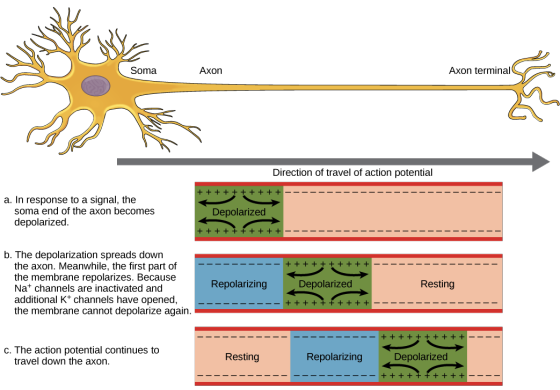
The action potential travelled down the length of a neuron,and from axon hillock to the tip of the axon,with the receiving neuron, a synapse formed.
Initially, an action potential undergoes in one patch of membrane(right at the axon hillock).
So that Na+ ions rush into the cell through the patch.
These ions later spread inside the cell and depolarized the neighbouring patch of membrane
And also triggered the neighbouring membrane and caused the patch to undergo its own action potential.
Second, the action potential travelled in only one direction from the cell body to the axon terminal
Occuring because the patch of membrane undergone one action potential - Refractory period (nerve cell cannot respond to additional stimulation).
This refractory period occurs due to the inactivation of voltage gated sodium ions and failed to keep of potassium ions in closing
This occurs at the peak of action potential,the slow closure of potassium channels also contribute to the refractory period by makes it harder to depolarize the membrane
This refractory period clears that action potential can travel only forward down the axon,never backwards through the potion of axon where action potential undergone.
The action potential reaches the end of axon cause a neurotransmitter containing vesicles
It fused with the membrane and released these molecules into the synaptic cleft(space between neurons).
The neurotransmitter binds to the ligand gated channels and caused depolarization of that cell which undergo its own action potential.
Add Answer to:
Please help me with several of these questions, thank you very
much.
1. During the propagation...
1. What triggers the opening of each of the different channels: ligand-gated K+ channels, ligand-gated Na+...
1. What triggers the opening of each of the different channels: ligand-gated K+ channels, ligand-gated Na+ channels, ligand-gated Cl- channels, voltage-gated Na+ channels, voltage-gated K+ channels, voltage-gated Ca2+ channels. 2. What happens to membrane potential in the immediate area where the channel is located when the channel opens and ions flow through? 3. Since graded and action potentials happen in different locations on the neuron, explain what has to happen to link these different events together.
Lo 10: Electrochemical Gradient The difference in voltage across the membrane is called the __________________________________. The...
Lo 10: Electrochemical Gradient The difference in voltage across the membrane is called the __________________________________. The inside of a normal cell is ___________________ (+/-); while the outside is ___________(+/-). The resting membrane potential of a neuron is ___________mV. Diagram the relative ratios of Ca++, Na+ and K+ in a cell under resting conditions. Draw an arrow for each of the molecules indicating which direction would be passive transport (into or out of the cell). For each of the following sentences, fill in...
Please answer all five multiple choice questions! i will give a thumbs up! 2015 BIOLOGY 24.The...
Please answer all five multiple choice questions! i will give a thumbs up! 2015 BIOLOGY 24.The concentration difference of ions across the membrane is maintained by a) Na+ ion channels. b) the Na+ K+ pump. c) K+ channels. d) Cl- channels 30. Developmental genes are a) usually highly variable. b) never expressed. c) usually highly conserved. d) found mainly in the mitochondrial genome. 2014 17. When the beta cells of the pancreas release insulin into the blood, a) the blood...
How does facilitated diffusion differ from simple diffusion? Facilitated diffusion requires ATP Facilitated diffusion requires a...
How does facilitated diffusion differ from simple diffusion? Facilitated diffusion requires ATP Facilitated diffusion requires a solute-specific protein carrier Facilitated diffusion transports solute against its’ concentration gradient Which of the following is TRUE about primary active cell membrane transport? It is a form of transport that requires a protein “pump” It is a form of transport that transports ions and/or solute against their concentration gradient It is a transport mechanism that requires energy released from the splitting of ATP by...
KEY TERMS March the numbered form with the definition that is it be definition the responding...
 KEY TERMS March the numbered form with the definition that is it be definition the responding sumber in front of the appropriate 40. excitatory postsynaptic potential 21. resting potential 22 on leakage channels 23. equilibrium potential -24 graded potential 25. gated ion channels 26. depolarization 27. hyperpolarization Sensory neurons 2. central nervous system 3. motor neurons 4. intercurons 5. peripheral nervous system 6. somatic motor neurons *7. autonomic motor neurons 8. sympathetic 9. parasympathetic 10. cell body all dendrites 12....
During the aerobic metabolism of glucose, glucose is ____________. Reduced to form water Oxidized to form...
During the aerobic metabolism of glucose, glucose is ____________. Reduced to form water Oxidized to form water Reduced to form CO2 Oxidized to form CO2 Which of the following describes the equation: FAD + XH2 à FADH2 + X. FAD is reduced to FADH2 It is a coupled reduction – oxidation reaction XH2 is oxidized to X All of the above Which of the following is FALSE about glycolysis? The initial steps of glycolysis requires energy derived from the splitting...
Efer Figure2 to answer questions 18-21: 8. produce the myelin sheaths of neurons in the central F...
 efer Figure2 to answer questions 18-21: 8. produce the myelin sheaths of neurons in the central Figure 2 nervous system. 19 form the Blood Brain Barrier 20._ are responsible for neurotransmitter release. 21 have ligand gated ion channels that are activated by neurotransmitters 22. Functionally, which cellular location is the neuron's "decision- making site" as to whether or not an action potential will be initiated? A axonal membrane B. axon hillock C. dendritic membrane D. presynaptic membrane 23. Calcium and...
1. What channels or carriers are NOT found at the axon to the axon terminal? Select...
1. What channels or carriers are NOT found at the axon to the axon terminal? Select one: a. Na+ leaky channels b. Cl- gated channels c. Na+ gated channels d. Na+-K+ ATPase e. None of the above 2. What is TRUE about action potential in the neuron? There may be more than one answer. Select one or more: a. At resting membrane potential (-70mV), the inactivation gate of the Na+ channel is closed while the activation gate is opened. b....
1. The following statement is similar to those you might see on exams. Write a paragraph...
1. The following statement is similar to those you might see on exams. Write a paragraph of 3-5 sentences describing 1) whether the statement is correct or incorrect and 2) the reasoning for your answer. Your answer should demonstrate your understanding of the physiological concepts underlying the statement and be written professionally. At a chemical synapse, the release of neurotransmitter occurs in response to a graded depolarization of the synaptic terminal. 2. Write a paragraph of 3-5 sentences answering the...
please write thorough answers thanks PART 1 Answer ONLY ONE of the following TWO questions of...
 please write thorough answers thanks
PART 1 Answer ONLY ONE of the following TWO questions of Part 1 ie a) OR b) a) A typical, healthy nerve cell in the body has intracellular and extracellular Na, K and Cl' concentrations as shown below. Na concentration: Extracellular: = 150 mm K concentration: Extracellular: = 4 mm Ci concentration: Extracellular: = 100 mm Temperature = 37°C (303.3K) R (the Universal Gas constant) = 8.315 VCmol'k F (Faraday's constant) = 96,485 Cmol Intracellular:...
please write thorough answers thanks
PART 1 Answer ONLY ONE of the following TWO questions of Part 1 ie a) OR b) a) A typical, healthy nerve cell in the body has intracellular and extracellular Na, K and Cl' concentrations as shown below. Na concentration: Extracellular: = 150 mm K concentration: Extracellular: = 4 mm Ci concentration: Extracellular: = 100 mm Temperature = 37°C (303.3K) R (the Universal Gas constant) = 8.315 VCmol'k F (Faraday's constant) = 96,485 Cmol Intracellular:...
 KEY TERMS March the numbered form with the definition that is it be definition the responding sumber in front of the appropriate 40. excitatory postsynaptic potential 21. resting potential 22 on leakage channels 23. equilibrium potential -24 graded potential 25. gated ion channels 26. depolarization 27. hyperpolarization Sensory neurons 2. central nervous system 3. motor neurons 4. intercurons 5. peripheral nervous system 6. somatic motor neurons *7. autonomic motor neurons 8. sympathetic 9. parasympathetic 10. cell body all dendrites 12....
 efer Figure2 to answer questions 18-21: 8. produce the myelin sheaths of neurons in the central Figure 2 nervous system. 19 form the Blood Brain Barrier 20._ are responsible for neurotransmitter release. 21 have ligand gated ion channels that are activated by neurotransmitters 22. Functionally, which cellular location is the neuron's "decision- making site" as to whether or not an action potential will be initiated? A axonal membrane B. axon hillock C. dendritic membrane D. presynaptic membrane 23. Calcium and...
 please write thorough answers thanks
PART 1 Answer ONLY ONE of the following TWO questions of Part 1 ie a) OR b) a) A typical, healthy nerve cell in the body has intracellular and extracellular Na, K and Cl' concentrations as shown below. Na concentration: Extracellular: = 150 mm K concentration: Extracellular: = 4 mm Ci concentration: Extracellular: = 100 mm Temperature = 37°C (303.3K) R (the Universal Gas constant) = 8.315 VCmol'k F (Faraday's constant) = 96,485 Cmol Intracellular:...
please write thorough answers thanks
PART 1 Answer ONLY ONE of the following TWO questions of Part 1 ie a) OR b) a) A typical, healthy nerve cell in the body has intracellular and extracellular Na, K and Cl' concentrations as shown below. Na concentration: Extracellular: = 150 mm K concentration: Extracellular: = 4 mm Ci concentration: Extracellular: = 100 mm Temperature = 37°C (303.3K) R (the Universal Gas constant) = 8.315 VCmol'k F (Faraday's constant) = 96,485 Cmol Intracellular:...
Most questions answered within 3 hours.
-
Where is the error in this code sequence?
String s1 = "Hello";
String s2 = "ello";...
asked 11 months ago -
Financial data for Joel de Paris, Inc., for last year
follow:
Joel de Paris, Inc.
Balance...
asked 11 months ago -
Consider this reaction:
Al2(SO4)3 (aq)+ BaCl3
(aq) Al2Cl6 (aq)- +
3BaSO4(s) . What is the...
asked 11 months ago -
Suppose that Savneet is considering increasing her
recent random sample from 20 car rentals to 40...
asked 11 months ago -
Trucks arrive at an unloading terminal at an average rate of 120
per hour.
Trucks arrive...
asked 11 months ago -
Why are methanol and ethanol completely soluble in water while
octanol is not very little soluble....
asked 11 months ago -
A facilities manager at a university reads in a research report
that the mean amount of...
asked 11 months ago -
When the CuSO4 is rehydrated by adding water to the anhydrous
compound, is this an endothermic...
asked 11 months ago -
A ray of sunlight is passing from diamond into crown glass; the
angle of incidence is...
asked 11 months ago -
A block of mass 0.249 kg is placed on top of a light, vertical
spring of...
asked 11 months ago -
how do the kidneys compensate in the presences of acidosis
a) trigger hyperventilate
b) reserve acid...
asked 11 months ago -
Question 501 pts
The rental rate of capital to the firm increases. Which of the
following...
asked 11 months ago