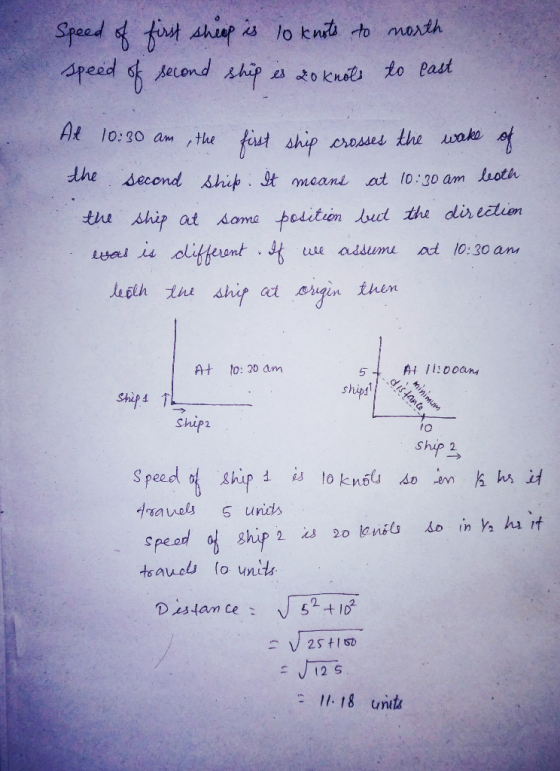
One ship is traveling north at 10 knots and another east at 20 knots. At 10:30...
One ship is traveling north at 10 knots and another east at 20 knots. At 10:30 AM, the first ship crosses the wake of the second ship precisely where the second ship had been at 10:30 AM. How is the distance between the ships changing at 11:00AM?
Homework Answers
Add Answer to:
One ship is traveling north at 10 knots and another
east at 20 knots. At 10:30...
At noon, ship A is 180 km west of ship B. Ship A is sailing east...
At noon, ship A is 180 km west of ship B. Ship A is sailing east at 40 km/h and ship B is sailing north at 30 km/h. How fast is the distance between the ships changing at 4:00 PM?
Ship A is located 4.1 km north and 2.3 km east of ship B. Ship A...
Ship A is located 4.1 km north and 2.3 km east of ship B. Ship A has a velocity of 20 km/h toward the south and ship B has a velocity of 42 km/h in a direction 37 ° north of east. What are the (a) x-component and (b) y-component of the velocity of A relative to B? (Axis directions are determined by the unit vectors î and ĵ , where î is toward the east.) (c) At what time...
A ship sails 40 kilometers 10 degrees north of east. It then turns 120 degrees to...
A ship sails 40 kilometers 10 degrees north of east. It then turns 120 degrees to the west, giving it a new heading of 50 degrees north of west. After sailing another 20 kilometers, how far is the boat (in kilometers) from where it started?
Car A, traveling south at 30 feet per second, is 400 feet due north of an...
Car A, traveling south at 30 feet per second, is 400 feet due north of an intersection. Car B, traveling west at 40 feet per second, is 300 feet due east of the same intersection. At this point in time how fast, in feet per second, is the distance between Car A and Car B changing? a) 42 b)44 c)46 d)48
.y ox A ship sails 30 kilometers 80 degrees north of east. It then turns 50...
 .y ox A ship sails 30 kilometers 80 degrees north of east. It then turns 50 degrees to the west, giving it a new heading of s0 degrees north of west After sailing another 50 kilometers, how far is the boat (in kilometers) from where it started? O A: 34.7OB: 50.3 c: 73.0 OD: 106 Submit Answer Tries 0/1 Post Discussion Send Feedback
(9.2) A person set out at 11:00 AM one day and walked three blocks east. Turning...
(9.2) A person set out at 11:00 AM one day and walked three blocks east. Turning a corner, he then continued walking four blocks north. Just as he reached the end of the fourth block, his watch read 11:10. (a) Determine the person’s displacement during his 10 minute walk (in terms of “east,” and “north” components). (b) Compute the magnitude and direction of his displacement. (c) Compute his average velocity (i) in terms of components (ii) in terms of magnitude...
Two cars, both of mass m, collide and stick togetber. Prior to the collision, one car had been traveling north at speed 2v
 Two cars, both of mass m, collide and stick togetber. Prior to the collision, one car had been traveling north at speed 2v, while the second was traveling at speed u at an angle φ south of east (as indicated in the figure). After the collision, the two-car system travels at speed vfinal at an angle θ east of north.
A helicopter takes off from a landing at 10:44 am and travels due east at speed...
A helicopter takes off from a landing at 10:44 am and travels due east at speed of 270 km/hr. A second helicopter traveling due south at 180 km/hr towards the pad set to land at 10:56 am/ Determine the rate at which the distance between the helicopters is changing at 10:48 am. (assume the helicopters are at the same altitude)
In an elastic collision two cars are traveling toward one another and crash head-on. The first...
 In an elastic collision two cars are traveling toward one another and crash head-on. The first car (A) has a mass of 700 kg and is traveling 20 m/s East and the second car (B) has a mass of 800 kg and is traveling 5 m/s West. After they collide, the first car (A) bounces backward at a rate of 15 m/s, what is the velocity of car (B) traveling at? A.0.625 m/s West B. 25.6 m/s East C. 25.6...
1. A car travels 30 miles north, then 10 miles east. The displacement vector is X...
 1. A car travels 30 miles north, then 10 miles east. The displacement vector is X miles north, Y miles east. A) What is X? B) What is Y? 2. A car travels 30 miles north, then 10 miles east, then 20 miles west, then 2 miles south. The displacement vector is X miles north, Y miles east. A) What is X? B) What is Y? (beware of signs) 3. A car travels 30 miles northwest. The displacement vector is...
 .y ox A ship sails 30 kilometers 80 degrees north of east. It then turns 50 degrees to the west, giving it a new heading of s0 degrees north of west After sailing another 50 kilometers, how far is the boat (in kilometers) from where it started? O A: 34.7OB: 50.3 c: 73.0 OD: 106 Submit Answer Tries 0/1 Post Discussion Send Feedback
 In an elastic collision two cars are traveling toward one another and crash head-on. The first car (A) has a mass of 700 kg and is traveling 20 m/s East and the second car (B) has a mass of 800 kg and is traveling 5 m/s West. After they collide, the first car (A) bounces backward at a rate of 15 m/s, what is the velocity of car (B) traveling at? A.0.625 m/s West B. 25.6 m/s East C. 25.6...
 1. A car travels 30 miles north, then 10 miles east. The displacement vector is X miles north, Y miles east. A) What is X? B) What is Y? 2. A car travels 30 miles north, then 10 miles east, then 20 miles west, then 2 miles south. The displacement vector is X miles north, Y miles east. A) What is X? B) What is Y? (beware of signs) 3. A car travels 30 miles northwest. The displacement vector is...
Most questions answered within 3 hours.
-
Where is the error in this code sequence?
String s1 = "Hello";
String s2 = "ello";...
asked 11 months ago -
Financial data for Joel de Paris, Inc., for last year
follow:
Joel de Paris, Inc.
Balance...
asked 11 months ago -
Consider this reaction:
Al2(SO4)3 (aq)+ BaCl3
(aq) Al2Cl6 (aq)- +
3BaSO4(s) . What is the...
asked 11 months ago -
Suppose that Savneet is considering increasing her
recent random sample from 20 car rentals to 40...
asked 11 months ago -
Trucks arrive at an unloading terminal at an average rate of 120
per hour.
Trucks arrive...
asked 11 months ago -
Why are methanol and ethanol completely soluble in water while
octanol is not very little soluble....
asked 11 months ago -
A facilities manager at a university reads in a research report
that the mean amount of...
asked 11 months ago -
When the CuSO4 is rehydrated by adding water to the anhydrous
compound, is this an endothermic...
asked 11 months ago -
A ray of sunlight is passing from diamond into crown glass; the
angle of incidence is...
asked 11 months ago -
A block of mass 0.249 kg is placed on top of a light, vertical
spring of...
asked 11 months ago -
how do the kidneys compensate in the presences of acidosis
a) trigger hyperventilate
b) reserve acid...
asked 11 months ago -
Question 501 pts
The rental rate of capital to the firm increases. Which of the
following...
asked 11 months ago