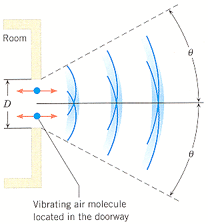
Sound emerges through a doorway, as in the figure. The width of
the doorway is 76 cm, and the speed of sound is 343 m/s. Find the
diffraction angle ? when the frequency is each of the
following.
(a) 5.8 kHz
_______°
(b) 5.8 ? 102 Hz
_______°
Homework Answers
Suppose the first maximum (what does it mean in this case?...): m=1


v=speed of sound
a=width of the door
Replace lambda in the first eq and get theta:
(a) theta1~4.6 deg
(b) theta2~53.2 deg.
Add Answer to:
Sound emerges through a doorway, as in the figure. The width of
the doorway is 76...
3. (4 points) Sound emerges through a doorway as shown in the figure. The width of...
 3. (4 points) Sound emerges through a doorway as shown in the figure. The width of the doorway is 77 cm, and the speed of sound is 343 m/s. Find the diffraction angle when the frequency of the sound is (a) 5.0 kHz and (b) 5.0.102 Hz. 0 8 III - B=
4. Loudspeakers A and B are vibrating in phase and are playing the same tone, which...
 4. Loudspeakers A and B are vibrating in phase and are playing the same tone, which has a frequency of 250 Hz. They are set up as in Figure 17.7, and point C is located as shown there. However, the distance between the speakers and the distance between speaker B and point C have the same value d. The speed of sound is 343 m/s. What is the smallest value of d, such that constructive interference occurs at point C?...
Sound with a frequency of 1220 Hz leaves a room through a doorway with a width...
Sound with a frequency of 1220 Hz leaves a room through a doorway with a width of 1.00 m . At which angles relative to the centerline perpendicular to the doorway will someone outside the room hear no sound? Use 344 m/s for the speed of sound in air and assume that the source and listener are both far enough from the doorway for Fraunhofer diffraction to apply. You can ignore effects of reflections. for 1, 2, 3
A sound wave with a frequency of 12.6 kHz emerges through a circular opening that has...
A sound wave with a frequency of 12.6 kHz emerges through a circular opening that has a diameter of 0.217 m. Find the diffraction angle θ when the sound travels (a) in air and (b) in water. (Note: The speed of sound in air is 343 m/s and the speed of sound in water is 1482 m/s.)
A sound wave with a frequency of 12.1 kHz emerges through a circular opening that has...
A sound wave with a frequency of 12.1 kHz emerges through a circular opening that has a diameter of 0.212 m. Find the diffraction angle θ when the sound travels (a) in air and (b) in water. (Note: The speed of sound in air is 343 m/s and the speed of sound in water is 1482 m/s.)
A sound wave a frequency of 20 kHz emerges through a circular opening that has a...
 A sound wave a frequency of 20 kHz emerges through a circular opening that has a diameter of 0.78 m. Concepts: The diffraction angle for a wave emerging through a circular opening is given by sin(theta) = 1.22 /D, where is the wavelength of the sound and D is the diameter of the opening. What is meant by the diffraction angle? the angle that the sound wave bends away from the center before passing through the opening the location of...
High-frequency sound waves exhibit less diffraction than low-frequency sound waves do. However, even high frequency sound...
High-frequency sound waves exhibit less diffraction than low-frequency sound waves do. However, even high frequency sound waves exhibit much more diffraction under normal circumstances than do light waves that pass through the same opening. The highest frequency that a healthy ear can typically hear is 2.0 × 10⁴ Hz. Assume that a sound wave with this frequency travels at 342 m/s and passes through a doorway that has a width of 1.2 m. (a) Determine the angle that locates the...
Sound exits a diffraction horn loudspeaker through a rectangular opening like a small doorway. Such a...
Sound exits a diffraction horn loudspeaker through a rectangular opening like a small doorway. Such a loudspeaker is mounted outside on a pole. In winter, when the temperature is 273 K, the diffraction angle θ has a value of 10o. What is the diffraction angle for the same sound on a summer day when the temperature is 311 K?
Sound exits a diffraction horn loudspeaker through a rectangular opening like a small doorway. Such a...
Sound exits a diffraction horn loudspeaker through a rectangular opening like a small doorway. Such a loudspeaker is mounted outside on a pole. In winter, when the temperature is 273 K, the diffraction angle θ has a value of 17o. What is the diffraction angle for the same sound on a summer day when the temperature is 311 K?
NT RESOURCESChapter 17, Pro Chapter 17, Problem 65 Chalkboard Video Copy of Chapter 17 Problems, Sections...
 NT RESOURCESChapter 17, Pro Chapter 17, Problem 65 Chalkboard Video Copy of Chapter 17 Problems, Sections 17.1-17.3 A sound wave with a frequency of 13.0 kHz emerges through a circular opening that has a diameter of 0.199 m. Find the diffraction angle θ when the sound travels (a) in air and (b) in water. (Note: The speed of sound in air is 343 m/s and the speed of sound in water is 1482 m/s) Units Chapter 17. Problem 17(a) Number...
 3. (4 points) Sound emerges through a doorway as shown in the figure. The width of the doorway is 77 cm, and the speed of sound is 343 m/s. Find the diffraction angle when the frequency of the sound is (a) 5.0 kHz and (b) 5.0.102 Hz. 0 8 III - B=
 4. Loudspeakers A and B are vibrating in phase and are playing the same tone, which has a frequency of 250 Hz. They are set up as in Figure 17.7, and point C is located as shown there. However, the distance between the speakers and the distance between speaker B and point C have the same value d. The speed of sound is 343 m/s. What is the smallest value of d, such that constructive interference occurs at point C?...
 A sound wave a frequency of 20 kHz emerges through a circular opening that has a diameter of 0.78 m. Concepts: The diffraction angle for a wave emerging through a circular opening is given by sin(theta) = 1.22 /D, where is the wavelength of the sound and D is the diameter of the opening. What is meant by the diffraction angle? the angle that the sound wave bends away from the center before passing through the opening the location of...
 NT RESOURCESChapter 17, Pro Chapter 17, Problem 65 Chalkboard Video Copy of Chapter 17 Problems, Sections 17.1-17.3 A sound wave with a frequency of 13.0 kHz emerges through a circular opening that has a diameter of 0.199 m. Find the diffraction angle θ when the sound travels (a) in air and (b) in water. (Note: The speed of sound in air is 343 m/s and the speed of sound in water is 1482 m/s) Units Chapter 17. Problem 17(a) Number...
Most questions answered within 3 hours.
-
Where is the error in this code sequence?
String s1 = "Hello";
String s2 = "ello";...
asked 11 months ago -
Financial data for Joel de Paris, Inc., for last year
follow:
Joel de Paris, Inc.
Balance...
asked 11 months ago -
Consider this reaction:
Al2(SO4)3 (aq)+ BaCl3
(aq) Al2Cl6 (aq)- +
3BaSO4(s) . What is the...
asked 11 months ago -
Suppose that Savneet is considering increasing her
recent random sample from 20 car rentals to 40...
asked 11 months ago -
Trucks arrive at an unloading terminal at an average rate of 120
per hour.
Trucks arrive...
asked 11 months ago -
Why are methanol and ethanol completely soluble in water while
octanol is not very little soluble....
asked 11 months ago -
A facilities manager at a university reads in a research report
that the mean amount of...
asked 11 months ago -
When the CuSO4 is rehydrated by adding water to the anhydrous
compound, is this an endothermic...
asked 11 months ago -
A ray of sunlight is passing from diamond into crown glass; the
angle of incidence is...
asked 11 months ago -
A block of mass 0.249 kg is placed on top of a light, vertical
spring of...
asked 11 months ago -
how do the kidneys compensate in the presences of acidosis
a) trigger hyperventilate
b) reserve acid...
asked 11 months ago -
Question 501 pts
The rental rate of capital to the firm increases. Which of the
following...
asked 11 months ago