
a) For the circuit shown in the figure find the current through each resistor.
b) For the circuit shown in the figure find the potential difference across each resistor.
Homework Answers
The concept required to solve the given problem is series and parallel combination of resistors and ohm’s law.
First use the formula for parallel and series combination of resistors to solve the equivalent resistance of the circuit.
Then, use Ohm’s law to calculate the current and potential drop across the resistors.
The ohm’s law states that the current flowing through the conductor is directly proportional to the potential difference across its ends. Thus, the numerical form of the law is,
Here, is the resistance, is the potential difference and is the current.
The resistance of the resistors in series is calculated by,
Here, , , ,… are the resistance of the resistors.
The resistance of the resistors in parallel is calculated by,
Here, , , ,… are the resistance of the resistors.
Across series combination of resistors current across each resistor is same and is equal to the current flowing through the circuit.
Across parallel combination of resistors voltage across each resistor is same and is equal to the voltage of the battery.
(a)
The following figure shows a circuit diagram with resistances and a battery with voltage .
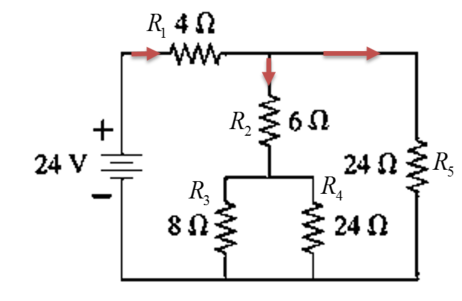
Since the resistors, are connected in parallel, the equivalent resistance of the resistors, is,
Substitute for and for in the above equation.
Since the resistors, are in series, the equivalent resistance of resistors, is,
Substitute for and for in the above equation.
Since the resistors, are connected in parallel, the equivalent resistance of the resistors, is,
Substitute for and for in the above equation.
Since the resistors are in series with each other, the equivalent resistance of the circuit is,
Substitute for and for in the above equation.
The current flowing through the circuit will be given by ohm’s law.
Substitute for and for in the above equation.
The current through the resistor will be equal to the current running in the circuit.
The current through the equivalent resistance will also be equal to .
Hence,
The voltage through the resistor is,
Substitute for and for in the above equation.
The potential difference across will be,
Substitute for in the above equation.
Since the resistors are in parallel to each other, the voltage drop across and across the equivalent resistance will be the same as .
The voltage drop across the resistor, is,
The current across the resistor, is,
Substitute for and for in the above equation.
The voltage drop across the resistor, is,
The current across the equivalent resistor, is,
Substitute for and for in the above equation.
The current through the resistor, will be equal to .
Thus,
The current through the equivalent resistor, will be equal to .
Thus,
The voltage drop across will be,
Substitute for and for in the above equation.
The potential drop across will be equal to since the two resistors are parallel. Thus, the voltage drop across is,
The current across the resistor will be given by,
Substitute for and for in the above equation.
The voltage drop across is,
The current across the resistor will be given by,
Substitute for and for in the equation .
The voltage through the resistor is,
Substitute for and for in the above equation.
Since the resistors are in parallel to each other, the voltage drop across and across the equivalent resistance will be the same as .
The voltage drop across the resistor, is,
The potential drop across will be equal to since the tow resistors are parallel.
The voltage drop across ,
The voltage drop across ,
The voltage across resistors is,
Substitute for and for in the above equation.
Ans: Part a
The current through the resistors are 2 A, 1.33 A, 0.998 A, 0.333 A, and 0.667 A respectively.
Part bThe potential differences across the resistors are 8.00 V, 7.98 V, 7.98 V, 7.98 V, and 16 V respectively.
Add Answer to:
a) For the circuit shown in the figure find the currentthrough each resistor.b) For...
For the circuit shown in the figure find the current through each resistor. For the circuit...
 For the circuit shown in the figure find the current through
each resistor.
For the circuit shown in the figure find the potential
difference across each resistor.
For the circuit shown in the figure find the current through
each resistor.
For the circuit shown in the figure find the potential
difference across each resistor.
A. For the circuit shown in the figure(Figure 1) find the current through each resistor. B....
 A. For the circuit shown in the figure(Figure 1) find the
current through each resistor.
B. For the circuit shown in the figure find the potential
difference across each resistor.
24 V 4 Ω
A. For the circuit shown in the figure(Figure 1) find the
current through each resistor.
B. For the circuit shown in the figure find the potential
difference across each resistor.
24 V 4 Ω
For the circuit shown in the figure, find the current through and the potential difference across each resistor.
 For the circuit shown in the figure, find the current through
and the potential difference across each resistor.What is the current through the 3 Ω resistor?What is the current through the 4 Ω resistor? What is the potential difference across the 3 Ω resistor.What is the potential difference across the 4 Ω resistor?What is the potential difference across the 48 Ω resistor?What is the current through the 48 Ω resistor?What is the potential difference
across the 16 Ω resistor?What is the...
For the circuit shown in the figure, find the current through
and the potential difference across each resistor.What is the current through the 3 Ω resistor?What is the current through the 4 Ω resistor? What is the potential difference across the 3 Ω resistor.What is the potential difference across the 4 Ω resistor?What is the potential difference across the 48 Ω resistor?What is the current through the 48 Ω resistor?What is the potential difference
across the 16 Ω resistor?What is the...
(A) For the circuit shown in the figure(Figure 1) find thecurrent through each resistor.Express...
 (A) For the circuit shown in the figure(Figure 1) find the
current through each resistor.Express your answers using two significant figures. Enter your
answers numerically separated by commas.(B)For the circuit shown in the figure find the potential
difference across each resistor.Express your answers using two significant figures. Enter your
answers numerically separated by commas.
(A) For the circuit shown in the figure(Figure 1) find the
current through each resistor.Express your answers using two significant figures. Enter your
answers numerically separated by commas.(B)For the circuit shown in the figure find the potential
difference across each resistor.Express your answers using two significant figures. Enter your
answers numerically separated by commas.
For each circuit shown in the figure, find the current through and potential difference across each...
 For each circuit shown in the figure, find the current through
and potential difference across each resistor
Thank you!
4Ω 6Ω 24 V 24 Ω 812 24 Ω
For each circuit shown in the figure, find the current through
and potential difference across each resistor
Thank you!
4Ω 6Ω 24 V 24 Ω 812 24 Ω
For the circuit shown in the figure (Figure 1), find the current through and the potential...
 For the circuit shown in the figure (Figure 1), find the current through and the potential difference across each resistor. For the steps and strategies involved in solving a similar problem, you may view a Video Tutor Solution.
1 Circuit Analysis For the circuit shown in Figure 1, find the current through and the...
 1 Circuit Analysis For the circuit shown in Figure 1, find the current through and the potential difference across each resistor. Place your results in a table for ease of reading. Please follow the context-Rich solution format. For sense-making, please try to reason why the amount of current through each resistor makes sense. Figure 1: 3 Ω 16 Ω 4822 12 V 412
For the circuit shown in the figure below, find the current through and the potential difference...
 For the circuit shown in the figure below, find the current through and the potential difference across each resistor. Place your results in the table for ease of reading. (Assume R1 = 27 ohm, R2 = 2 ohm, and V = 2 V.)
Consider the circuit shown in the figure below. (Let R = 30.0 ?.) (a) Find the...
 Consider the circuit shown in the figure
below. (Let R = 30.0 ?.)
(a) Find the current in the 30.0-?
resistor.
(b) Find the potential difference between points a and b.
Consider the circuit shown in the figure below. (Let R = 30.0 Ω.) 25.0 V 10.0 Ω 10.0 Ω 5.00 Ω 5.00 Ω (a) Find the current in the 30.0-2 resistor. Enter a number. otential difference across the 10-Ω resistor, the 5-Ω resistor and the (R + 5-Q) resistor...
Consider the circuit shown in the figure
below. (Let R = 30.0 ?.)
(a) Find the current in the 30.0-?
resistor.
(b) Find the potential difference between points a and b.
Consider the circuit shown in the figure below. (Let R = 30.0 Ω.) 25.0 V 10.0 Ω 10.0 Ω 5.00 Ω 5.00 Ω (a) Find the current in the 30.0-2 resistor. Enter a number. otential difference across the 10-Ω resistor, the 5-Ω resistor and the (R + 5-Q) resistor...
Answers labeled clearly please Consider the circuit shown in the figure below. (Let R-6.20 Ω and Δν-22.0 V.) 2.40 2 ΔΙ. 9.00 Ω (a) Find the equivalent resistance of the circuit in the figure above. (b...
 Answers labeled clearly please
Consider the circuit shown in the figure below. (Let R-6.20 Ω and Δν-22.0 V.) 2.40 2 ΔΙ. 9.00 Ω (a) Find the equivalent resistance of the circuit in the figure above. (b) Find the potential difference across each resistor. AVce - AVcd AVfd (c) Find each current indicated in the figure above. (d) Find the power delivered to each resistor. ac ce cd ed
Consider the circuit shown in the figure below. (Let R-6.20 Ω and...
Answers labeled clearly please
Consider the circuit shown in the figure below. (Let R-6.20 Ω and Δν-22.0 V.) 2.40 2 ΔΙ. 9.00 Ω (a) Find the equivalent resistance of the circuit in the figure above. (b) Find the potential difference across each resistor. AVce - AVcd AVfd (c) Find each current indicated in the figure above. (d) Find the power delivered to each resistor. ac ce cd ed
Consider the circuit shown in the figure below. (Let R-6.20 Ω and...
 For the circuit shown in the figure find the current through
each resistor.
For the circuit shown in the figure find the potential
difference across each resistor.
For the circuit shown in the figure find the current through
each resistor.
For the circuit shown in the figure find the potential
difference across each resistor.
 A. For the circuit shown in the figure(Figure 1) find the
current through each resistor.
B. For the circuit shown in the figure find the potential
difference across each resistor.
24 V 4 Ω
A. For the circuit shown in the figure(Figure 1) find the
current through each resistor.
B. For the circuit shown in the figure find the potential
difference across each resistor.
24 V 4 Ω
 For the circuit shown in the figure, find the current through
and the potential difference across each resistor.What is the current through the 3 Ω resistor?What is the current through the 4 Ω resistor? What is the potential difference across the 3 Ω resistor.What is the potential difference across the 4 Ω resistor?What is the potential difference across the 48 Ω resistor?What is the current through the 48 Ω resistor?What is the potential difference
across the 16 Ω resistor?What is the...
For the circuit shown in the figure, find the current through
and the potential difference across each resistor.What is the current through the 3 Ω resistor?What is the current through the 4 Ω resistor? What is the potential difference across the 3 Ω resistor.What is the potential difference across the 4 Ω resistor?What is the potential difference across the 48 Ω resistor?What is the current through the 48 Ω resistor?What is the potential difference
across the 16 Ω resistor?What is the...
 (A) For the circuit shown in the figure(Figure 1) find the
current through each resistor.Express your answers using two significant figures. Enter your
answers numerically separated by commas.(B)For the circuit shown in the figure find the potential
difference across each resistor.Express your answers using two significant figures. Enter your
answers numerically separated by commas.
(A) For the circuit shown in the figure(Figure 1) find the
current through each resistor.Express your answers using two significant figures. Enter your
answers numerically separated by commas.(B)For the circuit shown in the figure find the potential
difference across each resistor.Express your answers using two significant figures. Enter your
answers numerically separated by commas.
 For each circuit shown in the figure, find the current through
and potential difference across each resistor
Thank you!
4Ω 6Ω 24 V 24 Ω 812 24 Ω
For each circuit shown in the figure, find the current through
and potential difference across each resistor
Thank you!
4Ω 6Ω 24 V 24 Ω 812 24 Ω
 For the circuit shown in the figure (Figure 1), find the current through and the potential difference across each resistor. For the steps and strategies involved in solving a similar problem, you may view a Video Tutor Solution.
 1 Circuit Analysis For the circuit shown in Figure 1, find the current through and the potential difference across each resistor. Place your results in a table for ease of reading. Please follow the context-Rich solution format. For sense-making, please try to reason why the amount of current through each resistor makes sense. Figure 1: 3 Ω 16 Ω 4822 12 V 412
 For the circuit shown in the figure below, find the current through and the potential difference across each resistor. Place your results in the table for ease of reading. (Assume R1 = 27 ohm, R2 = 2 ohm, and V = 2 V.)
 Consider the circuit shown in the figure
below. (Let R = 30.0 ?.)
(a) Find the current in the 30.0-?
resistor.
(b) Find the potential difference between points a and b.
Consider the circuit shown in the figure below. (Let R = 30.0 Ω.) 25.0 V 10.0 Ω 10.0 Ω 5.00 Ω 5.00 Ω (a) Find the current in the 30.0-2 resistor. Enter a number. otential difference across the 10-Ω resistor, the 5-Ω resistor and the (R + 5-Q) resistor...
Consider the circuit shown in the figure
below. (Let R = 30.0 ?.)
(a) Find the current in the 30.0-?
resistor.
(b) Find the potential difference between points a and b.
Consider the circuit shown in the figure below. (Let R = 30.0 Ω.) 25.0 V 10.0 Ω 10.0 Ω 5.00 Ω 5.00 Ω (a) Find the current in the 30.0-2 resistor. Enter a number. otential difference across the 10-Ω resistor, the 5-Ω resistor and the (R + 5-Q) resistor...
 Answers labeled clearly please
Consider the circuit shown in the figure below. (Let R-6.20 Ω and Δν-22.0 V.) 2.40 2 ΔΙ. 9.00 Ω (a) Find the equivalent resistance of the circuit in the figure above. (b) Find the potential difference across each resistor. AVce - AVcd AVfd (c) Find each current indicated in the figure above. (d) Find the power delivered to each resistor. ac ce cd ed
Consider the circuit shown in the figure below. (Let R-6.20 Ω and...
Answers labeled clearly please
Consider the circuit shown in the figure below. (Let R-6.20 Ω and Δν-22.0 V.) 2.40 2 ΔΙ. 9.00 Ω (a) Find the equivalent resistance of the circuit in the figure above. (b) Find the potential difference across each resistor. AVce - AVcd AVfd (c) Find each current indicated in the figure above. (d) Find the power delivered to each resistor. ac ce cd ed
Consider the circuit shown in the figure below. (Let R-6.20 Ω and...
Most questions answered within 3 hours.
-
Where is the error in this code sequence?
String s1 = "Hello";
String s2 = "ello";...
asked 10 months ago -
Financial data for Joel de Paris, Inc., for last year
follow:
Joel de Paris, Inc.
Balance...
asked 10 months ago -
Consider this reaction:
Al2(SO4)3 (aq)+ BaCl3
(aq) Al2Cl6 (aq)- +
3BaSO4(s) . What is the...
asked 10 months ago -
Suppose that Savneet is considering increasing her
recent random sample from 20 car rentals to 40...
asked 10 months ago -
Trucks arrive at an unloading terminal at an average rate of 120
per hour.
Trucks arrive...
asked 10 months ago -
Why are methanol and ethanol completely soluble in water while
octanol is not very little soluble....
asked 10 months ago -
A facilities manager at a university reads in a research report
that the mean amount of...
asked 10 months ago -
When the CuSO4 is rehydrated by adding water to the anhydrous
compound, is this an endothermic...
asked 10 months ago -
A ray of sunlight is passing from diamond into crown glass; the
angle of incidence is...
asked 10 months ago -
A block of mass 0.249 kg is placed on top of a light, vertical
spring of...
asked 10 months ago -
how do the kidneys compensate in the presences of acidosis
a) trigger hyperventilate
b) reserve acid...
asked 10 months ago -
Question 501 pts
The rental rate of capital to the firm increases. Which of the
following...
asked 10 months ago