
Homework Answers
The situation is as shown in the figure above.
The total force on the pendulum

As
 and
and 



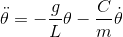
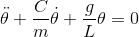
This is the require equation of motion.It is second order total differential equation with constat coefficients.

the solution remains periodic for sufficient long only if

which defnitely should be the case here.
Under this assumption the solution can be written as

Hence The amplitude

decrease exponentially
with g=9.8 ms-2 and L=1.5 m

time taken to comple 30 swings
T30=73.8 sec
Amplitude after 30 swings =
.

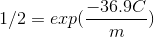


Let n be the no of swings the amplitude will reduce by half if L=2.0m

Time for n swings
Tn=2.838 n
soliving
with t=2,838n
C/m =0.0188
A=D0/2
we have


Thus the no of swings is 8
Add Answer to:
A small mass m is hung at the end of a light string of length 1.5...
A pendulum consists of a string of length L and a mass m hung at one...
 A pendulum consists of a string of length L and a mass m hung at one end and the mass oscillates along a circular arc. Part a) Familiarize yourself with the derivation of omega = Squareroot g/L to hold. i) Explain succinctly how the angular frequency of oscillation omega = Squareroot g/L comes about from Newton's Law, where g is the gravitational acceleration. ii) One assumption required is the small angle approximation: sin theta = theta and cos theta =...
A certain simple pendulum consists of a small 750.0 ? bob that swings on the end...
A certain simple pendulum consists of a small 750.0 ? bob that swings on the end of a 25.0 ?? string. The small amplitude of the oscillations of this pendulum decays to half its original value after 45.0 oscillations. The angular position of the pendulum as a function of time, ?(?), can be expressed as follows. ?(?) = ??0 ? − ??/2m cos(? ′ ? + ?) ??0 is the original angular amplitude. ? is the time, and ? is...
A 954 g mass swings on a 1.6 m-string as a pendulum. The amplitude is observed...
A 954 g mass swings on a 1.6 m-string as a pendulum. The amplitude is observed to decay to a third of its initial value after 31 oscillations. To the nearest second, what is the time constant for this oscillator?
A mass 20 (in grams) suspended from a string of length 94 (in cm) forms a...
A mass 20 (in grams) suspended from a string of length 94 (in cm) forms a simple pendulum. If its amplitude is θ0 (in degrees), during what fraction of its period can the pendulum be found between + θ ° and - θ °? The initial amplitude is small enough that the motion is simple harmonic to a very good approximation. Express your answer in terms of the given variables. HINTS: Use θ(t) = θ0 sin(ω t) to find ωt,...
7. Alex attaches a small pendulum bob of mass m to a string of length L....
 7. Alex attaches a small pendulum bob of mass m to a string of length L. James holds the bob so that the string is horizontal and then releases it from rest. At the lowest point of the swing, the string catches on a thin peg a distance R above the lowest point. Show that R must be smaller than 2 if the string is to remain taut as the bob swings around the peg in a full circle Ri
(a) Consider a pendulum with a mass m suspended at the end of a light string...
 (a) Consider a pendulum with a mass m suspended at the end of a light string of length l. As it moves through the air the mass experiences a damping force that is proportional to its speed, with constant of proportionality y. (i) Show that the angle θ that the string makes with the vertical is governed by the ordinary differential equation dt2 m dt l in the limit of small θ. 1) State the natural frequency wo of the...
A uniform thin rod of length L = 40.0 cm and mass M = 800 g...
A uniform thin rod of length L = 40.0 cm and mass M = 800 g is pinned so that it can swing about a point that is one-third of the way from one end of the rod. You pull the rod away from equilibrium by a small angle and release it, so that the rod swings back and forth. (a) What is the period of the rod’s motion as it swings back and forth? (b) What is the length...
6) A 0.25 kg mass is hanged from a string with length L = 0.65 m,...
6) A 0.25 kg mass is hanged from a string with length L = 0.65 m, making a pendulum. The mass is raised so that the taut string makes an angle of θ = 37◦ with the vertical, and then released from rest. When the mass swings past the bottom (where its speed is maximum) it is observed to have a speed of 1.1 m/s. a) Choosing the bottom as your h = 0 level, what is the initial height...
he length of a simple pendulum is 0.65 m and the mass of the particle (the...
he length of a simple pendulum is 0.65 m and the mass of the particle (the “bob”) at the end of the cable is 0.20 kg. The pendulum is pulled away from its equilibrium position by an angle of 7.7° and released from rest. Assume that friction can be neglected and that the resulting oscillatory motion is simple harmonic motion. (a) What is the angular frequency of the motion? (b) Using the position of the bob at its lowest point...
A mass 26.9 (in grams) suspended from a string of length 65 (in cm) forms a...
A mass 26.9 (in grams) suspended from a string of length 65 (in cm) forms a simple pendulum. If its amplitude is θ0 (in degrees), during what fraction of its period can the pendulum be found between + θ ° and - θ °? The initial amplitude is small enough that the motion is simple harmonic to a very good approximation. Express your answer in terms of the given variables.
 A pendulum consists of a string of length L and a mass m hung at one end and the mass oscillates along a circular arc. Part a) Familiarize yourself with the derivation of omega = Squareroot g/L to hold. i) Explain succinctly how the angular frequency of oscillation omega = Squareroot g/L comes about from Newton's Law, where g is the gravitational acceleration. ii) One assumption required is the small angle approximation: sin theta = theta and cos theta =...
 7. Alex attaches a small pendulum bob of mass m to a string of length L. James holds the bob so that the string is horizontal and then releases it from rest. At the lowest point of the swing, the string catches on a thin peg a distance R above the lowest point. Show that R must be smaller than 2 if the string is to remain taut as the bob swings around the peg in a full circle Ri
 (a) Consider a pendulum with a mass m suspended at the end of a light string of length l. As it moves through the air the mass experiences a damping force that is proportional to its speed, with constant of proportionality y. (i) Show that the angle θ that the string makes with the vertical is governed by the ordinary differential equation dt2 m dt l in the limit of small θ. 1) State the natural frequency wo of the...
Most questions answered within 3 hours.
-
Where is the error in this code sequence?
String s1 = "Hello";
String s2 = "ello";...
asked 11 months ago -
Financial data for Joel de Paris, Inc., for last year
follow:
Joel de Paris, Inc.
Balance...
asked 11 months ago -
Consider this reaction:
Al2(SO4)3 (aq)+ BaCl3
(aq) Al2Cl6 (aq)- +
3BaSO4(s) . What is the...
asked 11 months ago -
Suppose that Savneet is considering increasing her
recent random sample from 20 car rentals to 40...
asked 11 months ago -
Trucks arrive at an unloading terminal at an average rate of 120
per hour.
Trucks arrive...
asked 11 months ago -
Why are methanol and ethanol completely soluble in water while
octanol is not very little soluble....
asked 11 months ago -
A facilities manager at a university reads in a research report
that the mean amount of...
asked 11 months ago -
When the CuSO4 is rehydrated by adding water to the anhydrous
compound, is this an endothermic...
asked 11 months ago -
A ray of sunlight is passing from diamond into crown glass; the
angle of incidence is...
asked 11 months ago -
A block of mass 0.249 kg is placed on top of a light, vertical
spring of...
asked 11 months ago -
how do the kidneys compensate in the presences of acidosis
a) trigger hyperventilate
b) reserve acid...
asked 11 months ago -
Question 501 pts
The rental rate of capital to the firm increases. Which of the
following...
asked 11 months ago