Burns produced by steam at 100°C are much more severe than those produced by the same...
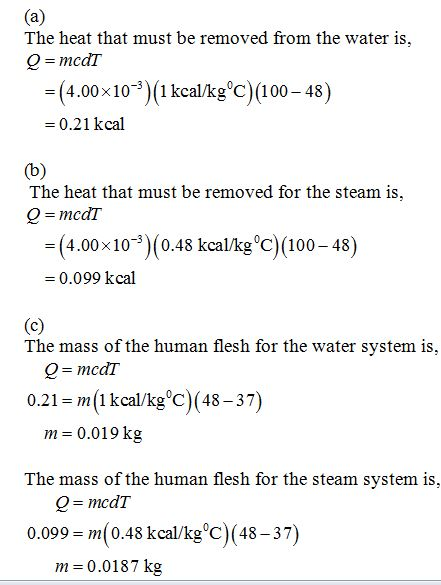
Burns produced by steam at 100°C are much more severe than those produced by the same mass of 100°C water. To verify this:
(a) Calculate the heat that must be removed from 4.00 g of 100°C
water to lower its temperature to 48.0°C.
kcal
(b) Calculate the heat that must be removed from 4.00 g of 100°C
steam to condense it and lower its temperature to 48.0°C.
kcal
(c) Calculate the mass of human flesh that the heat produced in
each case can raise from the normal 37.0°C to 48.0°C. (Flesh is
badly damaged at 50.0°C.)
steam
kg
water
kg
Homework Answers
Add Answer to:
Burns produced by steam at 100°C are much more severe than those
produced by the same...
Burns produced by steam at 100°C are much more severe than those produced by the same...
Burns produced by steam at 100°C are much more severe than those produced by the same mass of 100°C water. To verify this, answer the questions below. Specific heat of water = 1.00 kcal/(kg · °C); heat of vaporization = 539 kcal/kg; specific heat of human flesh = 0.83 kcal/(kg · °C). (a) Calculate the quantity of heat that must be removed from 3.60 g of 100°C water to lower its temperature to 47.0°C. (b) Calculate the quantity of heat...
Burns produced by steam at 100 degree C are much more severe than those produced by...
 Burns produced by steam at 100 degree C are much more severe than those produced by the same mass of 100 degree C water. To verify this, answer the questions below. Specific heat of water = 1.00 kcal/(kg degree C); heat of vaporization = 539 kcal/kg; specific heat of human flesh = 0.83 kcal/(kg degree C). Calculate the quantity of heat that must be removed from 7.00 g of 100degree C water to lower its temperature to 45.0degree C. kcal...
Burns produced by steam at 100°C are much more severe than those produced by the same...
Burns produced by steam at 100°C are much more severe than those produced by the same mass of 100°C water. To verify this: (a) Calculate the heat that must be removed from 6.00 g of 100°C water to lower its temperature to 53.0°C. ________kcal (b) Calculate the heat that must be removed from 6.00 g of 100°C steam to condense it and lower its temperature to 53.0°C. ________kcal (c) Calculate the mass of human flesh that the heat produced in...
Steam at 100°C is condensed into a 54.0 g copper calorimeter cup containing 300 g of water at 21.0°C. Determine the amou...
Steam at 100°C is condensed into a 54.0 g copper calorimeter cup containing 300 g of water at 21.0°C. Determine the amount of steam (in g) needed for the system to reach a final temperature of 48.0°C. The specific heat of copper is 387 J/(kg · °C).
Calculate the energy released when 50.0g of steam condenses at 100℃.
 Calculate the energy released when 50.0g of steam condenses at 100℃.Use the cooling curve to show what happens when 50.0g steam condenses at 100℃ and then cools to 20℃. Then calculate this energy change.6. Use the below cooling curve for water for the following questions. A. Label the melting/freezing point. B. Label the boiling/evaporation point. C. At what state is water when the temperature is 80 °c? D. At what state is water when the temperature is -20 °C? E. What happens to the temperature...
1. A 2.50 kg block of ice at 0°C is added to a picnic cooler. How...
 .1. A 2.50 kg block of ice at 0°C is added to a picnic cooler. How much heat (in kcal) will the ice remove as it melts to water at 0°C? 2. A 300.0 g pot of water at room temperature (25.0°C) is placed on a stove. How much heat (in kcal) is required to change this water to steam at 100.0°C? 3. Spent steam from an electric generating plant leaves the turbines at 110.0°C and is cooled to 95.0°C liquid water...
the amount of steam (in g) needed for the system to reach Steam at 100°C is...
 the amount of steam (in g) needed for the system to reach Steam at 100°C is condensed into a 54.0 g steel calorimeter cup containing 300 g of water at 23.0°C a final temperature of 64.0°C. The specific heat of steel is 490 3/(kg °C).
Calculate the final equilibrium temperature when 10.0 grams of steam initially at 100 degree C is...
 Calculate the final equilibrium temperature when 10.0 grams of steam initially at 100 degree C is mixed with 450 grams of liquid water and 110 grams of ice at 0 degree C in a calorimeter. That is, the liquid water AND the ice are initially at 0 degree C. Ignore any heat energy exchanges with the calorimeter and the surroundings. If you conclude that the final temperature of the system is 0 degree C, then what mass of ice remains,...
Calculate how many grams of ice at 0°C would be melted by 100 g of 100°C...
Calculate how many grams of ice at 0°C would be melted by 100 g of 100°C steam. Hint: heat will be transferred from the steam to the ice in two processes: •the steam will condense into liquid, and •that liquid will transfer heat until it is at the freezing point of water. Note that for water: Lf = 80 cal/g (ice), and Lv = 540 cal/g (steam) (Use calories) C(water) =1 cal/g*C Answer in grams no decimal places.
What mass of steam at 100°C must be mixed with 488 g of ice at its...
What mass of steam at 100°C must be mixed with 488 g of ice at its melting point, in a thermally insulated container, to produce liquid water at 59.0°C? The specific heat of water is 4186 J/kg·K. The latent heat of fusion is 333 kJ/kg, and the latent heat of vaporization is 2256 kJ/kg.
 Burns produced by steam at 100 degree C are much more severe than those produced by the same mass of 100 degree C water. To verify this, answer the questions below. Specific heat of water = 1.00 kcal/(kg degree C); heat of vaporization = 539 kcal/kg; specific heat of human flesh = 0.83 kcal/(kg degree C). Calculate the quantity of heat that must be removed from 7.00 g of 100degree C water to lower its temperature to 45.0degree C. kcal...
 Calculate the energy released when 50.0g of steam condenses at 100℃.Use the cooling curve to show what happens when 50.0g steam condenses at 100℃ and then cools to 20℃. Then calculate this energy change.6. Use the below cooling curve for water for the following questions. A. Label the melting/freezing point. B. Label the boiling/evaporation point. C. At what state is water when the temperature is 80 °c? D. At what state is water when the temperature is -20 °C? E. What happens to the temperature...
 .1. A 2.50 kg block of ice at 0°C is added to a picnic cooler. How much heat (in kcal) will the ice remove as it melts to water at 0°C? 2. A 300.0 g pot of water at room temperature (25.0°C) is placed on a stove. How much heat (in kcal) is required to change this water to steam at 100.0°C? 3. Spent steam from an electric generating plant leaves the turbines at 110.0°C and is cooled to 95.0°C liquid water...
 the amount of steam (in g) needed for the system to reach Steam at 100°C is condensed into a 54.0 g steel calorimeter cup containing 300 g of water at 23.0°C a final temperature of 64.0°C. The specific heat of steel is 490 3/(kg °C).
 Calculate the final equilibrium temperature when 10.0 grams of steam initially at 100 degree C is mixed with 450 grams of liquid water and 110 grams of ice at 0 degree C in a calorimeter. That is, the liquid water AND the ice are initially at 0 degree C. Ignore any heat energy exchanges with the calorimeter and the surroundings. If you conclude that the final temperature of the system is 0 degree C, then what mass of ice remains,...
Most questions answered within 3 hours.
-
Where is the error in this code sequence?
String s1 = "Hello";
String s2 = "ello";...
asked 10 months ago -
Financial data for Joel de Paris, Inc., for last year
follow:
Joel de Paris, Inc.
Balance...
asked 10 months ago -
Consider this reaction:
Al2(SO4)3 (aq)+ BaCl3
(aq) Al2Cl6 (aq)- +
3BaSO4(s) . What is the...
asked 10 months ago -
Suppose that Savneet is considering increasing her
recent random sample from 20 car rentals to 40...
asked 10 months ago -
Trucks arrive at an unloading terminal at an average rate of 120
per hour.
Trucks arrive...
asked 10 months ago -
Why are methanol and ethanol completely soluble in water while
octanol is not very little soluble....
asked 10 months ago -
A facilities manager at a university reads in a research report
that the mean amount of...
asked 10 months ago -
When the CuSO4 is rehydrated by adding water to the anhydrous
compound, is this an endothermic...
asked 10 months ago -
A ray of sunlight is passing from diamond into crown glass; the
angle of incidence is...
asked 10 months ago -
A block of mass 0.249 kg is placed on top of a light, vertical
spring of...
asked 10 months ago -
how do the kidneys compensate in the presences of acidosis
a) trigger hyperventilate
b) reserve acid...
asked 10 months ago -
Question 501 pts
The rental rate of capital to the firm increases. Which of the
following...
asked 10 months ago