Burns produced by steam at 100°C are much more severe than those produced by the same...
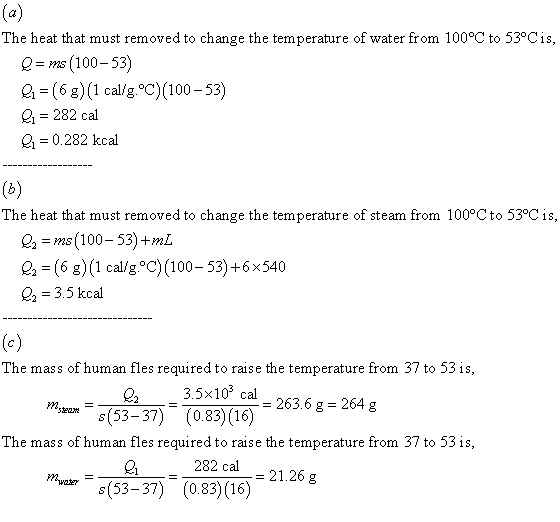
Burns produced by steam at 100°C are much more severe than those produced by the same mass of 100°C water. To verify this:
(a) Calculate the heat that must be removed from 6.00 g of 100°C
water to lower its temperature to 53.0°C.
________kcal
(b) Calculate the heat that must be removed from 6.00 g of 100°C
steam to condense it and lower its temperature to 53.0°C.
________kcal
(c) Calculate the mass of human flesh that the heat produced in
each case can raise from the normal 37.0°C to 53.0°C. (Flesh is
badly damaged at 50.0°C.)
steam=______kg
water=_______kg
Homework Answers
Add Answer to:
Burns produced by steam at 100°C are much more severe than those
produced by the same...
Burns produced by steam at 100°C are much more severe than those produced by the same...
Burns produced by steam at 100°C are much more severe than those produced by the same mass of 100°C water. To verify this: (a) Calculate the heat that must be removed from 4.00 g of 100°C water to lower its temperature to 48.0°C. kcal (b) Calculate the heat that must be removed from 4.00 g of 100°C steam to condense it and lower its temperature to 48.0°C. kcal (c) Calculate the mass of human flesh that the heat produced in...
Burns produced by steam at 100°C are much more severe than those produced by the same...
Burns produced by steam at 100°C are much more severe than those produced by the same mass of 100°C water. To verify this, answer the questions below. Specific heat of water = 1.00 kcal/(kg · °C); heat of vaporization = 539 kcal/kg; specific heat of human flesh = 0.83 kcal/(kg · °C). (a) Calculate the quantity of heat that must be removed from 3.60 g of 100°C water to lower its temperature to 47.0°C. (b) Calculate the quantity of heat...
Burns produced by steam at 100 degree C are much more severe than those produced by...
 Burns produced by steam at 100 degree C are much more severe than those produced by the same mass of 100 degree C water. To verify this, answer the questions below. Specific heat of water = 1.00 kcal/(kg degree C); heat of vaporization = 539 kcal/kg; specific heat of human flesh = 0.83 kcal/(kg degree C). Calculate the quantity of heat that must be removed from 7.00 g of 100degree C water to lower its temperature to 45.0degree C. kcal...
Calculate the energy released when 50.0g of steam condenses at 100℃.
 Calculate the energy released when 50.0g of steam condenses at 100℃.Use the cooling curve to show what happens when 50.0g steam condenses at 100℃ and then cools to 20℃. Then calculate this energy change.6. Use the below cooling curve for water for the following questions. A. Label the melting/freezing point. B. Label the boiling/evaporation point. C. At what state is water when the temperature is 80 °c? D. At what state is water when the temperature is -20 °C? E. What happens to the temperature...
Calculate how many grams of ice at 0°C would be melted by 100 g of 100°C...
Calculate how many grams of ice at 0°C would be melted by 100 g of 100°C steam. Hint: heat will be transferred from the steam to the ice in two processes: •the steam will condense into liquid, and •that liquid will transfer heat until it is at the freezing point of water. Note that for water: Lf = 80 cal/g (ice), and Lv = 540 cal/g (steam) (Use calories) C(water) =1 cal/g*C Answer in grams no decimal places.
Practice example a b 531 12-2 Some Properties of Liquids when ydrogen bonds;: and when to...
 Practice example a b
531 12-2 Some Properties of Liquids when ydrogen bonds;: and when to increase with the molecular and the of a gas neverse of uid is called condensation s always negative. Condensation is is always positive bums produced by a given mass c ster) are much mone severe than burns produced by the same Hot water cens by releasing heat as it cools. Steam antity of heat when it condenses to liquid water, followed by e liquid...
Practice example a b
531 12-2 Some Properties of Liquids when ydrogen bonds;: and when to increase with the molecular and the of a gas neverse of uid is called condensation s always negative. Condensation is is always positive bums produced by a given mass c ster) are much mone severe than burns produced by the same Hot water cens by releasing heat as it cools. Steam antity of heat when it condenses to liquid water, followed by e liquid...
A sample of steam with a mass of 0.584 g and at a temperature of 100.°C...
A sample of steam with a mass of 0.584 g and at a temperature of 100.°C condenses into an insulated container holding 4.69 g of water at 6.7°C. Assuming that no heat is lost to the surroundings, what will be the final temperature of the mixture?
Question 16 (8 points) Steam at 100°C was passed into a flask immersed in 937 g...
 Question 16 (8 points) Steam at 100°C was passed into a flask immersed in 937 g of water at 21°C, where the steam condensed to water at 100°C. How many grams of steam must have condensed if the temperature of the water around the flask was raised to 85°C? Assume that the condensed water remains at 100°C. The heat of vaporization of water is 40.7 kJ/mol and the specific heat is 4.18 J/(g°C).
A sample of steam with a mass of 0.518 g at a temperature of 100 ∘C...
A sample of steam with a mass of 0.518 g at a temperature of 100 ∘C condenses into an insulated container holding 4.20 g of water at 4.0 ∘C. (For water, ΔH∘vap=40.7 kJ/mol and Cwater=4.18 J/(g⋅∘C).) Assuming that no heat is lost to the surroundings, what is the final temperature of the mixture?
A sample of steam with a mass of 0.523 g at a temperature of 100 ∘C...
A sample of steam with a mass of 0.523 g at a temperature of 100 ∘C condenses into an insulated container holding 4.20 g of water at 3.0 ∘C. (For water, ΔH∘vap=40.7 kJ/mol and Cwater=4.18 J/(g⋅∘C).) Assuming that no heat is lost to the surroundings, what is the final temperature of the mixture?
 Burns produced by steam at 100 degree C are much more severe than those produced by the same mass of 100 degree C water. To verify this, answer the questions below. Specific heat of water = 1.00 kcal/(kg degree C); heat of vaporization = 539 kcal/kg; specific heat of human flesh = 0.83 kcal/(kg degree C). Calculate the quantity of heat that must be removed from 7.00 g of 100degree C water to lower its temperature to 45.0degree C. kcal...
 Calculate the energy released when 50.0g of steam condenses at 100℃.Use the cooling curve to show what happens when 50.0g steam condenses at 100℃ and then cools to 20℃. Then calculate this energy change.6. Use the below cooling curve for water for the following questions. A. Label the melting/freezing point. B. Label the boiling/evaporation point. C. At what state is water when the temperature is 80 °c? D. At what state is water when the temperature is -20 °C? E. What happens to the temperature...
 Practice example a b
531 12-2 Some Properties of Liquids when ydrogen bonds;: and when to increase with the molecular and the of a gas neverse of uid is called condensation s always negative. Condensation is is always positive bums produced by a given mass c ster) are much mone severe than burns produced by the same Hot water cens by releasing heat as it cools. Steam antity of heat when it condenses to liquid water, followed by e liquid...
Practice example a b
531 12-2 Some Properties of Liquids when ydrogen bonds;: and when to increase with the molecular and the of a gas neverse of uid is called condensation s always negative. Condensation is is always positive bums produced by a given mass c ster) are much mone severe than burns produced by the same Hot water cens by releasing heat as it cools. Steam antity of heat when it condenses to liquid water, followed by e liquid...
 Question 16 (8 points) Steam at 100°C was passed into a flask immersed in 937 g of water at 21°C, where the steam condensed to water at 100°C. How many grams of steam must have condensed if the temperature of the water around the flask was raised to 85°C? Assume that the condensed water remains at 100°C. The heat of vaporization of water is 40.7 kJ/mol and the specific heat is 4.18 J/(g°C).
Most questions answered within 3 hours.
-
Where is the error in this code sequence?
String s1 = "Hello";
String s2 = "ello";...
asked 10 months ago -
Financial data for Joel de Paris, Inc., for last year
follow:
Joel de Paris, Inc.
Balance...
asked 10 months ago -
Consider this reaction:
Al2(SO4)3 (aq)+ BaCl3
(aq) Al2Cl6 (aq)- +
3BaSO4(s) . What is the...
asked 10 months ago -
Suppose that Savneet is considering increasing her
recent random sample from 20 car rentals to 40...
asked 10 months ago -
Trucks arrive at an unloading terminal at an average rate of 120
per hour.
Trucks arrive...
asked 10 months ago -
Why are methanol and ethanol completely soluble in water while
octanol is not very little soluble....
asked 10 months ago -
A facilities manager at a university reads in a research report
that the mean amount of...
asked 10 months ago -
When the CuSO4 is rehydrated by adding water to the anhydrous
compound, is this an endothermic...
asked 10 months ago -
A ray of sunlight is passing from diamond into crown glass; the
angle of incidence is...
asked 10 months ago -
A block of mass 0.249 kg is placed on top of a light, vertical
spring of...
asked 10 months ago -
how do the kidneys compensate in the presences of acidosis
a) trigger hyperventilate
b) reserve acid...
asked 10 months ago -
Question 501 pts
The rental rate of capital to the firm increases. Which of the
following...
asked 10 months ago