
Homework Answers
Add Answer to:
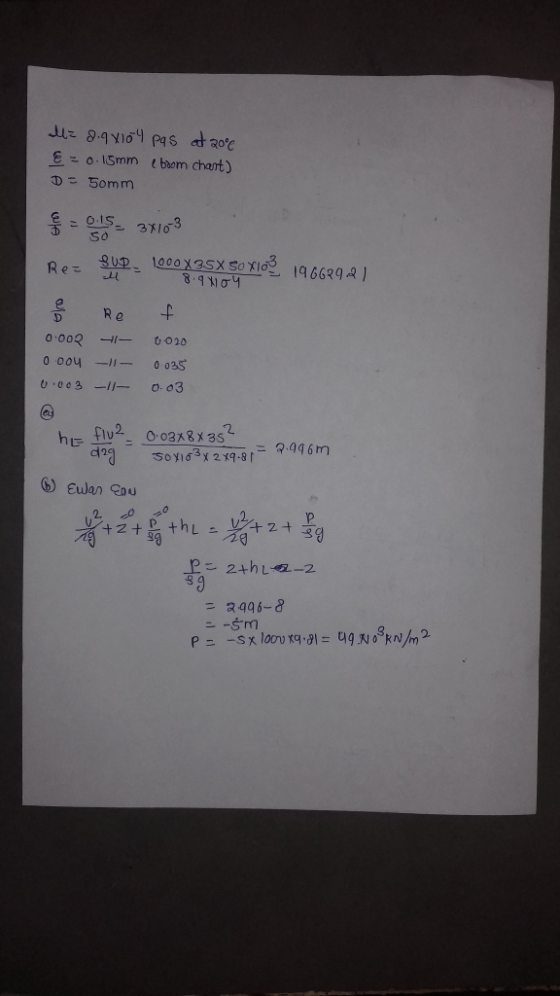
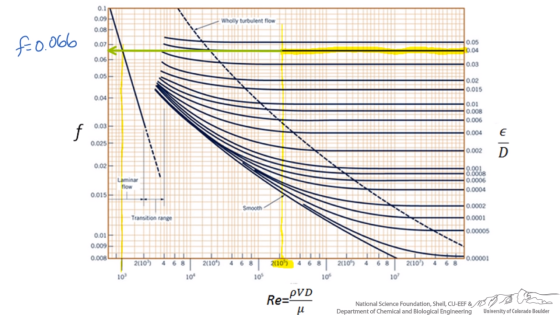
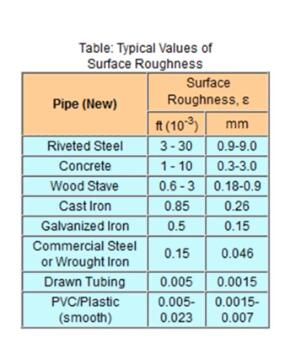
1) Water is flowing through the 50-mm galvanized-iron pipe system shown in the figure. The average...
4. Water flows through the pipe as shown with Bolts 80 mm the coefficient of friction...
 4. Water flows through the pipe as shown with Bolts 80 mm the coefficient of friction between the wheels and the surface is μ = 0.3 . If the weight of the 20m horizontal pipe (roughness = 0.15 mm) is 200N with a diameter of 80mm (Neglect Minor Losses): 3.0 m Galvanized iron What is the velocity in the horizontal pipe and friction factor? 1. What is the fluid pressure at the location of the Bolts? 2. 3. Draw a...
Water at 15-Celsius flowing through 25 meters of 100mm- diameter galvanized iron pipe, causes a head...
 Water at 15-Celsius flowing through 25 meters of 100mm- diameter galvanized iron pipe, causes a head loss (due to pipe friction) of 75mm. Find the flow rate
Please solve a,b,c,d,e,f 1) A water fountain is to be installed at a remote location by attaching a cast iron pipe directly to a water main through which water is flowing. The entrance to the pipe...
 Please solve a,b,c,d,e,f
1) A water fountain is to be installed at a remote location by attaching a cast iron pipe directly to a water main through which water is flowing. The entrance to the pipe is sharp-edged 15m (K-0.5), and the 15m long piping system involves three 90 bends without vanes (K1.1), a fully open gate valve (K.-0.2), and a fully open angle valve (K-5). If the diameter of the pipe is 2 em and the system is to...
Please solve a,b,c,d,e,f
1) A water fountain is to be installed at a remote location by attaching a cast iron pipe directly to a water main through which water is flowing. The entrance to the pipe is sharp-edged 15m (K-0.5), and the 15m long piping system involves three 90 bends without vanes (K1.1), a fully open gate valve (K.-0.2), and a fully open angle valve (K-5). If the diameter of the pipe is 2 em and the system is to...
4. Water at 50 deg C is flowing at 0.8m/s through a copper pipe 3cm in...
 4. Water at 50 deg C is flowing at 0.8m/s through a copper pipe 3cm in diameter and 60m long a. What is the Reynolds number? b. Is the flow most likely laminar, turbulent, or in- between? the Moody diagram? under these conditions? c. What is the resistance coefficient f for this flow from d. What is the head loss in this section of copper pipe
water at 20 degrees celsius is flowing through a cast iron pipe (surface roughness=0.00085 ft) and...
water at 20 degrees celsius is flowing through a cast iron pipe (surface roughness=0.00085 ft) and diameter 0.2 m. What is the frictional factor using moody diagram?
A 150-mm-diameter galvanized iron pipe is used to transport water at T = 30∘C with a...
 A 150-mm-diameter galvanized iron pipe is used to transport
water at T = 30∘C with a velocity of 1.5 m/s. Determine the
pressure drop over the 15-m length of the pipe.
Problem 10.28 A 150-mm-diameter galvanized iron pipe is used to transport water at T 30° C with a velocity of 1.5 m/s. Use the equation-=-1.8 log Figure 1) Determine the pressure drop over the 15-m length of the pipe. Express your answer to three significant figures and Use the...
A 150-mm-diameter galvanized iron pipe is used to transport
water at T = 30∘C with a velocity of 1.5 m/s. Determine the
pressure drop over the 15-m length of the pipe.
Problem 10.28 A 150-mm-diameter galvanized iron pipe is used to transport water at T 30° C with a velocity of 1.5 m/s. Use the equation-=-1.8 log Figure 1) Determine the pressure drop over the 15-m length of the pipe. Express your answer to three significant figures and Use the...
Water at 20 C flows through the 20-mm diameter galvanized iron pipe such that it discharges...
 Water at 20 C flows through the 20-mm diameter galvanized iron pipe such that it discharges at C from the fully opened gate valve B at 0.003 m/s Pe 998 3 kg/m3 and 100(10 ) m2/s Use the Part A Determine the required pressure at A Include the minor losses of the four elbows and gate valve. Express your answer to three significant figures and include the appropriate units. equation市一1.8kg(#)1.11 + 3.7 Figure 1 of 1 PA: I Value Units...
PartA The pipe system shown in (Figure 1) consists of a 3-in.-diameter, 100-ft-long galvanized iron pipe,...
 PartA The pipe system shown in (Figure 1) consists of a 3-in.-diameter, 100-ft-long galvanized iron pipe, a fully opened gate valve, four elbows, a flush entrance, and a pump with the pump head curve shown in (Figure 2). The friction factor is 0.022 Estimate the flow Express your answer using two significant figures gal/min Submit Previous Answers Request Answer X Incorrect; Try Again; 4 attempts remaining ▼ Part B Estimate the corresponding pump head generated by the pump Express your...
(b) Water flows under gravity between two reservoirs through a pipe of length 5000m. The diameter of the pipe is 0.2 m...
 (b) Water flows under gravity between two reservoirs through a pipe of length 5000m. The diameter of the pipe is 0.2 m and the roughness size is 0.04 mm. The water levels in the two reservoirs are maintained with a difference of 50 m. Determine the discharge through the pipe. Neglect all minor losses. Use the attached Moody diagram for estimation of friction factor. (10 marks) (c) In (b), now include entry loss at the upper reservoir with loss coefficient...
Water flows through a pipe at a velocity of 1 m/s. The pipe has a relative roughness of 0.001 and...
 Water flows through a pipe at a velocity of 1 m/s. The pipe has a relative roughness of 0.001 and has a diameter of 100 mm 1. Using the information provided above and in the Moody diagram, drag and drop circle 1 (located below the graph) where the corresponding Reynolds number and relative roughness intersect 2. Drag and drop circle 2 to the point on the y axis at which you would measure the friction factor () v 10-6 m2/s...
 4. Water flows through the pipe as shown with Bolts 80 mm the coefficient of friction between the wheels and the surface is μ = 0.3 . If the weight of the 20m horizontal pipe (roughness = 0.15 mm) is 200N with a diameter of 80mm (Neglect Minor Losses): 3.0 m Galvanized iron What is the velocity in the horizontal pipe and friction factor? 1. What is the fluid pressure at the location of the Bolts? 2. 3. Draw a...
 Water at 15-Celsius flowing through 25 meters of 100mm- diameter galvanized iron pipe, causes a head loss (due to pipe friction) of 75mm. Find the flow rate
 Please solve a,b,c,d,e,f
1) A water fountain is to be installed at a remote location by attaching a cast iron pipe directly to a water main through which water is flowing. The entrance to the pipe is sharp-edged 15m (K-0.5), and the 15m long piping system involves three 90 bends without vanes (K1.1), a fully open gate valve (K.-0.2), and a fully open angle valve (K-5). If the diameter of the pipe is 2 em and the system is to...
Please solve a,b,c,d,e,f
1) A water fountain is to be installed at a remote location by attaching a cast iron pipe directly to a water main through which water is flowing. The entrance to the pipe is sharp-edged 15m (K-0.5), and the 15m long piping system involves three 90 bends without vanes (K1.1), a fully open gate valve (K.-0.2), and a fully open angle valve (K-5). If the diameter of the pipe is 2 em and the system is to...
 4. Water at 50 deg C is flowing at 0.8m/s through a copper pipe 3cm in diameter and 60m long a. What is the Reynolds number? b. Is the flow most likely laminar, turbulent, or in- between? the Moody diagram? under these conditions? c. What is the resistance coefficient f for this flow from d. What is the head loss in this section of copper pipe
 A 150-mm-diameter galvanized iron pipe is used to transport
water at T = 30∘C with a velocity of 1.5 m/s. Determine the
pressure drop over the 15-m length of the pipe.
Problem 10.28 A 150-mm-diameter galvanized iron pipe is used to transport water at T 30° C with a velocity of 1.5 m/s. Use the equation-=-1.8 log Figure 1) Determine the pressure drop over the 15-m length of the pipe. Express your answer to three significant figures and Use the...
A 150-mm-diameter galvanized iron pipe is used to transport
water at T = 30∘C with a velocity of 1.5 m/s. Determine the
pressure drop over the 15-m length of the pipe.
Problem 10.28 A 150-mm-diameter galvanized iron pipe is used to transport water at T 30° C with a velocity of 1.5 m/s. Use the equation-=-1.8 log Figure 1) Determine the pressure drop over the 15-m length of the pipe. Express your answer to three significant figures and Use the...
 Water at 20 C flows through the 20-mm diameter galvanized iron pipe such that it discharges at C from the fully opened gate valve B at 0.003 m/s Pe 998 3 kg/m3 and 100(10 ) m2/s Use the Part A Determine the required pressure at A Include the minor losses of the four elbows and gate valve. Express your answer to three significant figures and include the appropriate units. equation市一1.8kg(#)1.11 + 3.7 Figure 1 of 1 PA: I Value Units...
 PartA The pipe system shown in (Figure 1) consists of a 3-in.-diameter, 100-ft-long galvanized iron pipe, a fully opened gate valve, four elbows, a flush entrance, and a pump with the pump head curve shown in (Figure 2). The friction factor is 0.022 Estimate the flow Express your answer using two significant figures gal/min Submit Previous Answers Request Answer X Incorrect; Try Again; 4 attempts remaining ▼ Part B Estimate the corresponding pump head generated by the pump Express your...
 (b) Water flows under gravity between two reservoirs through a pipe of length 5000m. The diameter of the pipe is 0.2 m and the roughness size is 0.04 mm. The water levels in the two reservoirs are maintained with a difference of 50 m. Determine the discharge through the pipe. Neglect all minor losses. Use the attached Moody diagram for estimation of friction factor. (10 marks) (c) In (b), now include entry loss at the upper reservoir with loss coefficient...
 Water flows through a pipe at a velocity of 1 m/s. The pipe has a relative roughness of 0.001 and has a diameter of 100 mm 1. Using the information provided above and in the Moody diagram, drag and drop circle 1 (located below the graph) where the corresponding Reynolds number and relative roughness intersect 2. Drag and drop circle 2 to the point on the y axis at which you would measure the friction factor () v 10-6 m2/s...
Most questions answered within 3 hours.
-
Where is the error in this code sequence?
String s1 = "Hello";
String s2 = "ello";...
asked 11 months ago -
Financial data for Joel de Paris, Inc., for last year
follow:
Joel de Paris, Inc.
Balance...
asked 11 months ago -
Consider this reaction:
Al2(SO4)3 (aq)+ BaCl3
(aq) Al2Cl6 (aq)- +
3BaSO4(s) . What is the...
asked 11 months ago -
Suppose that Savneet is considering increasing her
recent random sample from 20 car rentals to 40...
asked 11 months ago -
Trucks arrive at an unloading terminal at an average rate of 120
per hour.
Trucks arrive...
asked 11 months ago -
Why are methanol and ethanol completely soluble in water while
octanol is not very little soluble....
asked 11 months ago -
A facilities manager at a university reads in a research report
that the mean amount of...
asked 11 months ago -
When the CuSO4 is rehydrated by adding water to the anhydrous
compound, is this an endothermic...
asked 11 months ago -
A ray of sunlight is passing from diamond into crown glass; the
angle of incidence is...
asked 11 months ago -
A block of mass 0.249 kg is placed on top of a light, vertical
spring of...
asked 11 months ago -
how do the kidneys compensate in the presences of acidosis
a) trigger hyperventilate
b) reserve acid...
asked 11 months ago -
Question 501 pts
The rental rate of capital to the firm increases. Which of the
following...
asked 11 months ago