
Homework Answers
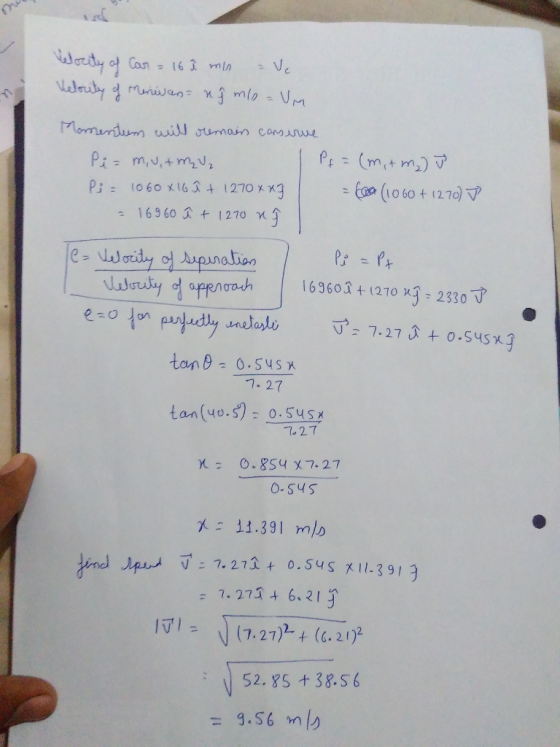
A car with a mass of 1040 kg and a speed of v1 = 15.0 m/s...
 A car with a mass of 1040 kg and a speed of v1 = 15.0 m/s
approaches an intersection, as shown in the figure. A 1270 kg
minivan traveling at v2 is heading for the same intersection. The
car and minivan collide and stick together. The direction of the
wreckage after the collision is theta=40.0 degrees above the x
axis.
Part A) Find the initial speed of the minivan, assuming external
forces can be ignored (in m/s).
Part B) Find...
A car with a mass of 1040 kg and a speed of v1 = 15.0 m/s
approaches an intersection, as shown in the figure. A 1270 kg
minivan traveling at v2 is heading for the same intersection. The
car and minivan collide and stick together. The direction of the
wreckage after the collision is theta=40.0 degrees above the x
axis.
Part A) Find the initial speed of the minivan, assuming external
forces can be ignored (in m/s).
Part B) Find...
3. A car with a mass of 950 kg and a speed of 16 m /...
3. A car with a mass of 950 kg and a speed of 16 m / s approximates an interception. A 1300 kg minivan traveling at 21 m / s is approaching the same interception. The car and the minivan collide and stay together. Find the speed and direction of the vehicles just after the collision, assuming that external forces are ignored.
Physics 2018-2019 Lesson Check 7.57 Constants A 950-kg red car (Figure 1) with a speed of...
 Physics 2018-2019 Lesson Check 7.57 Constants A 950-kg red car (Figure 1) with a speed of v 20.0 m/s approaches an intersection, traveling in the positive u direction. A 1300-kg blue minivan is heading for the same intersection in the positive y direction. The car and minivan collide and stick together, producing wreckage that moves at an angle of θ= 40.0, relative to the positive rats. PartA Find the initial speed of the blue minivan. Express your answer to two...
A car with a mass of 980 kg is initially traveling east towardan intersection with...
 A car with a mass of 980 kg is initially traveling east toward
an intersection with a speed of vc = 20.9 m/s and a 1500 kg pickup
is traveling north toward the same intersection. The car and truck
collide at the intersection and stick together. After the
collision, the wreckage (car and truck) moves off in a direction of
44.0° above the x-axis. Determine the initial speed of the truck
and the final speed of the wreckage in meters...
A car with a mass of 980 kg is initially traveling east toward
an intersection with a speed of vc = 20.9 m/s and a 1500 kg pickup
is traveling north toward the same intersection. The car and truck
collide at the intersection and stick together. After the
collision, the wreckage (car and truck) moves off in a direction of
44.0° above the x-axis. Determine the initial speed of the truck
and the final speed of the wreckage in meters...
A 1000-kg car approaches an intersection traveling north at 15.0 m/s. A 1300-kg car approaches the...
A 1000-kg car approaches an intersection traveling north at 15.0 m/s. A 1300-kg car approaches the same intersection traveling in the same direction behind first car at at 28.0 m/s. The two cars collide at the intersection and lock together. Ignoring any external forces that act on the cars during the collision, what is the velocity of the cars immediately after the collision?
A car with a mass of 980 kg is initially traveling east toward an intersection with...
 A car with a mass of 980 kg is initially traveling east toward
an intersection with a speed of vc = 20.9 m/s
and a 1500 kg pickup is traveling north toward the same
intersection. The car and truck collide at the intersection and
stick together. After the collision, the wreckage (car and truck)
moves off in a direction of 44.0° above the x-axis.
Determine the initial speed of the truck and the final speed of
the wreckage in meters...
A car with a mass of 980 kg is initially traveling east toward
an intersection with a speed of vc = 20.9 m/s
and a 1500 kg pickup is traveling north toward the same
intersection. The car and truck collide at the intersection and
stick together. After the collision, the wreckage (car and truck)
moves off in a direction of 44.0° above the x-axis.
Determine the initial speed of the truck and the final speed of
the wreckage in meters...
) A 1000-kg car approaches an intersection traveling north at 20.0 m/s. A 1200-kg car approaches...
) A 1000-kg car approaches an intersection traveling north at 20.0 m/s. A 1200-kg car approaches the same intersection traveling east at 22.0 m/s. The two cars collide at the intersection and lock together. Ignoring any external forces that act on the cars during the collision, what is the velocity of the cars immediately after the collision?
A 900-kg car traveling east at 15.0 m/s collides with a 750-kg car traveling north at...
A 900-kg car traveling east at 15.0 m/s collides with a 750-kg car traveling north at 20.0 m/s. The cars stick together. Assume that any other unbalanced forces are negligible. a. What is the speed of the wreckage just after the collision? b. In what direction does the wreckage move just after the collision? c. How much kinetic energy is lost in this collision.
A 1200-kg car is moving at 16.0 m/s due north. A 1500-kg car is moving at...
A 1200-kg car is moving at 16.0 m/s due north. A 1500-kg car is moving at 20.0 m/s due east. The two cars simultaneously approach an icy intersection where, with no brakes or steering, they collide and stick together. 1) Determine the speed of the combined two-car wreck immediately after the collision. (Express your answer to two significant figures.) m/sm/s 2) Determine the direction of the combined two-car wreck immediately after the collision. (Express your answer to two significant figures.)
 A car with a mass of 1040 kg and a speed of v1 = 15.0 m/s
approaches an intersection, as shown in the figure. A 1270 kg
minivan traveling at v2 is heading for the same intersection. The
car and minivan collide and stick together. The direction of the
wreckage after the collision is theta=40.0 degrees above the x
axis.
Part A) Find the initial speed of the minivan, assuming external
forces can be ignored (in m/s).
Part B) Find...
A car with a mass of 1040 kg and a speed of v1 = 15.0 m/s
approaches an intersection, as shown in the figure. A 1270 kg
minivan traveling at v2 is heading for the same intersection. The
car and minivan collide and stick together. The direction of the
wreckage after the collision is theta=40.0 degrees above the x
axis.
Part A) Find the initial speed of the minivan, assuming external
forces can be ignored (in m/s).
Part B) Find...
 Physics 2018-2019 Lesson Check 7.57 Constants A 950-kg red car (Figure 1) with a speed of v 20.0 m/s approaches an intersection, traveling in the positive u direction. A 1300-kg blue minivan is heading for the same intersection in the positive y direction. The car and minivan collide and stick together, producing wreckage that moves at an angle of θ= 40.0, relative to the positive rats. PartA Find the initial speed of the blue minivan. Express your answer to two...
 A car with a mass of 980 kg is initially traveling east toward
an intersection with a speed of vc = 20.9 m/s and a 1500 kg pickup
is traveling north toward the same intersection. The car and truck
collide at the intersection and stick together. After the
collision, the wreckage (car and truck) moves off in a direction of
44.0° above the x-axis. Determine the initial speed of the truck
and the final speed of the wreckage in meters...
A car with a mass of 980 kg is initially traveling east toward
an intersection with a speed of vc = 20.9 m/s and a 1500 kg pickup
is traveling north toward the same intersection. The car and truck
collide at the intersection and stick together. After the
collision, the wreckage (car and truck) moves off in a direction of
44.0° above the x-axis. Determine the initial speed of the truck
and the final speed of the wreckage in meters...
 A car with a mass of 980 kg is initially traveling east toward
an intersection with a speed of vc = 20.9 m/s
and a 1500 kg pickup is traveling north toward the same
intersection. The car and truck collide at the intersection and
stick together. After the collision, the wreckage (car and truck)
moves off in a direction of 44.0° above the x-axis.
Determine the initial speed of the truck and the final speed of
the wreckage in meters...
A car with a mass of 980 kg is initially traveling east toward
an intersection with a speed of vc = 20.9 m/s
and a 1500 kg pickup is traveling north toward the same
intersection. The car and truck collide at the intersection and
stick together. After the collision, the wreckage (car and truck)
moves off in a direction of 44.0° above the x-axis.
Determine the initial speed of the truck and the final speed of
the wreckage in meters...
Most questions answered within 3 hours.
-
Where is the error in this code sequence?
String s1 = "Hello";
String s2 = "ello";...
asked 11 months ago -
Financial data for Joel de Paris, Inc., for last year
follow:
Joel de Paris, Inc.
Balance...
asked 11 months ago -
Consider this reaction:
Al2(SO4)3 (aq)+ BaCl3
(aq) Al2Cl6 (aq)- +
3BaSO4(s) . What is the...
asked 11 months ago -
Suppose that Savneet is considering increasing her
recent random sample from 20 car rentals to 40...
asked 11 months ago -
Trucks arrive at an unloading terminal at an average rate of 120
per hour.
Trucks arrive...
asked 11 months ago -
Why are methanol and ethanol completely soluble in water while
octanol is not very little soluble....
asked 11 months ago -
A facilities manager at a university reads in a research report
that the mean amount of...
asked 11 months ago -
When the CuSO4 is rehydrated by adding water to the anhydrous
compound, is this an endothermic...
asked 11 months ago -
A ray of sunlight is passing from diamond into crown glass; the
angle of incidence is...
asked 11 months ago -
A block of mass 0.249 kg is placed on top of a light, vertical
spring of...
asked 11 months ago -
how do the kidneys compensate in the presences of acidosis
a) trigger hyperventilate
b) reserve acid...
asked 11 months ago -
Question 501 pts
The rental rate of capital to the firm increases. Which of the
following...
asked 11 months ago