
Homework Answers
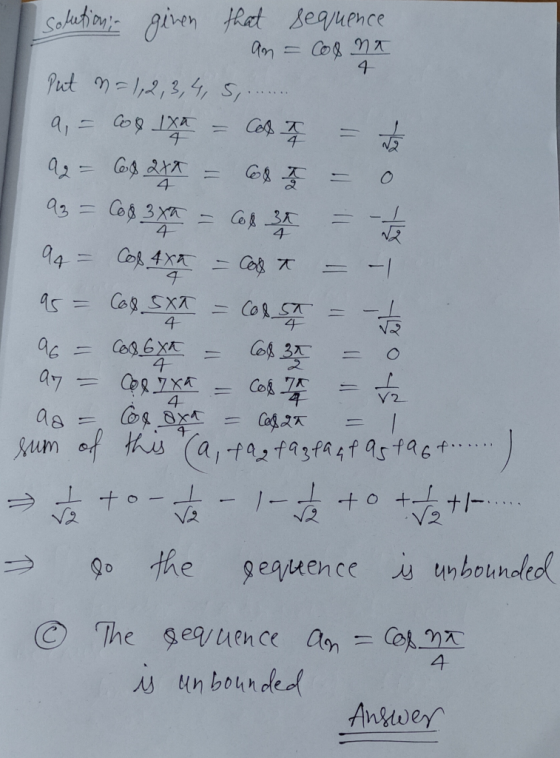
Add Answer to:
No calculator is allowed on this question. The sequence a = cos *** Elimination Tool A...
Question 1 3+cos(n) 2n X Which of the following properties hold for the sequence an for...
 Question 1 3+cos(n) 2n X Which of the following properties hold for the sequence an for n 2 1? l. Bounded Il. Monotonic IIl. Convergent Selected Answer a. I only a. I only b. Il only c. I and Il only d. I and Ill only e. I, II, and III Remember what these conditions mean: Bounded means all terms of the sequence have to lie within a specific range of values. Monotonic means the sequence is ALWAYS increasing or...
In questions 1-8, find the limit of the sequence. sin n cos n 2. 37 /n sin n 3. 4. cos rn 5. /n sin n o cos n n! 9. If c is a positive real number and lan) is a sequence such that for all inte...
 In questions 1-8, find the limit of the sequence. sin n cos n 2. 37 /n sin n 3. 4. cos rn 5. /n sin n o cos n n! 9. If c is a positive real number and lan) is a sequence such that for all integer n > 0, prove that limn →00 (an)/n-0. 10. If a > 0, prove that limn+ (sin n)/n 0 Theorem 6.9 Suppose that the sequence lan) is monotonic. Then ta, only if...
1)this sequence is bounded or unbounded? 2)this sequence is monotonic or nonmonotonic 6 Given the sequence...
 1)this sequence is bounded or unbounded?
2)this sequence is monotonic or nonmonotonic
6 Given the sequence an - 3ñ: This sequence is Select an answer v This sequence is Select an answer v Does this sequence converge or diverge? Select an answer v If the sequence does converge, to what value? If it diverges, enter DNE Question Help: D Video D Video Submit Question
1)this sequence is bounded or unbounded?
2)this sequence is monotonic or nonmonotonic
6 Given the sequence an - 3ñ: This sequence is Select an answer v This sequence is Select an answer v Does this sequence converge or diverge? Select an answer v If the sequence does converge, to what value? If it diverges, enter DNE Question Help: D Video D Video Submit Question
The answer : converges to 1 is incorrect. (1 point) Determine whether the sequence nº sin...
 The answer : converges to 1 is incorrect.
(1 point) Determine whether the sequence nº sin (9) converges or diverges. If it converges, n5 find its limit. If it diverges, enter "infinity", or "-infinity" if applicable, or enter "divergent" if the sequence diverges (but not to foo). The limit is 1
The answer : converges to 1 is incorrect.
(1 point) Determine whether the sequence nº sin (9) converges or diverges. If it converges, n5 find its limit. If it diverges, enter "infinity", or "-infinity" if applicable, or enter "divergent" if the sequence diverges (but not to foo). The limit is 1
1. Determine an infinite sequence that satisfies the following ... (a) An infinite sequence that is...
 1. Determine an infinite sequence that satisfies the following ... (a) An infinite sequence that is bounded below, decreasing, and convergent (b) An infinite sequence that is bounded above and divergent (c) An infinite sequence that is monotonic and converges to 1 as n → (d) An infinite sequence that is neither increasing nor decreasing and converges to 0 as n + 2. Given the recurrence relation an = 0n-1 +n for n > 2 where a = 1, find...
No calculator is allowed on this question. The function f(a) is defined for all real numbers...
 No calculator is allowed on this question. The function f(a) is defined for all real numbers and is always decreasing. Based on the values given in the table below, which of the following could be true? 57 1. f(4) = 7.36 II. f'(4) = -0.48 III. f(6) = 5.84 Elimination Tool I only. ion B land II only. *oint C and Ill only. D I, II, and III.
(1 point) Determine if the following sequence converges or diverges. = Note: If it converges, enter...
 (1 point) Determine if the following sequence converges or diverges. = Note: If it converges, enter the limit as your answer. If it diverges to co. -00, or neither enter infinity - Infinity, or divergent, respectively, Answer:
6. Give an example of a non-constant sequence that satisfies the given conditions or explain why...
 6. Give an example of a non-constant sequence that satisfies the given conditions or explain why such a sequence does not exist: (1) {an} is bounded above but not convergent. (2) {an} is neither decreasing nor increasing but still converges. (3) {an} is bounded but divergent. (4) {an} is unbounded but convergent. (5) {an} is increasing and converges to 2.
(1 point) Determine if the following sequence converges or diverges. a 3(3") + 7 15(4") Note:...
 (1 point) Determine if the following sequence converges or diverges. a 3(3") + 7 15(4") Note: If it converges, enter the limit as your answer. If it diverges to 00, -00, or neither enter infinity Infinity, or divergent, rospectively, Answer:
(1 point) Determine if the following sequence converges or diverges. a, 2 Note: If it converges,...
 (1 point) Determine if the following sequence converges or diverges. a, 2 Note: If it converges, enter the limit as your answer. If it divorges to co, -co, or neither enter infinity, -infinity, or divergent, respectively. Answer:
 Question 1 3+cos(n) 2n X Which of the following properties hold for the sequence an for n 2 1? l. Bounded Il. Monotonic IIl. Convergent Selected Answer a. I only a. I only b. Il only c. I and Il only d. I and Ill only e. I, II, and III Remember what these conditions mean: Bounded means all terms of the sequence have to lie within a specific range of values. Monotonic means the sequence is ALWAYS increasing or...
 In questions 1-8, find the limit of the sequence. sin n cos n 2. 37 /n sin n 3. 4. cos rn 5. /n sin n o cos n n! 9. If c is a positive real number and lan) is a sequence such that for all integer n > 0, prove that limn →00 (an)/n-0. 10. If a > 0, prove that limn+ (sin n)/n 0 Theorem 6.9 Suppose that the sequence lan) is monotonic. Then ta, only if...
 1)this sequence is bounded or unbounded?
2)this sequence is monotonic or nonmonotonic
6 Given the sequence an - 3ñ: This sequence is Select an answer v This sequence is Select an answer v Does this sequence converge or diverge? Select an answer v If the sequence does converge, to what value? If it diverges, enter DNE Question Help: D Video D Video Submit Question
1)this sequence is bounded or unbounded?
2)this sequence is monotonic or nonmonotonic
6 Given the sequence an - 3ñ: This sequence is Select an answer v This sequence is Select an answer v Does this sequence converge or diverge? Select an answer v If the sequence does converge, to what value? If it diverges, enter DNE Question Help: D Video D Video Submit Question
 The answer : converges to 1 is incorrect.
(1 point) Determine whether the sequence nº sin (9) converges or diverges. If it converges, n5 find its limit. If it diverges, enter "infinity", or "-infinity" if applicable, or enter "divergent" if the sequence diverges (but not to foo). The limit is 1
The answer : converges to 1 is incorrect.
(1 point) Determine whether the sequence nº sin (9) converges or diverges. If it converges, n5 find its limit. If it diverges, enter "infinity", or "-infinity" if applicable, or enter "divergent" if the sequence diverges (but not to foo). The limit is 1
 1. Determine an infinite sequence that satisfies the following ... (a) An infinite sequence that is bounded below, decreasing, and convergent (b) An infinite sequence that is bounded above and divergent (c) An infinite sequence that is monotonic and converges to 1 as n → (d) An infinite sequence that is neither increasing nor decreasing and converges to 0 as n + 2. Given the recurrence relation an = 0n-1 +n for n > 2 where a = 1, find...
 No calculator is allowed on this question. The function f(a) is defined for all real numbers and is always decreasing. Based on the values given in the table below, which of the following could be true? 57 1. f(4) = 7.36 II. f'(4) = -0.48 III. f(6) = 5.84 Elimination Tool I only. ion B land II only. *oint C and Ill only. D I, II, and III.
 (1 point) Determine if the following sequence converges or diverges. = Note: If it converges, enter the limit as your answer. If it diverges to co. -00, or neither enter infinity - Infinity, or divergent, respectively, Answer:
 6. Give an example of a non-constant sequence that satisfies the given conditions or explain why such a sequence does not exist: (1) {an} is bounded above but not convergent. (2) {an} is neither decreasing nor increasing but still converges. (3) {an} is bounded but divergent. (4) {an} is unbounded but convergent. (5) {an} is increasing and converges to 2.
 (1 point) Determine if the following sequence converges or diverges. a 3(3") + 7 15(4") Note: If it converges, enter the limit as your answer. If it diverges to 00, -00, or neither enter infinity Infinity, or divergent, rospectively, Answer:
 (1 point) Determine if the following sequence converges or diverges. a, 2 Note: If it converges, enter the limit as your answer. If it divorges to co, -co, or neither enter infinity, -infinity, or divergent, respectively. Answer:
Most questions answered within 3 hours.
-
Where is the error in this code sequence?
String s1 = "Hello";
String s2 = "ello";...
asked 10 months ago -
Financial data for Joel de Paris, Inc., for last year
follow:
Joel de Paris, Inc.
Balance...
asked 10 months ago -
Consider this reaction:
Al2(SO4)3 (aq)+ BaCl3
(aq) Al2Cl6 (aq)- +
3BaSO4(s) . What is the...
asked 10 months ago -
Suppose that Savneet is considering increasing her
recent random sample from 20 car rentals to 40...
asked 10 months ago -
Trucks arrive at an unloading terminal at an average rate of 120
per hour.
Trucks arrive...
asked 10 months ago -
Why are methanol and ethanol completely soluble in water while
octanol is not very little soluble....
asked 10 months ago -
A facilities manager at a university reads in a research report
that the mean amount of...
asked 10 months ago -
When the CuSO4 is rehydrated by adding water to the anhydrous
compound, is this an endothermic...
asked 10 months ago -
A ray of sunlight is passing from diamond into crown glass; the
angle of incidence is...
asked 10 months ago -
A block of mass 0.249 kg is placed on top of a light, vertical
spring of...
asked 10 months ago -
how do the kidneys compensate in the presences of acidosis
a) trigger hyperventilate
b) reserve acid...
asked 10 months ago -
Question 501 pts
The rental rate of capital to the firm increases. Which of the
following...
asked 10 months ago