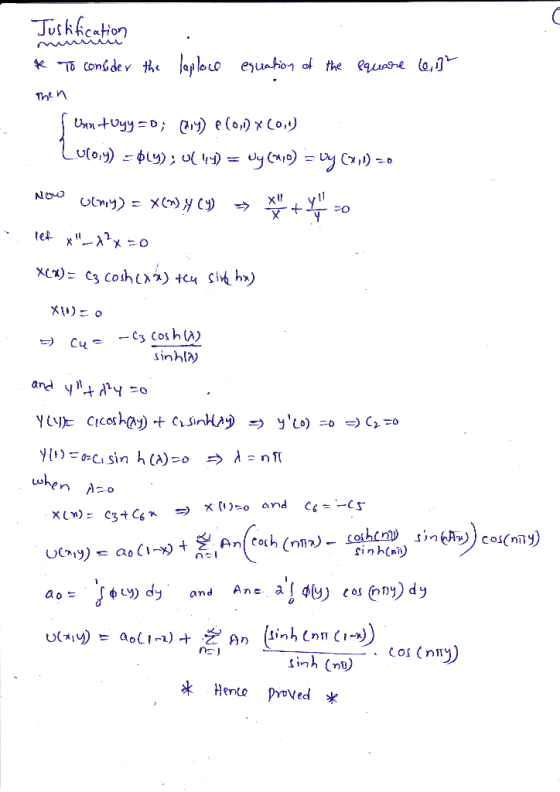
![6. (Duz, pp.101–107) Laplace on A Square. Consider the Laplace equation on the square [0, 1]2: JUxx + Uyy = 0; (x, y) € (0,1)](http://img.homeworklib.com/questions/a48c4ae0-6dfc-11eb-bd94-67e9bf5f3463.png?x-oss-process=image/resize,w_560)
Homework Answers
Add Answer to:
6. (Duz, pp.101–107) Laplace on A Square. Consider the Laplace equation on the square [0, 1]2:...
1. Consider the insulated heat equation up = cum, 0 <r<L, t > 0 u (0,t)...
 1. Consider the insulated heat equation up = cum, 0 <r<L, t > 0 u (0,t) = u (L, t) = 0, t > 0 u(x,0) = f(2). What is the steady-state solution? 2. Solve the two-dimensional wave equation (with c=1/) on the unit square (i.e., [0, 1] x [0,1) with homogeneous Dirichlet boundary conditions and initial conditions: (2, y,0) = sin(x) sin(y) (,y,0) = sin(x). 3. Solve the following PDE: Uzr + Uyy = 0, 0<<1,0 <y < 2...
Consider the Laplace equation on a circle of radius a around the origin of the xy-plane:...
 Consider the Laplace equation on a circle of radius a around the origin of the xy-plane: p?u=0, Osr<a, -Isosa. The boundary condition is u(a,0)= p cos?o, with p a positive constant. Find the solution u(r,o) by separation of variables. Require that the solution is finite at r = 0, and that the solution is continuous with a continuous derivative at 0 = Ín. To check your solution, set r = a and 0 = 0. You should get u(a,0) =...
Using Fourier transform, prove that a solution of the Laplace equation in the half plane: Urn+...
 Using Fourier transform, prove that a solution of the Laplace equation in the half plane: Urn+ Uyy=0,- << ,y>0, with the boundary conditions u(1,0) = f(t), - <I< u(x,y) +0,31 +0,+0, is given by r(2, y) == Love you > 0. Hint: 1. Take Fourier transform on the variable r, 2. Observe U(k, y) +0 as y → 00, 3. Use pt {e-Mliv = Vice in
Solve the heat equation 4,0 < x < 3,1 > 0 kou det u(0, 1) =...
 Solve the heat equation 4,0 < x < 3,1 > 0 kou det u(0, 1) = 0, u(3,t) = 0,1 > 0 S2, 0<x< } u(x,0) = { 10, { <x<3 are the eigenfunctions You will need to apply separation of variables to obtain a family of product solutions un(x, t) = x (x)Ty(t) where X of a Sturm-Liouville problem with eigenvalues an (as in Section 12.1). Using the explicit expressions for un(x, t) gives (8,0) = ŠA, n=0 Then...
1. Consider the equation xy" - 2y' + (2 - x)y = 0,x > 0. We...
 1. Consider the equation xy" - 2y' + (2 - x)y = 0,x > 0. We can easily verify that y(x) = e* is a solution of the equation. Use reduction of order to determine the general solution of the equation.
7.4 Solve the Laplace equation Δ11-0 in the square 0 < x, y < π, subject to the bound- ary condition 11(0, y) u(T, y) = 0. 11(x, 0) = 11(x, π) = 1, = 1/(π, y) = 7.4 Solve the Laplace equat...
 7.4 Solve the Laplace equation Δ11-0 in the square 0 < x, y < π, subject to the bound- ary condition 11(0, y) u(T, y) = 0. 11(x, 0) = 11(x, π) = 1, = 1/(π, y) =
7.4 Solve the Laplace equation Δ11-0 in the square 0
7.4 Solve the Laplace equation Δ11-0 in the square 0 < x, y < π, subject to the bound- ary condition 11(0, y) u(T, y) = 0. 11(x, 0) = 11(x, π) = 1, = 1/(π, y) =
7.4 Solve the Laplace equation Δ11-0 in the square 0
4. Consider the boundary value problem defined by the partial differential equation д?и д?и = 0,...
 4. Consider the boundary value problem defined by the partial differential equation д?и д?и = 0, ду? y > 0, да? with boundary conditions u(0, y) = u(T,y) = 0, u(x, 0) = 1 and limy-v00 |u(x, y)|< 0o. (a) Use separation of variables to find the eigenvalues and general series solution in terms of the normal modes. (b) Impose the inhomogeneous boundary condition u(x,0) = 1 to find the constants in the general series solution and hence the solution...
7. Consider the boundary value problem for the Laplace equation on the strip u (0, y)...
 7. Consider the boundary value problem for the Laplace equation on the strip u (0, y) u (т, y) = 0, = a. Explain why it makes sense to look for a solution of the form b. Find all solutions of the form u(x, y) -ZYn (v)sinnx satisfying c. Among the solutions you found in part (b) find the unique solution u (x, y)-Yn (y) sin n. the Laplace equation and the boundary conditions. (i.e. find Yn. (3).) that satisfies...
34. Consider a two-dimensional Cartesian coordinate system and a two-dimensional uv-system with t...
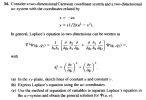 34. Consider a two-dimensional Cartesian coordinate system and a two-dimensional uv-system with the coordinates related by y = (1/2)(112-U2). In general, Laplace's equation in two dimensions can be written as with ох ду Zi (a) In the xy-plane, sketch lines of constant u and constant v. (b) Express Laplace's equation using the uw-coordinates. (c) Use the method of separation of variables to separate Laplace's equation in the v-system and obtain the general solution for ų'(u, u).
34. Consider a two-dimensional...
34. Consider a two-dimensional Cartesian coordinate system and a two-dimensional uv-system with the coordinates related by y = (1/2)(112-U2). In general, Laplace's equation in two dimensions can be written as with ох ду Zi (a) In the xy-plane, sketch lines of constant u and constant v. (b) Express Laplace's equation using the uw-coordinates. (c) Use the method of separation of variables to separate Laplace's equation in the v-system and obtain the general solution for ų'(u, u).
34. Consider a two-dimensional...
7. Consider the boundary value problem for the Laplace equation on the strip u(0, y) u(n,y)=0,...
 7. Consider the boundary value problem for the Laplace equation on the strip u(0, y) u(n,y)=0, = a. Explain why it makes sense to look for a solution of the form b. Find all solutions of the form u(x,y) = Σ Yn (y) sin nx satisfying c. Among the solutions you found in part (b) find the unique solution u (x, y) = Σ Y, (y) sin na. the Laplace equation and the boundary conditions. (i.e. find Yn (y).) that...
 1. Consider the insulated heat equation up = cum, 0 <r<L, t > 0 u (0,t) = u (L, t) = 0, t > 0 u(x,0) = f(2). What is the steady-state solution? 2. Solve the two-dimensional wave equation (with c=1/) on the unit square (i.e., [0, 1] x [0,1) with homogeneous Dirichlet boundary conditions and initial conditions: (2, y,0) = sin(x) sin(y) (,y,0) = sin(x). 3. Solve the following PDE: Uzr + Uyy = 0, 0<<1,0 <y < 2...
 Consider the Laplace equation on a circle of radius a around the origin of the xy-plane: p?u=0, Osr<a, -Isosa. The boundary condition is u(a,0)= p cos?o, with p a positive constant. Find the solution u(r,o) by separation of variables. Require that the solution is finite at r = 0, and that the solution is continuous with a continuous derivative at 0 = Ín. To check your solution, set r = a and 0 = 0. You should get u(a,0) =...
 Using Fourier transform, prove that a solution of the Laplace equation in the half plane: Urn+ Uyy=0,- << ,y>0, with the boundary conditions u(1,0) = f(t), - <I< u(x,y) +0,31 +0,+0, is given by r(2, y) == Love you > 0. Hint: 1. Take Fourier transform on the variable r, 2. Observe U(k, y) +0 as y → 00, 3. Use pt {e-Mliv = Vice in
 Solve the heat equation 4,0 < x < 3,1 > 0 kou det u(0, 1) = 0, u(3,t) = 0,1 > 0 S2, 0<x< } u(x,0) = { 10, { <x<3 are the eigenfunctions You will need to apply separation of variables to obtain a family of product solutions un(x, t) = x (x)Ty(t) where X of a Sturm-Liouville problem with eigenvalues an (as in Section 12.1). Using the explicit expressions for un(x, t) gives (8,0) = ŠA, n=0 Then...
 1. Consider the equation xy" - 2y' + (2 - x)y = 0,x > 0. We can easily verify that y(x) = e* is a solution of the equation. Use reduction of order to determine the general solution of the equation.
 7.4 Solve the Laplace equation Δ11-0 in the square 0 < x, y < π, subject to the bound- ary condition 11(0, y) u(T, y) = 0. 11(x, 0) = 11(x, π) = 1, = 1/(π, y) =
7.4 Solve the Laplace equation Δ11-0 in the square 0
7.4 Solve the Laplace equation Δ11-0 in the square 0 < x, y < π, subject to the bound- ary condition 11(0, y) u(T, y) = 0. 11(x, 0) = 11(x, π) = 1, = 1/(π, y) =
7.4 Solve the Laplace equation Δ11-0 in the square 0
 4. Consider the boundary value problem defined by the partial differential equation д?и д?и = 0, ду? y > 0, да? with boundary conditions u(0, y) = u(T,y) = 0, u(x, 0) = 1 and limy-v00 |u(x, y)|< 0o. (a) Use separation of variables to find the eigenvalues and general series solution in terms of the normal modes. (b) Impose the inhomogeneous boundary condition u(x,0) = 1 to find the constants in the general series solution and hence the solution...
 7. Consider the boundary value problem for the Laplace equation on the strip u (0, y) u (т, y) = 0, = a. Explain why it makes sense to look for a solution of the form b. Find all solutions of the form u(x, y) -ZYn (v)sinnx satisfying c. Among the solutions you found in part (b) find the unique solution u (x, y)-Yn (y) sin n. the Laplace equation and the boundary conditions. (i.e. find Yn. (3).) that satisfies...
 34. Consider a two-dimensional Cartesian coordinate system and a two-dimensional uv-system with the coordinates related by y = (1/2)(112-U2). In general, Laplace's equation in two dimensions can be written as with ох ду Zi (a) In the xy-plane, sketch lines of constant u and constant v. (b) Express Laplace's equation using the uw-coordinates. (c) Use the method of separation of variables to separate Laplace's equation in the v-system and obtain the general solution for ų'(u, u).
34. Consider a two-dimensional...
34. Consider a two-dimensional Cartesian coordinate system and a two-dimensional uv-system with the coordinates related by y = (1/2)(112-U2). In general, Laplace's equation in two dimensions can be written as with ох ду Zi (a) In the xy-plane, sketch lines of constant u and constant v. (b) Express Laplace's equation using the uw-coordinates. (c) Use the method of separation of variables to separate Laplace's equation in the v-system and obtain the general solution for ų'(u, u).
34. Consider a two-dimensional...
 7. Consider the boundary value problem for the Laplace equation on the strip u(0, y) u(n,y)=0, = a. Explain why it makes sense to look for a solution of the form b. Find all solutions of the form u(x,y) = Σ Yn (y) sin nx satisfying c. Among the solutions you found in part (b) find the unique solution u (x, y) = Σ Y, (y) sin na. the Laplace equation and the boundary conditions. (i.e. find Yn (y).) that...
Most questions answered within 3 hours.
-
Where is the error in this code sequence?
String s1 = "Hello";
String s2 = "ello";...
asked 10 months ago -
Financial data for Joel de Paris, Inc., for last year
follow:
Joel de Paris, Inc.
Balance...
asked 10 months ago -
Consider this reaction:
Al2(SO4)3 (aq)+ BaCl3
(aq) Al2Cl6 (aq)- +
3BaSO4(s) . What is the...
asked 10 months ago -
Suppose that Savneet is considering increasing her
recent random sample from 20 car rentals to 40...
asked 10 months ago -
Trucks arrive at an unloading terminal at an average rate of 120
per hour.
Trucks arrive...
asked 10 months ago -
Why are methanol and ethanol completely soluble in water while
octanol is not very little soluble....
asked 10 months ago -
A facilities manager at a university reads in a research report
that the mean amount of...
asked 10 months ago -
When the CuSO4 is rehydrated by adding water to the anhydrous
compound, is this an endothermic...
asked 10 months ago -
A ray of sunlight is passing from diamond into crown glass; the
angle of incidence is...
asked 10 months ago -
A block of mass 0.249 kg is placed on top of a light, vertical
spring of...
asked 10 months ago -
how do the kidneys compensate in the presences of acidosis
a) trigger hyperventilate
b) reserve acid...
asked 10 months ago -
Question 501 pts
The rental rate of capital to the firm increases. Which of the
following...
asked 10 months ago