
Homework Answers
Add Answer to:
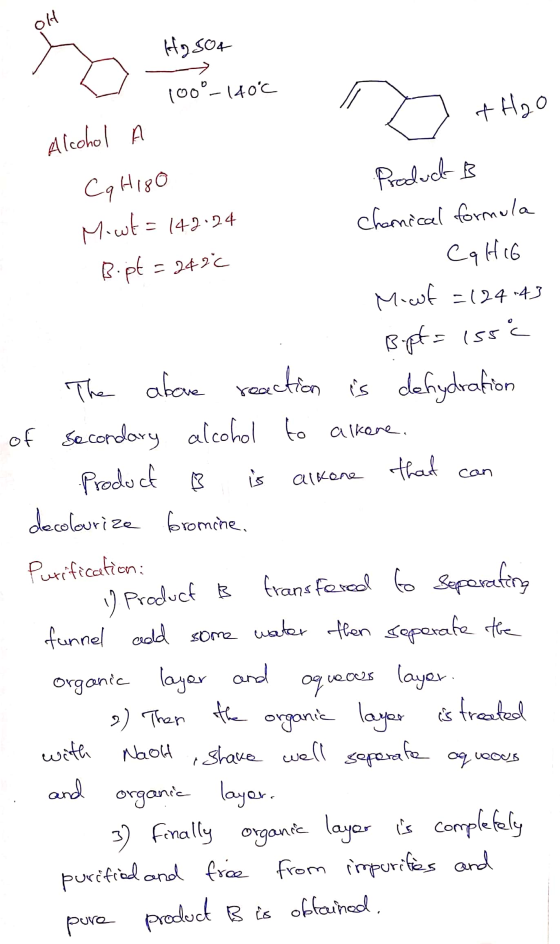
EXPERIMENTAL AND RESULTS (2 pts): Complete the reaction below by identifying product B, that decolorizes Bromine....
DATE: Teaching Assistant: LAB SECTION: Lab 9: Synthesis and Reaction of Alkenes 1. Complete the reaction...
 DATE: Teaching Assistant: LAB SECTION: Lab 9: Synthesis and Reaction of Alkenes 1. Complete the reaction below, and provide a mechanism for the formation of Product A and B (3 points) OH H,PO 0.5 M bromine in water A (60 % Yield) 2. Search the Internet or use any other resources to complete the data table (0.75 point) Compound Molecular Weight Density Boiling Point Cyclohexane Phosphoric acid Cyclohexanol 3b) How is the use of "Hickman Still" in this Lab connected...
Lab : Aldol Condensation Purpose. In this lab you will conduct the Aldol condensation reaction under solid-state...
Lab : Aldol Condensation Purpose. In this lab you will conduct the Aldol condensation reaction under solid-state reaction conditions that will involve grinding reactants in the solid phase. You must read ahead and learn about this reaction and the chemical mechanism for the Aldol condensation. There are two possible products which are the initial Aldol or subsequent elimination product. You will need to isolate and purify your reaction product. You will use your melting point, IR, 1H and 13C NMR spectra to...
answer it all please BS132 Experiment 3 2018-2019 The limiting reagent is the reagent which will...
 answer it all please
BS132 Experiment 3 2018-2019 The limiting reagent is the reagent which will completely react and so iIs excess. It will therefore be the reagent for which a lower number o present. Compare the respective molar proportions of the reagents used A and B above] and deduce which is the limiting reagent not in f moles are Igiven by Limiting reagent = 1 mark Scale of reaction (i.e. number of moles of limiting reagent used) - mol...
answer it all please
BS132 Experiment 3 2018-2019 The limiting reagent is the reagent which will completely react and so iIs excess. It will therefore be the reagent for which a lower number o present. Compare the respective molar proportions of the reagents used A and B above] and deduce which is the limiting reagent not in f moles are Igiven by Limiting reagent = 1 mark Scale of reaction (i.e. number of moles of limiting reagent used) - mol...
Postlab Questions Answer the following questions on a separate sheet or in your lab notebook. Make...
 Postlab Questions Answer the following questions on a separate sheet or in your lab notebook. Make sure that the copy page is readable! D) Calculate the percentage yield for both reactions. Show all calculations. 2) What is the color of the reaction at the beginning of reaction? What causes the color? 3) Why do you dissolve maleic acid in diethyl ether and fumaric acid in water? 4) Give the complete reaction mechanisms for the formation of meso and racemic 2,3-...
need help with the boxed bullet point. writing the chemical reaction scheme for the experiment. Synthesis of an A...
 need help with the boxed bullet point. writing the chemical
reaction scheme for the experiment.
Synthesis of an Alkyl Halide: A Nucleophilic Substitution Reaction, Part I Pre-lab Assignment for Synthesis of an Alkyl Halide: A Nucleophilic Substitution Reaction, Part 1 1. From The Organic Chem Lab Survival Manual ( edition) by Zubrick • Review pages 201-204: Standard Reflux. • Review pages 127-140: Extraction • Review pages 164-189: Distillation, Simple Distillation. The Distillation Example, and The Distillation Mistake. 2. Read this...
need help with the boxed bullet point. writing the chemical
reaction scheme for the experiment.
Synthesis of an Alkyl Halide: A Nucleophilic Substitution Reaction, Part I Pre-lab Assignment for Synthesis of an Alkyl Halide: A Nucleophilic Substitution Reaction, Part 1 1. From The Organic Chem Lab Survival Manual ( edition) by Zubrick • Review pages 201-204: Standard Reflux. • Review pages 127-140: Extraction • Review pages 164-189: Distillation, Simple Distillation. The Distillation Example, and The Distillation Mistake. 2. Read this...
The proton nmr and the infrared spectra of DCC, DMAP, DCU, the product and the nmrs...
 The proton nmr and the infrared spectra of DCC, DMAP, DCU, the
product and the nmrs of the starting materials and products are
shown. These are labeled Compounds A, B and C. a.Which nmr is the
product?
b. Which is the nmr of the starting material?
c. What is the mixture of compounds shown as compound C?
tert-Butyl Ethyl Fumarate DCC, DMAP, CHCI OH Chemical Formula: C,H,O Chemical Formula: CH 0 Molecular Weight: 144.13 Molecular Weight: 74.12 Chemical Formula: CH...
The proton nmr and the infrared spectra of DCC, DMAP, DCU, the
product and the nmrs of the starting materials and products are
shown. These are labeled Compounds A, B and C. a.Which nmr is the
product?
b. Which is the nmr of the starting material?
c. What is the mixture of compounds shown as compound C?
tert-Butyl Ethyl Fumarate DCC, DMAP, CHCI OH Chemical Formula: C,H,O Chemical Formula: CH 0 Molecular Weight: 144.13 Molecular Weight: 74.12 Chemical Formula: CH...
Process A. Preparation of 4-t-butylcyclohexene Assembling the equipment Fill the almost complete sand bath, place it...
 Process A. Preparation of 4-t-butylcyclohexene Assembling the equipment Fill the almost complete sand bath, place it on the base of the shelf, fix the thermometer with a clip and start heating until the temperature of the sand is - 110C. B. Mixing the reagents Using the plastic funnel, introduce 0.60-0.70 g of 4-t-butylcyclohexanol into a large, clean, dry test tube. Then add 10 drops of concentrated phosphoric acid, 3 drops of concentrated sulfuric acid and a pebble to moderate boiling....
PROCEDURE CAUTION!!! Nitric acid and sulfuric acid are strong and corrosive acids. For that reason, avoid...
 PROCEDURE CAUTION!!! Nitric acid and sulfuric acid are strong and corrosive acids. For that reason, avoid inhaling its vapors or causing any contact with the skin or clothing. Wear your protective glasses at all times. Use the extractors to work with these acids. A. Nitration of methyl benzoate 1. Preparation of the reactants. In the extractor you will find a burette with concentrated sulfuric acid, a second burette with concentrated nitric acid, clearly identified. Familiarize yourself with the scales of...
Synthesis of 1-Bromobutane: An SN2 Reaction Pre-Laboratory Exercises PRE-LABORATORY EXERCISES NAME: Cynthesis of 1-Bromobutane: An SN...
 Synthesis of 1-Bromobutane: An SN2 Reaction Pre-Laboratory
Exercises
PRE-LABORATORY EXERCISES NAME: Cynthesis of 1-Bromobutane: An SN 2 Reaction Butylbromide was prepared by refluxing in a 100-ml round bottomed flask a solution containing 13:35 Br 15 ml of water, 10 mL of n-butyl alcohol. 15 ml of concentrated H.SO. and a few boiling stories, 1. 2. R." d 1.275 laborales Nel CH3CH2CH2CH2OH + NaBr H2SO4 Superletalyst CHCH2CH2CHBr + NaHSO + HO (eq. 16) 1-butanol bp 118 C 1-bromobutane d 0.810 bp...
Synthesis of 1-Bromobutane: An SN2 Reaction Pre-Laboratory
Exercises
PRE-LABORATORY EXERCISES NAME: Cynthesis of 1-Bromobutane: An SN 2 Reaction Butylbromide was prepared by refluxing in a 100-ml round bottomed flask a solution containing 13:35 Br 15 ml of water, 10 mL of n-butyl alcohol. 15 ml of concentrated H.SO. and a few boiling stories, 1. 2. R." d 1.275 laborales Nel CH3CH2CH2CH2OH + NaBr H2SO4 Superletalyst CHCH2CH2CHBr + NaHSO + HO (eq. 16) 1-butanol bp 118 C 1-bromobutane d 0.810 bp...
Page 1 Synthesis using Carbonyl O-Substitution Chemistry Preamble This experiment involves the synthesis of target molecules...
 Page 1 Synthesis using Carbonyl O-Substitution Chemistry Preamble This experiment involves the synthesis of target molecules using a-substitution chemistry. You are assigned two target molecules, one of which is best synthesized by an alkylation approach, while the other is best synthesized by an addition or condensation approach. You must do the following: 1. Perform a retrosynthetic analysis on the two target molecules assigned to you. In each case the organic starting material (what you have to work backwards toward) depends...
 DATE: Teaching Assistant: LAB SECTION: Lab 9: Synthesis and Reaction of Alkenes 1. Complete the reaction below, and provide a mechanism for the formation of Product A and B (3 points) OH H,PO 0.5 M bromine in water A (60 % Yield) 2. Search the Internet or use any other resources to complete the data table (0.75 point) Compound Molecular Weight Density Boiling Point Cyclohexane Phosphoric acid Cyclohexanol 3b) How is the use of "Hickman Still" in this Lab connected...
 answer it all please
BS132 Experiment 3 2018-2019 The limiting reagent is the reagent which will completely react and so iIs excess. It will therefore be the reagent for which a lower number o present. Compare the respective molar proportions of the reagents used A and B above] and deduce which is the limiting reagent not in f moles are Igiven by Limiting reagent = 1 mark Scale of reaction (i.e. number of moles of limiting reagent used) - mol...
answer it all please
BS132 Experiment 3 2018-2019 The limiting reagent is the reagent which will completely react and so iIs excess. It will therefore be the reagent for which a lower number o present. Compare the respective molar proportions of the reagents used A and B above] and deduce which is the limiting reagent not in f moles are Igiven by Limiting reagent = 1 mark Scale of reaction (i.e. number of moles of limiting reagent used) - mol...
 Postlab Questions Answer the following questions on a separate sheet or in your lab notebook. Make sure that the copy page is readable! D) Calculate the percentage yield for both reactions. Show all calculations. 2) What is the color of the reaction at the beginning of reaction? What causes the color? 3) Why do you dissolve maleic acid in diethyl ether and fumaric acid in water? 4) Give the complete reaction mechanisms for the formation of meso and racemic 2,3-...
 need help with the boxed bullet point. writing the chemical
reaction scheme for the experiment.
Synthesis of an Alkyl Halide: A Nucleophilic Substitution Reaction, Part I Pre-lab Assignment for Synthesis of an Alkyl Halide: A Nucleophilic Substitution Reaction, Part 1 1. From The Organic Chem Lab Survival Manual ( edition) by Zubrick • Review pages 201-204: Standard Reflux. • Review pages 127-140: Extraction • Review pages 164-189: Distillation, Simple Distillation. The Distillation Example, and The Distillation Mistake. 2. Read this...
need help with the boxed bullet point. writing the chemical
reaction scheme for the experiment.
Synthesis of an Alkyl Halide: A Nucleophilic Substitution Reaction, Part I Pre-lab Assignment for Synthesis of an Alkyl Halide: A Nucleophilic Substitution Reaction, Part 1 1. From The Organic Chem Lab Survival Manual ( edition) by Zubrick • Review pages 201-204: Standard Reflux. • Review pages 127-140: Extraction • Review pages 164-189: Distillation, Simple Distillation. The Distillation Example, and The Distillation Mistake. 2. Read this...
 The proton nmr and the infrared spectra of DCC, DMAP, DCU, the
product and the nmrs of the starting materials and products are
shown. These are labeled Compounds A, B and C. a.Which nmr is the
product?
b. Which is the nmr of the starting material?
c. What is the mixture of compounds shown as compound C?
tert-Butyl Ethyl Fumarate DCC, DMAP, CHCI OH Chemical Formula: C,H,O Chemical Formula: CH 0 Molecular Weight: 144.13 Molecular Weight: 74.12 Chemical Formula: CH...
The proton nmr and the infrared spectra of DCC, DMAP, DCU, the
product and the nmrs of the starting materials and products are
shown. These are labeled Compounds A, B and C. a.Which nmr is the
product?
b. Which is the nmr of the starting material?
c. What is the mixture of compounds shown as compound C?
tert-Butyl Ethyl Fumarate DCC, DMAP, CHCI OH Chemical Formula: C,H,O Chemical Formula: CH 0 Molecular Weight: 144.13 Molecular Weight: 74.12 Chemical Formula: CH...
 Process A. Preparation of 4-t-butylcyclohexene Assembling the equipment Fill the almost complete sand bath, place it on the base of the shelf, fix the thermometer with a clip and start heating until the temperature of the sand is - 110C. B. Mixing the reagents Using the plastic funnel, introduce 0.60-0.70 g of 4-t-butylcyclohexanol into a large, clean, dry test tube. Then add 10 drops of concentrated phosphoric acid, 3 drops of concentrated sulfuric acid and a pebble to moderate boiling....
 PROCEDURE CAUTION!!! Nitric acid and sulfuric acid are strong and corrosive acids. For that reason, avoid inhaling its vapors or causing any contact with the skin or clothing. Wear your protective glasses at all times. Use the extractors to work with these acids. A. Nitration of methyl benzoate 1. Preparation of the reactants. In the extractor you will find a burette with concentrated sulfuric acid, a second burette with concentrated nitric acid, clearly identified. Familiarize yourself with the scales of...
 Synthesis of 1-Bromobutane: An SN2 Reaction Pre-Laboratory
Exercises
PRE-LABORATORY EXERCISES NAME: Cynthesis of 1-Bromobutane: An SN 2 Reaction Butylbromide was prepared by refluxing in a 100-ml round bottomed flask a solution containing 13:35 Br 15 ml of water, 10 mL of n-butyl alcohol. 15 ml of concentrated H.SO. and a few boiling stories, 1. 2. R." d 1.275 laborales Nel CH3CH2CH2CH2OH + NaBr H2SO4 Superletalyst CHCH2CH2CHBr + NaHSO + HO (eq. 16) 1-butanol bp 118 C 1-bromobutane d 0.810 bp...
Synthesis of 1-Bromobutane: An SN2 Reaction Pre-Laboratory
Exercises
PRE-LABORATORY EXERCISES NAME: Cynthesis of 1-Bromobutane: An SN 2 Reaction Butylbromide was prepared by refluxing in a 100-ml round bottomed flask a solution containing 13:35 Br 15 ml of water, 10 mL of n-butyl alcohol. 15 ml of concentrated H.SO. and a few boiling stories, 1. 2. R." d 1.275 laborales Nel CH3CH2CH2CH2OH + NaBr H2SO4 Superletalyst CHCH2CH2CHBr + NaHSO + HO (eq. 16) 1-butanol bp 118 C 1-bromobutane d 0.810 bp...
 Page 1 Synthesis using Carbonyl O-Substitution Chemistry Preamble This experiment involves the synthesis of target molecules using a-substitution chemistry. You are assigned two target molecules, one of which is best synthesized by an alkylation approach, while the other is best synthesized by an addition or condensation approach. You must do the following: 1. Perform a retrosynthetic analysis on the two target molecules assigned to you. In each case the organic starting material (what you have to work backwards toward) depends...
Most questions answered within 3 hours.
-
Where is the error in this code sequence?
String s1 = "Hello";
String s2 = "ello";...
asked 10 months ago -
Financial data for Joel de Paris, Inc., for last year
follow:
Joel de Paris, Inc.
Balance...
asked 10 months ago -
Consider this reaction:
Al2(SO4)3 (aq)+ BaCl3
(aq) Al2Cl6 (aq)- +
3BaSO4(s) . What is the...
asked 10 months ago -
Suppose that Savneet is considering increasing her
recent random sample from 20 car rentals to 40...
asked 10 months ago -
Trucks arrive at an unloading terminal at an average rate of 120
per hour.
Trucks arrive...
asked 10 months ago -
Why are methanol and ethanol completely soluble in water while
octanol is not very little soluble....
asked 10 months ago -
A facilities manager at a university reads in a research report
that the mean amount of...
asked 10 months ago -
When the CuSO4 is rehydrated by adding water to the anhydrous
compound, is this an endothermic...
asked 10 months ago -
A ray of sunlight is passing from diamond into crown glass; the
angle of incidence is...
asked 10 months ago -
A block of mass 0.249 kg is placed on top of a light, vertical
spring of...
asked 10 months ago -
how do the kidneys compensate in the presences of acidosis
a) trigger hyperventilate
b) reserve acid...
asked 10 months ago -
Question 501 pts
The rental rate of capital to the firm increases. Which of the
following...
asked 10 months ago