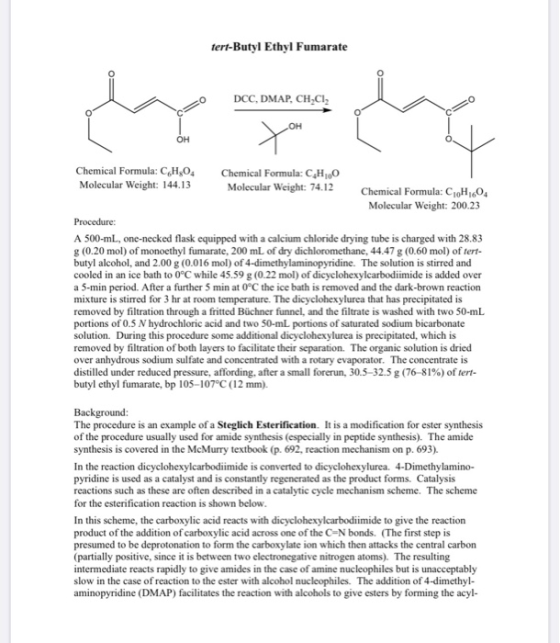
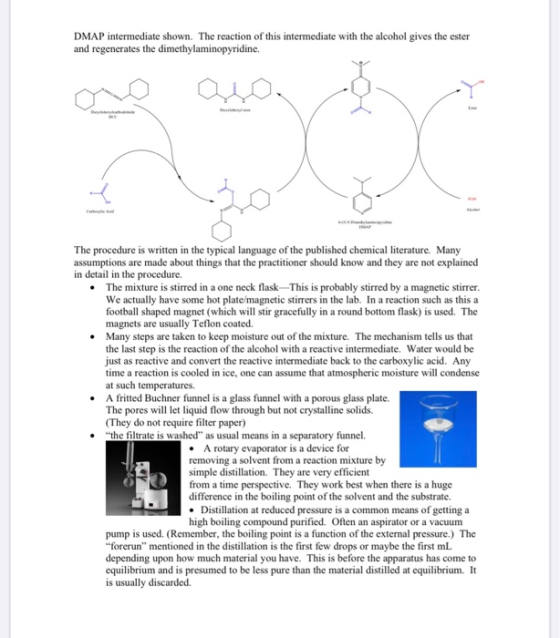

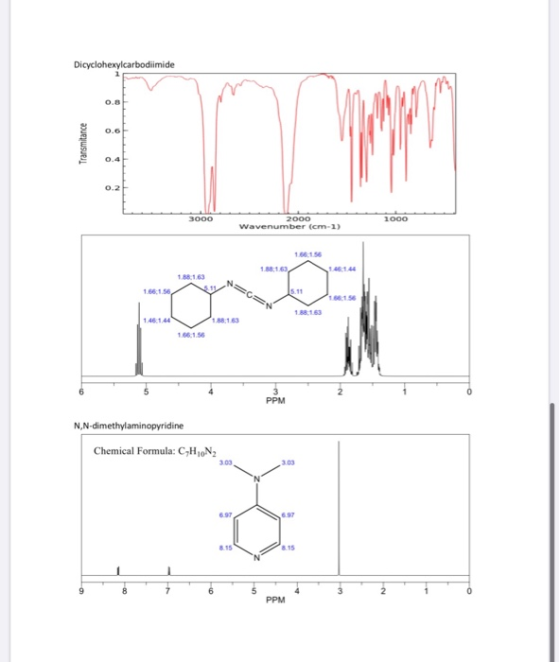

Homework Answers
proton NMR spectrum of compound A belong to starting material carboxylic acid

spectrum of compound B belong to product
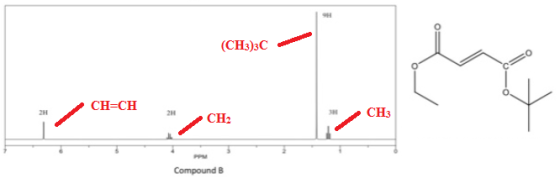
c.
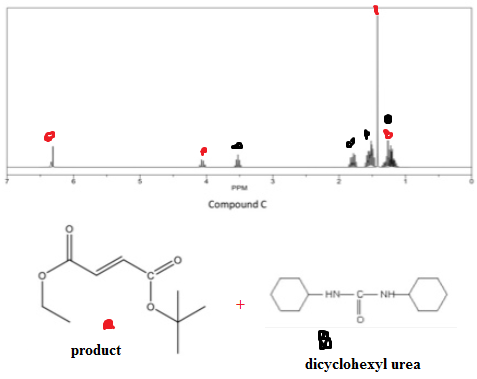
compound c is mixture of condensation product and dicyclohexyl urea. in the spectrum product signal is marked with red and dicyclohexyl urea signal is marked with black
Add Answer to:
The proton nmr and the infrared spectra of DCC, DMAP, DCU, the
product and the nmrs...
Give a detailed mechanism for this reaction and give a separation scheme NUCLEOPHILIC ACYL SUBSTITUTION: Synthesis...
 Give a detailed mechanism for this reaction and give a separation
scheme
NUCLEOPHILIC ACYL SUBSTITUTION: Synthesis of an Ester Isoamyl acetate (Banana Oil) Purpose This experiment demonstrat and alcohol. The technique of refluxing the reaction mixture is introduced. es the procedure for the synthesis of an ester from a carboxylic acid Esters are an important functional group in organic chemistry, and esters are found widely distributed in nature. Many lower molecular weight esters are associated with natural fuit flavors and...
Give a detailed mechanism for this reaction and give a separation
scheme
NUCLEOPHILIC ACYL SUBSTITUTION: Synthesis of an Ester Isoamyl acetate (Banana Oil) Purpose This experiment demonstrat and alcohol. The technique of refluxing the reaction mixture is introduced. es the procedure for the synthesis of an ester from a carboxylic acid Esters are an important functional group in organic chemistry, and esters are found widely distributed in nature. Many lower molecular weight esters are associated with natural fuit flavors and...
I need help with the lab’s question below and H-NMR ASAP. Please explain and show all...
 I need help with the lab’s question below and H-NMR ASAP.
Please explain and show all the work. I have posted lab guidelines
as well for the reference.
.nl H20令 9:19 AM X Chemistry 3342 Laboratory Manual Background (Week Two) Equal molar amounts of acid (Y) and alcohol (Y) starting material will be used in the second acid-catalyzed esterification reaction we will complete. When the reaction takes place one molecule or ester and one molecule of water will form, ie.,...
I need help with the lab’s question below and H-NMR ASAP.
Please explain and show all the work. I have posted lab guidelines
as well for the reference.
.nl H20令 9:19 AM X Chemistry 3342 Laboratory Manual Background (Week Two) Equal molar amounts of acid (Y) and alcohol (Y) starting material will be used in the second acid-catalyzed esterification reaction we will complete. When the reaction takes place one molecule or ester and one molecule of water will form, ie.,...
weight of cylinder 10.48g weight of cylinder with of isopentyl alcohol 14.55g weight of collecting flask...
 weight of cylinder 10.48g
weight of cylinder with of isopentyl alcohol 14.55g
weight of collecting flask 56.77 g
weight of collecting flask with product 60.42g
I need help getting theoretical yield and % yield.
Experiment 12 Isopentyl Acetate (Banana Oil) 93 Rasmussen, P. W. Qualitative Analysis by Gas Chromatography-G.C. versus the Nose in Formu- lation of Artificial Fruit Flavors." Journal of Chemical Education, 61 (January 1984): 62. Shreve, R. N., and Brink, J. Chemical Process Industries, 4th ed. New York:...
weight of cylinder 10.48g
weight of cylinder with of isopentyl alcohol 14.55g
weight of collecting flask 56.77 g
weight of collecting flask with product 60.42g
I need help getting theoretical yield and % yield.
Experiment 12 Isopentyl Acetate (Banana Oil) 93 Rasmussen, P. W. Qualitative Analysis by Gas Chromatography-G.C. versus the Nose in Formu- lation of Artificial Fruit Flavors." Journal of Chemical Education, 61 (January 1984): 62. Shreve, R. N., and Brink, J. Chemical Process Industries, 4th ed. New York:...
Experiment: In the experiment: Mix together 74 g. (92 ml.) of n-butyl alcohol and 120 g....
Experiment: In the experiment: Mix together 74 g. (92 ml.) of n-butyl alcohol and 120 g. (120 ml.) of glacial acetic acid in a 500 ml. round-bottomed flask, and add cautiously 10 ml. of concentrated sulphuric acid (use a small measuring cylinder or a burette or a calibrated dropper pipette). Attach a reflux condenser and reflux the mixture on a wire gauze for 3-6 hours. Pour the mixture into about 500 ml of water in a separatory funnel, remove the...
using the procedure above complete the stoichiometry table Procedure In an oven-dried, 100 ml round bottom...
 using the procedure above complete the stoichiometry
table
Procedure In an oven-dried, 100 ml round bottom flask containing magnetic stirring bar was added hydrobenzoin (1.0 8.4.7 mmol), anhydrous iron(III) chloride (0.3 g, 1.8 mmol), and anhydrous acetone (30 ml). The mixture was heated to reflux and stirred for 30 min. The reaction mixture was cooled tort and transferred to a separatory funnel containing 10% aq potassium carbonate (10 mL). Water (50 mL) was added and the aqueous solution was extracted...
using the procedure above complete the stoichiometry
table
Procedure In an oven-dried, 100 ml round bottom flask containing magnetic stirring bar was added hydrobenzoin (1.0 8.4.7 mmol), anhydrous iron(III) chloride (0.3 g, 1.8 mmol), and anhydrous acetone (30 ml). The mixture was heated to reflux and stirred for 30 min. The reaction mixture was cooled tort and transferred to a separatory funnel containing 10% aq potassium carbonate (10 mL). Water (50 mL) was added and the aqueous solution was extracted...
Synthesis of dimedone This lab exercise will give you practical experience with the generation of...
 Synthesis of dimedone This lab exercise will give you practical experience with the generation of a malonic ester enolate and subsequent reaction with an a,p-unsaturated carbonyl compound. This sequence is known as the Michael reaction. In the presence of sodium methoxide, dimethyl propanedioate (malonic ester/dimethyl malonate) is converted to the corresponding enolate anion and reaction with 4-methylpent-3-en-2-one (mesityl oxide) affords the Michael adduct 1, as shown in the reaction sequence below. Under the basic reaction conditions, the Michael adduct 1...
Synthesis of dimedone This lab exercise will give you practical experience with the generation of...
 Synthesis of dimedone This lab exercise will give you practical experience with the generation of a malonic ester enolate and subsequent reaction with an a,p-unsaturated carbonyl compound. This sequence is known as the Michael reaction. In the presence of sodium methoxide, dimethyl propanedioate (malonic ester/dimethyl malonate) is converted to the corresponding enolate anion and reaction with 4-methylpent-3-en-2-one (mesityl oxide) affords the Michael adduct 1, as shown in the reaction sequence below. Under the basic reaction conditions, the Michael adduct 1...
using the IR, the 13C, and DEPT NMR spectra of your product determine the identity of...
 using the IR, the 13C, and DEPT NMR spectra of your product
determine the identity of your unknown ester from a C-4 or C-5
alcohol. the identity of the C-4 or C-5 alcohol also needs to be
determined.
The following C-4 or C-5 alcohols will be used in this
experiment:
1-butanol (n-butyl alcohol)
2-butanol (sec-butyl alcohol)
2-methyl-1-propanol (isobutyl alcohol)
3-methyl-1-butanol (isopentyl alcohol)
1-pentanol (n-pentyl alcohol)
2-pentanol
3-pentanol
cyclopentanol
Questions:
1. Why is the mixture extracted with aqueous sodium
bicarbonate solution?...
using the IR, the 13C, and DEPT NMR spectra of your product
determine the identity of your unknown ester from a C-4 or C-5
alcohol. the identity of the C-4 or C-5 alcohol also needs to be
determined.
The following C-4 or C-5 alcohols will be used in this
experiment:
1-butanol (n-butyl alcohol)
2-butanol (sec-butyl alcohol)
2-methyl-1-propanol (isobutyl alcohol)
3-methyl-1-butanol (isopentyl alcohol)
1-pentanol (n-pentyl alcohol)
2-pentanol
3-pentanol
cyclopentanol
Questions:
1. Why is the mixture extracted with aqueous sodium
bicarbonate solution?...
Analyze the attached product NMR spectrum. Justify the structure of your final product and deduce the...
 Analyze the attached product NMR spectrum. Justify the
structure of your final product and deduce the identity of your
unknown starting material.
Provide a reaction mechanism using the starting material that
you deduced in Qu. 1.
Experimental Procedure In this experiment. Vou will perform a double reductive amination reac an unknown aldehyde to form the corresponding amine product determine the identity of the unknown starting material. reaction between ethylenediamine and oduct. Analyze the lab data obtained to HẠN NHA RE...
Analyze the attached product NMR spectrum. Justify the
structure of your final product and deduce the identity of your
unknown starting material.
Provide a reaction mechanism using the starting material that
you deduced in Qu. 1.
Experimental Procedure In this experiment. Vou will perform a double reductive amination reac an unknown aldehyde to form the corresponding amine product determine the identity of the unknown starting material. reaction between ethylenediamine and oduct. Analyze the lab data obtained to HẠN NHA RE...
Introduction A common method for synthesizing alkenes is by dehydrating (removing the elements of water) an...
 Introduction
A common method for synthesizing alkenes is by dehydrating
(removing the elements of water) an alcohol. The dehydration is
accomplished by heating the alcohol with either phosphoric or
sulfuric acid. In this experiment, the dehydration reaction is
illustrated by the conversion of 2-methylcyclohexanol to a mixture
of alkenes (remember the Saytzeff rule).
Information
Each step of this E1 elimination reaction is reversible and
thus, the reaction may be driven to completion by removing one or
more of the products,...
Introduction
A common method for synthesizing alkenes is by dehydrating
(removing the elements of water) an alcohol. The dehydration is
accomplished by heating the alcohol with either phosphoric or
sulfuric acid. In this experiment, the dehydration reaction is
illustrated by the conversion of 2-methylcyclohexanol to a mixture
of alkenes (remember the Saytzeff rule).
Information
Each step of this E1 elimination reaction is reversible and
thus, the reaction may be driven to completion by removing one or
more of the products,...
 Give a detailed mechanism for this reaction and give a separation
scheme
NUCLEOPHILIC ACYL SUBSTITUTION: Synthesis of an Ester Isoamyl acetate (Banana Oil) Purpose This experiment demonstrat and alcohol. The technique of refluxing the reaction mixture is introduced. es the procedure for the synthesis of an ester from a carboxylic acid Esters are an important functional group in organic chemistry, and esters are found widely distributed in nature. Many lower molecular weight esters are associated with natural fuit flavors and...
Give a detailed mechanism for this reaction and give a separation
scheme
NUCLEOPHILIC ACYL SUBSTITUTION: Synthesis of an Ester Isoamyl acetate (Banana Oil) Purpose This experiment demonstrat and alcohol. The technique of refluxing the reaction mixture is introduced. es the procedure for the synthesis of an ester from a carboxylic acid Esters are an important functional group in organic chemistry, and esters are found widely distributed in nature. Many lower molecular weight esters are associated with natural fuit flavors and...
 I need help with the lab’s question below and H-NMR ASAP.
Please explain and show all the work. I have posted lab guidelines
as well for the reference.
.nl H20令 9:19 AM X Chemistry 3342 Laboratory Manual Background (Week Two) Equal molar amounts of acid (Y) and alcohol (Y) starting material will be used in the second acid-catalyzed esterification reaction we will complete. When the reaction takes place one molecule or ester and one molecule of water will form, ie.,...
I need help with the lab’s question below and H-NMR ASAP.
Please explain and show all the work. I have posted lab guidelines
as well for the reference.
.nl H20令 9:19 AM X Chemistry 3342 Laboratory Manual Background (Week Two) Equal molar amounts of acid (Y) and alcohol (Y) starting material will be used in the second acid-catalyzed esterification reaction we will complete. When the reaction takes place one molecule or ester and one molecule of water will form, ie.,...
 weight of cylinder 10.48g
weight of cylinder with of isopentyl alcohol 14.55g
weight of collecting flask 56.77 g
weight of collecting flask with product 60.42g
I need help getting theoretical yield and % yield.
Experiment 12 Isopentyl Acetate (Banana Oil) 93 Rasmussen, P. W. Qualitative Analysis by Gas Chromatography-G.C. versus the Nose in Formu- lation of Artificial Fruit Flavors." Journal of Chemical Education, 61 (January 1984): 62. Shreve, R. N., and Brink, J. Chemical Process Industries, 4th ed. New York:...
weight of cylinder 10.48g
weight of cylinder with of isopentyl alcohol 14.55g
weight of collecting flask 56.77 g
weight of collecting flask with product 60.42g
I need help getting theoretical yield and % yield.
Experiment 12 Isopentyl Acetate (Banana Oil) 93 Rasmussen, P. W. Qualitative Analysis by Gas Chromatography-G.C. versus the Nose in Formu- lation of Artificial Fruit Flavors." Journal of Chemical Education, 61 (January 1984): 62. Shreve, R. N., and Brink, J. Chemical Process Industries, 4th ed. New York:...
 using the procedure above complete the stoichiometry
table
Procedure In an oven-dried, 100 ml round bottom flask containing magnetic stirring bar was added hydrobenzoin (1.0 8.4.7 mmol), anhydrous iron(III) chloride (0.3 g, 1.8 mmol), and anhydrous acetone (30 ml). The mixture was heated to reflux and stirred for 30 min. The reaction mixture was cooled tort and transferred to a separatory funnel containing 10% aq potassium carbonate (10 mL). Water (50 mL) was added and the aqueous solution was extracted...
using the procedure above complete the stoichiometry
table
Procedure In an oven-dried, 100 ml round bottom flask containing magnetic stirring bar was added hydrobenzoin (1.0 8.4.7 mmol), anhydrous iron(III) chloride (0.3 g, 1.8 mmol), and anhydrous acetone (30 ml). The mixture was heated to reflux and stirred for 30 min. The reaction mixture was cooled tort and transferred to a separatory funnel containing 10% aq potassium carbonate (10 mL). Water (50 mL) was added and the aqueous solution was extracted...
 Synthesis of dimedone This lab exercise will give you practical experience with the generation of a malonic ester enolate and subsequent reaction with an a,p-unsaturated carbonyl compound. This sequence is known as the Michael reaction. In the presence of sodium methoxide, dimethyl propanedioate (malonic ester/dimethyl malonate) is converted to the corresponding enolate anion and reaction with 4-methylpent-3-en-2-one (mesityl oxide) affords the Michael adduct 1, as shown in the reaction sequence below. Under the basic reaction conditions, the Michael adduct 1...
 Synthesis of dimedone This lab exercise will give you practical experience with the generation of a malonic ester enolate and subsequent reaction with an a,p-unsaturated carbonyl compound. This sequence is known as the Michael reaction. In the presence of sodium methoxide, dimethyl propanedioate (malonic ester/dimethyl malonate) is converted to the corresponding enolate anion and reaction with 4-methylpent-3-en-2-one (mesityl oxide) affords the Michael adduct 1, as shown in the reaction sequence below. Under the basic reaction conditions, the Michael adduct 1...
 using the IR, the 13C, and DEPT NMR spectra of your product
determine the identity of your unknown ester from a C-4 or C-5
alcohol. the identity of the C-4 or C-5 alcohol also needs to be
determined.
The following C-4 or C-5 alcohols will be used in this
experiment:
1-butanol (n-butyl alcohol)
2-butanol (sec-butyl alcohol)
2-methyl-1-propanol (isobutyl alcohol)
3-methyl-1-butanol (isopentyl alcohol)
1-pentanol (n-pentyl alcohol)
2-pentanol
3-pentanol
cyclopentanol
Questions:
1. Why is the mixture extracted with aqueous sodium
bicarbonate solution?...
using the IR, the 13C, and DEPT NMR spectra of your product
determine the identity of your unknown ester from a C-4 or C-5
alcohol. the identity of the C-4 or C-5 alcohol also needs to be
determined.
The following C-4 or C-5 alcohols will be used in this
experiment:
1-butanol (n-butyl alcohol)
2-butanol (sec-butyl alcohol)
2-methyl-1-propanol (isobutyl alcohol)
3-methyl-1-butanol (isopentyl alcohol)
1-pentanol (n-pentyl alcohol)
2-pentanol
3-pentanol
cyclopentanol
Questions:
1. Why is the mixture extracted with aqueous sodium
bicarbonate solution?...
 Analyze the attached product NMR spectrum. Justify the
structure of your final product and deduce the identity of your
unknown starting material.
Provide a reaction mechanism using the starting material that
you deduced in Qu. 1.
Experimental Procedure In this experiment. Vou will perform a double reductive amination reac an unknown aldehyde to form the corresponding amine product determine the identity of the unknown starting material. reaction between ethylenediamine and oduct. Analyze the lab data obtained to HẠN NHA RE...
Analyze the attached product NMR spectrum. Justify the
structure of your final product and deduce the identity of your
unknown starting material.
Provide a reaction mechanism using the starting material that
you deduced in Qu. 1.
Experimental Procedure In this experiment. Vou will perform a double reductive amination reac an unknown aldehyde to form the corresponding amine product determine the identity of the unknown starting material. reaction between ethylenediamine and oduct. Analyze the lab data obtained to HẠN NHA RE...
 Introduction
A common method for synthesizing alkenes is by dehydrating
(removing the elements of water) an alcohol. The dehydration is
accomplished by heating the alcohol with either phosphoric or
sulfuric acid. In this experiment, the dehydration reaction is
illustrated by the conversion of 2-methylcyclohexanol to a mixture
of alkenes (remember the Saytzeff rule).
Information
Each step of this E1 elimination reaction is reversible and
thus, the reaction may be driven to completion by removing one or
more of the products,...
Introduction
A common method for synthesizing alkenes is by dehydrating
(removing the elements of water) an alcohol. The dehydration is
accomplished by heating the alcohol with either phosphoric or
sulfuric acid. In this experiment, the dehydration reaction is
illustrated by the conversion of 2-methylcyclohexanol to a mixture
of alkenes (remember the Saytzeff rule).
Information
Each step of this E1 elimination reaction is reversible and
thus, the reaction may be driven to completion by removing one or
more of the products,...
Most questions answered within 3 hours.
-
Where is the error in this code sequence?
String s1 = "Hello";
String s2 = "ello";...
asked 11 months ago -
Financial data for Joel de Paris, Inc., for last year
follow:
Joel de Paris, Inc.
Balance...
asked 11 months ago -
Consider this reaction:
Al2(SO4)3 (aq)+ BaCl3
(aq) Al2Cl6 (aq)- +
3BaSO4(s) . What is the...
asked 11 months ago -
Suppose that Savneet is considering increasing her
recent random sample from 20 car rentals to 40...
asked 11 months ago -
Trucks arrive at an unloading terminal at an average rate of 120
per hour.
Trucks arrive...
asked 11 months ago -
Why are methanol and ethanol completely soluble in water while
octanol is not very little soluble....
asked 11 months ago -
A facilities manager at a university reads in a research report
that the mean amount of...
asked 11 months ago -
When the CuSO4 is rehydrated by adding water to the anhydrous
compound, is this an endothermic...
asked 11 months ago -
A ray of sunlight is passing from diamond into crown glass; the
angle of incidence is...
asked 11 months ago -
A block of mass 0.249 kg is placed on top of a light, vertical
spring of...
asked 11 months ago -
how do the kidneys compensate in the presences of acidosis
a) trigger hyperventilate
b) reserve acid...
asked 11 months ago -
Question 501 pts
The rental rate of capital to the firm increases. Which of the
following...
asked 11 months ago