
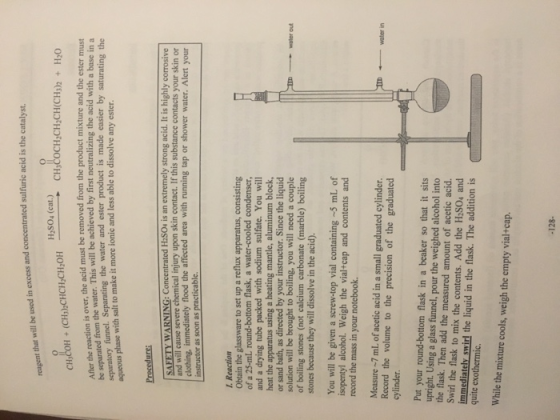
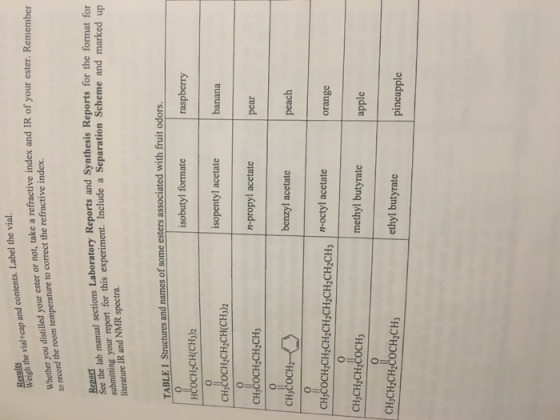
![Clamp the flask on the flask. Check that the sodium sulfate is packed loosely in the drying tube before placing it the condenser. securely to a ring stand. Add the boiling stones. Then place the reflux condenser on top of the condenser (otherwise, you will be heating a closed system!) Tum on the water to Place a heat source under the flask and turm it on to a moderate setting, Slowly bring the solution to a boil. Maintain a gentle reflux for at least 60 minutes, Remove the heat source and allow the flask to cool to room temperature. Do not remove the reflux condenser while the solution is still hot II. Work-up Set up a separatory funnel on a ring stand. Make sure the stop-cock is closed. Place a beaker under the funnel in case of leakage. Transfer the solution from the flask to the separatory funnel using a glass funnel to prevent contaminating the neck of the separatory funnel. Do not transfer the boiling stones. Add 10 mL of distilled water to the flask, swirl it, and transfer the solution to the separatory funnel. Stopper the separatory funnel. Mix the contents of the funnel by gently shaking and then venting. Allow the phases to separate Remove the stopper and lay it aside on a clean watch glass. Drain the lower aqueous layer into a beaker or Erlenmeyer flask Add 5 mL of 5% aqueous sodium bicarbonate to the separatory funnel (use a glass funnel to deliver the liquid). Carefully shake and vent immediately carbon dioxide gas might be generated during this step. Drain the lower aqueous layer into the same beaker or Erlenmeyer flask as used in the first extraction. Next, add 5 mL of saturated sodium chloride solution and extract the organic layer again. Drain the lower aqueous layer into the same beaker or Erlenmeyer flask as used in the earlier extractions. [Note: It is best never to discard an extraction phase until you have completed the work-up.] Pour the crude organic ester layer from the top of the separatory funnel into a 25-mL Erlenmeyer flask. Add anhydrous sodium sulfate to dry residual water from the ester. Stopper the flask and swirl occasionally for 10-15 minutes until the solution appears dry. If it is not dry, decant the ester into a clean, dry 25-mL Erlenmeyer flask and add more drying agent. When the ester is dry, decant the liquid into a clean, dry, pre-weighed screw-top vial+cap. (If you are to distill the ester, decant into a small round-bottom flask.) If you are instructed to do so, set up a simple distillation apparatus and distill the ester over ice until only one or two drops remain in the distilling flask. Pre-weigh the receiving flask before you begin the distillation. Aqueous waste can be poured down the drain. Organic waste should be placed in the designated container in the hood -129](http://img.homeworklib.com/questions/67e87980-6647-11eb-b0f1-abc4b87420ab.png?x-oss-process=image/resize,w_560)
Homework Answers

Add Answer to:
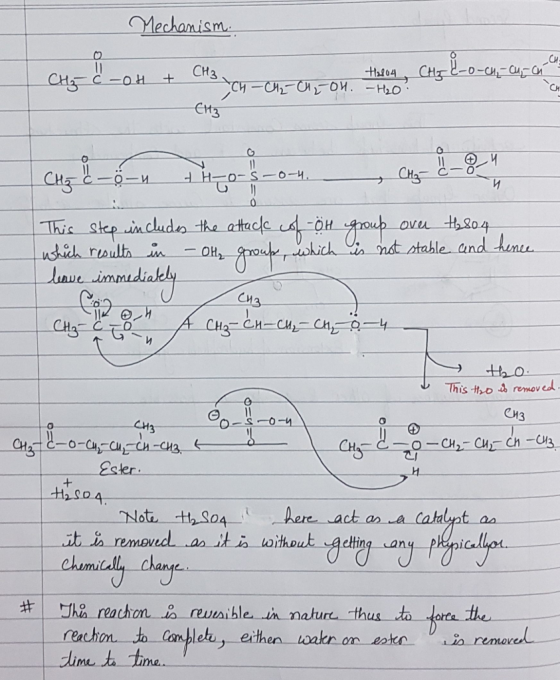
Give a detailed mechanism for this reaction and give a separation
scheme
NUCLEOPHILIC ACYL SUBSTITUTION: Synthesis...
weight of cylinder 10.48g weight of cylinder with of isopentyl alcohol 14.55g weight of collecting flask...
 weight of cylinder 10.48g
weight of cylinder with of isopentyl alcohol 14.55g
weight of collecting flask 56.77 g
weight of collecting flask with product 60.42g
I need help getting theoretical yield and % yield.
Experiment 12 Isopentyl Acetate (Banana Oil) 93 Rasmussen, P. W. Qualitative Analysis by Gas Chromatography-G.C. versus the Nose in Formu- lation of Artificial Fruit Flavors." Journal of Chemical Education, 61 (January 1984): 62. Shreve, R. N., and Brink, J. Chemical Process Industries, 4th ed. New York:...
weight of cylinder 10.48g
weight of cylinder with of isopentyl alcohol 14.55g
weight of collecting flask 56.77 g
weight of collecting flask with product 60.42g
I need help getting theoretical yield and % yield.
Experiment 12 Isopentyl Acetate (Banana Oil) 93 Rasmussen, P. W. Qualitative Analysis by Gas Chromatography-G.C. versus the Nose in Formu- lation of Artificial Fruit Flavors." Journal of Chemical Education, 61 (January 1984): 62. Shreve, R. N., and Brink, J. Chemical Process Industries, 4th ed. New York:...
Why did you wash the ether solution with sodium bicarbonate? Write chemical equations for the rea...
 Why did you wash the ether solution with sodium bicarbonate? Write chemical equations for the reactions that took place. b. At which purification steps was the unreacted methanol removed in the reaction? Some of it may have been removed in more than one place. c. Three-Step Synthesis of Methyl Anisate (Step 3) 0 CHOH. Н.so, cat.) Wear gloves. Methanol is poisonous. Ether is an anesthetic, so don't breathe it. Sulfuric acid is a strong corrosive acid. Wash any you spill...
SYNTHESIS OF T-PENTYL CHLORIDE LAB Provide a stoichiometry table for the reaction being performed in this...
 SYNTHESIS OF T-PENTYL CHLORIDE LAB
Provide a stoichiometry table for the reaction being performed
in this lab.
PROCEDURE Preparation oft-Pentyl Chloride In a 125-mL separatory funnel, place 10.0 mL of tert-pentyl alcohol (2-methyl-2- butanol, MW = 88.2, d = 0.805 g/mL) and 25 mL of concentrated hydrochloric acid (d 1.18 g/mL). Do not stopper the funnel. Gently swirl the mixture in the separa- tory funnel for about 1 minute. After this period of swirling, stopper the separatory funnel and carefully...
SYNTHESIS OF T-PENTYL CHLORIDE LAB
Provide a stoichiometry table for the reaction being performed
in this lab.
PROCEDURE Preparation oft-Pentyl Chloride In a 125-mL separatory funnel, place 10.0 mL of tert-pentyl alcohol (2-methyl-2- butanol, MW = 88.2, d = 0.805 g/mL) and 25 mL of concentrated hydrochloric acid (d 1.18 g/mL). Do not stopper the funnel. Gently swirl the mixture in the separa- tory funnel for about 1 minute. After this period of swirling, stopper the separatory funnel and carefully...
Help with PreLab questions 1-4 Procedure Esterification Each group will be assigned an unknown alcohol by...
 Help with PreLab questions 1-4
Procedure Esterification Each group will be assigned an unknown alcohol by the instructor. Record the unknown number and then add the contents of the vial (25 mmol of alcohol) to a 50 mL round bottom flask with a stir bar Then add 2.75 mL (approx. 50 mmol) of acetic acid followed by 0.25 mL of concentrated sulfuric acid Add a reflux condenser then reflux the mixture in a sand bath with stirring for one hour....
Help with PreLab questions 1-4
Procedure Esterification Each group will be assigned an unknown alcohol by the instructor. Record the unknown number and then add the contents of the vial (25 mmol of alcohol) to a 50 mL round bottom flask with a stir bar Then add 2.75 mL (approx. 50 mmol) of acetic acid followed by 0.25 mL of concentrated sulfuric acid Add a reflux condenser then reflux the mixture in a sand bath with stirring for one hour....
Write a mechanism of the synthesis diisobutylene from tert-butyl alcohol with the use of elimination reaction....
Write a mechanism of the synthesis diisobutylene from tert-butyl alcohol with the use of elimination reaction. The following is the procedure of how it was done in the orgo lab: First of all, with the use of graduated cylinder 7mL of water was measured and then transferred in a 50mL round bottom flask. To the round bottom flask, it was added 7mL of sulfuric acid. The mixture was then cooled until the temperature got below 50 °C. In order to...
Place 3.0 g of salicylic acid in a 125-ml Erlenmeyer flask. Carefully add, stirring constantly, 6...
 Place 3.0 g of salicylic acid in a 125-ml Erlenmeyer flask. Carefully add, stirring constantly, 6 mL of acetic anhydride, followed by 10 drops of concentrated sulfuric acid. Swirl the contents of the flask so that the reactants are thoroughly mixed. Stopper the flask with a one- hole cork fitted with an inverted Pasteur pipet to prevent condensation of water in the reaction flask during heating on the steam bath. Heat the flask in a boiling-water or steam bath for...
Thumbs up for good answer. Why does the liquid in the round bottom flask turn light...
 Thumbs up for good answer. Why does the liquid in the round
bottom flask turn light pink?, please explain (This happened
during/after step 2). This is the procedure and the experiment is
called Synthesis of Artificial Flavorings by Fischer
Esterification.
Thank you!
SAMPLE PROCEDURES: 1. Isoanvl acetate (banana) + H2O OH HO 1. Mix 6 mL of isoamyl alcohol (0.809 g/mL, 88.148 g/mol) and 10 ml ofglacial acetic acid (1.05 g/ml 60.05 g/mol) in a 100 mL round bottom flask....
Thumbs up for good answer. Why does the liquid in the round
bottom flask turn light pink?, please explain (This happened
during/after step 2). This is the procedure and the experiment is
called Synthesis of Artificial Flavorings by Fischer
Esterification.
Thank you!
SAMPLE PROCEDURES: 1. Isoanvl acetate (banana) + H2O OH HO 1. Mix 6 mL of isoamyl alcohol (0.809 g/mL, 88.148 g/mol) and 10 ml ofglacial acetic acid (1.05 g/ml 60.05 g/mol) in a 100 mL round bottom flask....
Experiment: In the experiment: Mix together 74 g. (92 ml.) of n-butyl alcohol and 120 g....
Experiment: In the experiment: Mix together 74 g. (92 ml.) of n-butyl alcohol and 120 g. (120 ml.) of glacial acetic acid in a 500 ml. round-bottomed flask, and add cautiously 10 ml. of concentrated sulphuric acid (use a small measuring cylinder or a burette or a calibrated dropper pipette). Attach a reflux condenser and reflux the mixture on a wire gauze for 3-6 hours. Pour the mixture into about 500 ml of water in a separatory funnel, remove the...
How can the NMP oxalate salt be converted back to NMP? Here is the procedure: PROCEDURES...
How can the NMP oxalate salt be converted back to NMP? Here is the procedure: PROCEDURES Part A: Synthesis of (±)-N,N-dimethyl-3-phenyl-3-(4-trifluoromethylphenoxy)propanamine To the 250-mL round-bottom flask (RBF) containing (±)-3-(dimethylamino)-1-phenylpropanol (product from Lab 6) and a magnetic stir bar, add 4 mL of 4-chlorobenzotrifluoride and 30 mL of dimethylacetamide (DMA). With stirring, add to this mixture 30 mL of 1.0 M potassium tert-butoxide (caustic alkali!) in tert-butyl alcohol using a syringe. Using a simple distillation apparatus, distill the mixture slowly, with...
we have 1.5 g final product for following experiment. how can I draw acid- base curve...
we have 1.5 g final product for following experiment. how can I draw acid- base curve for following experiment? Experimental procedure Weigh approximately 2.5 gof benzoic acid contaminated withtable salt (NaCl) as precisely as possible (record the exact quantity). Transfer the solid to a 100 mL separatory funnel and add 30 mL of ethyl acetate. In a 50 mL beaker, add 20 mL of water and 1.0 mL of 3 M hydrochloric acid. Transferthe mixtureto the separatory funnel. The solid...
 weight of cylinder 10.48g
weight of cylinder with of isopentyl alcohol 14.55g
weight of collecting flask 56.77 g
weight of collecting flask with product 60.42g
I need help getting theoretical yield and % yield.
Experiment 12 Isopentyl Acetate (Banana Oil) 93 Rasmussen, P. W. Qualitative Analysis by Gas Chromatography-G.C. versus the Nose in Formu- lation of Artificial Fruit Flavors." Journal of Chemical Education, 61 (January 1984): 62. Shreve, R. N., and Brink, J. Chemical Process Industries, 4th ed. New York:...
weight of cylinder 10.48g
weight of cylinder with of isopentyl alcohol 14.55g
weight of collecting flask 56.77 g
weight of collecting flask with product 60.42g
I need help getting theoretical yield and % yield.
Experiment 12 Isopentyl Acetate (Banana Oil) 93 Rasmussen, P. W. Qualitative Analysis by Gas Chromatography-G.C. versus the Nose in Formu- lation of Artificial Fruit Flavors." Journal of Chemical Education, 61 (January 1984): 62. Shreve, R. N., and Brink, J. Chemical Process Industries, 4th ed. New York:...
 Why did you wash the ether solution with sodium bicarbonate? Write chemical equations for the reactions that took place. b. At which purification steps was the unreacted methanol removed in the reaction? Some of it may have been removed in more than one place. c. Three-Step Synthesis of Methyl Anisate (Step 3) 0 CHOH. Н.so, cat.) Wear gloves. Methanol is poisonous. Ether is an anesthetic, so don't breathe it. Sulfuric acid is a strong corrosive acid. Wash any you spill...
 SYNTHESIS OF T-PENTYL CHLORIDE LAB
Provide a stoichiometry table for the reaction being performed
in this lab.
PROCEDURE Preparation oft-Pentyl Chloride In a 125-mL separatory funnel, place 10.0 mL of tert-pentyl alcohol (2-methyl-2- butanol, MW = 88.2, d = 0.805 g/mL) and 25 mL of concentrated hydrochloric acid (d 1.18 g/mL). Do not stopper the funnel. Gently swirl the mixture in the separa- tory funnel for about 1 minute. After this period of swirling, stopper the separatory funnel and carefully...
SYNTHESIS OF T-PENTYL CHLORIDE LAB
Provide a stoichiometry table for the reaction being performed
in this lab.
PROCEDURE Preparation oft-Pentyl Chloride In a 125-mL separatory funnel, place 10.0 mL of tert-pentyl alcohol (2-methyl-2- butanol, MW = 88.2, d = 0.805 g/mL) and 25 mL of concentrated hydrochloric acid (d 1.18 g/mL). Do not stopper the funnel. Gently swirl the mixture in the separa- tory funnel for about 1 minute. After this period of swirling, stopper the separatory funnel and carefully...
 Help with PreLab questions 1-4
Procedure Esterification Each group will be assigned an unknown alcohol by the instructor. Record the unknown number and then add the contents of the vial (25 mmol of alcohol) to a 50 mL round bottom flask with a stir bar Then add 2.75 mL (approx. 50 mmol) of acetic acid followed by 0.25 mL of concentrated sulfuric acid Add a reflux condenser then reflux the mixture in a sand bath with stirring for one hour....
Help with PreLab questions 1-4
Procedure Esterification Each group will be assigned an unknown alcohol by the instructor. Record the unknown number and then add the contents of the vial (25 mmol of alcohol) to a 50 mL round bottom flask with a stir bar Then add 2.75 mL (approx. 50 mmol) of acetic acid followed by 0.25 mL of concentrated sulfuric acid Add a reflux condenser then reflux the mixture in a sand bath with stirring for one hour....
 Place 3.0 g of salicylic acid in a 125-ml Erlenmeyer flask. Carefully add, stirring constantly, 6 mL of acetic anhydride, followed by 10 drops of concentrated sulfuric acid. Swirl the contents of the flask so that the reactants are thoroughly mixed. Stopper the flask with a one- hole cork fitted with an inverted Pasteur pipet to prevent condensation of water in the reaction flask during heating on the steam bath. Heat the flask in a boiling-water or steam bath for...
 Thumbs up for good answer. Why does the liquid in the round
bottom flask turn light pink?, please explain (This happened
during/after step 2). This is the procedure and the experiment is
called Synthesis of Artificial Flavorings by Fischer
Esterification.
Thank you!
SAMPLE PROCEDURES: 1. Isoanvl acetate (banana) + H2O OH HO 1. Mix 6 mL of isoamyl alcohol (0.809 g/mL, 88.148 g/mol) and 10 ml ofglacial acetic acid (1.05 g/ml 60.05 g/mol) in a 100 mL round bottom flask....
Thumbs up for good answer. Why does the liquid in the round
bottom flask turn light pink?, please explain (This happened
during/after step 2). This is the procedure and the experiment is
called Synthesis of Artificial Flavorings by Fischer
Esterification.
Thank you!
SAMPLE PROCEDURES: 1. Isoanvl acetate (banana) + H2O OH HO 1. Mix 6 mL of isoamyl alcohol (0.809 g/mL, 88.148 g/mol) and 10 ml ofglacial acetic acid (1.05 g/ml 60.05 g/mol) in a 100 mL round bottom flask....
Most questions answered within 3 hours.
-
Where is the error in this code sequence?
String s1 = "Hello";
String s2 = "ello";...
asked 10 months ago -
Financial data for Joel de Paris, Inc., for last year
follow:
Joel de Paris, Inc.
Balance...
asked 10 months ago -
Consider this reaction:
Al2(SO4)3 (aq)+ BaCl3
(aq) Al2Cl6 (aq)- +
3BaSO4(s) . What is the...
asked 10 months ago -
Suppose that Savneet is considering increasing her
recent random sample from 20 car rentals to 40...
asked 10 months ago -
Trucks arrive at an unloading terminal at an average rate of 120
per hour.
Trucks arrive...
asked 10 months ago -
Why are methanol and ethanol completely soluble in water while
octanol is not very little soluble....
asked 10 months ago -
A facilities manager at a university reads in a research report
that the mean amount of...
asked 10 months ago -
When the CuSO4 is rehydrated by adding water to the anhydrous
compound, is this an endothermic...
asked 10 months ago -
A ray of sunlight is passing from diamond into crown glass; the
angle of incidence is...
asked 10 months ago -
A block of mass 0.249 kg is placed on top of a light, vertical
spring of...
asked 10 months ago -
how do the kidneys compensate in the presences of acidosis
a) trigger hyperventilate
b) reserve acid...
asked 10 months ago -
Question 501 pts
The rental rate of capital to the firm increases. Which of the
following...
asked 10 months ago