
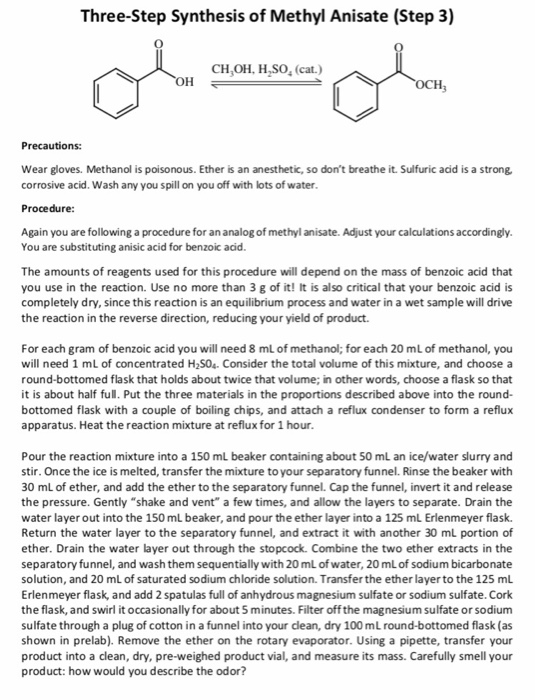
Three-Step Synthesis of Methyl Anisate (Step 3) 0 CHOH. Н.so, cat.) Wear gloves. Methanol is poisonous. Ether is an anesthetic, so don't breathe it. Sulfuric acid is a strong corrosive acid. Wash any you spill on you off with lots of water Procedure Again you are following a procedure for an analog of methyl anisate. Adjust your calculations accordingly You are substituting anisic acid for benzoic acid. The amounts of reagents used for this procedure will depend on the mass of benzoic acid that you use in the reaction. Use no more than 3 g of it! It is also critical that your benzoic acid is completely dry, since this reaction is an equilibrium process and water in a wet sample will drive the reaction in the reverse direction, reducing your yield of product. For each gram of benzoic acid you will need 8 mL of methanol; for each 20 mL of methanol, you will need 1 mL of concentrated H2S04. Consider the total volume of this mixture, and choose a round-bottomed flask that holds about twice that volume; in other words, choose a flask so that it is about half full. Put the three materials in the proportions described above into the round- bottomed flask with a couple of boiling chips, and attach a reflux condenser to form a reflux apparatus. Heat the reaction mixture at reflux for 1 hour Pour the reaction mixture into a 150 mL beaker containing about 50 mL an ice/water slurry and stir. Once the ice is melted, transfer the mixture to your separatory funnel. Rinse the beaker with 30 mL of ether, and add the ether to the separatory funnel. Cap the funnel, invert it and release the pressure. Gently "shake and vent" a few times, and allow the layers to separate. Drain the water layer out into the 150 mL beaker, and pour the ether layer into a 125 mL Erlenmeyer flask. Return the water layer to the separatory funnel, and extract it with another 30 ml portion of ether. Drain the water layer out through the stopcock. Combine the two ether extracts in the separatory funnel, and wash them sequentially with 20 mL of water, 20 mL of sodium bicarbonate solution, and 20 mL of saturated sodium chloride solution. Transfer the ether layer to the 125 mL Erlenmeyer flask, and add 2 spatulas full of anhydrous magnesium sulfate or sodium sulfate. Cork the flask, and swirl it occasionally for about 5 minutes. Filter off the magnesium sulfate or sodium sulfate through a plug of cotton in a funnel into your dlean, dry 100 mL round-bottomed flask (as shown in prelab). Remove the ether on the rotary evaporator. Using a pipette, transfer your product into a clean, dry, pre-weighed product vial, and measure its mass. Carefully smell your product: how would you describe the odor?
Homework Answers
Ether is washed by sodium by carbonate to neutralize the
unreacted compounds like some acid. Further, washing with 5% sodium
bicarbonate may produce carbon dioxide gas in the separatory
funnel. It is extremely important to vent the funnel immediately
upon inverting and before shaking.
NaHCO3+ Acid= CO2+ Na2CO3+ H2O
Add Answer to:
Why did you wash the ether solution with sodium bicarbonate? Write chemical equations for the rea...
noinizdle dn Draw a flow sheet to describe the separation procedure. (10 pts) doprleoudenagne aded 6....
 noinizdle dn Draw a flow sheet to describe the separation procedure. (10 pts) doprleoudenagne aded 6. Are several small-scale extractions more efficient than one large-scale extraction? Why? (10 pts) 7. Why the upper layer should be poured out from the top of the separatory funnel but not be drained from the stopcock? (10 pts) Extraction: Separation of a Neutral and Basic Substances 1 Dissolve 2 g of a mixture of naphthalene and 4-chloroaniline in 20 mL of ethyl ether and...
Experiment: A mixture of equal proportions of benzoic acid, ethyl 4-aminobenzoate, and 1,4-dimethoxybenzene are to be...
Experiment: A mixture of equal proportions of benzoic acid, ethyl 4-aminobenzoate, and 1,4-dimethoxybenzene are to be separated by extraction using the solvent diethyl ether. Day 1: Part A. Isolation of the basic component: In a small beaker, dissolve 3 g of the mixture (benzoic acid, ethyl 4-aminobenzoate, and 1,4-dimethoxybenzene) in 30 mL of diethyl ether and transfer the mixture to a 125- mL separatory funnel (see Fig. 1) using a little diethyl ether to complete the transfer. Add 10 mL...
Attached below are the pages from this lab report to help give context to the questions....
 Attached below are the pages from this lab report to help give
context to the questions. Please be as detailed as possible when
answering the questions and include any relevant information about
intermolecular forces at play. Thank you for your help!
Here are the questions which I need answered. Thank you in
advance for your help! :) Please be as detailed as possible and
discuss any intermolecular forces in detail if they are relevant to
the question. Thanks!
PARTA. SEPARATION...
Attached below are the pages from this lab report to help give
context to the questions. Please be as detailed as possible when
answering the questions and include any relevant information about
intermolecular forces at play. Thank you for your help!
Here are the questions which I need answered. Thank you in
advance for your help! :) Please be as detailed as possible and
discuss any intermolecular forces in detail if they are relevant to
the question. Thanks!
PARTA. SEPARATION...
Would the methylene chloride layer be above or below the experiment? Justify your answer. 1. aqueous layer in today...
 Would the methylene chloride layer be above or below the experiment? Justify your answer. 1. aqueous layer in today's ium carbonate used in the isolation of caffeine? Be specific as to the 2. Why is potass chemical species the carbonate may act on. Why was sodium sulfate used? 3. 4. After introducing 1.0 g of potassium carbonate into the centri hot water extract, it was capped, shaken, and then cooled to room temperature. Following this, roug minute. Why wasn't the...
QUESTION: Write a flow scheme for the work-up. THE WORK UP:
 QUESTION:
Write a flow scheme for the work-up.
THE WORK UP:
C. Work-up (save all layers) and Isolation of Product MgBrCl Benzoic acid Transfer the mixture into a test tube. Rinse the beaker with about 3 mL of regular (not anhydrous) diethyl ether and pour the washings into the test tube. There should be two distinct layers in the test tube Remove the aqueous layer (to be discarded) and shake the ether layer with about 2 mL of 3 M...
QUESTION:
Write a flow scheme for the work-up.
THE WORK UP:
C. Work-up (save all layers) and Isolation of Product MgBrCl Benzoic acid Transfer the mixture into a test tube. Rinse the beaker with about 3 mL of regular (not anhydrous) diethyl ether and pour the washings into the test tube. There should be two distinct layers in the test tube Remove the aqueous layer (to be discarded) and shake the ether layer with about 2 mL of 3 M...
Draw an extraction flow chart for the Extraction experiment you completed. experiment below Separation of a...
Draw an extraction flow chart for the Extraction experiment you completed. experiment below Separation of a Benzoic Acid/Biphenyl Mixture by Acid-Base Extraction Prepare the solution to be extracted by dissolving 2.5 g of a 1:1 mixture of benzoic acid/ biphenyl in 25 mL of tert-butyl methyl ether (MTBE) . Using a 125 mL separatory funnel extract the ether solution with a mixture containing 10 mL of distilled water and 15 mL of saturated NaHCO3 . Repeat After removing the aqueous...
Extraction of solids: Experiment outlined below Draw a “roadmap” of the experiment, containing chemical structures and...
 Extraction of solids: Experiment outlined below
Draw a “roadmap” of the experiment, containing chemical
structures and “layers” (organic and aqueous). This should contain
the individual reactions occurring in each step, and show which
layer the various components are present. Make sure you think about
whether the acetaminophen, caffeine and aspirin are neutral,
protonated or deprotonated.
Preliminary separation obtain a sample (1.0g) of the mixture. weigh the sample and record it. this sample should consist of a 2:1:1 mixture (by mass)...
Extraction of solids: Experiment outlined below
Draw a “roadmap” of the experiment, containing chemical
structures and “layers” (organic and aqueous). This should contain
the individual reactions occurring in each step, and show which
layer the various components are present. Make sure you think about
whether the acetaminophen, caffeine and aspirin are neutral,
protonated or deprotonated.
Preliminary separation obtain a sample (1.0g) of the mixture. weigh the sample and record it. this sample should consist of a 2:1:1 mixture (by mass)...
How can the NMP oxalate salt be converted back to NMP? Here is the procedure: PROCEDURES...
How can the NMP oxalate salt be converted back to NMP? Here is the procedure: PROCEDURES Part A: Synthesis of (±)-N,N-dimethyl-3-phenyl-3-(4-trifluoromethylphenoxy)propanamine To the 250-mL round-bottom flask (RBF) containing (±)-3-(dimethylamino)-1-phenylpropanol (product from Lab 6) and a magnetic stir bar, add 4 mL of 4-chlorobenzotrifluoride and 30 mL of dimethylacetamide (DMA). With stirring, add to this mixture 30 mL of 1.0 M potassium tert-butoxide (caustic alkali!) in tert-butyl alcohol using a syringe. Using a simple distillation apparatus, distill the mixture slowly, with...
i need help with #3 please! SAFETY NOTES: Bromobenene and acetophenone are irritants. Wear gloves and...
 i need help with #3 please!
SAFETY NOTES: Bromobenene and acetophenone are irritants. Wear gloves and avoid contact with skin, eyes, and clothing • MHC) is dritating to the skin avoid contact with the skin, eyes, and clothing Diethyl ether, usually referred to simply as "ether", is volatile and flammable. Keep a safe distance from hot electrical devices WASTE DISPOSAL *** A itrate is the liquid that passed through the Hirsch funnel, ending up in the bottom of the sidearm...
i need help with #3 please!
SAFETY NOTES: Bromobenene and acetophenone are irritants. Wear gloves and avoid contact with skin, eyes, and clothing • MHC) is dritating to the skin avoid contact with the skin, eyes, and clothing Diethyl ether, usually referred to simply as "ether", is volatile and flammable. Keep a safe distance from hot electrical devices WASTE DISPOSAL *** A itrate is the liquid that passed through the Hirsch funnel, ending up in the bottom of the sidearm...
Create a separation scheme flow chart/diagram to isolate methyl salicylate from a product mixture containing the...
Create a separation scheme flow chart/diagram to isolate methyl salicylate from a product mixture containing the following: Methyl salicylate, methanol, concentrated sulfuric acid. Lab procedure for separation: Extract with 25mL dichloromethane. Drain the bottom organic layer into a beaker. Repeat the extraction with another 25mL portion of dichloromethane, isolate the bottom layer, and then combine it with the first dichloromethane extract. Pour the combined extracts back into the funnel and wash the solution with 25mL of water. Drain the lower...
 noinizdle dn Draw a flow sheet to describe the separation procedure. (10 pts) doprleoudenagne aded 6. Are several small-scale extractions more efficient than one large-scale extraction? Why? (10 pts) 7. Why the upper layer should be poured out from the top of the separatory funnel but not be drained from the stopcock? (10 pts) Extraction: Separation of a Neutral and Basic Substances 1 Dissolve 2 g of a mixture of naphthalene and 4-chloroaniline in 20 mL of ethyl ether and...
 Attached below are the pages from this lab report to help give
context to the questions. Please be as detailed as possible when
answering the questions and include any relevant information about
intermolecular forces at play. Thank you for your help!
Here are the questions which I need answered. Thank you in
advance for your help! :) Please be as detailed as possible and
discuss any intermolecular forces in detail if they are relevant to
the question. Thanks!
PARTA. SEPARATION...
Attached below are the pages from this lab report to help give
context to the questions. Please be as detailed as possible when
answering the questions and include any relevant information about
intermolecular forces at play. Thank you for your help!
Here are the questions which I need answered. Thank you in
advance for your help! :) Please be as detailed as possible and
discuss any intermolecular forces in detail if they are relevant to
the question. Thanks!
PARTA. SEPARATION...
 Would the methylene chloride layer be above or below the experiment? Justify your answer. 1. aqueous layer in today's ium carbonate used in the isolation of caffeine? Be specific as to the 2. Why is potass chemical species the carbonate may act on. Why was sodium sulfate used? 3. 4. After introducing 1.0 g of potassium carbonate into the centri hot water extract, it was capped, shaken, and then cooled to room temperature. Following this, roug minute. Why wasn't the...
 QUESTION:
Write a flow scheme for the work-up.
THE WORK UP:
C. Work-up (save all layers) and Isolation of Product MgBrCl Benzoic acid Transfer the mixture into a test tube. Rinse the beaker with about 3 mL of regular (not anhydrous) diethyl ether and pour the washings into the test tube. There should be two distinct layers in the test tube Remove the aqueous layer (to be discarded) and shake the ether layer with about 2 mL of 3 M...
QUESTION:
Write a flow scheme for the work-up.
THE WORK UP:
C. Work-up (save all layers) and Isolation of Product MgBrCl Benzoic acid Transfer the mixture into a test tube. Rinse the beaker with about 3 mL of regular (not anhydrous) diethyl ether and pour the washings into the test tube. There should be two distinct layers in the test tube Remove the aqueous layer (to be discarded) and shake the ether layer with about 2 mL of 3 M...
 Extraction of solids: Experiment outlined below
Draw a “roadmap” of the experiment, containing chemical
structures and “layers” (organic and aqueous). This should contain
the individual reactions occurring in each step, and show which
layer the various components are present. Make sure you think about
whether the acetaminophen, caffeine and aspirin are neutral,
protonated or deprotonated.
Preliminary separation obtain a sample (1.0g) of the mixture. weigh the sample and record it. this sample should consist of a 2:1:1 mixture (by mass)...
Extraction of solids: Experiment outlined below
Draw a “roadmap” of the experiment, containing chemical
structures and “layers” (organic and aqueous). This should contain
the individual reactions occurring in each step, and show which
layer the various components are present. Make sure you think about
whether the acetaminophen, caffeine and aspirin are neutral,
protonated or deprotonated.
Preliminary separation obtain a sample (1.0g) of the mixture. weigh the sample and record it. this sample should consist of a 2:1:1 mixture (by mass)...
 i need help with #3 please!
SAFETY NOTES: Bromobenene and acetophenone are irritants. Wear gloves and avoid contact with skin, eyes, and clothing • MHC) is dritating to the skin avoid contact with the skin, eyes, and clothing Diethyl ether, usually referred to simply as "ether", is volatile and flammable. Keep a safe distance from hot electrical devices WASTE DISPOSAL *** A itrate is the liquid that passed through the Hirsch funnel, ending up in the bottom of the sidearm...
i need help with #3 please!
SAFETY NOTES: Bromobenene and acetophenone are irritants. Wear gloves and avoid contact with skin, eyes, and clothing • MHC) is dritating to the skin avoid contact with the skin, eyes, and clothing Diethyl ether, usually referred to simply as "ether", is volatile and flammable. Keep a safe distance from hot electrical devices WASTE DISPOSAL *** A itrate is the liquid that passed through the Hirsch funnel, ending up in the bottom of the sidearm...
Most questions answered within 3 hours.
-
Where is the error in this code sequence?
String s1 = "Hello";
String s2 = "ello";...
asked 10 months ago -
Financial data for Joel de Paris, Inc., for last year
follow:
Joel de Paris, Inc.
Balance...
asked 10 months ago -
Consider this reaction:
Al2(SO4)3 (aq)+ BaCl3
(aq) Al2Cl6 (aq)- +
3BaSO4(s) . What is the...
asked 10 months ago -
Suppose that Savneet is considering increasing her
recent random sample from 20 car rentals to 40...
asked 10 months ago -
Trucks arrive at an unloading terminal at an average rate of 120
per hour.
Trucks arrive...
asked 10 months ago -
Why are methanol and ethanol completely soluble in water while
octanol is not very little soluble....
asked 10 months ago -
A facilities manager at a university reads in a research report
that the mean amount of...
asked 10 months ago -
When the CuSO4 is rehydrated by adding water to the anhydrous
compound, is this an endothermic...
asked 10 months ago -
A ray of sunlight is passing from diamond into crown glass; the
angle of incidence is...
asked 10 months ago -
A block of mass 0.249 kg is placed on top of a light, vertical
spring of...
asked 10 months ago -
how do the kidneys compensate in the presences of acidosis
a) trigger hyperventilate
b) reserve acid...
asked 10 months ago -
Question 501 pts
The rental rate of capital to the firm increases. Which of the
following...
asked 10 months ago