


Homework Answers
mmol = millimole = 10^-3 mole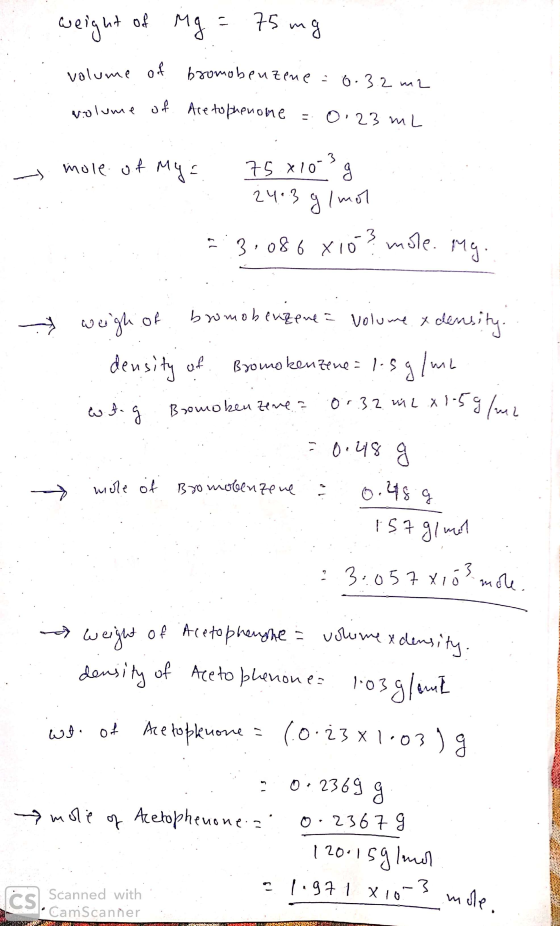


Add Answer to:
i need help with #3 please!
SAFETY NOTES: Bromobenene and acetophenone are irritants. Wear gloves and...
How can the NMP oxalate salt be converted back to NMP? Here is the procedure: PROCEDURES...
How can the NMP oxalate salt be converted back to NMP? Here is the procedure: PROCEDURES Part A: Synthesis of (±)-N,N-dimethyl-3-phenyl-3-(4-trifluoromethylphenoxy)propanamine To the 250-mL round-bottom flask (RBF) containing (±)-3-(dimethylamino)-1-phenylpropanol (product from Lab 6) and a magnetic stir bar, add 4 mL of 4-chlorobenzotrifluoride and 30 mL of dimethylacetamide (DMA). With stirring, add to this mixture 30 mL of 1.0 M potassium tert-butoxide (caustic alkali!) in tert-butyl alcohol using a syringe. Using a simple distillation apparatus, distill the mixture slowly, with...
____ Reaction workup details (role of K2CO3,Na2S2O3, brine)? HYDROBORATION-OXIDATION OF 1-HEXENE 1. In a screw cap...
 ____ Reaction workup details (role of
K2CO3,Na2S2O3,
brine)?
HYDROBORATION-OXIDATION OF 1-HEXENE 1. In a screw cap V-vial, prepare a solution of 0.33 g of iodine in 3 mL of dry THF. Firmly tighten the cap; keep the vial closed until ready to use. 2. In a 25 mL round-bottom flask, weigh 0.12 g of sodium borohydride. Add 8 mL of dry THF; stopper the flask with a septum, and stir the mixture for 10 min at room temperature 3. Prepare...
____ Reaction workup details (role of
K2CO3,Na2S2O3,
brine)?
HYDROBORATION-OXIDATION OF 1-HEXENE 1. In a screw cap V-vial, prepare a solution of 0.33 g of iodine in 3 mL of dry THF. Firmly tighten the cap; keep the vial closed until ready to use. 2. In a 25 mL round-bottom flask, weigh 0.12 g of sodium borohydride. Add 8 mL of dry THF; stopper the flask with a septum, and stir the mixture for 10 min at room temperature 3. Prepare...
____ What was the purpose of hydrogen peroxide and why was it added slowly with cooling?...
 ____ What was the purpose of hydrogen peroxide and why was it
added slowly with cooling?
HYDROBORATION-OXIDATION OF 1-HEXENE 1. In a screw cap V-vial, prepare a solution of 0.33 g of iodine in 3 mL of dry THF. Firmly tighten the cap; keep the vial closed until ready to use. 2. In a 25 mL round-bottom flask, weigh 0.12 g of sodium borohydride. Add 8 mL of dry THF; stopper the flask with a septum, and stir the mixture...
____ What was the purpose of hydrogen peroxide and why was it
added slowly with cooling?
HYDROBORATION-OXIDATION OF 1-HEXENE 1. In a screw cap V-vial, prepare a solution of 0.33 g of iodine in 3 mL of dry THF. Firmly tighten the cap; keep the vial closed until ready to use. 2. In a 25 mL round-bottom flask, weigh 0.12 g of sodium borohydride. Add 8 mL of dry THF; stopper the flask with a septum, and stir the mixture...
Propose another way of synthesizing NMP from the amino ketone hydrochloride salt starting materia...
 Propose another way of synthesizing NMP from the amino ketone
hydrochloride salt starting material you used.
Part A: Synthesis of (t)-N,N-dimethyl-3-phenyl-3-(4- trifluoromethylphenoxy)propanamine 1. To the 250-mL round-bottom flask (RBF) containing (t)-3-(dimethylamino)-1-phenylpropanol (product from Lab 6) and a magnetic stir bar, add 4 mL of 4- chlorobenzotrifluoride and 30 mL of dimethylacetamide (DMA) 2. With stirring, add to this mixture 30 mL of 1.0 M potassium tert-butoxide (caustic alkali!) in tert-butyl alcohol using a syringe 3. Using a simple distillation apparatus,...
Propose another way of synthesizing NMP from the amino ketone
hydrochloride salt starting material you used.
Part A: Synthesis of (t)-N,N-dimethyl-3-phenyl-3-(4- trifluoromethylphenoxy)propanamine 1. To the 250-mL round-bottom flask (RBF) containing (t)-3-(dimethylamino)-1-phenylpropanol (product from Lab 6) and a magnetic stir bar, add 4 mL of 4- chlorobenzotrifluoride and 30 mL of dimethylacetamide (DMA) 2. With stirring, add to this mixture 30 mL of 1.0 M potassium tert-butoxide (caustic alkali!) in tert-butyl alcohol using a syringe 3. Using a simple distillation apparatus,...
The alcohol could easily be converted to a tosylate, a good leaving group, and a conventional sub...
 The alcohol could easily be converted to a tosylate, a good
leaving group, and a conventional substitution reaction could have
been performed instead of the nucleophilic aromatic substitution
(NAS) reaction. Why was the NAS reaction the preferred method?
(Hint : Look up the nucleophiles of both reactions on chemical
manufacturing site.)
Part A: Synthesis of (t)-N,N-dimethyl-3-phenyl-3-(4- trifluoromethylphenoxy)propanamine 1. To the 250-mL round-bottom flask (RBF) containing (t)-3-(dimethylamino)-1-phenylpropanol (product from Lab 6) and a magnetic stir bar, add 4 mL of 4-...
The alcohol could easily be converted to a tosylate, a good
leaving group, and a conventional substitution reaction could have
been performed instead of the nucleophilic aromatic substitution
(NAS) reaction. Why was the NAS reaction the preferred method?
(Hint : Look up the nucleophiles of both reactions on chemical
manufacturing site.)
Part A: Synthesis of (t)-N,N-dimethyl-3-phenyl-3-(4- trifluoromethylphenoxy)propanamine 1. To the 250-mL round-bottom flask (RBF) containing (t)-3-(dimethylamino)-1-phenylpropanol (product from Lab 6) and a magnetic stir bar, add 4 mL of 4-...
please find the purpse, Discussion, conclusion un 27 Phoenix June 20 8:10 PM a 35AEXPERIMENT 35A...
 please find the purpse, Discussion, conclusion
un 27 Phoenix June 20 8:10 PM a 35AEXPERIMENT 35A Triphenylmethanol PROCEDURE ether MgBr+ C-OH + MgBr(OH) OMgBr 0 Addct Addition of Benzophenone While the phenylmagnesium bromide solution is being heated and stirred under reflux, make a solution of 1.09 g benzophenone in 2 mL of anhrudrous ether in a 5-mL conical vial. Cap the vial until the reflux period is over. Once the Grignard reagent is cooled to room temperature, draw some of...
please find the purpse, Discussion, conclusion
un 27 Phoenix June 20 8:10 PM a 35AEXPERIMENT 35A Triphenylmethanol PROCEDURE ether MgBr+ C-OH + MgBr(OH) OMgBr 0 Addct Addition of Benzophenone While the phenylmagnesium bromide solution is being heated and stirred under reflux, make a solution of 1.09 g benzophenone in 2 mL of anhrudrous ether in a 5-mL conical vial. Cap the vial until the reflux period is over. Once the Grignard reagent is cooled to room temperature, draw some of...
The alcohol could easily be converted to a tosylate, a good leaving group, and a conventional...
 The alcohol could easily be converted to a tosylate, a good
leaving group, and a conventional substitution reaction could have
been performed instead of the nucleophilic aromatic substitution
(NAS) reaction. Why was the NAS reaction the preferred method?
(Hint : Look up the nucleophiles of both reactions on chemical
manufacturing site.)
Part A: Synthesis of (t)-N,N-dimethyl-3-phenyl-3-(4- trifluoromethylphenoxy)propanamine 1. To the 250-mL round-bottom flask (RBF) containing (t)-3-(dimethylamino)-1-phenylpropanol (product from Lab 6) and a magnetic stir bar, add 4 mL of 4-...
The alcohol could easily be converted to a tosylate, a good
leaving group, and a conventional substitution reaction could have
been performed instead of the nucleophilic aromatic substitution
(NAS) reaction. Why was the NAS reaction the preferred method?
(Hint : Look up the nucleophiles of both reactions on chemical
manufacturing site.)
Part A: Synthesis of (t)-N,N-dimethyl-3-phenyl-3-(4- trifluoromethylphenoxy)propanamine 1. To the 250-mL round-bottom flask (RBF) containing (t)-3-(dimethylamino)-1-phenylpropanol (product from Lab 6) and a magnetic stir bar, add 4 mL of 4-...
I need help finding the theoretical yield (in grams) of triphenyl methanol product in this experiment....
 I need help finding the theoretical yield (in grams) of
triphenyl methanol product in this experiment. PLEASE SHOW WORK, I
would like to learn the steps.
below is pictures of the procedure with amounts of chemicals
used
126 Experiment 10 EXPERIMENTAL PROCEDURE All glassware used in a Grignard reaction must be scrupulously dried, Dry the following glasstare in an af 110°C for at last 20 mini drying to Canadair 8 ml comical rial 5 ml con vial, air cond glass...
I need help finding the theoretical yield (in grams) of
triphenyl methanol product in this experiment. PLEASE SHOW WORK, I
would like to learn the steps.
below is pictures of the procedure with amounts of chemicals
used
126 Experiment 10 EXPERIMENTAL PROCEDURE All glassware used in a Grignard reaction must be scrupulously dried, Dry the following glasstare in an af 110°C for at last 20 mini drying to Canadair 8 ml comical rial 5 ml con vial, air cond glass...
i need help with post questions, thanks Product Isolation After stirring the reaction for 5 minutes...
 i need help with post questions, thanks
Product Isolation After stirring the reaction for 5 minutes and allowing the reaction mixture to cool (the reaction can be exothermic), remove the Claisen head from the conical vial. Slowly add 3 M HCl(aq) drop-wise. The solid may need to be broken up with a stirring rod or a pipet. Continue to add acid until the aqueous phase (bottom layer) tests positive with pH paper. Extractions can be done using the conical funnel...
i need help with post questions, thanks
Product Isolation After stirring the reaction for 5 minutes and allowing the reaction mixture to cool (the reaction can be exothermic), remove the Claisen head from the conical vial. Slowly add 3 M HCl(aq) drop-wise. The solid may need to be broken up with a stirring rod or a pipet. Continue to add acid until the aqueous phase (bottom layer) tests positive with pH paper. Extractions can be done using the conical funnel...
using pictures and a maximum of 10 words, explain why an oven-dried 5-ml conical vial and...
 using pictures and a maximum of 10 words, explain why an oven-dried
5-ml conical vial and drying tube(step 1 and 2 of part 1) are used
in the reaction. do both please! also the notebook pages are the
procedure
(1) Using pictures and a maximum of 10 words, explain why an oven-dried 5-ml conical vial and drying tube (step 1 and 2 of Part 1) are used in the reaction. (2) After the addition of benzophenone to the mixture of...
using pictures and a maximum of 10 words, explain why an oven-dried
5-ml conical vial and drying tube(step 1 and 2 of part 1) are used
in the reaction. do both please! also the notebook pages are the
procedure
(1) Using pictures and a maximum of 10 words, explain why an oven-dried 5-ml conical vial and drying tube (step 1 and 2 of Part 1) are used in the reaction. (2) After the addition of benzophenone to the mixture of...
 ____ Reaction workup details (role of
K2CO3,Na2S2O3,
brine)?
HYDROBORATION-OXIDATION OF 1-HEXENE 1. In a screw cap V-vial, prepare a solution of 0.33 g of iodine in 3 mL of dry THF. Firmly tighten the cap; keep the vial closed until ready to use. 2. In a 25 mL round-bottom flask, weigh 0.12 g of sodium borohydride. Add 8 mL of dry THF; stopper the flask with a septum, and stir the mixture for 10 min at room temperature 3. Prepare...
____ Reaction workup details (role of
K2CO3,Na2S2O3,
brine)?
HYDROBORATION-OXIDATION OF 1-HEXENE 1. In a screw cap V-vial, prepare a solution of 0.33 g of iodine in 3 mL of dry THF. Firmly tighten the cap; keep the vial closed until ready to use. 2. In a 25 mL round-bottom flask, weigh 0.12 g of sodium borohydride. Add 8 mL of dry THF; stopper the flask with a septum, and stir the mixture for 10 min at room temperature 3. Prepare...
 ____ What was the purpose of hydrogen peroxide and why was it
added slowly with cooling?
HYDROBORATION-OXIDATION OF 1-HEXENE 1. In a screw cap V-vial, prepare a solution of 0.33 g of iodine in 3 mL of dry THF. Firmly tighten the cap; keep the vial closed until ready to use. 2. In a 25 mL round-bottom flask, weigh 0.12 g of sodium borohydride. Add 8 mL of dry THF; stopper the flask with a septum, and stir the mixture...
____ What was the purpose of hydrogen peroxide and why was it
added slowly with cooling?
HYDROBORATION-OXIDATION OF 1-HEXENE 1. In a screw cap V-vial, prepare a solution of 0.33 g of iodine in 3 mL of dry THF. Firmly tighten the cap; keep the vial closed until ready to use. 2. In a 25 mL round-bottom flask, weigh 0.12 g of sodium borohydride. Add 8 mL of dry THF; stopper the flask with a septum, and stir the mixture...
 Propose another way of synthesizing NMP from the amino ketone
hydrochloride salt starting material you used.
Part A: Synthesis of (t)-N,N-dimethyl-3-phenyl-3-(4- trifluoromethylphenoxy)propanamine 1. To the 250-mL round-bottom flask (RBF) containing (t)-3-(dimethylamino)-1-phenylpropanol (product from Lab 6) and a magnetic stir bar, add 4 mL of 4- chlorobenzotrifluoride and 30 mL of dimethylacetamide (DMA) 2. With stirring, add to this mixture 30 mL of 1.0 M potassium tert-butoxide (caustic alkali!) in tert-butyl alcohol using a syringe 3. Using a simple distillation apparatus,...
Propose another way of synthesizing NMP from the amino ketone
hydrochloride salt starting material you used.
Part A: Synthesis of (t)-N,N-dimethyl-3-phenyl-3-(4- trifluoromethylphenoxy)propanamine 1. To the 250-mL round-bottom flask (RBF) containing (t)-3-(dimethylamino)-1-phenylpropanol (product from Lab 6) and a magnetic stir bar, add 4 mL of 4- chlorobenzotrifluoride and 30 mL of dimethylacetamide (DMA) 2. With stirring, add to this mixture 30 mL of 1.0 M potassium tert-butoxide (caustic alkali!) in tert-butyl alcohol using a syringe 3. Using a simple distillation apparatus,...
 The alcohol could easily be converted to a tosylate, a good
leaving group, and a conventional substitution reaction could have
been performed instead of the nucleophilic aromatic substitution
(NAS) reaction. Why was the NAS reaction the preferred method?
(Hint : Look up the nucleophiles of both reactions on chemical
manufacturing site.)
Part A: Synthesis of (t)-N,N-dimethyl-3-phenyl-3-(4- trifluoromethylphenoxy)propanamine 1. To the 250-mL round-bottom flask (RBF) containing (t)-3-(dimethylamino)-1-phenylpropanol (product from Lab 6) and a magnetic stir bar, add 4 mL of 4-...
The alcohol could easily be converted to a tosylate, a good
leaving group, and a conventional substitution reaction could have
been performed instead of the nucleophilic aromatic substitution
(NAS) reaction. Why was the NAS reaction the preferred method?
(Hint : Look up the nucleophiles of both reactions on chemical
manufacturing site.)
Part A: Synthesis of (t)-N,N-dimethyl-3-phenyl-3-(4- trifluoromethylphenoxy)propanamine 1. To the 250-mL round-bottom flask (RBF) containing (t)-3-(dimethylamino)-1-phenylpropanol (product from Lab 6) and a magnetic stir bar, add 4 mL of 4-...
 please find the purpse, Discussion, conclusion
un 27 Phoenix June 20 8:10 PM a 35AEXPERIMENT 35A Triphenylmethanol PROCEDURE ether MgBr+ C-OH + MgBr(OH) OMgBr 0 Addct Addition of Benzophenone While the phenylmagnesium bromide solution is being heated and stirred under reflux, make a solution of 1.09 g benzophenone in 2 mL of anhrudrous ether in a 5-mL conical vial. Cap the vial until the reflux period is over. Once the Grignard reagent is cooled to room temperature, draw some of...
please find the purpse, Discussion, conclusion
un 27 Phoenix June 20 8:10 PM a 35AEXPERIMENT 35A Triphenylmethanol PROCEDURE ether MgBr+ C-OH + MgBr(OH) OMgBr 0 Addct Addition of Benzophenone While the phenylmagnesium bromide solution is being heated and stirred under reflux, make a solution of 1.09 g benzophenone in 2 mL of anhrudrous ether in a 5-mL conical vial. Cap the vial until the reflux period is over. Once the Grignard reagent is cooled to room temperature, draw some of...
 The alcohol could easily be converted to a tosylate, a good
leaving group, and a conventional substitution reaction could have
been performed instead of the nucleophilic aromatic substitution
(NAS) reaction. Why was the NAS reaction the preferred method?
(Hint : Look up the nucleophiles of both reactions on chemical
manufacturing site.)
Part A: Synthesis of (t)-N,N-dimethyl-3-phenyl-3-(4- trifluoromethylphenoxy)propanamine 1. To the 250-mL round-bottom flask (RBF) containing (t)-3-(dimethylamino)-1-phenylpropanol (product from Lab 6) and a magnetic stir bar, add 4 mL of 4-...
The alcohol could easily be converted to a tosylate, a good
leaving group, and a conventional substitution reaction could have
been performed instead of the nucleophilic aromatic substitution
(NAS) reaction. Why was the NAS reaction the preferred method?
(Hint : Look up the nucleophiles of both reactions on chemical
manufacturing site.)
Part A: Synthesis of (t)-N,N-dimethyl-3-phenyl-3-(4- trifluoromethylphenoxy)propanamine 1. To the 250-mL round-bottom flask (RBF) containing (t)-3-(dimethylamino)-1-phenylpropanol (product from Lab 6) and a magnetic stir bar, add 4 mL of 4-...
 I need help finding the theoretical yield (in grams) of
triphenyl methanol product in this experiment. PLEASE SHOW WORK, I
would like to learn the steps.
below is pictures of the procedure with amounts of chemicals
used
126 Experiment 10 EXPERIMENTAL PROCEDURE All glassware used in a Grignard reaction must be scrupulously dried, Dry the following glasstare in an af 110°C for at last 20 mini drying to Canadair 8 ml comical rial 5 ml con vial, air cond glass...
I need help finding the theoretical yield (in grams) of
triphenyl methanol product in this experiment. PLEASE SHOW WORK, I
would like to learn the steps.
below is pictures of the procedure with amounts of chemicals
used
126 Experiment 10 EXPERIMENTAL PROCEDURE All glassware used in a Grignard reaction must be scrupulously dried, Dry the following glasstare in an af 110°C for at last 20 mini drying to Canadair 8 ml comical rial 5 ml con vial, air cond glass...
 i need help with post questions, thanks
Product Isolation After stirring the reaction for 5 minutes and allowing the reaction mixture to cool (the reaction can be exothermic), remove the Claisen head from the conical vial. Slowly add 3 M HCl(aq) drop-wise. The solid may need to be broken up with a stirring rod or a pipet. Continue to add acid until the aqueous phase (bottom layer) tests positive with pH paper. Extractions can be done using the conical funnel...
i need help with post questions, thanks
Product Isolation After stirring the reaction for 5 minutes and allowing the reaction mixture to cool (the reaction can be exothermic), remove the Claisen head from the conical vial. Slowly add 3 M HCl(aq) drop-wise. The solid may need to be broken up with a stirring rod or a pipet. Continue to add acid until the aqueous phase (bottom layer) tests positive with pH paper. Extractions can be done using the conical funnel...
 using pictures and a maximum of 10 words, explain why an oven-dried
5-ml conical vial and drying tube(step 1 and 2 of part 1) are used
in the reaction. do both please! also the notebook pages are the
procedure
(1) Using pictures and a maximum of 10 words, explain why an oven-dried 5-ml conical vial and drying tube (step 1 and 2 of Part 1) are used in the reaction. (2) After the addition of benzophenone to the mixture of...
using pictures and a maximum of 10 words, explain why an oven-dried
5-ml conical vial and drying tube(step 1 and 2 of part 1) are used
in the reaction. do both please! also the notebook pages are the
procedure
(1) Using pictures and a maximum of 10 words, explain why an oven-dried 5-ml conical vial and drying tube (step 1 and 2 of Part 1) are used in the reaction. (2) After the addition of benzophenone to the mixture of...
Most questions answered within 3 hours.
-
Where is the error in this code sequence?
String s1 = "Hello";
String s2 = "ello";...
asked 11 months ago -
Financial data for Joel de Paris, Inc., for last year
follow:
Joel de Paris, Inc.
Balance...
asked 11 months ago -
Consider this reaction:
Al2(SO4)3 (aq)+ BaCl3
(aq) Al2Cl6 (aq)- +
3BaSO4(s) . What is the...
asked 11 months ago -
Suppose that Savneet is considering increasing her
recent random sample from 20 car rentals to 40...
asked 11 months ago -
Trucks arrive at an unloading terminal at an average rate of 120
per hour.
Trucks arrive...
asked 11 months ago -
Why are methanol and ethanol completely soluble in water while
octanol is not very little soluble....
asked 11 months ago -
A facilities manager at a university reads in a research report
that the mean amount of...
asked 11 months ago -
When the CuSO4 is rehydrated by adding water to the anhydrous
compound, is this an endothermic...
asked 11 months ago -
A ray of sunlight is passing from diamond into crown glass; the
angle of incidence is...
asked 11 months ago -
A block of mass 0.249 kg is placed on top of a light, vertical
spring of...
asked 11 months ago -
how do the kidneys compensate in the presences of acidosis
a) trigger hyperventilate
b) reserve acid...
asked 11 months ago -
Question 501 pts
The rental rate of capital to the firm increases. Which of the
following...
asked 11 months ago